Jammu & Kashmir and Ladakh - Indian Polity Notes
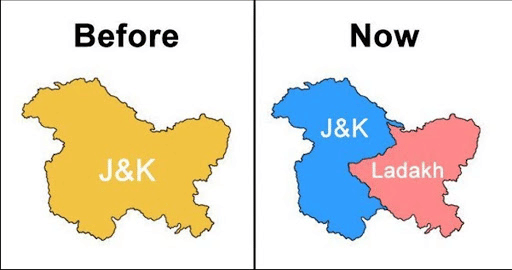
Union Territory of Jammu and Kashmir came into existence on 31 October, 2019 by Jammu and Kashmir Reorganisation Act 2019. The Union Territory of Jammu & Kashmir has been carved out of the former state of Jammu and Kashmir which became a single political and geographical unit by Treaty of Amritsar between the British Government and Mahahraja Gulab Singh signed on March 16, 1846.
| Read update on this topic: |
|
Table of Contents |
Historical Background
Pre 2019 Period
- The princely state of Jammu and Kashmir was partitioned between India (which held Jammu, Kashmir Valley, and Ladakh) and Pakistan (which controlled Gilgit–Baltistan and Azad Kashmir) following the Indo-Pakistani War of 1947–1948.
- In 1951, the Indian-controlled regions elected a constituent assembly, which accepted the state's accession to India in 1954.
- China built a road through the disputed Aksai Chin region of Ladakh in 1956–57 and thus the Sino-Indian War of 1962 was precipitated by India's late discovery of this road. Since then, China has administered Aksai Chin.
- Following the 1971 Indo-Pakistani War, India and Pakistan signed the Shimla Agreement, which recognized a Line of Control in Kashmir and committed to resolving the conflict peacefully through bilateral negotiations.
- Since 1989, a deadly struggle has raged between Islamic militant separatists and the Indian Army, with both sides accused of serious human rights violations such as kidnappings, killings, rapes, and armed robberies. .
Post 2019
- Both chambers of India's Parliament passed a bill in August 2019 to alter Article 370 which gave special provisions to Jammu & Kashmir and extend the Indian Constitution in its entirety to the state, which the President of India signed as a constitutional order.
- Meanwhile, the Jammu and Kashmir Reorganisation Act, 2019, was passed, which included provisions dissolving the state of Jammu and Kashmir and establishing two new union territories: the namesake Jammu & Kashmir and Ladakh.
- The President of India signed the reorganisation act, which took effect on October 31, 2019.
|
Jammu and Kashmir Reorganisation Act dissolved the state Jammu and Kashmir and reorganised it into two union territories – Jammu and Kashmir and Ladakh with effect from 31 October 2019. |
Jammu & Kashmir
- Kashmir is known as the 'Paradise of India' because of its natural beauty and peacefulness
- It is bordered on the east by the Indian union territory of Ladakh, on the south by the Indian states of Himachal Pradesh and Punjab, on the southwest by Pakistan, and on the northwest by the Pakistani-administered section of Kashmir.
- There are 20 districts in the area with a total area of 42,241 sq. km and according to the 2011 census, the union territory has a population of 9,944,283.
| Key Elements | Details |
|---|---|
| Union Territory | Jammu and Kashmir |
| Summer Capital | Srinagar |
| Winter Capital | Jammu |
| Number of Districts | 20 |
| Authorizing Body | Administration of Jammu and Kashmir |
| Governor | Manoj Sinha |
| Legislature | Unicameral (114 seats) |
| Parliamentary Constituencies | Rajya Sabha-04Lok Sabha-05 |
| Seat of High Court | Jammu and Kashmir |
| Area | 42,241 km sq. |
| Population (2011 Census Data) | 9,944,283 |
Ladakh
- Ladakh, located in the western Himalayas, became a Union Territory on October 31, 2019, after the government of Jammu & Kashmir repealed Article 370.
- The Ladakh Range, which is a south-eastern extension of the Karakoram Range, and the upper Indus River basin makeup around 45,000 square miles (117,000 square kilometres) of Union Territory of Ladakh.
- Ladakh is sometimes called 'Little Tibet' because of its cultural and historical similarities to Tibet.
- The Tibet Autonomous Region to the east, the Indian state of Himachal Pradesh to the south, both the Indian union territory of Jammu and Kashmir and Pakistan-administered Gilgit-Baltistan to the west, and the southwest corner of Xinjiang across the Karakoram Pass in the far north are all part of the territory.
- The territory has a total area of 59,146 km2.
| Key Elements | Details |
|---|---|
| Union Territory | Ladakh |
| Summer Capital | Leh |
| Winter Capital | Kargil |
| Statehood | October 31, 2019 |
| Number of Districts | 2 |
| Authorizing Body | Administration of Ladakh |
| Seat of High Court | Jammu and Kashmir |
| Area | 59,146 km sq. |
| Population (2011 Census Data) | 274,289 |
Conclusion
The reorganization of J&K represents a complex and multifaceted change with both potential benefits and significant challenges. The long-term success of this reorganization will depend on the effective implementation of development plans, restoration of normalcy, and the establishment of a robust democratic process that respects the aspirations of the people in the region.
FAQs
Question: What is the status of Jammu & Kashmir and Ladakh as per the current Indian political framework?
Answer: As of August 5, 2019, Jammu & Kashmir was bifurcated into two separate Union Territories—Jammu & Kashmir (with a Legislative Assembly) and Ladakh (without a Legislative Assembly). This reorganization was enacted through the Jammu and Kashmir Reorganisation Act, 2019.
Question: What led to the reorganization of Jammu & Kashmir?
Answer: The reorganization of Jammu & Kashmir was driven by the abrogation of Article 370 and Article 35A of the Indian Constitution, which granted special status and privileges to the region. This move aimed to integrate Jammu & Kashmir more closely with the Indian Union and bring uniformity in laws and governance.
Question: What is Article 370, and what was its significance?
Answer: Article 370 granted special autonomy to the state of Jammu & Kashmir, allowing it to have its own constitution, laws, and administrative powers, except in matters related to defense, foreign affairs, and communication. Its abrogation in 2019 marked a major shift in the state's political and constitutional status.
Question: What changes occurred after the abrogation of Article 370?
Answer: After the abrogation of Article 370, Jammu & Kashmir lost its special status and was reorganized into two Union Territories—Jammu & Kashmir with legislative powers and Ladakh without legislative powers. Central laws and provisions now uniformly apply across these territories.
Question: How has the abrogation of Article 370 impacted governance in Jammu & Kashmir and Ladakh?
Answer: The abrogation of Article 370 has led to direct governance by the central government in these regions, bringing all central laws into force, promoting greater economic integration, and enabling investments. However, it has also raised concerns about political representation, autonomy, and local identity among various communities.
MCQs
- When was Article 370 of the Indian Constitution abrogated?
A) August 15, 2018
B) January 26, 2019
C) August 5, 2019
D) October 2, 2019
Answer: (C) See the Explanation
Article 370, which granted special status to Jammu & Kashmir, was abrogated on August 5, 2019. This led to the reorganization of the state into two Union Territories—Jammu & Kashmir and Ladakh.
- Which of the following Articles was associated with special privileges for the residents of Jammu & Kashmir?
A) Article 21
B) Article 356
C) Article 35A
D) Article 51A
Answer: (C) See the Explanation
Article 35A provided special privileges to the residents of Jammu & Kashmir, including exclusive rights to own land and secure government jobs. It was annulled alongside Article 370 in 2019.
- What is the administrative status of Ladakh post-reorganization?
A) A Union Territory with a Legislative Assembly
B) A State with special status
C) A Union Territory without a Legislative Assembly
D) A Part of Himachal Pradesh
Answer: (C) See the Explanation
Following the bifurcation of Jammu & Kashmir, Ladakh became a Union Territory without a Legislative Assembly, governed directly by the central government.
- The Jammu and Kashmir Reorganisation Act was enacted in which year?
A) 2017
B) 2018
C) 2019
D) 2020
Answer: (C) See the Explanation
The Jammu and Kashmir Reorganisation Act, 2019, provided for the reorganization of the erstwhile state into two Union Territories—Jammu & Kashmir and Ladakh.
- Which of the following is true regarding the Union Territory of Jammu & Kashmir?
A) It has no legislative assembly
B) It is governed solely by a Lieutenant Governor
C) It has a legislative assembly with legislative powers
D) It was merged with Ladakh
Answer: (C) See the Explanation
The Union Territory of Jammu & Kashmir has a legislative assembly, unlike Ladakh, which is directly administered by the central government.
GS Mains Questions and Model Answers
Q1: Analyze the impact of the abrogation of Article 370 on the socio-political landscape of Jammu & Kashmir and Ladakh.
Answer: The abrogation of Article 370 in August 2019 transformed the socio-political landscape of Jammu & Kashmir and Ladakh. The move ended the region’s special status, leading to its reorganization into two Union Territories. This change brought Jammu & Kashmir under direct central control, making central laws applicable uniformly. While the government cited reasons such as better integration, improved governance, and economic development, the decision sparked diverse reactions. Proponents believe it will spur investment, reduce militancy, and ensure equal rights for all citizens. However, critics argue it undermines local political representation, erodes regional autonomy, and risks marginalizing local identities. The impact has been multifaceted, with increased security measures, internet shutdowns, and political detentions, reflecting a mix of security and developmental challenges. Long-term implications will depend on sustained development, inclusive governance, and reconciliation with local sentiments.
Q2: Explain the historical context and key features of Article 370 and its role in Jammu & Kashmir’s political identity.
Answer: Article 370, incorporated into the Indian Constitution in 1949, granted special autonomy to the state of Jammu & Kashmir. It allowed the state to have its own constitution, legislative powers, and autonomy over internal matters, except in defense, foreign affairs, and communications. The provision stemmed from the Instrument of Accession signed by Maharaja Hari Singh in 1947 when the state acceded to India, with assurances of limited central intervention. Article 370 shaped Jammu & Kashmir’s distinct political identity and defined its relationship with the Indian Union. It restricted property rights and public-sector employment to local residents under Article 35A. Over time, debates over Article 370 intensified, with some viewing it as an obstacle to integration and others as a safeguard for regional identity. Its abrogation in 2019 ended the state's special status, leading to its reorganization into Union Territories, altering its political and constitutional framework.
Q3: Discuss the implications of the bifurcation of Jammu & Kashmir on India’s federal structure.
Answer: The bifurcation of Jammu & Kashmir into two Union Territories—Jammu & Kashmir (with a Legislative Assembly) and Ladakh (without a Legislative Assembly)—marked a significant shift in India’s federal structure. The move, following the abrogation of Article 370, centralized power in the region, challenging the federal autonomy traditionally accorded to states. This unprecedented decision raised questions about the balance of power between the center and states, sparking debates on federalism, statehood rights, and constitutional safeguards. Supporters argue it enhances national integration, security, and uniform governance. Critics view it as a precedent for central intervention and potential erosion of federal principles. The change highlights the tension between regional aspirations and central authority, emphasizing the need for inclusive governance and dialogue. Long-term federal stability will depend on respecting regional identities while fostering cooperative federalism within the constitutional framework.
Previous Year Questions on Jammu Kashmir and Ladakh
1. UPSC CSE 2020
Question: Examine the constitutional and political implications of the abrogation of Article 370 in Jammu & Kashmir.
Answer: The abrogation of Article 370, which granted special status to Jammu & Kashmir, has far-reaching constitutional and political implications. Constitutionally, it marked a departure from the special autonomy framework, bringing the region under the purview of central laws. The move, enacted through a presidential order and subsequent legislation, effectively nullified Article 35A and reorganized the state into two Union Territories—Jammu & Kashmir with a Legislative Assembly and Ladakh without one. This shift centralized power and extended all Indian laws uniformly, impacting property rights, employment, and governance. Politically, the move sparked diverse reactions, with proponents viewing it as a step toward greater national integration and development. However, critics argued it undermined federalism, eroded regional autonomy, and risked marginalizing local identities. The abrogation has led to security and developmental challenges, highlighting the need for inclusive policies to address socio-political concerns.
2. UPSC CSE 2019
Question: Discuss the challenges and opportunities presented by the reorganization of Jammu & Kashmir and Ladakh into Union Territories.
Answer: The reorganization of Jammu & Kashmir and Ladakh into Union Territories presents both challenges and opportunities. On the one hand, direct central governance aims to improve security, attract investments, and implement central welfare schemes efficiently. The move also seeks to integrate the region with national laws and policies, fostering economic development and social inclusion. However, challenges include the erosion of local political autonomy, potential alienation of residents, and heightened security concerns. Political leaders and civil society have expressed apprehensions about the loss of statehood and cultural identity. Additionally, the transition to a Union Territory structure requires effective administrative management and capacity-building to meet developmental goals. Addressing these challenges through inclusive governance, reconciliation, and socio-economic development is crucial for realizing the potential opportunities and ensuring peace and prosperity in the region.
*email: contactus@prepp.in
Download the PREPP App and attempt FREE IAS Exam Mock Tests and get complete study material!

Live Test : UPSC CSE Prelims CSAT (Paper-II) (Oct 20 - 23)
Full Test - 04: UPSC CSE Prelims CSAT (Paper-II)
Full Test - 03: UPSC CSE Prelims CSAT (Paper-II)
UPSC CSE Prelims 2026 GS Paper 1 Question Paper (24-May-2026)
UPSC CSE Prelims 2026 CSAT Paper 2 Question Paper (24-May-2026)

17 February 2025 | The Hindu Must Read Articles | Current Affairs

16 February 2026 | The Hindu Must Read Articles | Current Affairs

13 February 2026 | The Hindu Must Read Articles | Current Affairs









Comments