Telangana - Indian Polity Notes
Telangana was established as a separate state by the Andhra Pradesh Reorganisation Act, 2014. It became the 29th state of India with Hyderabad as its capital for 10 years, shared with Andhra Pradesh.
States and Union Territories are an important part of the UPSC General Studies Preparation. Here we will discuss the State of Telangana.
|
Table of Contents |
Basic Facts
- Telangana is situated in the southern-central part of the Indian peninsula on the high Deccan Plateau. It was the eleventh largest state and the twelfth most populated state in India as per the 2011 census. Telugu is the most widely spoken and the primary official language of the state.
- The economy of Telangana is the ninth-largest in India. It has emerged as a major focal point for IT software companies, industry and the services sector.
- When India became independent in 1947, the Nizam of Hyderabad did not want to merge with the Indian Union and wanted to remain independent. The Government of India annexed Hyderabad State on 17 September 1948 after a military operation called Operation Polo.
|
Telangana was established as a separate state by the Andhra Pradesh Reorganisation Act, 2014. |
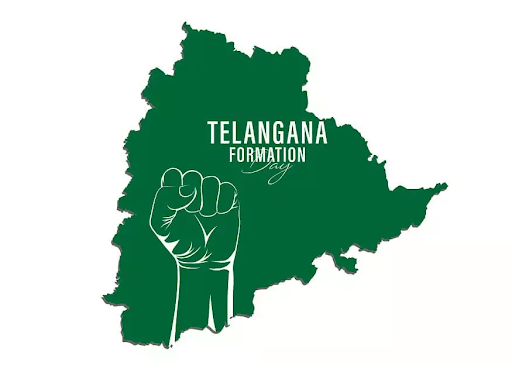
Formation of Telangana
- In 1953, the States Reorganisation Commission was appointed for the creation of states on linguistic lines. The commission, due to public demand, recommended the disintegration of Hyderabad State and a merger of the Marathi-speaking region with Bombay State and of the Kannada-speaking region with Mysore state.
- The States Reorganisation Commission (SRC) also discussed the merger of Telugu-speaking Telangana region of Hyderabad state with Andhra state. The commission was in favour of the creation of a separate state for poor underdeveloped Telanga region which may be known as the Hyderabad State with provision for its unification with Andhra after the general elections likely to be held in 1961 if by a two-thirds majority the legislature of the residuary Hyderabad State expresses itself in favour of such unification.
- Gentlemen's agreement of Andhra Pradesh was signed between Telangana and Andhra leaders before the formation of the state of Andhra Pradesh of India on 20 February 1956. It provided safeguards with the purpose of preventing discrimination against Telangana by the government of Andhra Pradesh. Actually, violations of the same agreement are cited as one of the reasons for formation of separate statehood for Telangana.
- In 1969, the first major Telangana movement erupted, with large-scale protests and strikes. It was suppressed, but the demand for a separate state persisted.
- The demand for Telangana gained momentum again in the early 2000s, driven by widespread dissatisfaction with the regional disparities.
- K. Chandrashekar Rao (KCR) founded the Telangana Rashtra Samithi (TRS) in 2001, with the primary aim of achieving statehood for Telangana.
- In 2009, KCR began a hunger strike, which galvanized massive support and widespread protests across the region.
- The Indian government announced the initiation of the process to form Telangana in December 2009, but this led to counter-protests in Andhra Pradesh.
- Srikrishna Committee was appointed in 2010. It observed that the continuing demand for a separate Telangana has some merit and is not entirely unjustified.
- In 2013, the Congress Working Committee unanimously passed a resolution to recommend the formation of a separate Telangana state. Ultimately Andhra Pradesh Reorganisation Act, 2014 was passed by the Parliament of India for the formation of Telangana state, comprising ten districts from north-western Andhra Pradesh.
- Telangana officially became the 29th state of India on June 2, 2014, with Hyderabad as its capital for 10 years, shared with Andhra Pradesh.
Conclusion
The creation of Telangana was the culmination of a decades-long struggle by local people, who sought recognition and administrative independence due to perceived economic neglect, lack of infrastructure, and cultural marginalization within the state of Andhra Pradesh.
FAQs
Question: What is the history behind the formation of Telangana?
Answer: Telangana was formed on June 2, 2014, after a prolonged struggle for statehood. The movement for the creation of Telangana was based on issues of economic disparity, underdevelopment, and cultural identity within the erstwhile state of Andhra Pradesh. The demand for a separate state gained momentum in the early 2000s, with significant support from the region's political and student organizations. The movement was marked by protests and demands for political autonomy. The Andhra Pradesh Reorganization Act, 2014, led to the bifurcation of Andhra Pradesh, creating Telangana as India's 29th state.
Question: What is the role of the Andhra Pradesh Reorganization Act, 2014 in the formation of Telangana?
Answer: The Andhra Pradesh Reorganization Act, 2014, was the legislation passed by the Parliament of India that formally led to the bifurcation of Andhra Pradesh. It provided for the creation of Telangana as a new state while determining the distribution of assets and liabilities, as well as the allocation of resources and services between the two states. This Act came into effect on June 2, 2014, after which Telangana became the 29th state of India, with Hyderabad as its capital.
Question: What are the major political and economic characteristics of Telangana?
Answer: Telangana is a politically significant state in southern India, primarily known for its dynamic political landscape. The state has been governed by the Telangana Rashtra Samithi (TRS), which played a central role in the state's formation. Economically, Telangana has a strong base in agriculture, particularly in the production of rice, cotton, and pulses. The state is also a major hub for the IT industry, with Hyderabad emerging as a major IT and biotech center, often referred to as "Cyberabad." Telangana's economic growth has been fueled by industries like pharmaceuticals, biotechnology, and information technology.
Question: What is the significance of Hyderabad in the formation of Telangana?
Answer: Hyderabad, the capital of Telangana, played a crucial role in the state’s formation. It was historically part of the princely state of Hyderabad before India's independence. The city's diverse culture, cosmopolitan nature, and historical importance made it a focal point during the statehood movement. Despite being the capital of Telangana, Hyderabad remains a joint capital with Andhra Pradesh for ten years, as per the provisions of the Andhra Pradesh Reorganization Act, 2014. Hyderabad is also one of the major economic, technological, and educational hubs in India.
Question: What are the challenges faced by Telangana after its formation?
Answer: After the formation of Telangana, the state has faced several challenges. These include:
- Water-sharing disputes with Andhra Pradesh, particularly regarding the Krishna and Godavari rivers.
- The division of assets and liabilities between the two states, particularly concerning government institutions and capital infrastructure.
- Ensuring balanced regional development within the state, especially between the urban centers like Hyderabad and rural areas.
- Addressing the socio-economic disparities within the region, such as poverty and unemployment in backward areas.
MCQs
1. Telangana was formed in the year:
A) 2010
B) 2012
C) 2014
D) 2016
Answer: (C) See the Explanation
Explanation: Telangana was formed on June 2, 2014, after the Andhra Pradesh Reorganization Act, 2014 was passed, creating Telangana as the 29th state of India.
2. The capital city of Telangana is:
A) Chennai
B) Bangalore
C) Hyderabad
D) Mumbai
Answer: (C) See the Explanation
Explanation: Hyderabad is the capital of Telangana and also serves as the joint capital with Andhra Pradesh for a period of ten years after the bifurcation.
3. Who was the primary political party behind the creation of Telangana?
A) Indian National Congress
B) Bharatiya Janata Party
C) Telangana Rashtra Samithi (TRS)
D) Telugu Desam Party
Answer: (C) See the Explanation
Explanation: Telangana Rashtra Samithi (TRS), led by K. Chandrashekar Rao, was the primary political party that spearheaded the demand for a separate Telangana state.
4. What is one of the primary economic sectors of Telangana?
A) Textiles
B) IT and Biotechnology
C) Tourism
D) Mining
Answer: (B) See the Explanation
Explanation: Telangana, especially Hyderabad, has emerged as a major hub for the IT and biotechnology industries, making it one of the key economic sectors of the state.
5. The Andhra Pradesh Reorganization Act, 2014, provided for:
A) Formation of Telangana and the allocation of assets and liabilities
B) Creation of a new language for Telangana
C) Allocation of water resources from the Ganga river
D) Devolution of powers to local governments
Answer: (A) See the Explanation
Explanation: The Andhra Pradesh Reorganization Act, 2014, led to the formation of Telangana, addressing the allocation of assets, liabilities, and resources between the newly created state and Andhra Pradesh.
GS Mains Questions and Model Answers
Q1: Discuss the role of the Telangana Rashtra Samithi (TRS) in the creation of Telangana.
Answer: The Telangana Rashtra Samithi (TRS), led by K. Chandrashekar Rao, played a pivotal role in the formation of Telangana. The TRS initiated and led the movement for a separate state based on demands for economic justice, cultural identity, and political autonomy. The party's political strategy involved mass mobilization, protests, and lobbying with central government officials. The TRS succeeded in gaining political support from the people of Telangana and other political parties, ultimately leading to the formation of Telangana through the Andhra Pradesh Reorganization Act, 2014. TRS's leadership was crucial in uniting various sections of society, including students, intellectuals, and political figures, for the cause of a separate state.
Q2: How did the bifurcation of Andhra Pradesh impact the socio-economic development of Telangana?
Answer: The bifurcation of Andhra Pradesh created both opportunities and challenges for Telangana. On the positive side, Telangana gained control over its resources, enabling the state to focus on its development priorities. The formation of the state allowed for targeted economic policies and more localized governance. Telangana's economy saw rapid growth, particularly in sectors like IT, biotechnology, and pharmaceuticals. However, challenges remained in terms of resource allocation, especially in water-sharing agreements with Andhra Pradesh. Telangana also faced difficulties in addressing regional disparities in development, with rural areas lagging behind urban centers like Hyderabad in terms of infrastructure and access to education and healthcare.
Q3: Evaluate the role of Hyderabad in the socio-economic transformation of Telangana post its formation as a separate state.
Answer: Hyderabad, as the capital of Telangana, has played a central role in the state's socio-economic transformation. It is one of India's major IT hubs, attracting multinational corporations and driving the state's economy. The city has also seen significant developments in infrastructure, real estate, and education. Additionally, Hyderabad's cosmopolitan nature and diverse cultural heritage have made it a prominent center for innovation, trade, and business in the region. However, the state has also faced challenges in ensuring that the benefits of this growth reach rural and underdeveloped areas of Telangana, requiring targeted efforts in policy and development initiatives.
Previous Year Questions on Telangana and Statehood Movements
1. UPSC CSE Prelims 2014:
Question: Telangana was formed as a separate state based on:
A) Economic and political reasons
B) Linguistic and cultural differences
C) Agricultural demands
D) Religious identities
Answer: (A)
Explanation: Telangana was formed primarily due to economic and political reasons, with demands for better development, cultural identity, and autonomy.
2. UPSC CSE Mains 2017 (GS Paper 2):
Question: Discuss the challenges faced by Telangana after its creation and the measures taken to address them.
Answer: After its creation, Telangana faced challenges such as resource allocation, water disputes with Andhra Pradesh, and disparities in development between urban and rural areas. The state government took measures such as focusing on IT and industrial development, implementing rural development programs, and addressing water-sharing concerns through negotiations with Andhra Pradesh. The socio-economic upliftment of backward regions and improving the livelihoods of farmers remained key priorities for the government.
*email: contactus@prepp.in
Download the PREPP App and attempt FREE IAS Exam Mock Tests and get complete study material!

Live Test : UPSC CSE Prelims CSAT (Paper-II) (Oct 20 - 23)
Full Test - 04: UPSC CSE Prelims CSAT (Paper-II)
Full Test - 03: UPSC CSE Prelims CSAT (Paper-II)
UPSC CSE Prelims 2026 GS Paper 1 Question Paper (24-May-2026)
UPSC CSE Prelims 2026 CSAT Paper 2 Question Paper (24-May-2026)

17 February 2025 | The Hindu Must Read Articles | Current Affairs

16 February 2026 | The Hindu Must Read Articles | Current Affairs

13 February 2026 | The Hindu Must Read Articles | Current Affairs









Comments