Integration of Princely States – Indian Polity Notes
Integration of princely states was a monumental task achieved through a blend of diplomacy, use of force, and negotiation by national leaders. At the time of independence, India was divided into British Indian provinces and princely states. The princely states were semi-autonomous regions ruled by local monarchs under British suzerainty. Indian Independence Act of 1947 gave princely states the option to join either India or Pakistan or to remain independent, leading to significant uncertainty and challenges for newly independent nations.
Integration of princely states is an important topic under the UPSC/IAS Exam Polity and Governance syllabus which is discussed in detail in this article.
|
Table of Contents |

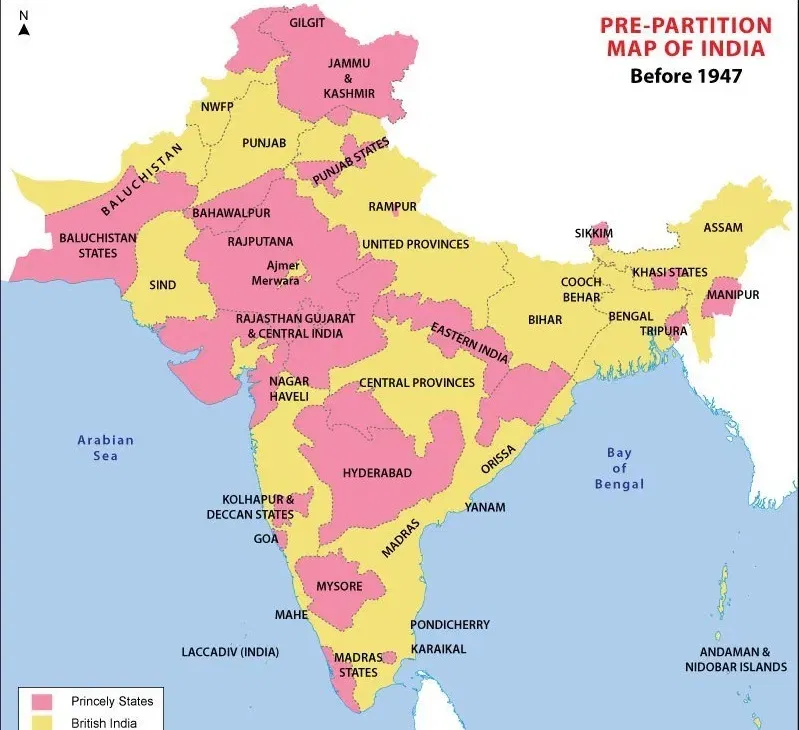
Princely States At The Time of Independence
Historical Background
- There were approximately 565 princely states that had special recognition from and relationships with the British Raj.
- The British announced shortly before independence that with the end of their rule over India, the British crown's supremacy over the Princely States would also end.
- This meant that all of these states, a total of 565 in total, would gain legal independence.
- The Indian Independence Act (1947) established two independent and separate dominions, India and Pakistan, and provided the princely states with three options: join India, join Pakistan, or remain independent.
- Sardar Vallabh Bhai Patel was tasked with integrating the princely states. He and V.P. Menon came up with a formula to present to the monarchs.
- The Instrument of Accession was the official treaty to be signed between the governments of India and Pakistan and the candidates for accession.
- According to the treaty's basic tenets, the Government of India would control only foreign affairs, defense, and communications, while all other internal issues would be administered by the states.
- On April 28, 1947, the states of Gwalior, Bikaner, Patiala, and Baroda became the first to join India.
- Others were wary, fearful of losing their influence as rulers, and distrusting a democratic government led by revolutionaries with uncertain, and possibly radical, views.
- Travancore's ruler declared that the state had decided to seek independence.
- The next day, the Nizam of Hyderabad made a similar announcement. The Nawab of Bhopal was also opposed to joining the Constituent Assembly.
- Because of the response of the rulers of the Princely States, there was a very real possibility that India would be further divided into a number of small countries after Independence.
- The prospects for democracy in these states appeared bleak as well.
- Most of these princely states had non-democratic governments, and their rulers were unwilling to grant their people democratic rights.
- Except for a few, the process of integrating princely states was nearly complete by 15 August 1947.
- Some simply postponed signing the Instrument of Accession, such as Piploda, a small state in central India that did not join India until March 1948.
- 549 of the 552 princely states located within India's geographical boundaries joined India, while the remaining three (Hyderabad, Junagarh, and Kashmir) refused to join.
- However, they were eventually integrated into India–Hyderabad through police action, Junagarh through the referendum, and Kashmir through the Instrument of Accession.
|
"The story of the integration of the Indian States is the story of the conflict between the forces which were attempting to disintegrate India and those which were striving to weld the country into a consolidated nation."- V.P. Menon |
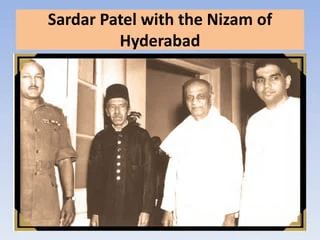
Integration of Each Princely State
Travancore
- The maritime state in southern India was strategically located for maritime trade and was rich in both human and mineral resources.
- It was one of the first princely states to refuse to join the Indian Union and to question the Congress' leadership of the country.
- By 1946, the Dewan of Travancore, Sir C.P. Ramaswamy Aiyar, had declared his intention to form an independent Travancore state and would be willing to sign a treaty with the Indian Union.
- Sir C.P. Aiyar is also said to have had secret ties with the UK government, which was in favor of an independent Travancore.
- The UK government was in hope of gaining exclusive access to a mineral called monazite, which the area was rich in and giving Britain an advantage in the nuclear arms race.
- He maintained his position until July 1947. Soon after surviving an assassination attempt by a member of the Kerala Socialist Party, he changed his mind.
- Travancore became a part of India on July 30, 1947.
Jodhpur
- Despite having a Hindu king and a large Hindu population, the Rajput princely state had an odd inclination towards Pakistan.
- Hanvant Singh, a young and inexperienced Jodhpur prince, believed that because his state was contiguous with Pakistan, he could get a better "deal."
- Jinnah is said to have given the Maharaja a signed blank sheet of paper on which he listed all of his demands.
- He also offered him free access to the Karachi port for the manufacture and import of arms, as well as military and agrarian assistance.
- Recognizing the dangers of the border state acceding to Pakistan, Patel immediately contacted the prince and offered him adequate benefits.
- Patel assured him that importing arms would be permitted, that Jodhpur would be linked to Kathiawar by rail, and that India would supply grain during famines.
- On August 11, 1947, Maharaja Hanvant Singh, King of Jodhpur, signed the Instrument of Accession, and the State of Jodhpur became a part of the Indian Dominion.
Bhopal
- The state of Bhopal also wished to declare its independence.
- Here, a Muslim Nawab, Hamidullah Khan, ruled over a Hindu majority.
- He was a close friend of the Muslim League and was an outspoken opponent of Congress's rule.
- He had made it clear to Mountbatten that he wanted independence.
- However, the latter replied that "no ruler could run away from the dominion closest to him."
- By July 1947, the Prince had become aware of the large number of princes who had acceded to India and had decided to join the country.
Hyderabad
- It was the largest and wealthiest of all princely states, encompassing much of the Deccan plateau.
- Nizam Mir Usman Ali ruled over a predominantly Hindu population in the princely state.
- He was unequivocal in his demand for independence and flatly refused to join the Indian dominion.
- He gained Jinnah's support, and the conflict over Hyderabad intensified over time.
- Both requests and threats from Patel and other mediators failed to sway the Nizam, who continued to build his army by importing weapons from Europe.
- When armed fanatics (Razakars) unleashed violence against Hyderabad's Hindu residents, things took a turn for the worse.
- Following Lord Mountbatten's resignation in June 1948, the Congress government decided to take a more decisive stance.
- On September 13, 1948, Indian troops were dispatched to Hyderabad as part of 'Operation Polo.'
- The Indian army took full control of the state after a four-day armed conflict, and Hyderabad became an integral part of India.
- Later, as a way of rewarding Nizam for his submission, he was appointed governor of the state of Hyderabad.
Junagadh
- The princely state, located in southwestern Gujarat, did not join the Indian union by August 15, 1947.
- It was the most important of the Kathiawar states, with a large Hindu population, and was ruled by the Nawab, Muhammad Mahabat Khanji III.
- On September 15, 1947, Nawab Mahabat Khanji chose to join Pakistan despite Mountbatten's objections, claiming that Junagadh was connected to Pakistan by sea.
- The rulers of two states subject to Junagadh's suzerainty — Mangrol and Babariawad — reacted by declaring independence from Junagadh and acceding to India.
- As a result, the Nawab of Junagadh militarily occupied both states.
- The rulers of the other neighboring states reacted angrily, sending troops to the Junagadh border and requesting help from the Government of India.
- India feared that allowing Junagadh to join Pakistan would exacerbate the already simmering communal tensions in Gujarat, so it refused to accept the Nawab's choice of accession.
- The government emphasized that the state was 80 percent Hindu and called for a plebiscite on the issue of accession.
- India cut off fuel and coal supplies to Junagadh, severed air and postal links, sent troops to the border, and occupied the acceded-to-India principalities of Mangrol and Babariawad.
- Pakistan agreed to hold a plebiscite in exchange for the withdrawal of Indian troops, which India rejected.
- Following clashes with Indian troops, the Nawab and his family fled to Pakistan on October 26. The Nawab had depleted the state treasury of cash and securities before departing.
- Junagadh's court, facing collapse, invited the Government of India to take over the administration of the state on November 7, 1947.
- Sir Shah Nawaz Bhutto, the Dewan of Junagadh and father of the more famous Zulfiqar Ali Bhutto, decided to seek intervention from the Government of India.
- The Indian government accepted Dewan's invitation to intervene.
- In February 1948, a plebiscite was held, and the result was almost unanimously in favor of India's accession.
- Junagadh was a part of the Indian state of Saurashtra until November 1, 1956, when Saurashtra was absorbed into the state of Bombay.
- In 1960, Bombay state was divided into the linguistic states of Maharashtra and Gujarat, which included Junagadh, and Junagadh has been a part of Gujarat since then.
Kashmir
- It was a princely state ruled by a Hindu king over a predominantly Muslim population that had resisted joining either of the two dominions.
- The case of this strategically located kingdom was not only unique but also one of the most difficult because it had significant international borders.
- Kashmir's ruler, Maharaja Hari Singh, had proposed a cease-fire agreement to both India and Pakistan, pending a final decision on the state's accession.
- Pakistan signed the cease-fire agreement but then invaded Kashmir from the north with an army of soldiers and tribesmen carrying weapons.
- Thousands of tribal Pathans swept into Kashmir in the early hours of October 24, 1947.
- The Maharaja of Jammu and Kashmir requested assistance from India. He dispatched his representative, Sheikh Abdullah, to Delhi to seek India's assistance.
- On October 26, 1947, Maharaja Hari Singh fled Srinagar and arrived in Jammu, where he signed the J&K state's "Instrument of Accession."
- According to the document's terms, India's jurisdiction would include external affairs, communications, and defense.
- Following the signing of the agreement, Indian troops were airlifted into the state and fought alongside the Kashmiris.
- Maharaja Hari Singh announced the formation of an interim popular government on March 5, 1948, with Sheikh Mohammed Abdullah as Prime Minister.
- The state constituent assembly was elected in 1951. On October 31, 1951, it convened for the first time in Srinagar.
- The Delhi Agreement, signed in 1952 by the Prime Ministers of India and Jammu and Kashmir, granted the state a special position within the Indian Constitutional framework.
- The J&K constituent assembly ratified the state's accession to the Union of India on February 6, 1954.
- Following that, the President issued a constitutional order under Article 370 of the Constitution, which extended the Union Constitution to the state with some exceptions and modifications.
- Jammu and Kashmir is and shall remain an integral part of the Union of India, according to Section 3 of the J&K constitution.
- The Constitution (Application to Jammu and Kashmir) Order, 2019, was promulgated by the President of India on August 5, 2019.
- The order effectively repeals the special status granted to Jammu and Kashmir under Article 370, which stated that provisions of the Constitution applicable to other states were not applicable to Jammu and Kashmir (J&K).
Significance
- Political Unity: Integration of over 562 princely states ensured the consolidation of Indian territories, creating a cohesive and unified India.
- National Integrity: It prevented the balkanization of India into numerous smaller, potentially conflicting states, which could have threatened national integrity and stability.
- The successful integration of India teaches important lessons to the rest of the world, particularly to the countries of Europe and their patchy efforts to unite. It took the nations of Western Europe thirteen years after World War II to begin their process of integration.
- A politically unified India presented a stronger front against any external interference or aggression, particularly from Pakistan which would have been possible because of the existence of independent princely states within India.
- Economic Development: It allowed for the implementation of uniform economic policies across the nation, facilitating coordinated economic development.
- Standardized Governance: Integration led to the establishment of a standardized administrative framework, enhancing governance efficiency and consistency.
- Cultural Cohesion: Integration promoted the blending of diverse cultural practices, fostering a sense of national identity and unity among different ethnic and linguistic groups.
Conclusion
- Present-day India is extremely grateful to Sardar Vallabhbhai Patel for his vision, strategy, diplomacy, and practical approach.
- He is responsible for the merger and integration of 562 princely states with the Union of India and prevented the Balkanization of the newly independent country.
FAQs
Question: What was the Instrument of Accession?
Answer: The Instrument of Accession was a legal document that allowed the princely states to accede to India or Pakistan, transferring control over defense, external affairs, and communications to the Government of India.
Question: Who played a key role in the integration of princely states into India?
Answer: Sardar Vallabhbhai Patel, the first Deputy Prime Minister and Home Minister of India, played a key role in the integration of princely states, with the support of V.P. Menon.
Question: What was Operation Polo?
Answer: Operation Polo was a military operation launched by India in 1948 to annex the princely state of Hyderabad into the Indian Union after the Nizam resisted accession.
Question: How was the princely state of Junagadh integrated into India?
Answer: The princely state of Junagadh, whose Muslim ruler wanted to join Pakistan, was integrated into India through military intervention after the majority Hindu population expressed their desire to join India.
Question: What constitutional provisions deal with the integration of princely states?
Answer: Articles 294 to 296 of the Constitution of India deal with the transfer of power, assets, and the legal integration of princely states, while Article 363 deals with disputes related to agreements signed with princely states.
MCQs
1. Which princely state was integrated into India through Operation Polo?
A. Junagadh
B. Kashmir
C. Hyderabad
D. Bhopal
Answer: (C) See the Explanation
Operation Polo was launched by India in 1948 to integrate the princely state of Hyderabad, whose Nizam was resisting accession to India.
2. What was the main objective of the Instrument of Accession?
A. To grant independence to princely states
B. To allow princely states to accede to India or Pakistan
C. To provide military assistance to princely states
D. To establish new states in India
Answer: (B) See the Explanation
The Instrument of Accession allowed princely states to choose between acceding to India or Pakistan, transferring control over defense, external affairs, and communications to the respective country.
3. Which leader was primarily responsible for the integration of princely states into India?
A. Jawaharlal Nehru
B. Mahatma Gandhi
C. B.R. Ambedkar
D. Sardar Vallabhbhai Patel
Answer: (D) See the Explanation
Sardar Vallabhbhai Patel, as India’s Deputy Prime Minister and Home Minister, played the most significant role in the integration of princely states into India.
4. Which princely state wanted to join Pakistan despite having a majority Hindu population?
A. Kashmir
B. Hyderabad
C. Junagadh
D. Travancore
Answer: (C) See the Explanation
The Muslim ruler of Junagadh wanted to join Pakistan, but the majority of its population was Hindu. The state was eventually integrated into India.
5. How was the issue of Kashmir's accession to India resolved?
A. Through peaceful negotiations
B. By signing the Instrument of Accession after invasion by Pakistan-backed tribesmen
C. Through military force by India
D. By holding a plebiscite
Answer: (B) See the Explanation
The Maharaja of Kashmir signed the Instrument of Accession with India after Pakistan-backed tribesmen invaded Kashmir, leading to its contentious accession to India.
GS Mains Questions and Model Answers
Q1: Discuss the challenges faced during the integration of princely states into India and how they were resolved.
Answer: The integration of over 565 princely states into India was a monumental challenge after independence. Many princely rulers were reluctant to join India, with some opting for Pakistan or seeking independence. Junagadh, Hyderabad, and Kashmir posed significant challenges due to their strategic locations and the political inclinations of their rulers. Sardar Vallabhbhai Patel, along with V.P. Menon, adopted a strategy of diplomacy and persuasion, while also using military force when necessary, such as in the cases of Hyderabad (Operation Polo) and Junagadh. The Instrument of Accession was signed by most princely states, enabling the seamless transition of power to India.
Q2: Evaluate the role of Sardar Vallabhbhai Patel in the successful integration of princely states into the Indian Union.
Answer: Sardar Vallabhbhai Patel was instrumental in the integration of princely states into India. His diplomatic approach, coupled with firmness, ensured that the majority of the princely states willingly acceded to India. Patel’s pragmatic approach is evident in his handling of Junagadh, Hyderabad, and Kashmir. By deploying Operation Polo in Hyderabad and responding swiftly to the Junagadh crisis, Patel demonstrated his ability to balance diplomacy with the use of force. His vision of a unified India was realized through his tireless efforts and close collaboration with V.P. Menon, ensuring that India emerged as a cohesive and united nation.
Q3: Analyze the impact of the integration of princely states on the political and administrative structure of independent India.
Answer: The integration of princely states had a profound impact on the political and administrative structure of independent India. By merging the princely states with the provinces of British India, the Indian government was able to create a unified political entity. This not only ensured territorial integrity but also laid the foundation for a federal democratic system. The creation of administrative units from the princely states allowed for more efficient governance. Furthermore, the integration process strengthened India’s sovereignty and prevented potential fragmentation, which could have resulted in a Balkanized subcontinent. The Constitution of India provided the necessary legal framework for the seamless integration of these states into the Union.
Previous Year Questions on Integration of Princely States
1. UPSC CSE Prelims 2018
Question: Which princely state was annexed by India through the military operation named 'Operation Polo'?
A. Kashmir
B. Junagadh
C. Hyderabad
D. Travancore
Answer: C
Explanation: Operation Polo was the military action conducted by the Government of India in 1948 to annex the princely state of Hyderabad into the Indian Union. The Nizam of Hyderabad had refused to join India, leading to this decisive military operation, after which Hyderabad was integrated into India.
2. UPSC CSE Mains 2017 (GS Paper 1)
Question: Examine the role of Sardar Vallabhbhai Patel in integrating the princely states into the Indian Union after independence.
Answer: Sardar Vallabhbhai Patel played a pivotal role in integrating more than 500 princely states into the Indian Union. As the Home Minister and Deputy Prime Minister, Patel adopted a combination of diplomacy, persuasion, and military intervention. His efforts, along with the support of V.P. Menon, led to the peaceful accession of most princely states through the Instrument of Accession. In challenging cases such as Hyderabad, Junagadh, and Kashmir, Patel used military force or diplomatic pressure to ensure their integration into India. His leadership was instrumental in preventing the disintegration of post-independence India and laid the foundation for a united nation.
*email: contactus@prepp.in
Download the PREPP App and attempt FREE IAS Exam Mock Tests and get complete study material!

Full Test - 04: UPSC CSE Prelims CSAT (Paper-II)
Full Test - 03: UPSC CSE Prelims CSAT (Paper-II)
UPSC CSE Prelims 2026 GS Paper 1 Question Paper (24-May-2026)
UPSC CSE Prelims 2026 CSAT Paper 2 Question Paper (24-May-2026)

17 February 2025 | The Hindu Must Read Articles | Current Affairs

16 February 2026 | The Hindu Must Read Articles | Current Affairs

13 February 2026 | The Hindu Must Read Articles | Current Affairs









Comments