Union of States - Indian Polity Notes
India ie. Bharat, is described as a 'Union of States' in Article 1 of the Constitution. Article 1 refers to India as a "Union of States" rather than a "Federation of States." This provision addresses two issues: the name of the country and the type of polity. India is an indestructible Union of States, not a mere federation of states like the United States of America and Australia. This topic is important because UPSC generally frames questions on analysis of the issue and this topic has gained prominence due to the recent petition to remove the word “India” from Article 1 and the secessionist movements.
|
Table of Contents |
Union of States - Constitutional Provisions
- Article 1 defines the name and territory of India.
- The use of the word "Union" was intended to emphasise that Indian Federation is not the result of an agreement among the states, like the American Federation. The states have no right to secede from the federation.
- It's important to distinguish between the terms "Union of India" and "Indian Territory."
- The Union of India is made up of only those states that are members of the federal system and share power distribution with the Union.
- The Union Territories are not included in the "Union of States," however the term "Territory of India" refers to both the States and the Union Territories, as well as any new territories that India may acquire.
- In the First Schedule, the names of the States and Union Territories are listed.
Note:
|
|
Indian federation is not the result of an agreement among the states, like the American Federation. The states have no right to secede from the federation. |
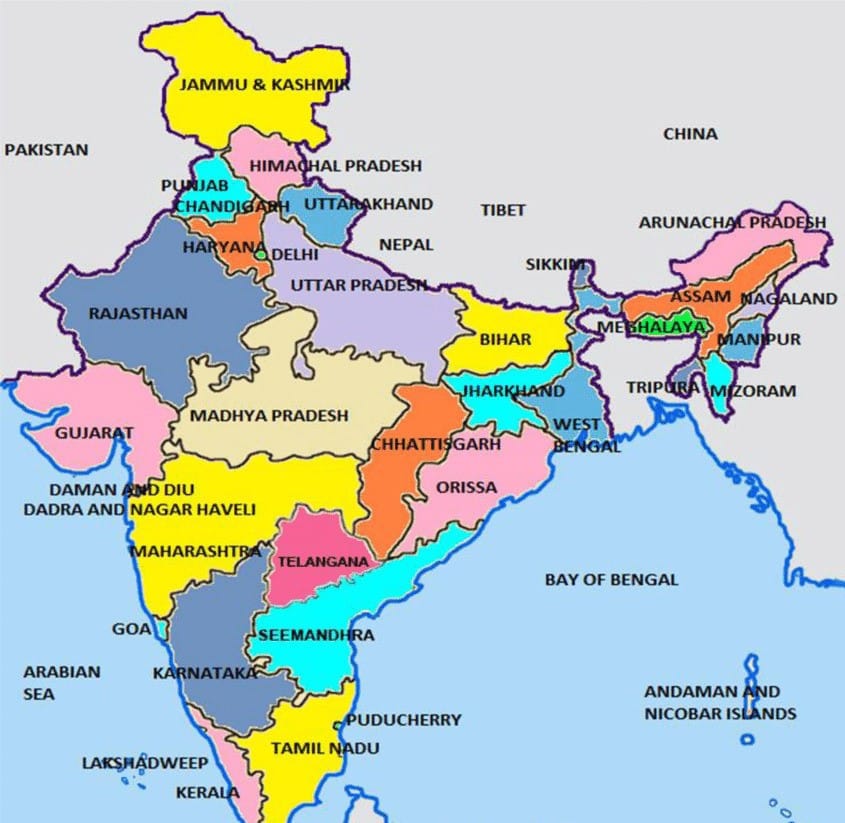
Classification of territory
- According to Article 1, India's territory is divided into three categories:
- Territories of the states
- Union territories
- Territories that may be acquired by the Government of India at any time.
- The names of states and union territories, as well as their territorial extent, are mentioned in the Constitution's first schedule.
- The provisions of the Constitution pertaining to states are equally applicable to all states.
- Notably, the 'Territory of India' is a broader expression than the 'Union of India,' because the latter includes only states, whereas the former includes not only states, but also union territories and territories that the Government of India may acquire at any time in the future.
- The states are members of the federal system and share power distribution with the central government.
Constitutional Assembly Debates
- The Indian federation, according to Dr B R Ambedkar, is a "Union" since it is indissoluble, and no state has the authority to separate from it.
- Prof. K. T. Shah proposed to add ‘Secular, Federal, Socialist’ to ‘Union of States’.
- H. V. Kamath suggested alternative names to India such as ‘Bharat’ or ‘Hind’ to gain more prominence and to be placed before ‘India’.
- Maulana Hasrat Moulani suggested ‘Union of Indian Socialistic Republics UISR.’ on the lines of the U.S.S.R.
Supreme Court Verdict on the Name change
- The apex court had dismissed a petition in 2016.
- The then Chief Justice of India, T.S. Thakur, said orally that every Indian has the right to call his nation 'Bharat' or 'India.'
- The Chief Justice stated that the Supreme Court has no authority to tell or decide what a citizen's country should be called.
Conclusion
India, or Bharat, will function as a union of states. The States shall be as defined in the First Schedule, including their respective territories. As a union of states, India is a sovereign, secular, democratic republic with a parliamentary system of government. Despite numerous suggestions, all of the proposals were rejected when they were put to a vote. Therefore, the Constituent Assembly decided that "India, that is, Bharat, shall be a Union of States," which is the current form.
FAQs
Q1: What is the Union of States in India?
Answer: The Union of States refers to the relationship and structure of the Indian states under the Constitution, emphasizing the sovereignty of the Union.
Q2: Which articles of the Indian Constitution outline the Union of States?
Answer: Articles 1 to 4 define the Union and its territorial extent, including the formation and alteration of states.
Q3: What is the significance of Article 1 of the Constitution?
Answer: Article 1 states that India is a Union of States, establishing the country's federal structure.
Q4: Can the Union Parliament alter state boundaries?
Answer: Yes, the Parliament can alter state boundaries and create new states through legislative measures.
Q5: How does the Union of States ensure national integrity?
Answer: It maintains a balance between state autonomy and central authority, ensuring unity while respecting regional diversity.
MCQs
- Which article states that India is a Union of States?
a) Article 1
b) Article 2
c) Article 3
d) Article 4
Answer: (A) See the Explanation
- What is the role of Article 3 in the Indian Constitution?
a) Defines the territory of India
b) Provides for the alteration of state boundaries
c) Discusses fundamental rights
d) Establishes the legislative framework
Answer: (B) See the Explanation
- How many states and union territories are currently in India?
a) 28 states and 8 UTs
b) 29 states and 7 UTs
c) 26 states and 9 UTs
d) 30 states and 6 UTs
Answer: (B) See the Explanation
- Which constitutional body is responsible for the reorganization of states?
a) Supreme Court
b) Union Parliament
c) President of India
d) Finance Commission
Answer: (B) See the Explanation
- What does Article 4 deal with?
a) State's powers
b) Representation in Parliament
c) Admission or establishment of new states
d) Directive principles
Answer: (C) See the Explanation
GS Mains Questions and Model Answers
Q1: Discuss the importance of the Union of States concept in the Indian Constitution.
Answer: The concept of the Union of States is fundamental to India's constitutional framework, ensuring a balance between unity and regional diversity. It recognizes India as a federation where states have defined powers while being part of a larger national identity. This structure promotes cooperation between the central and state governments, enabling effective governance. Additionally, it helps manage regional aspirations and conflicts, fostering national integration. By providing a framework for state creation and boundary alterations, the Union of States reflects India's dynamic socio-political landscape.
Q2: Analyze the implications of state reorganization in India.
Answer: State reorganization has significant implications for India's governance and social fabric. It allows for the adaptation of administrative units to reflect demographic changes, regional aspirations, and cultural identities. While it can enhance local governance and development, it may also lead to tensions over resources, identity, and political representation. The process impacts the distribution of powers and responsibilities between the central and state governments, necessitating careful consideration of the interests of all stakeholders. Overall, state reorganization must aim to balance regional aspirations with national unity for sustainable development.
Q3: Evaluate the role of the Union Parliament in the context of state boundaries and formation.
Answer: The Union Parliament plays a pivotal role in determining the boundaries and formation of states in India, as enshrined in Article 3 of the Constitution. This authority allows it to respond to regional demands for autonomy and representation, fostering a responsive governance structure. However, the process must consider the socio-political implications of such changes, ensuring that the interests of affected populations are taken into account. The Parliament’s ability to create new states or alter boundaries highlights the need for a delicate balance between central authority and regional aspirations, ultimately contributing to national integration.
Previous Year Questions on Union of States
1. UPSC CSE 2019
Question: "What are the features of the Union of States in India?"
Answer: The Union of States in India is characterized by a federal structure, where states possess defined powers while being integrated into a single national framework. Key features include the distribution of powers between the Union and states, the ability of Parliament to alter state boundaries, and the recognition of states' rights under the Constitution. This framework fosters regional diversity while ensuring national integrity, allowing for local governance aligned with national interests. The Union of States promotes cooperation, enhances representation, and maintains unity amidst diversity.
2. UPSC CSE 2021
Question: "Discuss the challenges faced in the reorganization of states in India."
Answer: The reorganization of states in India poses several challenges, including regional disparities, identity conflicts, and political tensions. As new states are formed or boundaries altered, issues of resource allocation, representation, and cultural identity can lead to unrest. Additionally, balancing the aspirations of diverse ethnic and linguistic groups while maintaining national unity is a complex task. Political considerations often complicate the reorganization process, as parties may exploit regional sentiments for electoral gains. Therefore, effective dialogue and consensus-building are essential to address these challenges and ensure harmonious governance within the Union of States framework.
*email: contactus@prepp.in
Download the PREPP App and attempt FREE IAS Exam Mock Tests and get complete study material!

Full Test - 04: UPSC CSE Prelims CSAT (Paper-II)
Full Test - 03: UPSC CSE Prelims CSAT (Paper-II)
UPSC CSE Prelims 2026 GS Paper 1 Question Paper (24-May-2026)
UPSC CSE Prelims 2026 CSAT Paper 2 Question Paper (24-May-2026)

17 February 2025 | The Hindu Must Read Articles | Current Affairs

16 February 2026 | The Hindu Must Read Articles | Current Affairs

13 February 2026 | The Hindu Must Read Articles | Current Affairs









Comments