Reorganisation of States – Indian Polity Notes
Reorganization of states after independence posed an important challenge for a nascent country like India because of its diverse linguistic, cultural, and regional identities. This process has evolved over time, shaped by historical contexts, socio-political demands, and constitutional provisions. States Reorganisation Act of 1956 was the first major step in this direction.
Reorganisation of States is an important topic under UPSC/IAS Exam Polity and Governance syllabus which is discussed in detail in this article.
| To Read update on this topic: |
|
Table of Contents |

Historical Background
- Indian states were originally formed as a result of historical accidents and circumstances. After independence, there has been a growing demand for reorganisation of the States on a linguistic basis.
- The Indian States were formed after independence taking cognizance of financial, economic, and administrative factors.
- In 1951, India had 27 states divided into four parts: Part A, Part B, Part C, and Part D.
| Part A | Assam, West Bengal, Bihar, Bombay, Madhya Pradesh (formerly Central Provinces and Berar), Madras, Orissa, Punjab, and Uttar Pradesh (formerly United Provinces) |
| Part B | Hyderabad, Jammu and Kashmir, Saurashtra, Mysore, Travancore-Cochin, Madhya Bharat, Vindhya Pradesh, Patiala, and East Punjab States Union (PEPSU), and Rajasthan |
| Part C | Delhi, Kutch, Himachal Pradesh, Bilaspur, Coorg, Bhopal, Manipur, Ajmer, Cooch-Behar, and Tripura |
| Part D | The Andaman and Nicobar Islands (Part D) was a territory ruled by a governor appointed by the Indian President. |
- After independence, there was a demand for reorganisation of states on the basis of language as promised by national leaders before independence.
- To address these demands government established S.K. Dhar Commission and JVP Committee respectively in 1948.
- A prolonged agitation and the death of Gandhian leader Potti Sriramulu after a 56-day hunger strike pressurised government to establish a separate state for Telugu speaking people. Therefore a new state Andhra Pradesh was carved out from the state of Madras which led to formation of Andhra Pradesh in 1953.
- Consequently, similar demands rose from different parts of India for the creation of states on linguistic basis.
- To address these demands, government appointed States Reorganisation Commission under the leadership of Justice Fazal Ali in 1953 to consider reorganisation of states on the basis of language. K.M. Panikkar and H.N. Kunzru were other members of the commission.
- It recommended language as the basis of Reorganization of states. At the same time rejected the theory of “One Language-One State”.
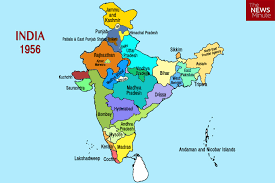
- The commission's recommendations were accepted with some modifications and implemented in the States Reorganisation Act in 1956. The act created 14 states and 6 centrally administered territories.
- In order to implement the States Reorganisation Act, 7th Constitutional Amendment Act was passed which nullified the qualification between Part A, B, C and D States.
- Following it, Parliament enacted various Reorganisation Acts from time to time, i.e.
- Bombay Reorganisation Act in 1960
- Punjab Reorganisation Act in 1966
- State of Himachal Pradesh Reorganisation Act in 1970
- North-Eastern States Reorganization Act in 1971
- The Reorganisation Acts of Uttar Pradesh, Madhya Pradesh, and Bihar, enacted by the Parliament in November 2000 as well as the creation of two Union Territories from the erstwhile Jammu and Kashmir in 2019 are the most recent in this category.
|
"The creation of states on a linguistic basis is recommended, but it must be balanced with considerations of administrative convenience, economic viability, and the promotion of national integration."- Fazal Ali Commission |
Rational Behind Reorganization
- Historical Agreement on Linguistic Reorganization: In Nagpur Session of Indian National Congress (INC) in 1920, national leaders accepted that provincial boundaries should be drawn on linguistic lines. Even the Nehru Commission Report, 1928 recommended redistribution of provinces on a linguistic basis.
- The British administration demarcated provincial boundaries to serve their political, administrative, and economic needs, disrupting regional geolinguistic and cultural coherence. This led to the development of strong linguistic identities and a surge in language politics in post-independence India.
- Language is also associated with education, economic development, employment opportunities and access to political power. The successful establishment and functioning of a democratic system also required the provinces to be reorganised on linguistic lines.
- Functioning of the government agencies, law-making, judicial work need to be carried out in local languages to deepen the nascent democracy at grassroots leve. It would not have been possible without organisation of states on linguistic basis.
- Linguistic reorganization reinforced India's federal structure, allowing for regional autonomy within the framework of a united nation.
Challenges Created by Linguistic Reorganization of States in India
- Regional disparities: Some linguistically reorganized states faced economic challenges due to uneven resource distribution and development opportunities.
- Boundary conflicts: Disputes over newly drawn boundaries often led to tensions and conflicts between neighbouring states. Eg. Between Maharashtra and Karnataka over Belgaum region.
- Resource sharing: Disagreements over the sharing of natural resources, such as river waters, created prolonged disputes. Eg. Cauvery water dispute between Karnataka and Tamil Nadu.
- Cultural and ethnic tensions: It marginalized smaller linguistic and cultural groups within states, leading to demands for further division Eg. demands for Gorkhaland in West Bengal, Tulunadu in Karnataka.
- Communal tensions: In some regions, linguistic reorganization heightened communal tensions, particularly when linguistic identity intersected with religious and ethnic identities.
- Domino effect: Success of initial linguistic reorganization led to continuous demands for new states, putting pressure on the central and state governments.
Sequence And Facts About New States And Union Territories Created After 1956
| States | Sequence and Facts |
|---|---|
| Andhra Pradesh | The State of Andhra Pradesh Act of 1953 created the state by carving out some areas from the State of Madras. |
| Gujarat and Maharashtra | The State of Bombay was divided into two States i.e., Maharashtra and Gujarat by the Bombay (Reorganization) Act, of 1960. · Gujarat became the 15th state of the Indian Union. |
| Kerala | Created by the State Reorganization Act, of 1956. It comprised Travancore and Cochin areas. |
| Karnataka | Created from the princely State of Mysore by the State Reorganization Act, of 1956. · It has been renamed Karnataka in 1973. |
| Dadra and Nagar Haveli | This territory was ruled by the Portuguese until it was liberated in 1954. · Following that, the administration was carried on by an administrator chosen by the people themselves until 1961. · The 10th Constitutional Amendment Act of 1961 made it a union territory of India. |
| Puducherry | Puducherry's territory includes the former French settlements in India known as Puducherry, Karaikal, Mahe, and Yanam. · In 1954, the French handed over this territory to India. · It was then administered as an "acquired territory" until 1962 when the 14th Constitutional Amendment Act made it a union territory. |
| Nagaland | The State of Nagaland Act of 1962 separated it from the State of Assam. |
| Haryana | In 1966, the State of Punjab was bifurcated to create Haryana, the 17th state of the Indian Union and the union territory of Chandigarh. |
| Himachal Pradesh | The Union Territories of Himachal Pradesh were elevated to the status of State by the State of Himachal Pradesh Act, of 1970. |
| Meghalaya | State within the State of Assam by 23rd Constitutional Amendment Act, 1969. · Later, in 1971, it received the status of a full-fledged State through the North-Eastern Areas (Reorganization) Act, 1971. |
| Manipur and Tripura | Both these States were elevated from the status of Union Territories by North – Eastern Areas (Reorganization) Act, of 1971. |
| Sikkim | Sikkim was given first the status of ‘Associate State’ through the enactment of the 35th Constitutional Amendment Act (1974). · It got the status of full State in 1975 by 36th Amendment Act, 1975. |
| Mizoram | It was elevated to the status of a full state by the state of Mizoram Act, of 1986. · It was done after the signing of a memorandum of settlement (Mizoram Peace Accord) in 1986 between the Central government and the Mizo National Front. |
| Arunachal Pradesh | It received the status of a full state by the State of Arunachal Pradesh Act, 1986. · Prior to this, Arunachal Pradesh was a Union Territory since 1972. |
Conclusion
Language was a central factor in the linguistic reorganization of states because it addressed the need for cultural preservation, administrative efficiency, educational development, political stability, and economic growth. Recognizing linguistic identities helped to mitigate conflicts, enhance governance, and promote regional development, thereby strengthening the overall unity and integrity of the nation.
FAQs
Question: What is meant by the reorganisation of states in India?
Answer: The reorganisation of states in India refers to the process of redrawing the boundaries of states and union territories, which can involve the creation of new states, merging existing states, or altering their boundaries. This process is guided by the principles of administrative efficiency, cultural and linguistic homogeneity, and the need for effective governance. Significant instances of reorganisation include the States Reorganisation Act of 1956 and subsequent changes based on linguistic and regional identities.
Question: What are the primary factors that influence the reorganisation of states in India?
Answer: Several factors influence the reorganisation of states in India, including linguistic and cultural identities, administrative convenience, geographical considerations, and socio-economic factors. Linguistic demands often drive the creation of new states, as seen with the formation of states like Andhra Pradesh and Gujarat. Additionally, historical movements and local governance needs can necessitate changes to state boundaries to ensure effective administration and representation.
Question: What role does the Parliament play in the reorganisation of states?
Answer: The Parliament of India plays a crucial role in the reorganisation of states. According to Article 3 of the Constitution, Parliament can create new states and alter the boundaries of existing states through legislation. The process typically involves a proposal from the President, followed by discussions and approvals in both houses of Parliament. This ensures that any changes are legally sanctioned and reflect the will of the central government.
Question: What was the significance of the States Reorganisation Act of 1956?
Answer: The States Reorganisation Act of 1956 was a landmark legislation that reorganised the boundaries of Indian states based on linguistic lines. It aimed to ensure that each state would have a cohesive cultural and linguistic identity, thereby promoting better governance and representation. The Act led to the creation of several new states and the reconfiguration of existing ones, significantly shaping the political landscape of modern India.
Question: How does reorganisation of states impact local governance?
Answer: The reorganisation of states has a profound impact on local governance by potentially improving administrative efficiency, representation, and accountability. New states or restructured boundaries can lead to more localized governance, allowing for better allocation of resources and tailored policies that address the specific needs of communities. However, it can also pose challenges, such as the need for new administrative frameworks and potential conflicts over resource distribution.
MCQs
1. Which article of the Indian Constitution empowers Parliament to reorganise states?
A) Article 2
B) Article 3
C) Article 4
D) Article 5
Answer: (B) See the Explanation
Explanation: Article 3 of the Indian Constitution empowers Parliament to create new states, alter the boundaries of existing states, and make provisions for the formation of new states on the basis of language or other factors. This article outlines the legal framework for state reorganisation in India.
2. The States Reorganisation Act of 1956 primarily reorganised states on what basis?
A) Geographical
B) Historical
C) Linguistic
D) Cultural
Answer: (C) See the Explanation
Explanation: The States Reorganisation Act of 1956 primarily reorganised states based on linguistic lines. This was aimed at ensuring that each state would consist of people speaking a common language, thereby promoting cultural and administrative unity.
3. Which state was created as a result of the reorganisation based on linguistic demands in 1956?
A) Maharashtra
B) Tamil Nadu
C) Andhra Pradesh
D) Gujarat
Answer: (C) See the Explanation
Explanation: Andhra Pradesh was created in 1956 following the linguistic reorganisation of states. It was formed to satisfy the demands of Telugu-speaking people, leading to the establishment of a state that represented their cultural and linguistic identity.
4. What was one of the main objectives of the States Reorganisation Act?
A) To decentralise power
B) To promote unity among states
C) To create smaller states for better governance
D) To establish a uniform legal system
Answer: (C) See the Explanation
Explanation: One of the main objectives of the States Reorganisation Act was to create smaller states for better governance and administrative efficiency. By reorganising states based on linguistic lines, the Act aimed to enhance local governance and representation.
5. Which commission recommended the reorganisation of states based on linguistic lines in India?
A) Mandal Commission
B) States Reorganisation Commission
C) Kothari Commission
D) Bhore Committee
Answer: (B) See the Explanation
Explanation: The States Reorganisation Commission, established in 1953, recommended the reorganisation of states on the basis of linguistic lines. Its recommendations led to the enactment of the States Reorganisation Act in 1956, reshaping the political map of India.
GS Mains Questions and Model Answers
Q1: Discuss the impact of the reorganisation of states on Indian federalism.
Answer: The reorganisation of states has significant implications for Indian federalism, primarily by reflecting the principles of regional autonomy and representation. By creating states that align with linguistic and cultural identities, it enhances the sense of belonging and local governance. This process allows for a more responsive administrative framework that can cater to the unique needs of diverse populations.
However, it also poses challenges, such as potential inter-state conflicts over resources and the delicate balance between state and central powers. The reorganisation reflects a dynamic federal structure that adapts to the aspirations of regional identities, promoting a more integrated nation while simultaneously navigating the complexities of regional diversity.
Q2: Analyze the reasons behind the demand for statehood in various regions of India.
Answer: The demand for statehood in various regions of India is driven by several factors, including cultural and linguistic identity, economic disparities, and historical grievances. Many communities seek recognition and representation that aligns with their language, customs, and traditions, leading to calls for new states to address these aspirations.
Economic factors also play a role, as regions often believe that statehood will enable better resource allocation and development tailored to local needs. Historical grievances related to colonial legacies or administrative injustices further fuel these demands. Overall, the push for statehood reflects a desire for autonomy and self-determination among diverse communities across India.
Q3: Evaluate the role of the States Reorganisation Act in shaping contemporary Indian politics.
Answer: The States Reorganisation Act of 1956 played a pivotal role in shaping contemporary Indian politics by establishing a framework for state boundaries based on linguistic and cultural identities. This not only addressed historical injustices but also fostered a sense of unity among diverse groups by providing them with political representation aligned with their identities.
The Act has led to ongoing discussions about regional autonomy, representation, and the need for further reorganisation in response to emerging demands. Its influence is evident in contemporary political dynamics, where regional parties often advocate for the interests of specific linguistic or cultural groups, highlighting the Act's lasting impact on the political landscape of India.
Previous Year Questions on Reorganisation of States
1. UPSC CSE Mains 2016:
Question: Critically evaluate the impact of linguistic reorganisation of states on national integration.
Answer: The linguistic reorganisation of states has had a complex impact on national integration. On one hand, it has fostered a sense of identity and belonging among regional populations, leading to greater political participation and representation. This recognition of linguistic identities can enhance loyalty to the state and the country, thereby promoting national integration.
On the other hand, it can also lead to regionalism and separatism, as communities may prioritize regional over national interests. The challenge lies in balancing regional aspirations with national unity, ensuring that the reorganisation serves as a means of integration rather than division.
2. UPSC CSE Mains 2019:
Question: Examine the challenges posed by the reorganisation of states in India.
Answer: The reorganisation of states in India poses several challenges, including inter-state conflicts over resources, administrative inefficiencies, and the potential for regional imbalances in development. Newly formed states may struggle with governance issues due to inadequate infrastructure and resources, leading to disparities in economic growth and public services.
Additionally, the demand for further reorganisation continues to create political tensions, as various groups seek recognition and autonomy. The government must navigate these complexities carefully to maintain stability and promote equitable development across all regions.
*email: contactus@prepp.in
Download the PREPP App and attempt FREE IAS Exam Mock Tests and get complete study material!

Full Test - 04: UPSC CSE Prelims CSAT (Paper-II)
Full Test - 03: UPSC CSE Prelims CSAT (Paper-II)
UPSC CSE Prelims 2026 GS Paper 1 Question Paper (24-May-2026)
UPSC CSE Prelims 2026 CSAT Paper 2 Question Paper (24-May-2026)

17 February 2025 | The Hindu Must Read Articles | Current Affairs

16 February 2026 | The Hindu Must Read Articles | Current Affairs

13 February 2026 | The Hindu Must Read Articles | Current Affairs









Comments