Evolution Of States and Union Territories – Indian Polity Notes
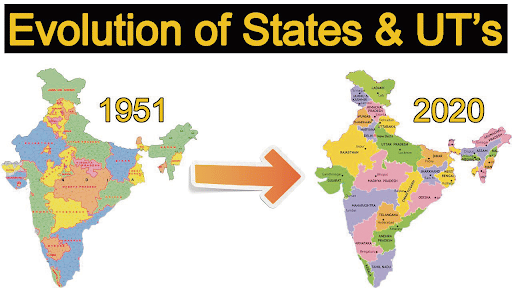
Before they took their current shapes, sizes, and names, the constituent states of the Indian Republic went through a long process of evolution of states and union territories. Since 1956, several new states and union territories have been formed, and several union territories have become states. Today, republic of India is made up of 28 states and 8union territories.
|
Table of Contents |
Historical Background
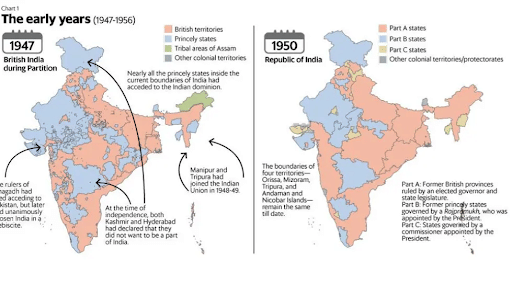
- India was divided into 565 princely states prior to independence.
- These indigenous princely states believed in self-government, which posed the greatest challenge to the development of a strong India.
- India had three types of states at the time:
- Territories of British India
- Princely states
- Colonial territories of France and Portugal.
- Except for Hyderabad, Junagadh, Bhopal, and Kashmir, 562 princely states agreed to join the Indian Confederation after India's independence.
- By the 26th of January 1950, India had formally transitioned from a dominion to a republic of states. It had largely merged the smaller states into larger regional territories like Saurashtra.
- This union of states was divided into three parts based on whether they were former provinces (part A), princely states (part B), or territories that would be directly ruled by the Union government (part C), the precursor to UTs.
- Following the establishment of an Andhra state in 1953 for Telugu-speaking regions of Madras state, the State Reorganization Commission (SRC) was formed to evaluate the republic's restructuring largely along linguistic lines.
- 14 States and 6 centrally Administered Territories were created under the State Reorganization Act, 1956.
- The states included Andhra Pradesh, Bihar, Bombay, Jammu and Kashmir, Kerala, Madhya Pradesh, Mysore, Tamil Nadu, Orissa-Punjab, Rajasthan, Uttar Pradesh and West Bengal.
- Since Indian independence the boundaries of the Indian states have kept on changing year by year.
Related Constitutional Provisions
- Part I of the Constitution (Articles 1–4)explain the Union and its territory.
- Article 1 defines India, that is, Bharat, as a "Union of States."
- The Indian Federation was a “Union” because it was inseparable, and no State had the right to withdraw from the Indian Union.
- Article 2 of the Constitution gives Parliament the authority to admit or establish new states.
- Article 3 of the Indian Constitution deals with the 'formation of new states and changes to the areas, boundaries, or names of existing states.' It states that Parliament may by law:
- form a new state by separating territory from another state, joining two or more states or parts of states, or joining any territory to a part of another state;
- increase the area of any State;
- diminish the area of any State;
- alter the boundaries of any State;
- alter the name of any State;
- To give effect to the scheme of reorganization, the States Reorganisation Act, 1956, was enacted by the Parliament under Article 4 of the Constitution of India.
- In order to implement the States Reorganisation Act, the Constitution introduced the 7th Constitutional Amendment, which received the Indian President's assent on October 19, 1956.
- This amendment not only resulted in the formation of new states by altering the areas and boundaries of the then-existing states, but it also resulted in the abolition of the Part A, Part B, and Part C states and the designation of certain areas as Union Territories.
|
"The idea of linguistic states has always appealed to me. The adjustment of boundaries to meet linguistic demands is the essence of democracy. However, this must be done with caution and without endangering the unity of the country." - Jawaharlal Nehru |
Related Challenges
- India inherited a multitude of princely states and regions with distinct ethnic and linguistic identities. Integrating these into a unified nation while respecting cultural and linguistic diversity was a significant challenge.
- The States Reorganisation Act of 1956, which reorganized states on a linguistic basis. However, it also sparked demands for further subdivisions and created tensions between linguistic groups.
- Relative deprivation among states has led to demands for separate states. Regions feeling neglected or underdeveloped have sought statehood to gain greater control over their development agendas. Eg. Formation of Jharkhand, Uttarakhand, Chattisgarh etc.
- Rise of separatist and secessionist movements posed a challenge to India’s unity and integrity. Eg.demand for Khalistan, Dravida Nadu etc.
- State formation has often been influenced by political considerations, with various political parties supporting statehood demands to gain electoral advantages. This has sometimes led to the politicization of statehood movements, complicating objective decision-making.
- Inter-state Disputes: The reorganization of states has sometimes led to disputes over resources, borders, and administrative control.
- Various regions and ethnic groups have demanded separate statehood to preserve their unique identities and gain autonomy. These movements have sometimes led to prolonged agitations, violence, and political unrest.
- Rising economic and infrastructural inequalities have led to growing demand for separate states in recent time. Eg.Bodoland,Tulunadu, Bundelkhand, Vidarbha, Saurashtra etc.
Sequence and Facts about New States and Union Territories Created After 1956
| States | Sequence and Facts |
|---|---|
| Andhra Pradesh | The State of Andhra Pradesh Act of 1953 created the state by carving out some areas from the State of Madras. |
| Gujarat and Maharashtra | The State of Bombay was divided into two States i.e., Maharashtra and Gujarat by Bombay (Reorganization) Act, 1960. · Gujarat became the 15th state of the Indian Union. |
| Kerala | Created by State Reorganization Act, 1956. It comprised Travancor and Cochin areas. |
| Karnataka | Created from princely State of Mysore by State Reorganization Act, 1956. · It has been renamed Karnataka in 1973. |
| Dadra and Nagar Haveli | This territory was ruled by the Portuguese until it was liberated in 1954. · Following that, the administration was carried on by an administrator chosen by the people themselves until 1961. · The 10th Constitutional Amendment Act of 1961 made it a union territory of India. |
| Puducherry | Puducherry's territory includes the former French settlements in India known as Puducherry, Karaikal, Mahe, and Yanam. · In 1954, the French handed over this territory to India. · It was then administered as an "acquired territory" until 1962, when the 14th Constitutional Amendment Act made it a union territory. |
| Nagaland | The State of Nagaland Act of 1962 separated it from the State of Assam. |
| Haryana | In 1966, the State of Punjab was bifurcated to create Haryana, the 17th state of the Indian Union and the union territory of Chandigarh. |
| Himachal Pradesh | The Union Territories of Himachal Pradesh was elevated to the status of State by State of Himachal Pradesh Act, 1970. |
| Meghalaya | State within the State of Assam by 23rd Constitutional Amendment Act, 1969. · Later, in 1971, it received the status of a full-fledged State by North-Eastern Areas (Reorganization) Act, 1971. |
| Manipur and Tripura | Both these States were elevated from the status of Union Territories by North-Eastern Areas (Reorganization) Act, 1971. |
| Sikkim | Sikkim was given first the status of ‘Associate State’ through enactment of 35th Constitutional Amendment Act (1974). · It got the status of full State in 1975 by 36th Amendment Act, 1975. |
| Mizoram | It was elevated to the status of a full state by state of Mizoram Act, 1986. · It was done after signing of a memorandum of settlement (Mizoram Peace Accord) in 1986 between the Central government and the Mizo National Front. |
| Arunachal Pradesh | It received the status of a full state by State of Arunachal Pradesh Act, 1986. · Prior to this, Arunachal Pradesh was a Union Territory since 1972. |
Conclusion
The journey of state formation in India from 1947 to 2024 has been marked by a complex interplay of ethnic, linguistic, economic, and political factors. The creation of new states and reorganization of existing ones have not only fostered regional identities and aspirations but also strengthened the democratic fabric of the nation. As India continues to grow and change, the principles and practices guiding state formation will remain vital to its unity, stability, and inclusive development.
FAQs
Question: What factors influenced the evolution of states and union territories in India?
Answer: The evolution of states and union territories in India has been influenced by a variety of factors, including historical, cultural, linguistic, and political considerations. The reorganization of states post-independence was driven largely by the need to create administrative units that reflected the diverse linguistic and cultural landscape of the country. The States Reorganisation Act of 1956 was a pivotal moment, as it aimed to reorganize state boundaries based on language, leading to the formation of states such as Andhra Pradesh and Gujarat. Additionally, the demand for greater autonomy and representation from various regions has prompted the creation of new states and union territories, such as Chhattisgarh, Jharkhand, and Uttarakhand, to address regional aspirations. The evolving political dynamics, including demands for decentralization and local governance, continue to shape the structure of states and union territories in contemporary India.
Question: How did the States Reorganisation Act of 1956 impact the political landscape of India?
Answer: The States Reorganisation Act of 1956 significantly transformed the political landscape of India by reorganizing state boundaries and creating new states based on linguistic and cultural lines. This act aimed to address the aspirations of various linguistic and ethnic groups, fostering a sense of identity and representation. By redrawing the boundaries of states, it led to the formation of several new states, including Andhra Pradesh, Maharashtra, and Kerala, which were intended to facilitate better governance and administration. The reorganization also helped to reduce regional tensions and conflicts, as communities felt their identities were acknowledged within the political framework. Additionally, the act set a precedent for future demands for statehood, contributing to the political discourse on autonomy and federalism in India. Overall, the States Reorganisation Act played a crucial role in shaping the federal structure and enhancing the representation of diverse groups in the Indian polity.
Question: What are the differences between states and union territories in India?
Answer: States and union territories in India differ primarily in their governance structure and the degree of autonomy they possess. States have their own legislative assemblies, which allow them to enact laws and manage their affairs within the framework of the Constitution. They have a higher degree of autonomy compared to union territories, which are directly governed by the Central Government. Union territories may or may not have legislative assemblies, and those with assemblies (like Delhi and Puducherry) have limited powers compared to full-fledged states. Additionally, states have a greater capacity for self-governance and the ability to influence state policies, while union territories often rely on the central government for administrative and legislative decisions. This distinction underscores the varying levels of autonomy and representation afforded to different regions in India.
Question: How do recent developments influence the formation of new states and union territories?
Answer: Recent developments influencing the formation of new states and union territories in India are driven by political, economic, and social factors. The demand for statehood often arises from regional aspirations for greater autonomy, development, and representation. Economic considerations, such as disparities in resource allocation and development levels, can also lead to calls for new states to ensure better governance and focused development initiatives. Social movements advocating for the rights and recognition of marginalized communities have further fueled demands for the creation of new states and union territories. The government’s response to these demands is shaped by political will, public sentiment, and administrative feasibility, as seen in the formation of states like Telangana in 2014. As regional identities continue to evolve, the conversation around statehood remains a dynamic aspect of Indian polity.
Question: What role do political parties play in the evolution of states and union territories?
Answer: Political parties play a significant role in the evolution of states and union territories by shaping public discourse, advocating for regional interests, and influencing policy decisions. They often mobilize support for the creation of new states based on linguistic, cultural, or economic grounds, thereby channeling regional aspirations into political demands. Political parties can leverage electoral strategies to promise statehood as a means to gain support from local populations, as seen in the movements for states like Chhattisgarh and Uttarakhand. Furthermore, party dynamics at both the state and national levels can affect how and when new states or union territories are formed, as coalitions and alliances often influence legislative processes. Overall, political parties act as crucial intermediaries between the central government and regional populations, facilitating the conversation around statehood and governance.
MCQs
1. What was the primary purpose of the States Reorganisation Act of 1956?
A) To abolish states
B) To reorganize states based on language
C) To create union territories
D) To centralize power
Answer: (B) See the Explanation
Explanation: The primary purpose of the States Reorganisation Act of 1956 was to reorganize the boundaries of states in India based on linguistic and cultural lines, ensuring better governance and representation.
2. Which of the following is a characteristic of union territories in India?
A) They have their own legislative assemblies
B) They are directly governed by the Central Government
C) They have full state powers
D) They are never formed from states
Answer: (B) See the Explanation
Explanation: Union territories are directly governed by the Central Government, and while some may have legislative assemblies, they generally possess less autonomy compared to states.
3. What factor primarily influenced the formation of Telangana as a new state?
A) Religious differences
B) Linguistic and cultural identity
C) Economic prosperity
D) Environmental concerns
Answer: (B) See the Explanation
Explanation: The formation of Telangana was primarily influenced by linguistic and cultural identity, as the movement sought to recognize the distinct cultural heritage of the Telugu-speaking population in the region.
4. Which of the following best describes the relationship between states and the Central Government in India?
A) States are completely autonomous
B) States have no legislative powers
C) States have significant powers but remain under the purview of the Central Government
D) States are not part of the Indian Union
Answer: (C) See the Explanation
Explanation: States in India have significant powers under the Constitution but remain under the purview of the Central Government, which has authority over certain areas such as defense, foreign affairs, and communications.
5. What socio-political factors contributed to the demand for the creation of new states in India?
A) Economic stability
B) Regional aspirations and identity
C) Globalization
D) Technological advancement
Answer: (B) See the Explanation
Explanation: The demand for the creation of new states in India has been largely influenced by regional aspirations and identity, with communities seeking greater representation and autonomy to address their unique needs and issues.
GS Mains Questions and Model Answers
Q1: Examine the evolution of states and union territories in India post-independence. What key events and legislation have shaped this evolution?
Answer: The evolution of states and union territories in India post-independence has been marked by significant legislative changes and historical events. One of the pivotal moments was the States Reorganisation Act of 1956, which aimed to reorganize state boundaries based on linguistic lines, facilitating better governance and addressing regional aspirations. This act led to the formation of several states such as Andhra Pradesh and Gujarat, reflecting the diverse cultural and linguistic landscape of India. Additionally, the demand for new states has continued into the 21st century, as seen in the creation of Telangana in 2014, which was a result of prolonged agitation for recognition of regional identity and development. Other important developments include the establishment of union territories such as Ladakh and Jammu & Kashmir following the abrogation of Article 370 in 2019. Overall, the evolution of states and union territories in India has been a dynamic process driven by the need for administrative efficiency, representation, and recognition of diverse identities.
Q2: Discuss the impact of the linguistic reorganization of states on the political landscape of India. How has this affected regional identities?
Answer: The linguistic reorganization of states has profoundly impacted the political landscape of India by acknowledging and institutionalizing regional identities based on language and culture. This reorganization facilitated the creation of states that reflected the linguistic demographics of the population, enhancing the representation of various linguistic communities in governance. It has fostered a sense of belonging and pride among regional populations, strengthening local identities. Politically, this has led to the emergence of regional parties that advocate for specific linguistic and cultural interests, influencing national politics and policy-making. The linguistic reorganization has also encouraged cultural preservation and the promotion of regional languages and traditions, which contribute to the rich diversity of India's socio-political fabric. However, it has also raised challenges, such as inter-state conflicts and demands for further reorganization, highlighting the need for a balanced approach to regional representation and national integration.
Q3: Evaluate the significance of union territories in the administrative framework of India. How do they differ from states in terms of governance and autonomy?
Answer: Union territories play a crucial role in the administrative framework of India, serving as regions that require direct governance by the central government due to their unique circumstances. Unlike states, which have their own legislative assemblies and greater autonomy, union territories may have limited or no legislative powers, depending on their specific status. For instance, while some union territories like Delhi and Puducherry have legislative assemblies and limited self-governance, others are directly administered by the central government without any local legislative framework. This structure allows for a more centralized approach to governance in regions where the central government seeks to maintain control, often in areas with security concerns or developmental challenges. The significance of union territories lies in their ability to address specific regional needs while also allowing for direct intervention by the central government when necessary, providing a flexible administrative mechanism that complements the federal structure of India.
Previous Year Questions on Evolution of States and Union Territories
1. UPSC CSE Prelims 2021:
Question: What was the main objective of the States Reorganisation Act of 1956?
A) To centralize power
B) To reorganize states based on linguistic and cultural lines
C) To abolish states
D) To create new union territories
Answer: (B)
Explanation: The main objective of the States Reorganisation Act of 1956 was to reorganize the boundaries of states in India based on linguistic and cultural lines, ensuring better governance and representation.
2. UPSC CSE Mains 2020 (GS Paper 1):
Question: "Examine the significance of union territories in the context of Indian governance." Discuss their role and relationship with the central government.
Answer: Union territories serve as regions requiring direct governance by the central government and play a significant role in the Indian administrative framework. They may have limited legislative powers compared to states, facilitating a centralized approach to governance in areas with specific needs or challenges. This direct administration allows the central government to maintain control while addressing regional issues effectively. Union territories also reflect the diversity of India and the need for tailored governance structures, as seen in areas like Jammu & Kashmir, which were historically significant for national security. The relationship between union territories and the central government underscores the flexibility and adaptability of India's federal structure, ensuring that governance can respond to regional dynamics and complexities.
*email: contactus@prepp.in
Download the PREPP App and attempt FREE IAS Exam Mock Tests and get complete study material!

Full Test - 04: UPSC CSE Prelims CSAT (Paper-II)
Full Test - 03: UPSC CSE Prelims CSAT (Paper-II)
UPSC CSE Prelims 2026 GS Paper 1 Question Paper (24-May-2026)
UPSC CSE Prelims 2026 CSAT Paper 2 Question Paper (24-May-2026)

17 February 2025 | The Hindu Must Read Articles | Current Affairs

16 February 2026 | The Hindu Must Read Articles | Current Affairs

13 February 2026 | The Hindu Must Read Articles | Current Affairs









Comments