Parliament’s Power to Reorganise the States (Article 3) - Indian Polity Notes
Parliament's power to reorganise states is elaborated under Article 3 of the Indian Constitution. It refers to power to alter the boundaries, names, and territories of existing states, and to create new states or union territories. In this article, the Parliament’s Power to Reorganise the States (Article 3) is discussed in detail.
|
Table of Contents |
Parliament’s Power to Reorganise the States
- Article 3 of the Indian Constitution outlines the formation of new states as well as changes to existing states' areas, boundaries, or names.
- Article 3 authorises the Parliament to:
(a) form a new state by separation of territory from any state or by uniting two or more states or parts of states or by uniting any territory to a part of any state;
(b) increase the area of any state;
(c) diminish the area of any state;
(d) alter the boundaries of any state;
(e) alter the name of any state
- However, Article 3 imposes two conditions in this regard: first, a bill proposing the above changes can be introduced in Parliament only with the President's prior recommendation; and second, before recommending the bill, the President must refer it to the state legislature concerned for comment within a specified period.
- The views of the state legislature are not binding on the President (or Parliament), who may accept or reject them regardless of when they are received.
|
Parliament's power to reorganise states refers to its power to alter the boundaries, names, and territories of existing states, and to create new states or union territories. |
Procedure of Changing the Name of a State
- First, a resolution is passed in the state legislature. Once passed, this resolution is forwarded to the central government.
- The state assembly (the people of the state) authorises the state government to present the matter to the Government of India for the change of the state's name. This change may also affect the Hindi translations of the state's name.
- No Bill for this purpose may be introduced in either House of Parliament except on the recommendation of the President and unless the President has referred the Bill to the Legislature of the affected State for comment within the timeframe specified in the reference or within any additional time frame the President may permit, in cases where the proposal contained in the Bill affects the area, boundaries, or name of any of the States.
- It will change Schedule 1. The entry 10 in Schedule 1 was changed from Orissa to Odisha when Orissa became Odisha, for example.
Comments of eminent Constitutional Philosophers
- Prof. K.T Shah strongly believed that the proposal to alter an existing State must originate from the concerned State Legislature and not the parliament. He also felt that Article 3 compromised federalism and placed ‘unnecessary’ and ‘excessive’ power at the Centre.
- K Santhanam raised his opinion that it would stifle minority demands for separate states as it would be impossible to get a State to support its separation.
Conclusion
The ability to alter boundaries, names, and territories, as well as create new states or union territories, highlights the flexibility and responsiveness of the Indian federal system to evolving needs and circumstances. This constitutional provision thus serves as a testament to India's commitment to democratic governance and its ability to adapt to the changing contours of its polity.
FAQs
Question: What does Article 3 of the Indian Constitution deal with?
Answer: Article 3 of the Indian Constitution deals with the power of the Parliament to reorganize the states and union territories of India. It grants the Parliament the authority to form new states, alter the boundaries of existing states, and change the names of states. However, this power is exercised only after receiving the recommendations of the concerned state legislature. The article empowers the central government to decide on matters related to the reorganization of states while maintaining the federal structure of India. The article ensures flexibility in the country's political and administrative framework to adapt to changing needs.
Question: What are the conditions for the Parliament to reorganize the states as per Article 3?
Answer: As per Article 3, the Parliament may reorganize the states or union territories with the following conditions: 1. The proposal for reorganization must be introduced by the President of India, who consults the concerned state legislature before initiating the process. 2. The views of the state legislature must be considered, but they are not binding on the Parliament. 3. The reorganization process can include creating new states, merging or dividing existing ones, and changing the boundaries or names of states. These conditions ensure that the reorganization process is carried out in a consultative manner, although the final decision rests with the Parliament.
Question: Can the President of India act unilaterally in matters of state reorganization under Article 3?
Answer: While the President of India plays a pivotal role in the reorganization of states, Article 3 mandates that the President must consult the concerned state legislature before introducing any bill regarding state reorganization. However, the consultation is not a requirement for seeking approval from the legislature, meaning the final decision rests with the Parliament. The President acts as a facilitator, initiating the process, but Parliament has the ultimate authority to approve changes to the state's boundaries, names, or status.
Question: How has Article 3 been used in the past to reorganize states in India?
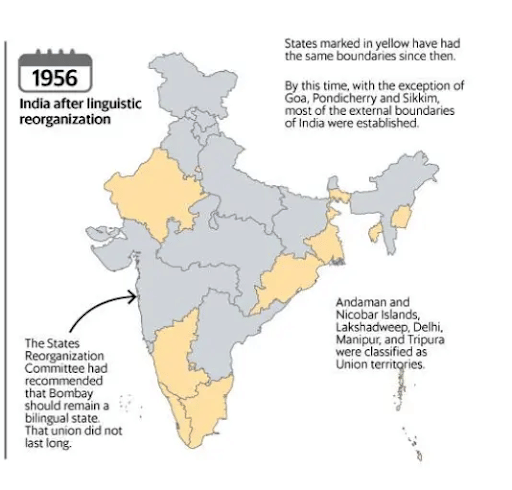
Answer: Article 3 has been used multiple times for the reorganization of states in India, with the most notable instance being the reorganization of states in 1956 under the States Reorganization Act. This act, which was based on the recommendations of the States Reorganization Commission, led to the creation of new states and the redefinition of boundaries of existing ones. Another example is the formation of Telangana in 2014, which was carved out from Andhra Pradesh through the passage of the Andhra Pradesh Reorganisation Act, 2014, by Parliament. These instances illustrate the flexibility and adaptability of the Indian Constitution in addressing the evolving needs of governance and administration.
Question: How does the reorganization of states under Article 3 impact India's federal structure?
Answer: The reorganization of states under Article 3 is designed to preserve the federal structure of India by allowing for changes in the political and administrative setup while respecting the division of powers between the central government and the states. The article ensures that any changes made through state reorganization are in line with the overall framework of India's federalism. While the reorganization may alter state boundaries or create new states, the power-sharing mechanism between the Union and states remains intact. In this way, the reorganization process helps adapt the federal system to meet the administrative needs of the country while maintaining its basic structure.
MCQs
1. Which article of the Indian Constitution grants Parliament the power to reorganize states?
A) Article 1
B) Article 2
C) Article 3
D) Article 4
Answer: (C) See the Explanation
Explanation: Article 3 of the Indian Constitution grants the Parliament the authority to reorganize states, including altering their boundaries, merging them, or changing their names.
2. Can the President of India introduce a bill for state reorganization under Article 3 without consulting the state legislature?
A) Yes, the President can introduce it without consultation.
B) No, the President must consult the state legislature before introducing the bill.
C) The state legislature can veto the bill.
D) The President's decision is final.
Answer: (B) See the Explanation
Explanation: As per Article 3, the President must consult the concerned state legislature before introducing a bill for state reorganization, though the final decision rests with Parliament.
3. What is required for Parliament to pass a bill for the reorganization of states under Article 3?
A) Approval from the state legislature
B) Only the President’s approval
C) Recommendation from the concerned state legislature
D) Approval from the state government
Answer: (C) See the Explanation
Explanation: Article 3 requires Parliament to receive a recommendation from the concerned state legislature before proceeding with a bill for the reorganization of states, although the final decision is with Parliament.
4. In which year was the States Reorganization Act, which reorganized states based on language, passed?
A) 1947
B) 1956
C) 1961
D) 1972
Answer: (B) See the Explanation
Explanation: The States Reorganization Act, which reorganized Indian states based on linguistic considerations, was passed in 1956. This act led to the formation of new states and the reorganization of existing ones.
5. Which state was created through the reorganization process under Article 3 in 2014?
A) Goa
B) Jharkhand
C) Telangana
D) Chhattisgarh
Answer: (C) See the Explanation
Explanation: Telangana was created in 2014 through the Andhra Pradesh Reorganisation Act, 2014, under Article 3, which led to the bifurcation of Andhra Pradesh.
GS Mains Questions and Model Answers
Q1: Discuss the significance of Article 3 in the Indian Constitution. How does it reflect India's federal structure?
Answer: Article 3 of the Indian Constitution grants the Parliament the authority to reorganize states and union territories. This provision is crucial for maintaining the federal nature of India’s political system, allowing for the adaptation of the country’s administrative boundaries in response to evolving needs. The reorganization process under Article 3 provides flexibility, enabling the central government to create new states or modify existing ones while maintaining the distribution of powers between the Union and the states. This power has been used to address regional demands, ensure better governance, and promote administrative efficiency. While Parliament holds the final say, the process includes consultation with state legislatures, ensuring that regional aspirations are considered. Thus, Article 3 ensures that India’s federal structure can accommodate political and administrative changes, ensuring a dynamic and responsive governance system.
Q2: How does the reorganization of states under Article 3 impact the socio-political landscape of India?
Answer: The reorganization of states under Article 3 has had a profound impact on India’s socio-political landscape. Historically, the formation of states such as Maharashtra, Gujarat, and Punjab, based on linguistic and cultural factors, has fostered regional identity and unity. It has also helped in addressing local governance issues more effectively by reducing administrative complexity. However, the process has sometimes led to political tensions, particularly when demands for statehood arise based on economic, cultural, or social factors. The creation of Telangana, for example, was the result of long-standing demands for a separate state based on perceived regional neglect. While reorganization has helped address regional inequalities, it has also raised challenges in balancing the interests of various communities within new state boundaries. Thus, Article 3 plays a vital role in shaping India's political structure and accommodating regional aspirations while balancing national unity.
Q3: Examine the role of Article 3 in state reorganization and the balance between central authority and regional autonomy.
Answer: Article 3 plays a key role in maintaining a balance between central authority and regional autonomy in India. While the Parliament holds the power to reorganize states, this power is exercised with a consultative approach, involving the state legislature. This ensures that the regional needs and aspirations are considered, even though the final decision lies with the central government. The reorganization process reflects the flexibility of India’s federal system, allowing for changes in the political and administrative structure based on socio-economic, cultural, and linguistic factors. However, the central government retains ultimate authority to ensure the unity and integrity of the country. This balance between central control and regional aspirations is central to India’s dynamic federal framework, which must adapt to changing political realities without compromising national cohesion.
Previous Year Questions on Article 3
1. UPSC CSE Prelims 2021:
Question: What is the role of Article 3 in the reorganization of states in India?
A) It empowers the Parliament to create new states and modify existing state boundaries.
B) It grants states the authority to reorganize themselves.
C) It allows the Union to dissolve states.
D) It mandates the creation of states based on linguistic preferences.
Answer: (A)
Explanation: Article 3 empowers Parliament to create new states, alter the boundaries of existing states, and modify their names. It allows for the reorganization of states based on various factors, including administrative needs.
2. UPSC CSE Mains 2020 (GS Paper 2):
Question: "Discuss the role of Article 3 of the Indian Constitution in the reorganization of states. How does it reflect the principles of federalism?"
Answer: Article 3 grants Parliament the power to reorganize states, but the process involves consultation with state legislatures, ensuring regional considerations are taken into account. It reflects India’s flexible federal structure, allowing for adaptation to changing political and administrative needs while maintaining national unity. This balance between central authority and regional autonomy underscores the dynamic nature of India’s federal system.
*email: contactus@prepp.in
Download the PREPP App and attempt FREE IAS Exam Mock Tests and get complete study material!

Full Test - 04: UPSC CSE Prelims CSAT (Paper-II)
Full Test - 03: UPSC CSE Prelims CSAT (Paper-II)
UPSC CSE Prelims 2026 GS Paper 1 Question Paper (24-May-2026)
UPSC CSE Prelims 2026 CSAT Paper 2 Question Paper (24-May-2026)

17 February 2025 | The Hindu Must Read Articles | Current Affairs

16 February 2026 | The Hindu Must Read Articles | Current Affairs

13 February 2026 | The Hindu Must Read Articles | Current Affairs









Comments