Difference between State and Union Territory - Indian Polity Notes
States and Union territories (UTs) define a country’s political unit. A State is a unit under an Indian constituency with a separate government whereas a Union Territory is a unit that is directly governed by the Central Government through a Lieutenant Governor who is the representative of the Indian President. The Lieutenant Governor is appointed by the Central Government as opposed to the state. India is divided into 28 states and 8 union territories. The difference between States and Union Territories is an important part of the UPSC/IAS Exam General Studies Preparation which is discussed in this article in detail.
|
Table of Contents |

Difference Between State And Union Territory
The primary difference between a state and a union territory is that a union territory is directly governed by the Central Government, whereas the States have their own administrative authority. The other differences are as follows:
| State | Union Territory |
|---|---|
| A state is a political unit with its own government. States have their own elected governments with the authority to enact legislation. | The Central Government of India administers and controls the union territories directly. |
| The federal link between the states and the Central Government exists. The legislative and executive branches of government are divided. | Union territories have a unitary relationship with the Central Government, which implies the Union retains all legislative and executive authorities. |
| The Governor is the constitutional head of the state. | The President is the executive head of the union territory. |
| The state is administered by the chief minister, who was legitimately elected by the people. | An administrator, who is selected by the president, is in charge of Union territory. |
| States are substantially larger than union territories in terms of area. | When compared to the states, the Union territories are substantially smaller. |
| States have their own set of powers. | Union territories are not self-governing. |
|
"States enjoy significant autonomy with their own governments and legislative powers, while Union Territories are centrally administered regions with varying degrees of self-governance.” |
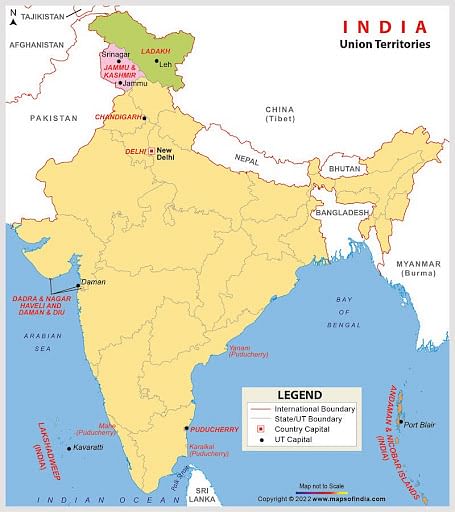
How are the UTs Delhi, Puducherry, and Jammu & Kashmir Different from other UTs?
- All of India's states, as well as the three union territories of Puducherry, Delhi, and Jammu & Kashmir, have elected legislatures and governments.
- There are eight union territories in India, three of which, namely Jammu and Kashmir, Delhi, and Puducherry, have elected members and a Chief Minister, thanks to a constitutional modification that granted them partial statehood.
- These three operate like states, with their own legislative assembly and executive council. Because the remaining union territories are controlled and regulated by the country's union, they are referred to as union territories.
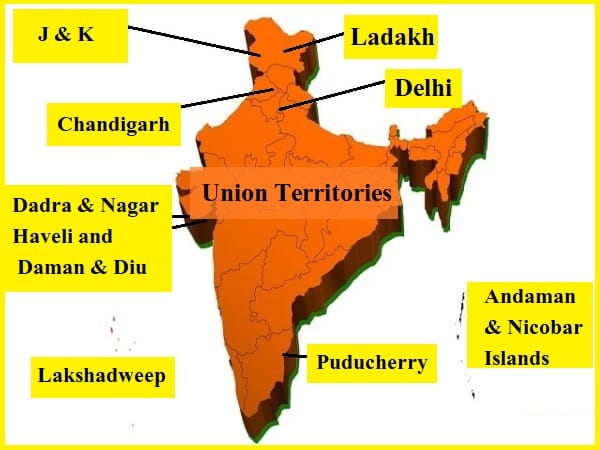
Union Territories of India
- Andaman and Nicobar Islands
- Dadra and Nagar Haveli and Daman and Diu
- Chandigarh
- Lakshadweep
- Puducherry
- Delhi
- Ladakh
- Jammu and Kashmir
Conclusion
Thus the primary difference between a state and a union territory lies in the nature of its governance and administrative authority. The reason why India was divided into States and Union Territories is because of its large size and population. This demarcation makes it easy to administer, maintain law and order, and act toward their growth and development.
FAQs
Question. What is the difference between a State and a Union Territory in India?
Answer: In India, the main difference between a State and a Union Territory lies in the degree of administrative autonomy they possess. States have their own legislatures, which can make laws on matters under the State List (as per the Seventh Schedule of the Indian Constitution). Union Territories (UTs), on the other hand, are administered directly by the Central Government in most cases, with limited or no legislative powers. Some UTs, like Delhi and Puducherry, have legislatures that can make laws on certain matters, but the central government retains more control.
Question. How are States and Union Territories governed in India?
Answer: States are governed by the State Government, which consists of a Governor (appointed by the President) and a Chief Minister along with the Council of Ministers. States have a high degree of autonomy and can legislate on a wide range of issues, including those in the State List and Concurrent List. In contrast, Union Territories are directly governed by the Central Government, and their administrative structure is more controlled. Some UTs have legislatures, like Delhi and Puducherry, which have legislative assemblies to make laws on certain subjects, but the Lieutenant Governor (appointed by the President) holds substantial authority in these territories.
Question. Why do some Union Territories have legislative powers while others do not?
Answer: The reason why some Union Territories (like Delhi, Puducherry, and Ladakh) have legislative powers while others do not lies in the special status granted to them under the Constitution of India. These territories have been granted limited autonomy to manage their affairs through legislatures. However, the central government still retains control over important matters, particularly in cases of national security or financial regulation. The territories without legislatures, such as Chandigarh, Dadra and Nagar Haveli, and Daman and Diu, are directly administered by the Central Government.
Question. What is the role of the Governor in States and Union Territories?
Answer: In States, the Governor is the constitutional head, representing the President of India. The Governor has substantial powers but operates mainly on the advice of the Council of Ministers headed by the Chief Minister. The Governor acts as a link between the State Government and the Central Government.
In Union Territories, the role of the Governor (or Lieutenant Governor) varies. Some Union Territories, like Delhi and Puducherry, have a Lieutenant Governor who has a similar role to the Governor but with more powers vested in the Central Government. In Union Territories without legislatures, the Lieutenant Governor functions as the head of the administration and governs directly under the instructions of the President of India.
Question. How do the legislative powers differ between States and Union Territories?
Answer: States have significant legislative powers, including the ability to pass laws on matters in the State List and Concurrent List. They can also propose amendments to the Constitution and manage their internal affairs independently. Union Territories, however, have more limited legislative powers. While some UTs (like Delhi and Puducherry) have legislatures, their scope is generally confined to local matters like policing, transport, and public health. The Central Government has overriding powers in most matters affecting Union Territories.
MCQs on Difference Between State and Union Territory
- Which of the following is a key difference between a State and a Union Territory in India?
A) Union Territories have no legislative powers
B) States are directly governed by the Central Government
C) Union Territories have more autonomy than States
D) States have limited legislative powers
Answer: (A) See the Explanation
Union Territories typically have limited or no legislative powers, whereas States have full legislative authority over most matters.
- Which of the following Union Territories has its own legislature?
A) Chandigarh
B) Dadra and Nagar Haveli
C) Delhi
D) Lakshadweep
Answer: (C) See the Explanation
Delhi has its own Legislative Assembly, which makes laws on certain matters, while other Union Territories do not have a legislature.
- Who appoints the head of the State Government?
A) The Prime Minister
B) The President of India
C) The Chief Minister
D) The Governor
Answer: (B) See the Explanation
The Governor, who is the head of a State Government, is appointed by the President of India.
- What is the primary difference between the governance of Union Territories with a legislature and those without one?
A) Union Territories with a legislature are governed by the President
B) Union Territories with a legislature have more autonomy than those without
C) Union Territories without a legislature have their laws decided by the Central Government only
D) All Union Territories are governed by the same system
Answer: (B) See the Explanation
Union Territories with legislatures, like Delhi and Puducherry, have more powers in local governance compared to those without, where the Central Government has full control.
- Which of the following Union Territories is directly administered by the Central Government without a legislative assembly?
A) Puducherry
B) Delhi
C) Chandigarh
D) Jammu and Kashmir
Answer: (C) See the Explanation
Chandigarh is directly administered by the Central Government and does not have a Legislative Assembly like Delhi or Puducherry.
GS Mains Questions and Model Answers
Q1: Discuss the governance structure of States and Union Territories in India, highlighting their differences.
Answer: The governance structure of States and Union Territories in India varies primarily in terms of autonomy and administrative control. States have a greater degree of autonomy and are governed by a State Government, which includes a Governor (appointed by the President), a Chief Minister, and a Council of Ministers. States can legislate on matters in the State List and Concurrent List, with legislative powers being vested in the State Legislative Assembly. The Governor acts as the constitutional head, but the real executive power lies with the Chief Minister and the Council of Ministers.
In contrast, Union Territories (UTs) are governed directly by the Central Government. Some UTs, like Delhi and Puducherry, have a Legislative Assembly, but their powers are limited, and the Central Government retains significant control. The Lieutenant Governor (appointed by the President) functions as the head of the administration in most UTs. The Central Government controls the law-making process for most UTs, and the powers of their legislatures are confined to local matters. In UTs without legislatures, like Chandigarh and Lakshadweep, the administration is directly managed by the Lieutenant Governor or the Central Government. Thus, while States enjoy more autonomy, Union Territories are more centralized in their governance.
Q2: What is the impact of the difference between States and Union Territories on the administrative autonomy and legislative powers in India?
Answer: The difference between States and Union Territories (UTs) in India has significant implications for their administrative autonomy and legislative powers. States enjoy considerable administrative autonomy, as they have the authority to make laws on a broad range of subjects listed in the State List and Concurrent List of the Seventh Schedule of the Indian Constitution. They can also independently run various government functions and institutions, with minimal intervention from the Central Government. The Governor serves as the constitutional head of a State, but the real executive power lies with the Chief Minister and the Council of Ministers.
On the other hand, Union Territories have a more centralized governance structure. Most Union Territories are directly administered by the Central Government, and the Lieutenant Governor holds significant powers in UTs without legislatures. UTs like Delhi and Puducherry, which have their own legislative assemblies, have limited autonomy in areas such as law-making, particularly in matters of governance and finance. The Central Government plays a major role in the legislative and administrative affairs of Union Territories, which significantly restricts their decision-making powers compared to States. This difference impacts the degree of self-governance and regional influence that States and UTs hold within the Indian Union.
Q3: Examine the constitutional provisions related to States and Union Territories in India and their implications for governance.
Answer: The Constitution of India provides a clear distinction between States and Union Territories (UTs), particularly in relation to governance, legislative powers, and administrative autonomy. The Constitution divides matters of governance into the Union List, State List, and Concurrent List, with States having the authority to legislate on matters in the State List and Concurrent List. This gives States significant autonomy in managing their internal affairs, including law-making, administration, and governance, under the leadership of a Chief Minister and a Governor.
Union Territories, however, have a different governance framework. Article 239 of the Constitution gives the President the power to administer Union Territories either directly or through a Lieutenant Governor. While some UTs, like Delhi and Puducherry, have their own legislative assemblies to make laws on certain matters, their legislative powers are more restricted than those of States. The Central Government retains greater control over Union Territories, particularly in matters such as finance, national security, and policing. The Lieutenant Governor holds significant powers, especially in UTs without legislatures, thereby limiting the level of self-governance in Union Territories.
These constitutional provisions underscore the greater autonomy granted to States while placing Union Territories under the more direct control of the Central Government, which has implications for the political structure, administrative control, and regional governance in India.
Previous Year Questions on Difference Between State and Union Territory
1. UPSC CSE 2020
Question: "Discuss the distinction between States and Union Territories in India in terms of governance and legislative powers."
Answer: This question required an analysis of the differences between States and Union Territories in terms of administrative autonomy, legislative powers, and governance mechanisms in India.
2. UPSC CSE 2019
Question: "Analyze the constitutional provisions that differentiate States from Union Territories in India and their impact on governance."
Answer: This question asked candidates to examine the constitutional provisions for States and Union Territories, particularly the powers and autonomy granted to them, and their implications for governance in India.
*email: contactus@prepp.in
Download the PREPP App and attempt FREE IAS Exam Mock Tests and get complete study material!

Full Test - 04: UPSC CSE Prelims CSAT (Paper-II)
Full Test - 03: UPSC CSE Prelims CSAT (Paper-II)
UPSC CSE Prelims 2026 GS Paper 1 Question Paper (24-May-2026)
UPSC CSE Prelims 2026 CSAT Paper 2 Question Paper (24-May-2026)

17 February 2025 | The Hindu Must Read Articles | Current Affairs

16 February 2026 | The Hindu Must Read Articles | Current Affairs

13 February 2026 | The Hindu Must Read Articles | Current Affairs









Comments