Puducherry - Indian Polity Notes
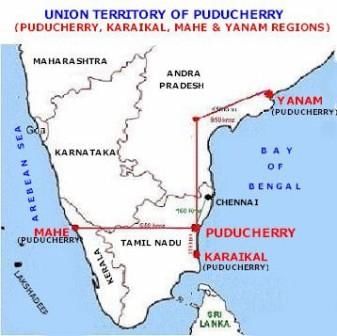
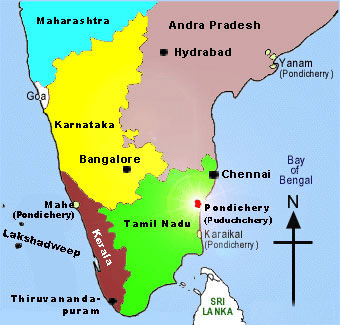
Puducherry is a union territory in India that constitutes the former French colonies of Puducherry, Karaikal, Mahe, and Yanam. Puducherry, often spelled Pondicherry is surrounded by Tamil Nadu and the Bay of Bengal in the east. The term Puducherry was derived from the Tamil word 'putucceri,' putu ("new"), and Ceri ("village"). Puducherry is presently a popular tourist destination as well as the union territory's administrative center. The topic “Puducherry” is an important part of UPSC/IAS Mains 2023 preparation.
|
Table of Contents |
Puducherry - History
Pre- British Era
- Pondicherry was founded in 1673 after the "La Compagnie française des Indes Orientales" (French East India Company), was granted Farman by the Qiladar of Valikandapuram, who served under the Sultan of Bijapur.
- The French Company appointed François Martin as the first Governor in 1674.
- He began the enormous undertaking of transforming Pondicherry from a modest fishing village to a bustling port city and thus established a trading post in Pondicherry, which eventually became the most important French settlement in India.
- At that time European corporations fought each other for a piece of the Indian market.
- As a result, the Dutch conquered Pondicherry in 1693, but the Treaty of Ryswick in 1699 returned it to French control.
- Between 1720 and 1738, the French corporation gained Mahe, Yanam, and Karaikal.
British Interventions
- During the Anglo-French wars, from 1742 to 1763, Puducherry changed hands.
- In 1761, the British East India Company took Puducherry from the French, and by the Treaty of Paris in 1763, the
- French Company Government was restored there.
- The British East India Company again acquired control of the territory during the French Revolution in 1793, and it was returned to the French in 1814.
- Later, when the British took control of all of India in the late 1850s, the French were allowed to keep their settlements at Pondicherry, Mahe, Yanam, Karaikal, and Chandernagor.
Post Independence
- The independence of India in 1947 sparked the unification of France's Indian possessions with former British India, and a 1948 agreement between the French and Indian governments mandated that the people of France's Indian possessions would decide on their political future.
- On 1 November 1954, the bureaucracy was de facto combined with India's, and the de jure union of French India with the Indian Union took effect in 1963.
- In the process, Chandronagor chose to be combined with West Bengal, while Pondicherry, together with Karaikal, Mahe, and Yanam, was incorporated into the Indian Union as a Union Territory.
|
"The formation of Puducherry as a Union Territory in 1962 symbolized the seamless integration of India's diverse colonial past into its democratic present, preserving its unique Franco-Indian heritage while fostering local governance and development." |
Puducherry - Geography
- Pondicherry is bordered to the east by the Bay of Bengal, and on the other three sides by the Tamil Nadu district of Arcot.
- Karaikal is located about 150 kilometers south of Pondicherry on the east coast and is bordered on the east by the Bay of Bengal and on the other three sides by the Tamil Nadu district of Thanjavur.
- Mahe town is located on the Malabar coast, on the western ghats, south of the Mahe river, and is surrounded by Kerala.
- Yanam, which is larger than Mahe, is located 200 kilometers from Vishakapatnam in Andhra Pradesh's East Godavari district.
- The union territory has a total area of 492 square kilometers.
- Seaside tourism resorts may be found in all four sections of the territory.
- A canal divides Puducherry into two halves, and all of the principal streets, which run parallel to one another, go to the open roadstead offshore.
- The main industries include food processing and electrical appliance manufacturing, as well as textiles, paper, and lumber.
- Around 300 villages and hamlets make up the Puducherry region.
Conclusion
Formation of Puducherry as a Union Territory in 1962 marked a significant chapter in India's journey towards complete sovereignty and regional integration. This transition from French colonial rule to becoming an integral part of India underscored the country's commitment to reunifying its diverse territories.
FAQs
Question: What is Puducherry's political status in India?
Answer: Puducherry is a Union Territory of India, meaning it is governed directly by the Central Government. However, it also has its own legislative assembly, which was established in 1963. The legislative assembly consists of elected representatives, and Puducherry has a Chief Minister who heads the government, similar to the states. The Lieutenant Governor represents the President of India in Puducherry, overseeing the administration and working in collaboration with the Chief Minister.
Question: How did Puducherry become a Union Territory?
Answer: Puducherry was a French colony until 1954, when it was ceded to India under the Treaty of Cession. Following the transfer, it became a Union Territory of India. Initially, it was governed directly by the Central Government, but in 1963, Puducherry was granted a Legislative Assembly with limited powers, making it a Union Territory with a legislature. The decision to make it a Union Territory was based on its historical ties with France and the strategic importance of maintaining direct control over it by the Indian Government.
Question: What is the role of the Lieutenant Governor in Puducherry?
Answer: The Lieutenant Governor (LG) of Puducherry is the representative of the President of India and holds executive powers. The LG oversees the administration of the Union Territory and works alongside the Chief Minister and the Cabinet. While the Chief Minister is responsible for the day-to-day governance, the LG plays an important role in matters relating to law and order, appointments, and state policies. In cases of disputes or if the Chief Minister's government is unable to function, the LG has the authority to report to the Central Government for intervention.
Question: How is the legislature of Puducherry structured?
Answer: The legislature of Puducherry is unicameral, consisting of a single house called the Legislative Assembly. The assembly has 33 members, of which 30 are elected by the public through direct elections, while 3 members are nominated by the President of India. The assembly is responsible for making laws on subjects in the Union and Concurrent Lists, while the Central Government handles matters in the Union List. The Chief Minister heads the government, and the Legislative Assembly plays a crucial role in shaping policies and passing laws for the Union Territory.
Question: What is the historical significance of Puducherry in the context of India's freedom struggle?
Answer: Puducherry's historical significance lies in its association with French colonial rule. Unlike the rest of India, which was under British rule, Puducherry was a French colony until 1954. During the Indian freedom struggle, Puducherry remained a French possession, and Indian nationalists worked towards gaining its independence from French rule. The peaceful transfer of Puducherry from France to India in 1954 marked an important milestone, and it became one of the last French colonies in Asia to be integrated into the Indian Union.
MCQs
1. When did Puducherry become a Union Territory of India?
A) 1947
B) 1954
C) 1963
D) 1972
Answer: (B) See the Explanation
Explanation: Puducherry became a Union Territory of India in 1954 after it was ceded by France to India under the Treaty of Cession.
2. Which of the following is NOT true about Puducherry's legislative assembly?
A) It has 33 members.
B) 30 members are elected.
C) It has a bicameral legislature.
D) 3 members are nominated by the President of India.
Answer: (C) See the Explanation
Explanation: Puducherry has a unicameral legislature, not a bicameral one. The assembly consists of 33 members, including 30 elected and 3 nominated members.
3. Who represents the President of India in Puducherry?
A) Chief Minister
B) Lieutenant Governor
C) Governor of Tamil Nadu
D) Prime Minister
Answer: (B) See the Explanation
Explanation: The Lieutenant Governor represents the President of India in Puducherry, overseeing the administration and working with the Chief Minister.
4. What is the main reason for Puducherry's distinct political status?
A) It was never part of British India.
B) It was a French colony.
C) It has a population of over 10 million.
D) It has been a Union Territory since 1947.
Answer: (B) See the Explanation
Explanation: Puducherry’s distinct political status is due to its history as a French colony, which remained under French control until 1954.
5. Who heads the government in Puducherry?
A) Chief Minister
B) Governor
C) Lieutenant Governor
D) President of India
Answer: (A) See the Explanation
Explanation: The Chief Minister heads the government in Puducherry, with the Lieutenant Governor serving as the representative of the President of India.
GS Mains Questions and Model Answers
Q1: Discuss the role of the Lieutenant Governor in the administration of Union Territories like Puducherry. How does it differ from a state government?
Answer: The Lieutenant Governor (LG) plays a crucial role in administering Union Territories like Puducherry. The LG represents the President of India and has the authority to exercise executive powers in the administration of the Union Territory. Unlike states, which have a full-fledged government with a Chief Minister and Cabinet responsible for governance, Union Territories like Puducherry have a unique structure. In Puducherry, the Chief Minister leads the government, but the LG holds considerable powers, especially in matters relating to law and order, appointments, and emergency governance. In comparison, states enjoy greater autonomy, with more control over key decisions related to governance, lawmaking, and executive orders. The balance between the Chief Minister and the Lieutenant Governor in Puducherry makes it a semi-autonomous Union Territory.
Q2: Examine the significance of Puducherry's role in India's freedom struggle and its eventual integration into India. What were the key events?
Answer: Puducherry played a significant yet distinct role in India’s freedom struggle due to its status as a French colony. Unlike most of India, which was under British colonial rule, Puducherry was ruled by France, and its people remained outside the immediate influence of the Indian independence movement. However, the demand for independence led to protests in Puducherry, and nationalist movements began to take shape in the region. The key event in its integration into India was the Treaty of Cession, signed in 1954, which led to Puducherry being ceded to India. After the treaty, Puducherry became a Union Territory of India. The peaceful integration of Puducherry into India stands as an important part of the nation’s post-independence history, showcasing the diplomatic efforts to end colonial rule in all forms.
Q3: Analyze the impact of Puducherry's political structure on its governance and development. How does it compare to other Union Territories and states?
Answer: Puducherry’s political structure is unique due to its dual governance system, with the Lieutenant Governor representing the President and the Chief Minister overseeing local governance. This system provides a mix of central oversight and local autonomy. The presence of a legislative assembly allows Puducherry to make laws on certain matters, but the central government retains power over critical issues such as law and order. Compared to other Union Territories like Delhi, which has more powers and legislative autonomy, Puducherry's system is somewhat limited. However, its political structure has contributed positively to the development of key areas like education, healthcare, and infrastructure. The central oversight ensures that the region remains aligned with national policies while allowing local leaders to address the unique needs of the population.
Previous Year Questions on Puducherry
1. UPSC CSE Prelims 2021:
Question: Which of the following is true about the Union Territory of Puducherry?
A) It has a bicameral legislature.
B) It is governed directly by the President of India.
C) The Chief Minister is the head of the government.
D) It does not have its own legislature.
Answer: (C)
Explanation: Puducherry has a unicameral legislature, and the Chief Minister is the head of the government, while the Lieutenant Governor represents the President of India.
2. UPSC CSE Mains 2019 (GS Paper 2):
Question: "Discuss the political and historical significance of Puducherry's integration into India. How has its colonial history shaped its modern governance?"
Answer: Puducherry’s integration into India after being ceded by France was a significant event in India’s post-independence history. The region’s colonial past as a French colony meant that it had distinct cultural and administrative systems compared to other parts of India under British rule. The peaceful transfer of Puducherry to India in 1954 marked the end of colonial rule in the region. Its unique political structure, with a Lieutenant Governor and a Legislative Assembly, reflects its colonial heritage and its position as a Union Territory with special governance needs. Over time, Puducherry has become a model for handling smaller Union Territories with both legislative autonomy and central oversight, highlighting the complexities of post-colonial governance in India.
*email: contactus@prepp.in
Download the PREPP App and attempt FREE IAS Exam Mock Tests and get complete study material!
UPSC IAS : CSAT - Mini Live Test

Live Test : UPSC CSE Prelims CSAT (Paper-II) (Oct 20 - 23)
Full Test - 04: UPSC CSE Prelims CSAT (Paper-II)
Full Test - 03: UPSC CSE Prelims CSAT (Paper-II)
UPSC CSE Prelims 2026 GS Paper 1 Question Paper (24-May-2026)
UPSC CSE Prelims 2026 CSAT Paper 2 Question Paper (24-May-2026)

17 February 2025 | The Hindu Must Read Articles | Current Affairs

16 February 2026 | The Hindu Must Read Articles | Current Affairs

13 February 2026 | The Hindu Must Read Articles | Current Affairs









Comments