Chhattisgarh, Uttarakhand and Jharkhand - Indian Polity Notes
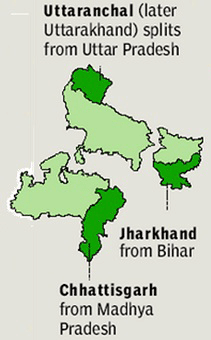
Chhattisgarh, Uttarakhand, and Jharkhand were formed on November 1, 2000, as part of the reorganization of states to address regional demands for better governance and to eliminate the feeling of relative deprivation. In this article, we will discuss formation of Chhattisgarh, Uttarakhand, and Jharkhand which is important for UPSC Preliminary as well as mains examination.
|
Table of Contents |
Chhattisgarh
Brief History
- Chhattisgarh is a state in eastern India bordered on the north and northeast by Uttar Pradesh and Jharkhand, on the east by Odisha (Orissa), on the south by Telangana, and on the west by Maharashtra and Madhya Pradesh.
- The name Chhattisgarh, which means "thirty-six forts," was once used to refer to the Ratanpur area of the Haihaya dynasty, which was created around 750 CE.
- The history of Chhattisgarh may be traced back to the 4th century when the region was known as Southern (or South) Kosala.
- Chhattisgarh was under Bhonsles of Nagpur (Maratha Rule) from 1741 to 1845. It came under British rule from 1845 to 1947 as the Chhattisgarh Division of the Central Provinces. Raipur gained prominence over the capital Ratanpur with the advent of the British in 1845. Before reorganisation of states, Chhattisgarh region was part of the Central Provinces and Berar and some areas were princely states under British rule.
- These areas merged into Madhya Pradesh on 1 November 1956, under the States Reorganisation Act, 1956, and remained a part of that state for 44 years.
Formation of Chattisgarh
- The demand for separate province of Chattisgarh was raised by the Raipur Congress unit in 1924 and was also discussed in the Indian Congress at Tripuri. In 1954, when the State Reorganisation Commission was set up, the demand was put forward but was rejected.
- Again in 1955, the demand was raised in the Nagpur assembly of Madhya Bharat.
- In the 1990s, the demand became more prominent, resulting in the formation of a Chhattisgarh Rajya Nirman Manch under the leadership of Chandulal Chadrakar, several successful region-wide strikes and rallies were organised under it, all of which were supported by major political parties, such as the Indian National Congress and the Bharatiya Janata Party.
- National Democratic Alliance government sent the Separate Chhattisgarh Bill for approval to the Madhya Pradesh Assembly, where it was unanimously approved and then submitted to the Lok Sabha. The bill was passed in the Lok Sabha and the Rajya Sabha, which led to the creation of the state of Chhattisgarh on 1 November 2000.
|
Chhattisgarh, Uttarakhand, and Jharkhand were formed on November 1, 2000, as part of the reorganization of states to address regional demands for better governance and to eliminate the feeling of relative deprivation. |
Jharkhand
Brief History
- Jharkhand is located in the country's east, bordered on the north by Bihar, on the east by West Bengal, on the south by Odisha, on the west by Chhattisgarh, and on the northwest by Uttar Pradesh.
- The area was dominated by chiefs of numerous indigenous groups prior to the arrival of the British in Chota Nagpur and in 1765, the territory was annexed by the British as part of Bihar.
- Thus, from the time of British expansion till the turn of the twenty-first century, Jharkhand's history was intertwined with that of Bihar.
- The Ho insurrection (1820–27) and the Munda uprising (1831–32) were the most significant uprisings against British dominance in the region.
- Chota Nagpur was divided from Bihar on Nov. 15, 2000, after decades of mounting unrest, particularly among indigenous peoples, to establish Jharkhand, India's 28th state.
Formation of Jharkhand
- In 1928, Unnati Samaj, the political wing of Christian tribals submitted a memorandum to the Simon Commission to constitute a tribal state in Eastern India.
- Leaders like Jaipal Singh Munda and Ram Narayan Singh demanded a separate state.
- In 1955, Jharkhand Party, led by Jaipal Singh Munda, submitted a memorandum to States Reorganization Commission for Jharkhand state for tribals, but it was rejected because the region had different languages, the tribals were in minority, Hindustani was majority language and it could have led to adverse effect on economy of Bihar.
- In 1972, Binod Bihari Mahato, Shibu Soren and A. K. Roy founded Jharkhand Mukti Morcha (JMM). Nirmal Mahto founded All Jharkhand Students Union (AJSU). They spearheaded the movement for a separate state of Jharkhand.
- In 1988, Bharatiya Janata party decided to demand separate state Vanachal composed of forest region of South Bihar in Jamshedpur. Inder Singh Namdhari, Samresh Singh and Rudra Pratap Sarangi were prominent leader of Vanachal movement. They organised several rallies to form a separate state Vanachal.
- Government formed a committee on the Jharkhand matter in 1989. It stressed the need for greater allocation of the development funds for the area.
- Jharkhand Area Autonomous Council Bill was passed in Bihar legislative assembly in 1994. Jharkhand Area Autonomous Council was given the charge of 40 subjects including agriculture, rural health, public work, public health, and minerals. The council had the power to recommend legislation to the Assembly through the state government and to frame bylaws and regulations.
- In 1998, thousands of supporters of separate state took to streets in leadership of Justice Shahdeo.
- Finally, with the support from both RJD and Congress, the ruling coalition at the Centre led by the BJP cleared the Bihar Reorganisation Act in 2000, thus paving the way for the creation of a separate Vanachal state comprising Chota Nagpur Division and Santhal Pargana Division of South Bihar on 15 November 2000.
- Later the name of the state was changed from Vanachal to Jharkhand.
Uttarakhand
Brief History
- The region consists of Garhwal and Kumaon divisions, which were ruled by local kings until the British Raj.
- The British defeated the Gorkha rulers in the Anglo-Nepalese War (1814-1816), and by Treaty of Sugauli (1816), Kumaon and Garhwal were incorporated into the British empire.
Formation of Uttarakhand
- The demand for separate state of Uttarakhand was first raised at a special session of the Indian National Congress in Srinagar, Garhwal in 1938.
- In 1940, at the Haldwani conference, a need to grant special status to the mountainous region has been voiced. Anusuya Prasad Bahuguna proposed the formation of Kumaon - Garhwal as separate units.
- In 1954, Uttar Pradesh Legislative Council member Indra Singh Nayal demanded a separate development plan for the highlands.
- Justice Fazal Ali's commission recommended the formation of the hill region as a separate state.
- On 12 May 1970, then Prime Minister Indira Gandhi addressed the issues of the hill region and admitted that the diagnosis of the problems of the hill region is the responsibility of both State and Central Governments.
- In 1979, Uttarakhand Kranti Dal (UKD) was formed which advocated for a separate state.
- Anti-Uttarakhand statements by then UP Chief Minister Mulayam Singh Yadav in 1994 fueled the statehood movement again. It led to violent incidences eg. Khatima Firing, Mussoorie Firing in which several activists were killed.
- Demand for a separate state eventually took the form of a mass movement that resulted in the formation of Uttarakhand as separate state on 9th November 2000.
Conclusion
Uttarakhand, Jharkhand and Chhattisgarh were carved out of Uttar Pradesh, Bihar, and Madhya Pradesh, respectively, in response to longstanding regional demands for better governance and socio-economic development. The creation of these states represented a significant step towards decentralization and enhanced self-governance. The new states aimed to ensure more efficient administration, promote regional development and preserve cultural identities. Their formation underscored the dynamic nature of India's federal structure, capable of evolving to meet the diverse needs of its population.
FAQs
Question: When were Chhattisgarh, Uttarakhand, and Jharkhand created?
Answer: These states were created in November 2000 to enhance administrative efficiency, meet regional aspirations, and address developmental disparities.
Question: Which states were divided to create Chhattisgarh, Uttarakhand, and Jharkhand?
Answer: Chhattisgarh was carved out of Madhya Pradesh, Uttarakhand from Uttar Pradesh, and Jharkhand from Bihar.
Question: What were the main reasons for creating these states?
Answer: The creation of these states aimed to address regional developmental disparities, improve governance, resource allocation, and empower local communities.
Question: What is the significance of creating new states like Chhattisgarh, Uttarakhand, and Jharkhand?
Answer: The new states were intended to ensure better governance, improve regional development, and cater to local cultural and socio-economic needs.
Question: How has statehood impacted these regions?
Answer: Statehood has allowed these regions to prioritize local development, better resource utilization, and address regional needs more effectively.
MCQs
- Chhattisgarh was formed by bifurcating which state?
A) Bihar
B) Madhya Pradesh
C) Uttar Pradesh
D) Andhra Pradesh
Answer: (B) See the Explanation
Chhattisgarh was carved out of Madhya Pradesh in November 2000.
- Uttarakhand, formerly known as Uttaranchal, was created from:
A) Madhya Pradesh
B) Bihar
C) Uttar Pradesh
D) West Bengal
Answer: (C) See the Explanation
Uttarakhand was created from Uttar Pradesh, reflecting the demand for a separate hill state.
- Jharkhand was primarily created due to demands from:
A) The Maratha community
B) Tribal and regional groups in Bihar
C) Coastal population
D) Urban industrialists
Answer: (B) See the Explanation
Jharkhand was formed in response to the demands of tribal communities and regional groups for better representation and governance.
- Which of the following was a primary reason for the formation of new states like Chhattisgarh, Uttarakhand, and Jharkhand?
A) To reduce taxes
B) To ensure better regional development and governance
C) To promote international trade
D) To eliminate local languages
Answer: (B) See the Explanation
These states were created to address regional disparities and improve governance and development.
- When were the states of Chhattisgarh, Uttarakhand, and Jharkhand formed?
A) 1995
B) 2000
C) 2010
D) 1980
Answer: (B) See the Explanation
These states were created in November 2000.
GS Mains Questions and Model Answers
Q1: Discuss the reasons behind the creation of new states like Chhattisgarh, Uttarakhand, and Jharkhand in 2000.
Answer: The creation of these states was driven by demands for better governance, resource allocation, and regional development. Chhattisgarh, Uttarakhand, and Jharkhand were formed to address the unique cultural, geographical, and socio-economic needs of their populations. Regional aspirations for better representation and administrative efficiency played a key role in their creation. This move allowed for more focused development policies, empowering local governance, and improving the overall quality of life.
Q2: Analyze the impact of statehood on the socio-economic development of Chhattisgarh, Uttarakhand, and Jharkhand.
Answer: Statehood allowed these regions to prioritize local needs and improve governance, leading to more efficient use of resources and targeted development programs. Economic growth, infrastructure development, and social initiatives have improved regional standards of living. However, challenges like resource management, economic disparities, and tribal rights remain. Addressing these issues through participatory governance and inclusive development policies is crucial for sustaining long-term growth.
Q3: How has the creation of new states like Chhattisgarh, Uttarakhand, and Jharkhand influenced regional identity and governance?
Answer: The creation of these states strengthened regional identity by recognizing cultural and socio-economic aspirations. It enabled governance closer to the people, allowing state-specific development policies to address local issues. Regional autonomy facilitated better decision-making, focused resource allocation, and improved infrastructure and social welfare. However, balancing development and cultural preservation, addressing local grievances, and ensuring equitable growth remain ongoing challenges.
Previous Year Questions on Chhattisgarh Uttarakhand and Jharkhand
1. UPSC CSE 2018
Question: Evaluate the rationale and impact of creating new states in India with reference to Chhattisgarh, Uttarakhand, and Jharkhand.
Answer: The creation of Chhattisgarh, Uttarakhand, and Jharkhand addressed demands for regional development, improved governance, and representation. Statehood enabled more focused development, better resource management, and empowerment of local communities. Infrastructure improvements, economic policies tailored to local needs, and social welfare programs highlighted the benefits. However, challenges like regional disparities, tribal rights, and environmental issues persist, requiring balanced policies for sustained growth and equity.
2. UPSC CSE 2020
Question: Discuss the role of regional aspirations in the formation of states like Uttarakhand, Chhattisgarh, and Jharkhand.
Answer: Regional aspirations played a key role in the formation of Uttarakhand, Chhattisgarh, and Jharkhand, driven by demands for cultural identity, better governance, and regional development. Tribal communities, hill populations, and resource-rich areas sought greater autonomy and representation. Statehood empowered these regions, enabling localized development policies and resource allocation. It also highlighted the significance of recognizing regional identity within India's federal structure.
*email: contactus@prepp.in
Download the PREPP App and attempt FREE IAS Exam Mock Tests and get complete study material!
UPSC IAS : CSAT - Mini Live Test

Live Test : UPSC CSE Prelims CSAT (Paper-II) (Oct 20 - 23)
Full Test - 04: UPSC CSE Prelims CSAT (Paper-II)
Full Test - 03: UPSC CSE Prelims CSAT (Paper-II)
UPSC CSE Prelims 2026 GS Paper 1 Question Paper (24-May-2026)
UPSC CSE Prelims 2026 CSAT Paper 2 Question Paper (24-May-2026)

17 February 2025 | The Hindu Must Read Articles | Current Affairs

16 February 2026 | The Hindu Must Read Articles | Current Affairs

13 February 2026 | The Hindu Must Read Articles | Current Affairs









Comments