Nagaland - Indian Polity Notes
Since the 1950s, the state has been affected by insurgency and interethnic conflict, which has prevented it from developing economically. However, with agriculture making up more than 70% of the state's economy, the state possesses enormous natural mineral, petroleum, and hydropower resource reserves. Forestry, tourism, insurance, real estate, horticulture, and various cottage businesses are additional key activities that can be focused upon for the overall development of the state.
|
Table of Contents |
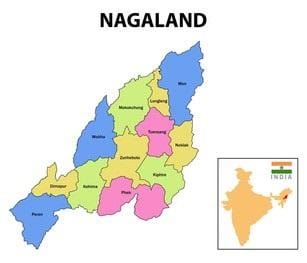
System of Governance
- Nagaland is governed by a Council of Ministers, which is led by a chief minister and reports to the Legislative Assembly, which has 60 members (Vidhan Sabha).
- The Governor, who is selected by the President of India, is the constitutional head of state with seven administrative districts.
|
Nagaland was formally inaugurated on 1 December 1963, as the 16th State of the Indian Union. |
Nagaland – History
Pre- Independence Era
- Though the medieval chronicles of the neighboring Ahom Kingdom of Assam mention the Naga tribes, their economy, and their customs, Nagaland has no written history.
- The invasion of Assam by Burmans from Myanmar in 1816 resulted in repressive Burman rule from 1819 to 1826.
- The introduction of the British administration in 1892, which covered the whole Naga territory (excluding the hilly Tuensang area in the northeast), put an end to headhunting and intervillage incursions and brought relative stability to the region.
Post Independence Period
- The Naga area was initially a part of Assam after India gained independence in 1947.
- However, a strong nationalist movement calling for the Naga tribes to form a political union arose while radicals wanted total independence from the Indian union.
- Following a series of violent occurrences, the Indian army was brought in to restore order in 1955.
- The Naga Hills region of Assam and the Tuensang frontier division to the northeast were brought together under a single unit.
- This was directly managed by the Indian government in 1957, following an agreement between Naga leaders and the Indian government.
- Later, Nagaland became a state in 1963, with a democratically elected government taking power the following year.
- However, rebel activity continued. It increased taking the form of banditry and was frequently driven by tribal conflict and personal retribution rather than political aspiration.
Nagaland – Geography
- Nagaland is almost entirely mountainous with the Naga Hills rising from the Brahmaputra valley to roughly 2,000 feet (610 metres) in the north, then ascending to more than 6,000 feet in the southeast (1,830 metres).
- Along the Myanmar border, the mountains join with the Patkai Range.
- This is part of the Arakan system, reaching a maximum height of 12,552 feet (3826 metres) at Mount Saramati.
- Rivers cut the territory in half: the Doyang and Dikhu in the north, the Barak in the southwest, and the tributaries of Myanmar's Chindwin River in the southeast.
- The climate of Nagaland is monsoonal (wet-dry) with annual rainfall ranging from 70 to 100 inches (1,800 to 2,500 mm) and is concentrated during the southwest monsoon months (May to September).
- Nagaland's forests encompass roughly one-sixth of the state.
- Tropical and subtropical evergreen forests with palms, rattan, and bamboo, as well as valuable timber species, can be found below 4,000 feet (1220 metres).
- At higher elevations, coniferous forests can be found. High grass, reeds, and scrub jungle grow as secondary growth in areas cleared for jhum (shifting farming).
Conclusion
Since the 1950s, the state has been affected by insurgency and interethnic conflict, which has prevented it from developing economically. However, with agriculture making up more than 70% of the state's economy, the state possesses enormous natural mineral, petroleum, and hydropower resource reserves. Forestry, tourism, insurance, real estate, horticulture, and various cottage businesses are additional key activities that can be focused upon for the overall development of the state.
FAQs
Question. What is the significance of Nagaland in India’s political landscape?
Answer: Nagaland, located in the northeastern region of India, holds strategic importance due to its geographical location and cultural diversity. It was the first state to be created after India’s independence on the basis of ethnicity and language, with the enactment of the Nagaland Act in 1963. Nagaland plays a crucial role in India’s security dynamics due to its proximity to international borders with Myanmar. The state is also a key part of India’s Look East Policy and the development of the northeastern region.
Question. What are the key features of the political system in Nagaland?
Answer: Nagaland follows the political system of India, but with certain special provisions due to its unique demographic and cultural characteristics. The state has a unicameral legislature, the Nagaland Legislative Assembly, which consists of 60 members, with 59 elected and one nominated by the Governor. It has its own set of laws in some areas, with provisions to preserve its indigenous culture. The state also follows the provisions of the Sixth Schedule of the Indian Constitution, which provides for the administration of tribal areas.
Question. What is the role of the Governor in Nagaland’s governance?
Answer: The Governor of Nagaland, like in other states, is the constitutional head of the state and represents the President of India. The Governor's responsibilities include appointing the Chief Minister, ensuring the formation of the government, and overseeing the state’s functioning in accordance with the Constitution. The Governor also has special powers in areas like law and order and the maintenance of peace, particularly given Nagaland’s history of ethnic conflicts and insurgency.
Question. What is the role of the Naga Nationalist Movement in the state's history?
Answer: The Naga Nationalist Movement has been a significant part of Nagaland’s history, especially since the post-independence period. It has been centered around the demand for greater autonomy or even independence for the Naga people. The movement began in the 1940s, led by the Naga National Council (NNC), and has been marked by conflict, negotiations, and peace agreements. The most notable peace agreement in recent times is the 2015 Framework Agreement between the Government of India and the Nationalist Socialist Council of Nagaland (NSCN-IM), aimed at resolving the issue of Naga autonomy and territorial integrity.
Question. How does Nagaland differ from other states in India in terms of governance?
Answer: Nagaland is different from other states in India in terms of governance due to its special status under Article 371A of the Indian Constitution. This article grants the state significant autonomy in matters concerning its religious and social practices, land, and customary law. Nagaland also follows the provisions of the Sixth Schedule of the Indian Constitution, which allows for the creation of autonomous district councils for tribal areas. Additionally, Nagaland has an exemption from certain central laws, and its legislative process includes unique provisions for the preservation of tribal culture.
MCQs
- Which article of the Indian Constitution grants special provisions for Nagaland?
A) Article 370
B) Article 371A
C) Article 35A
D) Article 355
Answer: (B) See the Explanation
Article 371A grants special provisions for Nagaland, recognizing its unique cultural and historical context, and allows for the preservation of its indigenous customs and laws.
- What is the structure of the legislative assembly in Nagaland?
A) Bicameral legislature
B) Unicameral legislature
C) Presidential system
D) Parliamentary system with local governance
Answer: (B) See the Explanation
Nagaland has a unicameral legislative assembly with 60 members, 59 of whom are elected and one is nominated by the Governor.
- Which of the following provides for the administration of tribal areas in Nagaland?
A) The Sixth Schedule of the Indian Constitution
B) The Seventh Schedule of the Indian Constitution
C) The Naga Hills Act
D) The Naga Accord
Answer: (A) See the Explanation
The Sixth Schedule of the Indian Constitution deals with the administration of tribal areas in Nagaland and other northeastern states, providing for autonomous district councils.
- What is the primary issue addressed by the Naga Nationalist Movement?
A) Economic development
B) Religious freedom
C) Autonomy or independence for the Naga people
D) Protection of wildlife
Answer: (C) See the Explanation
The Naga Nationalist Movement has primarily focused on the demand for greater autonomy or independence for the Naga people, beginning in the post-independence period.
- What was the outcome of the 2015 Framework Agreement between the Government of India and the NSCN-IM?
A) Full independence for Nagaland
B) Creation of a separate Naga state
C) Agreement on greater autonomy for Nagas
D) Complete dissolution of the Naga movement
Answer: (C) See the Explanation
The 2015 Framework Agreement was aimed at providing greater autonomy for Nagaland and addressing issues related to Naga territorial integrity and governance.
GS Mains Questions and Model Answers
Q1: Discuss the role of Article 371A in ensuring the autonomy of Nagaland.
Answer: Article 371A of the Indian Constitution provides special provisions for the state of Nagaland. This article grants Nagaland significant autonomy, especially in matters related to the state’s religious and social practices, customary laws, and land ownership. It ensures that the Naga people can preserve their unique cultural heritage and govern themselves according to their customs. For example, no law passed by the Indian Parliament can affect the religious or social practices of the Naga tribes or their customary laws regarding land, unless the state legislature agrees. This provision is a direct acknowledgment of the state’s distinct identity and the need to protect its indigenous traditions and practices. Additionally, it has helped reduce tensions between the Naga people and the Indian government by recognizing their historical grievances and addressing issues of autonomy and self-governance.
Q2: Evaluate the impact of the Naga Nationalist Movement on the state’s political landscape.
Answer: The Naga Nationalist Movement has had a profound impact on Nagaland's political landscape. The movement, which began in the late 1940s, was initially driven by the demand for Naga independence. Over the decades, it led to significant political instability and armed conflict between Naga insurgents and the Indian state. The formation of the Naga National Council (NNC) and the subsequent Naga insurgency, especially in the 1950s and 60s, disrupted the political and social fabric of the region. However, over time, the movement evolved into a push for greater autonomy rather than full independence, and this shift led to peace negotiations with the Government of India.
The 2015 Framework Agreement between the Nationalist Socialist Council of Nagaland (NSCN-IM) and the Government of India marked a turning point, offering a solution for greater autonomy within the Indian Union. The political repercussions of the movement have led to the creation of special legislative provisions for Nagaland under Article 371A, as well as the establishment of autonomous district councils in the state. These measures have contributed to political stability, but challenges related to ethnic diversity, territorial disputes, and the need for continued dialogue remain central to the region’s politics.
Q3: Assess the challenges faced by Nagaland in achieving political stability and development.
Answer: Nagaland has faced several challenges in achieving political stability and development. One of the primary issues is the demand for greater autonomy and the insurgency linked to the Naga Nationalist Movement. While the 2015 Framework Agreement between the Government of India and the NSCN-IM has provided a pathway for resolution, tensions persist over issues like territorial integrity and the political aspirations of various Naga groups.
Another challenge is the need for economic development. Nagaland, like many other northeastern states, faces issues of underdevelopment, with a lack of infrastructure, limited industrial growth, and insufficient access to basic services like healthcare and education. The state’s dependence on agriculture and its remoteness from major economic hubs have hindered its progress.
Previous Year Questions on Nagaland
1. UPSC CSE 2021
Question: "Which article of the Indian Constitution grants special provisions for Nagaland?"
Answer: Article 371A of the Indian Constitution grants special provisions to Nagaland, particularly in preserving its customary laws and practices.
2. UPSC CSE 2020
Question: "Discuss the role of the Naga Nationalist Movement in shaping the political landscape of Nagaland."
Answer: The Naga Nationalist Movement played a central role in shaping the political landscape of Nagaland, from its demand for independence to its transition towards seeking greater autonomy within India. The movement led to several peace agreements, including the 2015 Framework Agreement, which paved the way for the resolution of long-standing issues regarding autonomy and governance.
*email: contactus@prepp.in
Download the PREPP App and attempt FREE IAS Exam Mock Tests and get complete study material!
UPSC IAS : CSAT - Mini Live Test

Live Test : UPSC CSE Prelims CSAT (Paper-II) (Oct 20 - 23)
Full Test - 04: UPSC CSE Prelims CSAT (Paper-II)
Full Test - 03: UPSC CSE Prelims CSAT (Paper-II)
UPSC CSE Prelims 2026 GS Paper 1 Question Paper (24-May-2026)
UPSC CSE Prelims 2026 CSAT Paper 2 Question Paper (24-May-2026)

17 February 2025 | The Hindu Must Read Articles | Current Affairs

16 February 2026 | The Hindu Must Read Articles | Current Affairs

13 February 2026 | The Hindu Must Read Articles | Current Affairs









Comments