Mizoram, Arunachal Pradesh and Goa - Indian Polity Notes
States and Union Territories are an important part of the UPSC General Studies Preparation. Here we will discuss the States of Mizoram, Arunachal Pradesh, and Goa.
Mizoram, Arunachal Pradesh, and Goa became the 23rd, 24th, and 25th states of the Indian Union, respectively, in 1987.
|
Table of Contents |
Goa
Basic Facts
- It is one of India's smallest states, bordered on the north by Maharashtra, on the east and south by Karnataka, and on the west by the Arabian Sea and consists of a mainland district and an outlying island on the country's southwest coast.
- Previously a Portuguese colony, it was annexed by India in 1962 and declared a state in 1987.
- The state with Panaji (Panjim) as the capital city has a total area of 3,702 square km with a population of 1,457,723 ( Census 2011).
- The climate of Goa is temperate, with high temperatures in the 30 Degree C and low temperatures 20 Degree C all around the year. and it gets roughly 3,000 mm of rain every year, with the most of it falling during the monsoon season between June and September.
- The 105-km coastline of mainland Goa is characterized by sandy beaches, estuaries, and promontories and the Mandavi and the Zuari are the two major rivers,
A Brief History
- Goa was liberated from 451 years of Portuguese colonial rule on December 19, 1961, along with overland pockets of Daman & Diu, and was administered as a Union Territory at the time.
- It became the Indian Union's 25th state on May 30, 1987 when granted statehood.
- Goa has become a model of secularism, with peaceful coexistence prevailing among people of many faiths, whether Hindus, Catholics, or Muslims, and infused with the ethos of "Sarva Dharma Sarva Bhava," or equal respect for all religions.
|
Mizoram, Arunachal Pradesh, and Goa became the 23rd, 24th, and 25th states of the Indian Union, respectively, in 1987. |
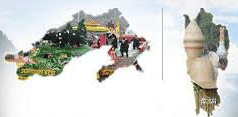
Arunachal Pradesh
Basic Facts
- Arunachal Pradesh, which means "Land of the Rising Sun," with Itanagar as the capital, is an Indian state with a hilly terrain in the country's extreme north-eastern corner.
- It is bordered on the west by Bhutan, on the north by the Tibet Autonomous Region of China, on the south and southeast by Myanmar and the Indian state of Nagaland, and on the south and southwest of Assam.
- The topography of Arunachal Pradesh is dominated by vast valleys flanked by highland plateaus and ridges that climb to the Great Himalayan ranges.
- The Brahmaputra and its tributaries, the Dibang [Sikang], Lohit, Subansiri, Kameng, and Tirap, are the state's principal rivers.
A Brief History
- The British Indian government signed agreements with the indigenous peoples of north-eastern India's Himalayas in 1912–13 to establish the Balipara border tract in the west, the Sadiya frontier tract in the east, and the Abor and Mishmi hills, as well as the Tirap frontier tract in the south.
- North–East Frontier Agency (NEFA) was incorporated into the larger Assam state in 1950.
- North-Eastern Areas (Reorganisation) Act, 1971 established the Union Territories of Arunachal Pradesh. It became a full-fledged state in 1987.
Mizoram
- Mizoram is an Indian state, located in the north-eastern region of the country, bordered on the east and south by Myanmar , on the west by Bangladesh, and on the northwest by the states of Tripura, Assam, and Manipur.
- The state capital is Aizawl and has a population of 1,091,014 according to the 2011 Census
- Before being named the Mizo Hills District in 1954, Mizoram ("Land of the Mizos") was known as the Lushai Hills District of Assam.
- In 1959, Mizoram area was devastated by a great famine known as the 'Mautam Famine'. A number of people died of starvation. A Mizo National Front was established under the leadership of Pu Laldenga to address the issues created by famine. It blamed the Assam government for its failure to undertake enough relief measures. MNFF gained considerable popularity as a large number of Mizo Youth assisted in transporting rice and other essential commodities to interior villages.
- Mizo National Famine Front transformed into Mizo National Front (MNF) in 1961. to seek sovereign independence of Greater Mizoram. It led to rise of insurgency in Mizo district. The Mizo District Council delegation met the then Prime Minister Indira Gandhi in 1971 and demanded full-fledged statehood for Mizoram. In 1972, by North-Eastern Areas (Reorganisation) Act, 1971, Mizoram became a Union Territory
- Laldenga met the then prime minister Rajiv Gandhi on 15 February 1985. Terms of negotiations were resolved between the two parties. Mizoram Peace Accord was signed between the Mizo National Front and the Union Government on 30 June 1986 and statehood was accorded to Mizoram on 20 February 1987.
Conclusion
The granting of statehood to Mizoram, Arunachal Pradesh, and Goa in 1987 was a testament to India's commitment to accommodating its diverse regions and peoples within a federal framework. This transition not only addressed longstanding demands for greater autonomy and representation but also facilitated regional development and stability.
FAQs
Question: What is the significance of Mizoram in the context of Indian polity?
Answer: Mizoram, located in the northeastern region of India, holds strategic importance due to its geographical location and cultural diversity. It was the first state to be created after India’s independence on the basis of ethnicity and language, with the enactment of the Nagaland Act in 1963. Mizoram plays a crucial role in India’s security dynamics due to its proximity to international borders with Myanmar. The state is also a key part of India’s Look East Policy and the development of the northeastern region.
Question: What are the key features of the political system in Arunachal Pradesh?
Answer: Arunachal Pradesh is another northeastern state of India, known for its diverse tribal population. The political system of Arunachal Pradesh is based on the framework of the Indian Constitution, with provisions for a unicameral legislative assembly that has 60 members. Arunachal Pradesh was granted statehood in 1987 and is governed by a Chief Minister and a Council of Ministers, while the Governor represents the President of India. The state is significant for its political challenges, especially with the border dispute with China and issues surrounding the autonomy of local tribal communities. The state follows a mixed system of governance that combines traditional tribal leadership with the modern state structure.
Question: What is the historical and political importance of Goa in Indian polity?
Answer: Goa holds significant historical and political importance in Indian polity due to its colonial past as a Portuguese territory. It became a part of India in 1961 after a military intervention, which ended over 450 years of Portuguese rule. Goa became a Union Territory and was later granted statehood in 1987. It is the smallest state in India by area and is known for its strong tourism-based economy. Goa's political system is based on the Indian Constitution, and it follows a parliamentary system with a legislative assembly, Chief Minister, and a Governor. Goa has a unique cultural identity, with a significant Christian population, which adds to its distinct political and social dynamics within India.
Question: How does the governance system in Mizoram differ from other states in India?
Answer: Mizoram has a unique governance system that is shaped by its history and cultural diversity. The Mizoram Legislative Assembly is the main legislative body, consisting of 40 members. The state has been granted certain autonomous powers under Article 371G of the Indian Constitution, which protects the customs and traditions of the Mizo people. This provision ensures that laws concerning religion, social practices, and land tenure can be made by the state legislature, safeguarding the local cultural heritage. The Mizoram Legislative Assembly also plays a significant role in preserving the identity and customs of the indigenous people, with certain decisions being subject to their approval.
Question: What are the key constitutional provisions related to Arunachal Pradesh and its special status?
Answer: Arunachal Pradesh, like Mizoram, is governed by special provisions under the Indian Constitution. Under Article 371H, Arunachal Pradesh enjoys a special status that provides for a legislative assembly and safeguards the interests of the indigenous tribal communities. The article grants the state the power to enact laws in various areas, but any law related to land rights, trade, and social customs requires the approval of the Governor. This ensures that the tribal communities' rights and cultural practices are protected, allowing the state to have a flexible governance structure that accounts for its unique demographic and geographical conditions.
MCQs
- Which article of the Indian Constitution grants special provisions for Mizoram?
A) Article 370
B) Article 371A
C) Article 371G
D) Article 371H
Answer: (C) See the Explanation
Article 371G of the Indian Constitution grants special provisions to Mizoram, ensuring protection of its customs, traditions, and laws.
- What is the minimum age requirement to become a member of the Legislative Assembly in Goa?
A) 21 years
B) 25 years
C) 30 years
D) 35 years
Answer: (B) See the Explanation
Like most other states in India, the minimum age to become a member of the Legislative Assembly in Goa is 25 years.
- Which of the following states was granted statehood in 1987?
A) Arunachal Pradesh
B) Mizoram
C) Goa
D) Sikkim
Answer: (B) See the Explanation
Mizoram was granted statehood in 1987, after being a Union Territory post-Independence.
- Which of the following is a significant feature of Arunachal Pradesh’s political system?
A) It has a bicameral legislature
B) It has no provision for a legislative assembly
C) It is governed under Article 371H of the Indian Constitution
D) It has a presidential form of governance
Answer: (C) See the Explanation
Arunachal Pradesh has special provisions under Article 371H, which safeguards the interests of its tribal population.
- What is the primary economic base of Goa?
A) Agriculture
B) Mining
C) Tourism
D) Manufacturing
Answer: (C) See the Explanation
Goa’s economy is primarily based on tourism, which is a major contributor to the state’s income and employment.
GS Mains Questions and Model Answers
Q1: Discuss the political and historical significance of Goa in India’s post-independence polity.
Answer: Goa holds great historical and political significance in India’s post-independence history. It was a Portuguese colony for over 450 years, and its incorporation into India in 1961 marked a key moment in the nation’s unification. Goa’s transition from being a Portuguese territory to an Indian state involved a military intervention, which ended Portuguese rule and paved the way for its integration into the Indian Union. Goa was initially made a Union Territory and granted statehood in 1987. Since then, it has been governed under the provisions of the Indian Constitution, with a legislative assembly and a parliamentary system of governance. Goa is notable for its distinct cultural and social dynamics, shaped by its colonial past, its Christian-majority population, and its significant tourism-driven economy. Politically, Goa is unique in its governance structure and social fabric, making it a key player in India’s diverse polity.
Q2: Examine the special provisions granted to Arunachal Pradesh under the Indian Constitution and their impact on governance.
Answer: Arunachal Pradesh enjoys special provisions under Article 371H of the Indian Constitution, which grants the state a distinct legislative framework. This article allows for greater autonomy in governing the tribal areas and provides safeguards for the interests of the indigenous communities, especially concerning land rights and customary practices. The state’s unique governance system requires that certain laws related to land and tribal affairs be subject to the approval of the Governor, ensuring that the tribal population is protected from external influence or exploitation. These provisions reflect the state’s commitment to preserving its cultural identity and self-governance while integrating with the larger political framework of India. The special provisions of Article 371H are crucial in balancing the developmental needs of Arunachal Pradesh with the preservation of its rich tribal traditions and customs.
Q3: Assess the challenges faced by Mizoram, Arunachal Pradesh, and Goa in maintaining political stability and economic development.
Answer: Mizoram, Arunachal Pradesh, and Goa each face unique challenges in ensuring political stability and economic development. Mizoram, despite its peaceful environment after the Mizoram Accord of 1986, continues to deal with issues related to the preservation of indigenous cultures and land rights. The state’s geographic isolation and dependence on agriculture and forest products limit its economic growth.
Arunachal Pradesh faces challenges related to border security due to its proximity to China, alongside internal issues related to ethnic diversity and governance. The state’s infrastructure development remains slow, and its economic growth is hindered by its rugged terrain and underdeveloped transport networks. Additionally, the need to balance tribal autonomy with state-level governance remains a complex issue. Goa’s major challenge lies in managing its tourism-driven economy while ensuring sustainable development. The state faces issues related to environmental degradation, over-tourism, and the social impact of its reliance on the tourism sector. Additionally, Goa’s political landscape is shaped by its diverse communities and the legacy of its colonial history, which often results in tensions between maintaining traditional values and modern development.
Despite these challenges, these states continue to contribute to India’s political diversity, each offering unique insights into governance, culture, and development within the broader Indian polity.
Previous Year Questions on Mizoram Arunachal Pradesh and Goa
1. UPSC CSE 2021
Question: "Which article of the Indian Constitution provides special provisions for Arunachal Pradesh?"
Answer: Article 371H provides special provisions for Arunachal Pradesh, focusing on the governance of its tribal areas and the protection of the interests of indigenous communities.
2. UPSC CSE 2020
Question: "Discuss the socio-political issues faced by the northeastern states, with specific reference to Mizoram, Arunachal Pradesh, and Goa."
Answer: Mizoram, Arunachal Pradesh, and Goa face distinct socio-political challenges, from ethnic diversity and border disputes in Arunachal Pradesh to economic sustainability and identity preservation in Mizoram and Goa. Each state has worked to overcome these challenges through special constitutional provisions and strategic development.
*email: contactus@prepp.in
Download the PREPP App and attempt FREE IAS Exam Mock Tests and get complete study material!

Live Test : UPSC CSE Prelims CSAT (Paper-II) (Oct 20 - 23)
Full Test - 04: UPSC CSE Prelims CSAT (Paper-II)
Full Test - 03: UPSC CSE Prelims CSAT (Paper-II)
UPSC CSE Prelims 2026 GS Paper 1 Question Paper (24-May-2026)
UPSC CSE Prelims 2026 CSAT Paper 2 Question Paper (24-May-2026)

17 February 2025 | The Hindu Must Read Articles | Current Affairs

16 February 2026 | The Hindu Must Read Articles | Current Affairs

13 February 2026 | The Hindu Must Read Articles | Current Affairs









Comments