Manipur, Tripura and Meghalaya - Indian Polity Notes
States and Union Territories is a crucial part of the UPSC General Studies preparation. Here, we will discuss the formation of Manipur, Tripura, and Meghalaya states out of larger Assam state.
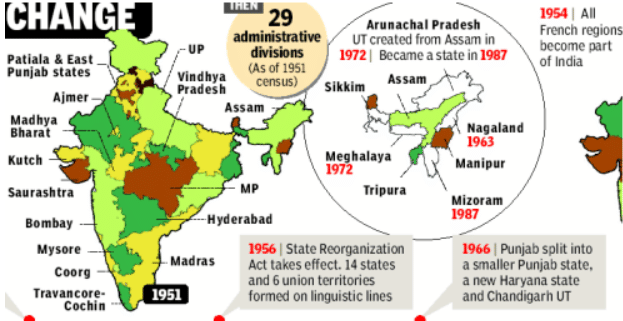
The North Eastern Areas (Re-Organisation) Act, 1971 which came into effect on January 21,1972 conferred complete statehood to Meghalaya, which was earlier a part of Assam and the former princely states of Tripura and Manipur attained full statehood.
Manipur
Basic Facts
- Manipur is a state in Northeast India with a land area of 22,327 square kilometres and a population of over 3 million people who speak Sino-Tibetan languages, including the Meetei, Kuki, Naga, and Pangal peoples.
- Imphal, Manipur's capital, is also known by other names such as Kangleipak and Sanaleibak.
- It is bordered by Nagaland on the north, Mizoram on the south, Assam on the west, and Myanmar on the east (Burma).
History
- Manipur's history may be traced back to around the year 900 CE. Manipur's more recent history begins in 1762, when Raja Jai Singh signed a pact with the British to repel a Burman invasion from Myanmar (Burma).
- There was little communication after then until 1824, when the British were asked to deport the Burmans once more. Until Chura Chand, a five-year-old member of the royal family, was nominated raja in 1891, disputed successions were a constant cause of political unrest.
- The raja and the durbar, or council, took over the government in 1907, with the vice president being a member of the Indian civil service.
- In 1917, a new government system was implemented, with the territory being divided into three sections, each led by an officer from Assam's neighbouring government.
- The political agency exercised by Assam was dissolved with the admission of Manipur to India in 1947. Manipur was made a union territory two years later, with a chief commissioner and an elected territorial council.
|
Tripura, Meghalaya, and Manipur received the title of full-fledged states under the North Eastern Region Re-Organisation Act, 1971 on 21st January 1972. |
Tripura
Basic Facts
- Tripura has a total area of 10.491 sq km and is bordered on the north, south, and west by Bangladesh (East Bengal), and on the east by the states of Assam and Mizoram.
- The Hindu Bengali people make up the majority of Tripura's ethnolinguistic population and scheduled tribes (indigenous communities) account for roughly 30% of the state's population.
- Among the 19 tribes, the Kokborok-speaking tribes are the most numerous.
- Tripura has a tropical savanna environment and receives strong rainfall from the southwest monsoon on a seasonal basis. More than half of the land is covered in forest. It is home to the most primate species.
History
- The Rajamala, a chronicle of the reputed early maharajas (kings) of Tripura, describes two separate periods in Tripura's history:
- The primarily mythological time portrayed in the Rajamala, and
- The period since the reign of the great king Dharma Manikya (reigned c. 1431–62).
- The Brahmans in Dharma Manikya's court compiled the Rajamala, which is written in Bengali verse.
- The Mughal empire did not expand its rule over much of Tripura until the beginning of the 17th century.
- The area of Tripura that had been under Mughal sovereignty fell under British influence when the British East India Company secured the diwani, or financial administration, of Bengal in 1765.
- The last ruling maharaja of Tripura, Bir Bikram Kishore Manikya, ascended the throne in 1923, and before his death in 1947, he settled Tripura’s accession to the newly independent country of India.
- Tripura officially became part of India on October 15, 1949; it was made a union territory on September 1, 1956, and it became a state on January 21, 1972.
Meghalaya
Basic Facts
- Meghalaya translates to "cloud dwelling" in Sanskrit. The state has a total area of 22,430 square kilometres.
- The Bangladesh divisions of Mymensingh and Sylhet border it on the south. Rangpur, Bangladesh's division, is to the west, and Assam is to the east.
- Meghalaya's capital is Shillong. Meghalaya was previously part of Assam, but on January 21, 1972, the districts of Khasi, Garo, and Jaintia hills became the new state of Meghalaya.
- Khasi, Pnar, Garo, and English are the languages spoken.
- Meghalaya is India's wettest state, with forests covering over 70% of the territory.
History
- Except for records of the more prominent Khasi kingdoms in the annals of the neighbouring Ahoms and Kacharis, little is known about Meghalaya before the British period.
- However, in the early nineteenth century, the British intention to connect Bengal and Assam by building a road through the region led to a treaty (1827) with the ruler (system) of the Khasi principality of Nongkhlaw.
- The British maintained political sovereignty over the territory, which was then known as the Garrows and Cossiya (Khasi) States,
- The region's rulers acceded to India's newly independent country in 1947. Jawaharlal Nehru, India's first prime minister, devised a program to conserve and protect tribal peoples' way of life.
- The territory was given special protection under the Indian constitution,
- When Assamese was made the official language of the state in 1960, demand for autonomy and self-rule grew.
- In 1970, Meghalaya was established as an autonomous state inside Assam, and on January 21, 1972, it was granted full statehood.
Conclusion
The formation of Manipur, Tripura, and Meghalaya as full-fledged states in 1972 marked a significant milestone in India's post-independence reorganization and integration of its northeastern region. This political restructuring aimed to address the unique ethnic, cultural, and historical contexts of these areas, ensuring better governance and development. Manipur and Tripura, previously Union Territories, gained statehood, which provided them with greater autonomy and the ability to self-govern within the framework of the Indian Union. Meghalaya was carved out from Assam, fulfilling long-standing demands for a separate state to better represent the interests and identities of its tribal communities.
FAQs
Question. What led to the formation of Manipur, Tripura, and Meghalaya as states?
Answer: The formation of these states was part of India's post-independence reorganization, mainly driven by the North Eastern Areas (Re-Organisation) Act, 1971. On January 21, 1972, Manipur, Tripura, and Meghalaya were granted full statehood to address their unique cultural, ethnic, and geographical identities.
Question. What are the key features of Manipur's geography and history?
Answer: Manipur is located in Northeast India with a population of over 3 million, speaking Sino-Tibetan languages. Its capital, Imphal, has historical significance, and its modern history dates back to 1762 when it signed a pact with the British. Manipur's status evolved from a princely state to a union territory before achieving full statehood.
Question. How did Tripura become a part of India?
Answer: Tripura was a princely state that merged with India after its ruler Bir Bikram Kishore Manikya signed the instrument of accession in 1947. It became a Union Territory in 1956 and later achieved statehood on January 21, 1972, under the North Eastern Region Re-Organisation Act.
Question. What is the historical significance of Meghalaya?
Answer: Meghalaya, meaning "cloud dwelling" in Sanskrit, was part of Assam before gaining full statehood in 1972. The state is culturally and historically rich, with tribes like the Khasi, Garo, and Jaintia. It was granted special protection for its indigenous communities under Indian law.
Question. How did Meghalaya's statehood come about?
Answer: Meghalaya's statehood was a result of growing demands for autonomy, particularly after the Assamese language became the official language of Assam in 1960. The state was formed from the Khasi, Garo, and Jaintia hills to better represent the tribal communities, gaining statehood on January 21, 1972.
MCQs
- When did Manipur, Tripura, and Meghalaya gain full statehood?
A) January 21, 1971
B) January 21, 1972
C) August 15, 1947
D) May 15, 1950
Answer: (B) See the Explanation
Manipur, Tripura, and Meghalaya were granted full statehood under the North Eastern Areas (Re-Organisation) Act on January 21, 1972, which was a crucial event in the reorganization of India's northeastern region.
- What is the capital of Meghalaya?
A) Imphal
B) Agartala
C) Shillong
D) Guwahati
Answer: (C) See the Explanation
Shillong is the capital of Meghalaya, which was formed in 1972 after being carved out from Assam. It is also known as "Scotland of the East."
- Which of the following states was once a Union Territory before achieving statehood in 1972?
A) Manipur
B) Goa
C) Punjab
D) Kerala
Answer: (A) See the Explanation
Manipur was initially a Union Territory after India’s independence and was granted full statehood in 1972 under the North Eastern Areas (Re-Organisation) Act.
- Which region was Tripura historically a part of before joining India?
A) Bengal
B) Assam
C) Odisha
D) Rajasthan
Answer: (A) See the Explanation
Tripura was a princely state that historically had connections with Bengal. It merged with India in 1949 and later became a state in 1972.
- The term "Khasi" is most commonly associated with which of the following states?
A) Manipur
B) Tripura
C) Meghalaya
D) Nagaland
Answer: (C) See the Explanation
The Khasi people are one of the major indigenous tribes of Meghalaya. They, along with the Garo and Jaintia tribes, played a key role in the formation of the state.
GS Mains Questions and Model Answer
Q1: Analyze the political and cultural significance of the creation of Manipur, Tripura, and Meghalaya as states in 1972.
Answer: The creation of Manipur, Tripura, and Meghalaya in 1972 was a significant political event aimed at addressing the diverse cultural, ethnic, and historical needs of the Northeast region. It granted these states autonomy and helped to safeguard the interests of tribal communities. The move also facilitated better governance, economic development, and representation for these areas. The formation of Meghalaya, in particular, fulfilled long-standing demands for a separate state, highlighting the importance of cultural and regional identity in India’s federal structure.
Q2: Discuss the role of ethnic and cultural identities in the political formation of Manipur, Tripura, and Meghalaya.
Answer: The political formation of these states was deeply influenced by ethnic and cultural identities. Manipur’s struggle for autonomy, for example, was largely driven by its distinct language and culture. Tripura’s integration with India was shaped by the merging of its royal history and the demands of its indigenous communities. Meghalaya was created to represent the Khasi, Garo, and Jaintia tribes, who sought greater autonomy after Assamese was made the official language of Assam. These states’ formations underline the importance of recognizing regional diversity within India’s political framework.
Q3: Evaluate the socio-economic challenges faced by Manipur, Tripura, and Meghalaya after becoming states.
Answer: After gaining statehood, Manipur, Tripura, and Meghalaya faced significant socio-economic challenges. These included infrastructural deficits, inadequate educational facilities, and limited industrial development. In addition, ethnic tensions and demands for autonomy have led to political instability in some areas. While the states have made progress in terms of governance and development, issues like unemployment, inadequate healthcare, and regional disparities still persist. The states' geographical location and mountainous terrain also pose challenges for transportation and trade.
Previous Year Questions on Manipur Tripura and Meghalaya
1. UPSC CSE 2018
Question: What were the historical and political factors that led to the creation of Meghalaya, Tripura, and Manipur as states in 1972?
Answer: This question asks for an analysis of the historical and political context behind the creation of these states. The answer should highlight the ethnic, cultural, and historical factors such as the demand for greater autonomy by tribal communities, the unique governance needs of the states, and the role of the North Eastern Areas (Re-Organisation) Act, 1971.
2. UPSC CSE 2019
Question: Discuss the significance of Meghalaya’s formation in the context of tribal autonomy and the protection of indigenous cultures.
Answer: This question focuses on the formation of Meghalaya and the need to protect tribal autonomy. The answer should discuss how Meghalaya’s creation was a response to the demands of the Khasi, Garo, and Jaintia tribes, who sought to preserve their cultural identity and traditions.
*email: contactus@prepp.in
Download the PREPP App and attempt FREE IAS Exam Mock Tests and get complete study material!

Live Test : UPSC CSE Prelims CSAT (Paper-II) (Oct 20 - 23)
Full Test - 04: UPSC CSE Prelims CSAT (Paper-II)
Full Test - 03: UPSC CSE Prelims CSAT (Paper-II)
UPSC CSE Prelims 2026 GS Paper 1 Question Paper (24-May-2026)
UPSC CSE Prelims 2026 CSAT Paper 2 Question Paper (24-May-2026)

17 February 2025 | The Hindu Must Read Articles | Current Affairs

16 February 2026 | The Hindu Must Read Articles | Current Affairs

13 February 2026 | The Hindu Must Read Articles | Current Affairs









Comments