Sikkim - New States and Union Territories Created After 1956 - Indian Polity Notes
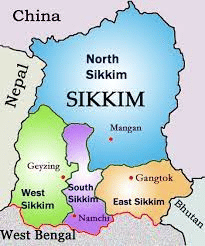
Sikkim is a state in India's northeastern region. It is bounded to the north by China, to the east by Bhutan, and to the west by Nepal. Sikkim shares its southern border with West Bengal, India. The 35th Constitutional Amendment Act (1974) granted Sikkim the status of 'Associate State' for the first time. The 36th Amendment Act of 1975 granted it full statehood. This article explains about the Sikkim - New States and Union Territories Created After 1956 which is important for UPSC Indian Polity Preparation.
|
Table of Contents |
Sikkim – An overview
- Sikkim is India's smallest state in terms of both area and population.
- It is located in the eastern Himalayas, bordering Tibet (China) to the north, Bhutan to the east, and Nepal to the west.
- The name of the state comes from the Limbu words su his, which means "new house."
- Nepali is the state's official language. Bhutia, Lepcha, Limbu, and English are among the other languages spoken in Sikkim.
- Sikkim is well-known for its calm and political stability. After a vote that dissolved the monarchy, it united with India and became a state in 1975. Since then, the state has had a generally calm and pleasant existence.
| Key Elements | Details |
|---|---|
| State | Sikkim |
| Capital | Gangtok |
| Statehood | May 16, 1975 |
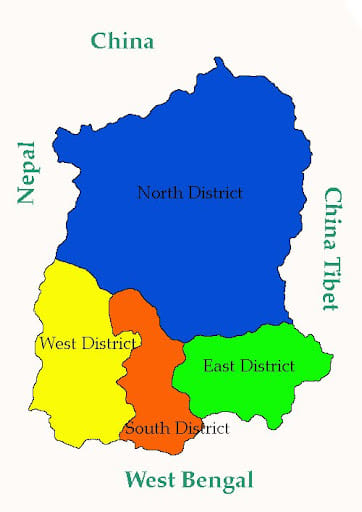
| Number of Districts | 04 |
| Governor | Lakshman Prasad Acharya |
| Chief Minister | Prem Singh Tamang |
| Legislature | Unicameral (32 seats) |
| Parliamentary Constituencies | Rajya Sabha-01Lok Sabha-01 |
| Seat of High Court | Sikkim |
| Area | 7096 km2 |
| Population (2011 Census Data) | 610, 577 |
|
It was on May 16, 1975 that Sikkim became 22nd state of the Union of India by 36th Amendment) Act 1975. |
Sikkim – History
- Prior to the 17th century, little is known about Sikkim's history.
- Beginning in the mid-18th century, Sikkim fought a series of territorial battles with both Bhutan and Nepal, with Nepal subsequently occupying areas of western Sikkim and the submontane Terai region to the south.
- British India acquired political control over Sikkim in the nineteenth century. In 1861, the Treaty of Tumlong established Sikkim as a princely kingdom under British protection.
- The British assisted in the state's development and maintained a political presence in Sikkim.
- For the first time after India's independence in 1947, political parties began to develop in Sikkim.
- The removal of feudalism, the formation of a popularly elected administration, and the admission of Sikkim to India were among their goals.
- Sikkim's Constitution was drafted by India and accepted by its national assembly in 1974.
- Sikkim was first designated as an Indian union territory. Then, in 1975, in a special referendum, more than 97 percent of the electorate voted in favour of Sikkim joining India. Thus, on May 16, 1975, Sikkim became India's 22nd state.
Sikkim – Geography
- Sikkim is located in the Himalayan foothills. It spans 7906 square kilometres and Kangchenjunga, India's tallest Himalayan peak, is one of the state's main attractions.
- Sikkim features both evergreen and deciduous forests, which contribute to the state's lush vegetation and most of the state has an average annual temperature of 18 degrees Celsius.
- Mount Kanchenjunga, the world's third tallest peak, is located in Sikkim and has an elevation of 8,586 metres (28,169 feet). The mountain is very important to the people of Sikkim, and it is venerated as a guardian god.
- Sikkim is well-known for the Nathu La Pass, a mountain pass that connects India and China at an elevation of 4,310 metres (14,140 feet). It was formerly an important commerce route and is today a major tourist destination.
- Sikkim is known for its diverse biodiversity and is home to a number of rare and endangered species.
- The state has undertaken substantial environmental conservation efforts and is India's first completely organic state.
| Area | 7906 km2 |
|---|---|
| Population Density | 86 per km sq. |
| Forests | Evergreen and Deciduous Forests |
| Mountain Ranges | Highest Peak-Kanchenjunga |
| Rivers | Teesta, River Rangeet, Rangpo Chu, Lachung River etc |
Sikkim – Economy
- Sikkim's GDP per capita being $7,530 (₹ 5,50,000) thus constituting the third-smallest among India's 28 states.
- The state's economy is largely agrarian based on the terraced farming of rice and the cultivation of crops such as maize, millet, wheat, barley, oranges, tea, and cardamom.
- Sikkim produces more cardamom than any other Indian state and is home to the largest cultivated area of cardamom.
- Sikkim became the first fully organic state state in India.
- In recent years, the state has experienced an increase in food processing, cosmetics, pharmaceuticals, and breweries, and has become an industrial hub for these items.
Sikkim – Cultural Diversity and Tourism
- Sikkim has a great cultural variety despite its tiny size. It is home to a variety of ethnic groups, including the Lepchas, Bhutias, and Nepalis.
- Each region has its own language, traditions, and festivals, which contribute to the state's complex cultural tapestry.
- Sikkim attracts a great number of tourists from all over the world due to its natural beauty, adventure options, and spiritual importance.
- The state has stunning scenery, including snow-capped mountains, alpine meadows, clean lakes, and monasteries.
- Sikkim is dotted with ancient Buddhist monasteries, known as gompas, that are rich in cultural and religious importance.
- Among the most renowned are Rumtek Monastery, Pemayangtse Monastery, and Tashiding Monastery.
Conclusion
In 1975, following a referendum for the abolition of the monarchy and integration with India, Sikkim became the 22nd state of the Indian Union. This process was facilitated by the Indian government, which provided both political and logistical support to ensure a smooth transition.
The incorporation of Sikkim into India brought several benefits to the region, including political stability, economic development, and greater access to educational and healthcare facilities. It also enhanced India's strategic and geopolitical position in the Himalayan region.
FAQs
Question. When did Sikkim become a state of India?
Answer: Sikkim became the 22nd state of India on May 16, 1975, after a referendum where more than 97% of the electorate voted in favor of joining India.
Question. What was Sikkim’s status before it became a state?
Answer: Before it became a state, Sikkim was an "Associate State" after the 35th Constitutional Amendment Act of 1974. It became a full state after the 36th Amendment Act of 1975.
Question. What is the capital of Sikkim?
Answer: The capital of Sikkim is Gangtok.
Question. Which countries border Sikkim?
Answer: Sikkim borders China to the north, Bhutan to the east, Nepal to the west, and West Bengal to the south.
Question. What is the significance of Mount Kanchenjunga to Sikkim?
Answer: Mount Kanchenjunga, the third tallest peak in the world, is located in Sikkim and is venerated as a guardian god by the people of Sikkim.
MCQs
- When did Sikkim officially become a state of India?
A) 1947
B) 1971
C) 1975
D) 1980
Answer: (C) See the Explanation
Sikkim became the 22nd state of India in 1975 after a referendum.
- Which is the official language of Sikkim?
A) Hindi
B) Nepali
C) English
D) Tamil
Answer: (B) See the Explanation
Nepali is the official language of Sikkim, although other languages like Bhutia and Lepcha are also spoken.
- Which mountain in Sikkim is known as the third tallest in the world?
A) Mount Everest
B) Mount Kanchenjunga
C) Mount Kilimanjaro
D) Mount Fuji
Answer: (B) See the Explanation
Mount Kanchenjunga, located in Sikkim, is the third tallest mountain in the world, at 8,586 meters.
- What is the significance of the 36th Amendment Act of 1975?
A) It granted Jammu and Kashmir special status
B) It made Sikkim a full-fledged state of India
C) It introduced the provision for the President’s rule
D) It merged Goa into India
Answer: (B) See the Explanation
The 36th Amendment Act of 1975 granted Sikkim full statehood, following a referendum.
- Which state borders Sikkim to the south?
A) Bihar
B) Uttar Pradesh
C) West Bengal
D) Odisha
Answer: (C) See the Explanation
Sikkim shares its southern border with the state of West Bengal.
GS Mains Questions and Model Answers
Q1: Discuss the process through which Sikkim became a part of India and its significance in Indian polity.
Answer: Sikkim became an official part of India through a series of constitutional amendments. Initially, it was granted the status of an "Associate State" in 1974 under the 35th Constitutional Amendment Act. The following year, a referendum was held, in which over 97% of the electorate voted in favor of joining India. Subsequently, the 36th Amendment Act of 1975 gave Sikkim full statehood. This marked the integration of the last independent princely state into the Indian Union. The integration of Sikkim not only expanded India’s territory but also contributed to the political stability of the region, especially in light of its strategic position bordering China, Bhutan, and Nepal.
Q2: Analyze the geographical importance of Sikkim in India's security strategy.
Answer: Sikkim holds strategic geographical importance due to its location in the eastern Himalayas, bordering China, Bhutan, Nepal, and West Bengal. Its proximity to China’s Tibet region, especially with the presence of the Nathu La Pass, makes it a critical point for India’s security strategy. The pass connects India and China, and its control is crucial for both defense and trade. The region’s mountainous terrain and proximity to neighboring countries also make Sikkim an important area for monitoring and managing geopolitical tensions, particularly with China. Additionally, Sikkim’s security contributes to India’s overall defense readiness in the northeast.
Q3: Examine the economic contributions of Sikkim to India’s development.
Answer: Sikkim’s economy, though small, plays an important role in India’s development, particularly through tourism, agriculture, and organic farming. The state is known for its agricultural produce, including cardamom, oranges, and other fruits. Sikkim has also pioneered organic farming, making it India’s first completely organic state, which has garnered attention for its environmental sustainability practices. Additionally, the state is a major tourist destination due to its scenic landscapes, Buddhist monasteries, and Mount Kanchenjunga, which contributes significantly to its economy. In recent years, Sikkim has seen growth in sectors such as food processing, pharmaceuticals, and breweries, contributing to India’s industrial growth.
Previous Year Questions on Sikkim
1. UPSC CSE 2018
Question: "Analyze the political and geographical significance of Sikkim’s integration into India."
Answer: The integration of Sikkim into India was both politically and geographically significant. Politically, it marked the last state to be integrated into India post-independence, solidifying India's territorial integrity. Geographically, Sikkim’s location, bordered by China, Bhutan, Nepal, and West Bengal, made it strategically crucial for India’s defense in the region. Its integration also contributed to strengthening India’s control over the Himalayan region and improving diplomatic ties with neighboring countries.
2. UPSC CSE 2020
Question: "Discuss the role of Sikkim’s geography in shaping its economy and tourism."
Answer: Sikkim’s geography, with its location in the eastern Himalayas and proximity to China, Bhutan, and Nepal, has shaped its economy and tourism. The state’s breathtaking landscapes, including the Kanchenjunga peak and its many alpine meadows, attract tourists. Sikkim is also known for its unique biodiversity and organic farming practices, which contribute to its agricultural economy. The challenging terrain limits large-scale industrial development but has enhanced tourism and eco-tourism, making it an important part of Sikkim's economic identity.
*email: contactus@prepp.in
Download the PREPP App and attempt FREE IAS Exam Mock Tests and get complete study material!

Live Test : UPSC CSE Prelims CSAT (Paper-II) (Oct 20 - 23)
Full Test - 04: UPSC CSE Prelims CSAT (Paper-II)
Full Test - 03: UPSC CSE Prelims CSAT (Paper-II)
UPSC CSE Prelims 2026 GS Paper 1 Question Paper (24-May-2026)
UPSC CSE Prelims 2026 CSAT Paper 2 Question Paper (24-May-2026)

17 February 2025 | The Hindu Must Read Articles | Current Affairs

16 February 2026 | The Hindu Must Read Articles | Current Affairs

13 February 2026 | The Hindu Must Read Articles | Current Affairs









Comments