Maharashtra and Gujarat – Indian Polity Notes
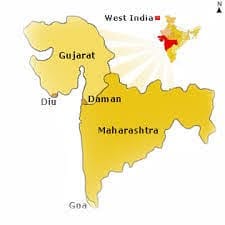
Maharashtra and Gujarat were established as a result of the Bombay Reorganisation Act, 1960, which was passed by Parliament on April 25, 1960. The bilingual state of Bombay was divided into two separate states. Maharashtra for Marathi speakers and Gujarat for Gujarati speakers. The states of Gujarat and Maharashtra have designated May 1st as "Gujarat Foundation Day" and "Maharashtra Day" respectively.
|
Table of Contents |
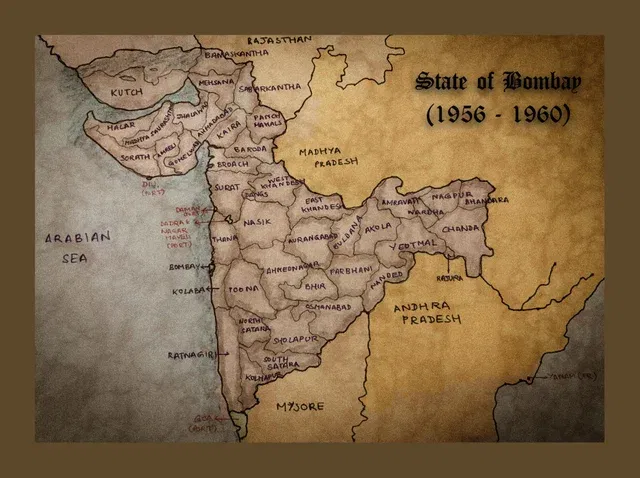
The State of Bombay before 1960
Historical Background
- The Constitution's First Schedule (1949) recognized Indian States in Parts A, B, and C, and Territories in Parts D.
- Part A States were the former Governors' Provinces of British India, of which nine were listed, including Bombay.
- The Bombay State included much of modern Maharashtra, as well as parts of modern Gujarat and Karnataka.
Reasons
- The States Reorganisation Act redrew the boundaries of the State of Bombay, transferring some Kannada-speaking areas to the State of Mysore.
- It expanded Bombay's territory to include the Marathi-speaking states of Marathwada and Vidarbha, as well as Gujarati-speaking Saurashtra and Kutch.
- The new state was bilingual, with areas speaking Kutchi and Konkani as well. However, having two linguistic units in one state did not appear to work.
- Since 1956, the Samyukta Maharashtra movement has led the charge for a separate Marathi-speaking state with Bombay as its capital.
- Simultaneously, the Mahagujarat Movement advocated for a Gujarat state for Gujarati-speaking people in Bombay.
|
"The formation of new states like Gujarat and Maharashtra in 1960 marked the triumph of linguistic and cultural identities, ensuring that governance resonated with the local ethos." |
Impact
- The states of Maharashtra and Gujarat were established as a result of the Bombay Reorganisation Act, 1960, which was passed by Parliament on April 25, 1960.
- On May 1, 1960, the act went into effect. Maharashtra and Gujarat were divided and granted statehood under the Bombay Reorganisation Act.
- While both the Samyukta Maharashtra Movement and the Mahagujarat Movement had the same goal, certain elements clashed over which of the new states would receive India's financial capital, Bombay.
- It eventually became part of Maharashtra.
Conclusion
Even after the large-scale reorganization of the states in 1956, the political map of India changed on a regular basis due to popular agitations and political conditions. The demand for the formation of new states based on linguistic or cultural homogeneity resulted in the division of existing states.
FAQs
Question: What led to the formation of Maharashtra and Gujarat?
Answer: The Bombay Reorganisation Act, 1960, led to the division of the bilingual Bombay State into Maharashtra and Gujarat on May 1, 1960, following demands for separate states by Marathi and Gujarati-speaking people.
Question: When was the Bombay Reorganisation Act passed?
Answer: The Bombay Reorganisation Act was passed in 1960 to address linguistic and cultural differences within the Bombay State.
Question: What movements were associated with the creation of Maharashtra and Gujarat?
Answer: The Samyukta Maharashtra Movement demanded a Marathi-speaking state, while the Mahagujarat Movement sought a separate Gujarati-speaking state.
Question: Which city became the capital of Maharashtra?
Answer: Bombay (now Mumbai) became the capital of Maharashtra after the state's formation.
Question: What constitutional provision ensures special status for Maharashtra and Gujarat?
Answer: Article 371 provides special provisions for the development and administration of Maharashtra and Gujarat.
MCQs
- The Bombay Reorganisation Act was enacted in:
A) 1950
B) 1960
C) 1947
D) 1975
Answer: (B) See the Explanation
The act was passed to divide the Bombay State into Maharashtra and Gujarat based on linguistic lines.
- The capital of Maharashtra after its formation was:
A) Ahmedabad
B) Surat
C) Bombay (Mumbai)
D) Nagpur
Answer: (C) See the Explanation
Bombay became the capital of Maharashtra post the state's formation.
- Which movement demanded a separate Marathi-speaking state?
A) Mahagujarat Movement
B) Dravidian Movement
C) Samyukta Maharashtra Movement
D) Non-Cooperation Movement
Answer: (C) See the Explanation
The movement sought a distinct Marathi-speaking state within India.
- Gujarat was formed as a separate state in:
A) 1947
B) 1956
C) 1960
D) 1971
Answer: (C) See the Explanation
Gujarat became a separate state on May 1, 1960, following the Bombay Reorganisation Act.
- Article 371 of the Indian Constitution provides:
A) Special status for Maharashtra and Gujarat
B) Provisions for emergency governance
C) Trade and commerce regulations
D) Reservation in educational institutions
Answer: (A) See the Explanation
Article 371 includes provisions aimed at regional development and administrative efficiency for Maharashtra and Gujarat.
GS Mains Questions and Model Answers
Q1: Explain the significance of the Bombay Reorganisation Act, 1960, in shaping Maharashtra and Gujarat.
Answer: The Bombay Reorganisation Act, 1960, led to the division of the bilingual Bombay State into Maharashtra and Gujarat based on linguistic lines. This decision acknowledged the cultural and linguistic identity of the Marathi and Gujarati-speaking populations, resulting in more focused regional administration and development. The act played a pivotal role in recognizing linguistic diversity as a critical factor in state formation, contributing to India's inclusive federal structure.
Q2: Analyze the role of linguistic movements in the formation of Maharashtra and Gujarat.
Answer: Linguistic movements, such as the Samyukta Maharashtra Movement and the Mahagujarat Movement, played a key role in the formation of Maharashtra and Gujarat. These movements highlighted the aspirations of Marathi and Gujarati speakers for distinct statehood, reflecting the broader demand for linguistic reorganization in India. Their success exemplifies how democratic and cultural demands can drive regional restructuring for effective governance and identity preservation.
Q3: Discuss the challenges faced by Maharashtra and Gujarat post their formation in 1960.
Answer: Post-formation, Maharashtra and Gujarat faced challenges like economic reorganization, balancing urban and rural development, and fostering unity among diverse populations. Maharashtra, with Bombay as its capital, became an industrial and financial hub, while Gujarat focused on trade and commerce. Both states have had to navigate issues of regional disparity, resource allocation, and socio-economic development within a rapidly changing national context.
Previous Year Questions on Maharashtra and Gujarat Formation
1. UPSC CSE 2018
Question: Evaluate the impact of linguistic reorganization on the political and cultural landscape of Maharashtra and Gujarat.
Answer: Linguistic reorganization through the Bombay Reorganisation Act, 1960, affirmed the cultural and linguistic identity of Maharashtra and Gujarat. It allowed for more focused regional governance, addressing local aspirations and enhancing development. Linguistic identity played a central role in political mobilization, shaping state policies and cultural pride. However, balancing regional interests and equitable development remains a challenge for both states.
2. UPSC CSE 2020
Question: How did the formation of Maharashtra and Gujarat reflect India’s approach to federalism?
Answer: The formation of Maharashtra and Gujarat exemplified India’s commitment to linguistic and cultural diversity within its federal structure. The Bombay Reorganisation Act acknowledged regional aspirations, promoting administrative efficiency and regional development. This approach strengthened the federal system by accommodating local identities, showcasing India's ability to adapt to diverse linguistic and cultural needs while maintaining national unity.
*email: contactus@prepp.in
Download the PREPP App and attempt FREE IAS Exam Mock Tests and get complete study material!
UPSC IAS : CSAT - Mini Live Test

Live Test : UPSC CSE Prelims CSAT (Paper-II) (Oct 20 - 23)
Full Test - 04: UPSC CSE Prelims CSAT (Paper-II)
Full Test - 03: UPSC CSE Prelims CSAT (Paper-II)
UPSC CSE Prelims 2026 GS Paper 1 Question Paper (24-May-2026)
UPSC CSE Prelims 2026 CSAT Paper 2 Question Paper (24-May-2026)

17 February 2025 | The Hindu Must Read Articles | Current Affairs

16 February 2026 | The Hindu Must Read Articles | Current Affairs

13 February 2026 | The Hindu Must Read Articles | Current Affairs









Comments