Dadra and Nagar Haveli - Indian Polity Notes
Dadra and Nagar Haveli is a district of the union territory “Dadra and Nagar Haveli and Daman and Diu”. Dadra and Nagar Haveli is located in the western part of India. Dadra and Nagar Haveli has two distinct geographical areas: Dadra (surrounded by Gujarat) and Nagar Haveli (on the border of Maharastra and Gujarat). The 10th Constitutional Amendment Act of 1961 made it a union territory of India. This article will discuss about formation of Dadra and Nagar Haveli as UT in greater details.
|
Table of Contents |
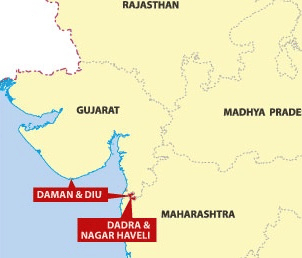
Location of Dadra and Nagar Haveli
Recent Merging of Dadra and Nagar Haveli
- The union territory of Dadra and Nagar Haveli was merged with Daman and Diu, the neighbouring union territory in the year 2020.
- Now, the new union territory is called “Dadra and Nagar Haveli and Daman and Diu”.
- Now, this union territory has three districts: Daman, Diu, and Dadra and Nagar Haveli.
Historical Background
- In the mid-18th century, the Marathas took over Nagar Haveli from its Rajput rulers.
- It was ruled by the Portuguese from 1783 until it was liberated in 1954.
- Following that, the administration was carried on by an administrator chosen by the people themselves until 1961.
- It was given to the Portuguese in 1783 as a result of the destruction of a ship by the Marathas. In 1785, the Portuguese took over Dadra.
- Following India's independence from Britain, Lisbon refused to hand over its Indian territories, claiming that they were an integral part of Portugal.
- Indian nationalist volunteers forced the Portuguese to abandon this area in 1954.
|
The merger of Dadra and Nagar Haveli with Daman and Diu in 2020 was a step towards administrative efficiency. |
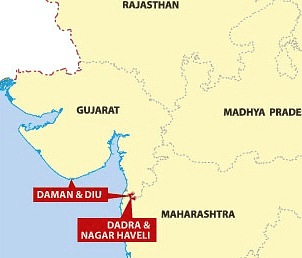
Reasons
- Following India's independence in 1947, nationalists in Goa (the oldest Portuguese possession in India) sought independence from Portugal.
- Their first success was the seizure of Dadra on the night of July 21, 1954, and the capture of Nagar Haveli two weeks later.
- A pro-Indian administration was formed in these territories and on June 1, 1961, Dadra and Nagar Haveli requested accession to the Indian union.
- Although it enjoyed de facto independence, Dadra and Nagar Haveli was still recognised internationally as Portuguese possessions.
- Recidents of the former colony requested administrative assistance from the Indian government.
- K.G. Badlani, an IAS officer was sent as administrator.
Impact
- Dadra and Nagar Haveli were governed by a citizen's council known as the Varishta Panchayat of Free Dadra and Nagar Haveli from 1954 to 1961.
- Dadra and Nagar Haveli was designated as Union Territory in the year 1961.
- When Indian forces took over Goa, Daman, and Diu in 1961, Badlani was appointed Prime Minister of Dadra and Nagar Haveli for one day.
- This was done so that, as Head of State, he could sign an agreement with India's Prime Minister, Jawaharlal Nehru, to formally merge Dadra and Nagar Haveli with the Republic of India.
- On December 31, 1974, India and Portugal signed a treaty recognising India's sovereignty over Goa, Daman, Diu, Dadra, and Nagar Haveli.
Conclusion
By integrating the territories of Dadra, Nagar Haveli, and Daman into a unified administrative unit, India aimed to streamline governance, enhance developmental efforts, and ensure effective representation for its diverse populace.
FAQs
Question: Where is Dadra and Nagar Haveli located?
Answer: Dadra and Nagar Haveli is a Union Territory located in western India. It lies between Gujarat and Maharashtra, with the Daman Ganga River flowing through it.
Question: What is the capital of Dadra and Nagar Haveli?
Answer: The capital of Dadra and Nagar Haveli is Silvassa. It serves as the administrative headquarters of the Union Territory.
Question: How did Dadra and Nagar Haveli become a part of India?
Answer: Dadra and Nagar Haveli were liberated from Portuguese rule in 1954 and officially integrated into the Indian Union in 1961 after the annexation of Goa.
Question: What are the key features of the governance structure in Dadra and Nagar Haveli?
Answer: As a Union Territory, Dadra and Nagar Haveli is directly governed by the Central Government through an Administrator appointed by the President of India.
Question: What languages are spoken in Dadra and Nagar Haveli?
Answer: Gujarati, Hindi, Marathi, and Bhili are the major languages spoken in Dadra and Nagar Haveli, reflecting the region’s diverse cultural heritage.
MCQs
1. Which river flows through Dadra and Nagar Haveli?
A) Tapi River
B) Daman Ganga River
C) Mahi River
D) Sabarmati River
Answer: (B) See the Explanation
The Daman Ganga River flows through Dadra and Nagar Haveli, playing a significant role in the region's ecology and economy.
2. When did Dadra and Nagar Haveli officially become a part of India?
A) 1947
B) 1954
C) 1961
D) 1971
Answer: (C) See the Explanation
Dadra and Nagar Haveli officially became part of India in 1961 following the annexation of Goa and its liberation from Portuguese rule.
3. What is the administrative structure of Dadra and Nagar Haveli?
A) State Government
B) Union Territory with Legislature
C) Direct administration by the Central Government
D) Autonomous Council
Answer: (C) See the Explanation
Dadra and Nagar Haveli is a Union Territory directly administered by the Central Government through an Administrator appointed by the President.
4. What is the capital of Dadra and Nagar Haveli?
A) Daman
B) Silvassa
C) Vapi
D) Surat
Answer: (B) See the Explanation
Silvassa is the capital and administrative headquarters of Dadra and Nagar Haveli.
5. Which colonial power ruled Dadra and Nagar Haveli before its liberation?
A) British
B) Dutch
C) Portuguese
D) French
Answer: (C) See the Explanation
Dadra and Nagar Haveli were under Portuguese rule until their liberation in 1954 and subsequent integration into India in 1961.
GS Mains Questions and Model Answers
Q1: Discuss the historical significance of Dadra and Nagar Haveli's integration into India.
Answer: The integration of Dadra and Nagar Haveli into India holds historical significance as it marked the liberation of a region from Portuguese colonial rule. The region was freed in 1954 through local uprisings and officially integrated into India in 1961 following the annexation of Goa. This event symbolized India’s determination to end colonial rule in all territories. The integration further strengthened India’s territorial integrity and allowed for socio-economic development in the region under Indian governance.
Q2: Analyze the governance structure of Dadra and Nagar Haveli and its implications for regional administration.
Answer: As a Union Territory, Dadra and Nagar Haveli is directly governed by the Central Government through an Administrator appointed by the President. This structure ensures close monitoring and uniform implementation of policies across the region. While this setup aids in maintaining administrative efficiency, it also limits local self-governance. Balancing centralized administration with local development needs is crucial for inclusive growth and addressing regional disparities effectively.
Q3: Evaluate the socio-economic challenges and opportunities in Dadra and Nagar Haveli.
Answer: Dadra and Nagar Haveli face socio-economic challenges like limited infrastructure, dependency on agriculture, and a need for skill development. However, its strategic location and proximity to industrial hubs offer opportunities for economic growth. Initiatives like promoting tourism, enhancing connectivity, and industrial investment can unlock the region’s potential. Addressing education and healthcare disparities will further improve the quality of life, ensuring sustainable development.
Previous Year Questions on Dadra and Nagar Haveli
1. UPSC CSE Prelims 2021:
Question: Which Union Territory was liberated from Portuguese rule before becoming part of India?
A) Puducherry
B) Dadra and Nagar Haveli
C) Andaman and Nicobar Islands
D) Lakshadweep
Answer: (B)
Dadra and Nagar Haveli were liberated from Portuguese rule in 1954 and became part of India in 1961, along with Goa.
2. UPSC CSE Mains 2020:
Question: Discuss the role of local uprisings in the liberation of Dadra and Nagar Haveli from Portuguese rule.
Answer: Local uprisings played a crucial role in the liberation of Dadra and Nagar Haveli from Portuguese rule in 1954. The region’s residents, supported by nationalist movements, staged peaceful protests and revolts, eventually ousting Portuguese officials. This grassroots movement highlighted the collective effort for freedom, contributing to India’s post-independence goal of unifying its territories. The event underscores the importance of local resistance in achieving national objectives.
*email: contactus@prepp.in
Download the PREPP App and attempt FREE IAS Exam Mock Tests and get complete study material!
UPSC IAS : CSAT - Mini Live Test

Live Test : UPSC CSE Prelims CSAT (Paper-II) (Oct 20 - 23)
Full Test - 04: UPSC CSE Prelims CSAT (Paper-II)
Full Test - 03: UPSC CSE Prelims CSAT (Paper-II)
UPSC CSE Prelims 2026 GS Paper 1 Question Paper (24-May-2026)
UPSC CSE Prelims 2026 CSAT Paper 2 Question Paper (24-May-2026)

17 February 2025 | The Hindu Must Read Articles | Current Affairs

16 February 2026 | The Hindu Must Read Articles | Current Affairs

13 February 2026 | The Hindu Must Read Articles | Current Affairs









Comments