New States and Union Territories Created After 1956 – Indian Polity Notes
Since independence, the Indian state has had to deal with the demands of separate statehood largely based on language, culture, ethnicity, religion, etc. Later the basis for separate statehood demands was largely shifted to better governance and greater participation, administrative convenience, and economic viability in the developmental needs of sub-regions. We will Discuss New States and Union Territories Created After 1956 in this article which is an important element of the UPSC General Studies Syllabus.
|
Table of Contents |
Historical Background
- In 1953 the Andhra agitation burst out resulting in the fast by the death of a Gandhian leader, Potti Sriramalu. In the same year, the state of Andhra was established.
- This was followed by the appointment of a States Reorganisation Commission (SRC) in 1955.
- The SRC recommended splitting the four types of states into two categories: states and union territories, as well as merging the former Part B state of Hyderabad with Andhra Pradesh.
- To give effect to the scheme of reorganization, the States Reorganisation Act, 1956, was enacted by the Parliament under Article 4 of the Constitution of India.
- In order to implement the States Reorganisation Act, the Constitution introduced the 7th Constitutional Amendment, which received the Indian President's assent on October 19, 1956.
- This amendment not only resulted in the formation of new states by altering the areas and boundaries of the then-existing states, but it also resulted in the abolition of Part A, Part B, and Part C states and the designation of certain areas as Union Territories.
- The States Reorganisation Act of 1956 reduced the number of states from 27 to 14.
- Andhra Pradesh, Bombay Kerala, Madhya Pradesh, Madras, Mysore, Punjab, and Rajasthan are the new states formed as a result of state reorganization in 1956.
- Following that, the Parliament enacted various Reorganisation Acts from time to time which resulted in the bifurcation of existing states.
|
Creation of smaller states can lead to more responsive and effective governance, tailored development, and a stronger sense of identity and community among residents. |
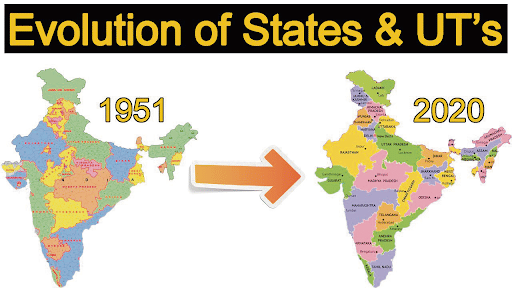
Sequence and Facts about New States and Union Territories Created After 1956
| States | Sequence and Facts |
|---|---|
| Andhra Pradesh |
The State of Andhra Pradesh Act of 1953 created the state by carving out some areas from the State of Madras. |
| Gujarat and Maharashtra |
|
| Kerala |
Created by State Reorganization Act, 1956. It comprised Travancore and Cochin areas. |
| Karnataka |
|
| Dadra and Nagar Haveli |
|
| Puducherry |
|
| Nagaland |
The State of Nagaland Act of 1962 separated it from the State of Assam. |
| Haryana |
In 1966, the State of Punjab was bifurcated to create Haryana, the 17th state of the Indian Union and the union territory of Chandigarh. |
| Himachal Pradesh |
The Union Territories of Himachal Pradesh were elevated to the status of State by the State of Himachal Pradesh Act, 1970. |
| Meghalaya |
|
| Manipur and Tripura |
Both these States were elevated from the status of Union Territories by the North-Eastern Areas (Reorganization) Act, 1971. |
| Sikkim |
|
| Mizoram |
|
| Arunachal Pradesh |
|
| Goa |
|
| Chhattisgarh |
This is formed by the Constitutional Amendment Act 2000 by dividing Madhya Pradesh |
| Uttarakhand |
|
| Jharkhand |
|
| Telangana |
The state of Telangana was formed by the “Andhra Pradesh State Reorganization Act 2014”. |
| Jammu & Kashmir |
On 31 October 2019, the act reconstituted the former state of Jammu and Kashmir into two union territories, Jammu and Kashmir and Ladakh. |
Significance
- Smaller states have several advantages. Since they have smaller assemblies their decision-making is faster, and their laws are applicable only to their specific area.
- It also helps them to preserve their culture distinctly.
- When several states with different cultures were carved out of Assam, the identities of Nagas, Mizos, etc. became increasingly well-known all over the country.
- Government become accessible to people, allowing for more responsive and efficient governance.
- When obscure cities like Ranchi, Dehradun, and Raipur became the capitals of new states, their names became household names.
- The establishment of new cities is always beneficial in terms of attracting new industries and jobs to the area.
Conclusion
The States Reorganisation Act of 1956 was a major reform to redraw state boundaries on linguistic lines.The Centre needs to play an impartial role of an arbitrator to ensure that the cake is cut into pieces that satisfy everyone’s need but not anyone’s greed.
FAQs
Q1: Which states were created under the State Reorganization Act, 1956?
Answer: The 1956 State Reorganization Act reorganized Indian states on linguistic lines. It resulted in the formation of Andhra Pradesh, Kerala, and Karnataka, and merged regions like Madhya Bharat and Vindhya Pradesh into Madhya Pradesh.
Q2: Why was the state of Telangana created in 2014?
Answer: Telangana was carved out of Andhra Pradesh after years of agitation for regional identity, fueled by concerns over unequal development and administrative neglect.
Q3: How did Goa achieve statehood?
Answer: Goa was liberated from Portuguese control in 1961 and was granted full statehood in 1987 after being administered as a Union Territory for several years.
Q4: What was the reason for dividing Bihar into Bihar and Jharkhand?
Answer: Jharkhand was formed in 2000 to address demands for autonomy by tribal populations in the region, aiming to ensure better representation and development opportunities for them.
Q5: When was the Union Territory of Jammu and Kashmir created?
Answer: In 2019, Jammu and Kashmir was bifurcated into two Union Territories—Jammu & Kashmir, and Ladakh—following the abrogation of Article 370, which previously granted it special autonomy.
MCQs
- Which year did the State Reorganization Act come into effect?
A) 1947
B) 1950
C) 1956
D) 1960
Answer: (C) See the Explanation
- Which was the first state formed on linguistic basis in India?
A) Kerala
B) Andhra Pradesh
C) Tamil Nadu
D) Gujarat
Answer: (B) See the Explanation
- When did Chhattisgarh become a separate state?
A) 1998
B) 2000
C) 2002
D) 2010
Answer: (B) See the Explanation
- Which Union Territory was bifurcated in 2019?
A) Lakshadweep
B) Chandigarh
C) Jammu & Kashmir
D) Daman & Diu
Answer: (C) See the Explanation
- Which state was carved out of Uttar Pradesh in 2000?
A) Sikkim
B) Jharkhand
C) Uttarakhand
D) Meghalaya
Answer: (C) See the Explanation
GS Mains Model Questions Model Answers
Q1: Discuss the impact of the State Reorganization Act, 1956, on Indian federalism.
Answer: The State Reorganization Act, 1956, played a pivotal role in shaping Indian federalism by reorganizing state boundaries on linguistic lines. While it ensured better cultural representation and administrative efficiency, it also set a precedent for regional demands, leading to future bifurcations. However, challenges like political instability and inter-state disputes emerged over resource sharing and governance.
Q2: Examine the political and social factors behind the formation of new states like Chhattisgarh, Uttarakhand, and Jharkhand in 2000.
Answer: The creation of Chhattisgarh, Uttarakhand, and Jharkhand was driven by socio-political demands for autonomy and better governance. These regions sought focused development and representation for marginalized communities, especially tribal populations. Their formation marked a shift towards decentralization but also posed challenges in managing administrative divisions.
Q3: Analyze the significance of the 2019 bifurcation of Jammu & Kashmir into Union Territories.
Answer: The bifurcation of Jammu & Kashmir in 2019, following the abrogation of Article 370, aimed to integrate the region more closely with the Union of India. It also aimed to promote development by bringing the region under central governance. However, the move has sparked debate on federalism, regional identity, and political representation.
Previous Year Questions on New States and Union Territories Created After 1956
1. UPSC CSE (Prelims) 2017
Question: Which one of the following Schedules of the Indian Constitution lists the names of states and specifies their territories?
Answer: The First Schedule of the Indian Constitution enumerates the names of states and Union Territories and defines their respective boundaries. It plays a key role in identifying the political map of India.
2. UPSC CSE (Mains) 2019
Question: "Discuss the impact of the bifurcation of Andhra Pradesh and the formation of Telangana on regional politics and development."
Answer: The formation of Telangana in 2014 had a significant impact on regional politics and development. Politically, it shifted the power dynamics in Andhra Pradesh, giving rise to new political alliances. Telangana benefited from focused governance, while Andhra Pradesh faced challenges in developing its new capital. Economically, both states prioritized regional growth through industrial policies, although concerns over water sharing and resource allocation persisted.
*email: contactus@prepp.in
Download the PREPP App and attempt FREE IAS Exam Mock Tests and get complete study material!
UPSC IAS : CSAT - Mini Live Test

Live Test : UPSC CSE Prelims CSAT (Paper-II) (Oct 20 - 23)
Full Test - 04: UPSC CSE Prelims CSAT (Paper-II)
Full Test - 03: UPSC CSE Prelims CSAT (Paper-II)
UPSC CSE Prelims 2026 GS Paper 1 Question Paper (24-May-2026)
UPSC CSE Prelims 2026 CSAT Paper 2 Question Paper (24-May-2026)

17 February 2025 | The Hindu Must Read Articles | Current Affairs

16 February 2026 | The Hindu Must Read Articles | Current Affairs

13 February 2026 | The Hindu Must Read Articles | Current Affairs









Comments