Goa, Daman and Diu – Indian Polity Notes
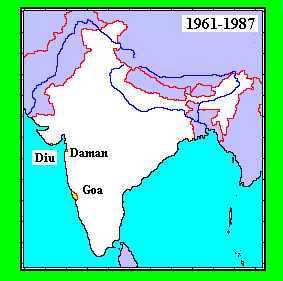
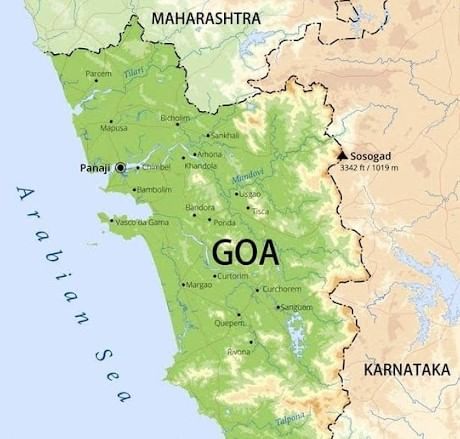
Goa, Daman and Diu were once union territory of India. In 1961, India took the three territories, Goa, Daman and Diu from the Portuguese through police action. The 12th Constitutional Amendment Act of 1962 established them as a union territory. Goa was later granted statehood in 1987. As a result, Daman and Diu became a separate union territory. This article will discuss about formation of Goa, Daman and Diu as UT in greater details.
|
Table of Contents |
Historical Background
- Prior to the arrival of the Portuguese, both Daman and Diu were part of the Sultanate of Gujarat, a 15th and 16th-century independent kingdom that included present-day Gujarat and neighbouring areas.
- The Shah signed the Treaty of Bassein with the Portuguese in 1534, ceding Diu to them as well as other territories of his empire such as Vasai and the islands that now comprise Mumbai.
- In 1559, the Portuguese took Daman from the Shah.
- Diu became an important port for the Portuguese, who built a large fortress and other structures there.
- Gujarati ships using the port of Diu were required to pay duties to the Portuguese within a few years of the island's acquisition.
- Daman and Diu were both part of the Portuguese dominions in India for over four centuries and were ruled by Goa.
- Daman and Diu remained Portuguese overseas territories until 1961, when they along with Goa became a part of India.
|
"The formation of Goa as a Union Territory in 1961 marked the dawn of a new era, as the region transitioned from colonial rule to self-governance. |
Reasons
- Following India's independence from Britain, Lisbon refused to hand over its Indian territories, claiming that they were an integral part of Portugal.
- On a diplomatic level, India attempted to persuade Portugal to peacefully transfer its territories.
- On a local level, Indian nationalists organized resistance to the Portuguese occupation.
- They were able to seize Dadra and Nagar Haveli in 1954, and an economic blockade was imposed on the remaining Portuguese-held territories.
- The Portuguese were alarmed by the loss of Dadra and Nagar Haveli, and security was beefed up in their remaining Indian possessions.
- As conciliation efforts failed, India launched Operation Vijay against Portuguese India in December 1961. While the majority of the fighting took place in Goa, there was also fighting in the Daman and Diu territories.
Impact
- Goa, Daman, and Diu were merged into the Union Territory of Goa, Daman, and Diu in December 1961.
- On December 9, 1963, the liberated Goa, Daman, and Diu held their first general election.
- For the first time in their long and tumultuous history, the people were given the opportunity to directly participate in government and elect 30 members of the First Legislative Assembly.
- In 1967, a referendum known as the 'Goa Opinion Poll' was held.
- In this operation, the voters were asked whether the UT should be merged with Maharashtra or remain separate.
- The mandate was against a merger, so the UT remained as it was. Goa became a state in 1987, and Daman and Diu became a separate UT.
- Daman and Diu union territory was merged with Dadra and Nagar Haveli union territory in the year 2020.
Conclusion
The formation of Goa as a Union Territory in 1961 was a significant milestone in India's post-independence history, symbolizing the nation's successful integration of former Portuguese territories into its sovereign fold. This transition marked the end of colonial rule in the region and the beginning of a new era of self-governance and development for Goa.
FAQs
Question: What was the historical significance of Goa, Daman, and Diu in the context of Indian polity?
Answer: Goa, Daman, and Diu were Portuguese colonies until they were annexed by India in 1961. The region’s integration into India was a significant moment in Indian history as it marked the end of European colonial presence in India. The annexation of Goa, Daman, and Diu was not only a matter of national pride but also of political importance, as it solidified India's territorial integrity. Goa's integration was accomplished after military intervention, and the region was formally incorporated into the Indian Union as a Union Territory in 1961. Goa later became a full-fledged state in 1987.
Question: How did Goa, Daman, and Diu become part of India?
Answer: Goa, Daman, and Diu were annexed into India in 1961 after the Indian Armed Forces carried out "Operation Vijay," which led to the surrender of the Portuguese administration. Following this, the territories were declared Union Territories under the administration of the Government of India. The integration was significant in the post-independence phase, as it ended Portuguese colonial rule, which had lasted for over 450 years in parts of India.
Question: What is the current political status of Goa, Daman, and Diu?
Answer: Goa became a full-fledged state of India in 1987, while Daman and Diu remained Union Territories. The political and administrative status of these territories has been important in the context of state and Union Territory governance. Goa's statehood allowed it more autonomy in legislative matters, while Daman and Diu remained under the direct administration of the central government. In 2020, there was a proposal to merge Goa, Daman, and Diu into a single entity, but it remains a matter of discussion.
Question: What is the significance of Goa's statehood in the Indian political system?
Answer: Goa's statehood in 1987 was a major step in the political development of the Indian Union, as it marked the recognition of its distinct cultural and historical identity. As a state, Goa has its own legislative assembly and enjoys greater autonomy in terms of administration, law-making, and governance compared to Union Territories. Goa's statehood also contributed to the strengthening of regional representation within India's federal structure.
Question: How does the governance structure of Goa, Daman, and Diu differ?
Answer: Goa, as a state, has a Chief Minister and a Governor, with a legislative assembly to make laws on subjects in the Union and Concurrent Lists. Daman and Diu, as Union Territories, are administered by a Lieutenant Governor appointed by the President of India. While Goa has a more autonomous political system with its own legislature, Daman and Diu rely on the central government for legislative functions. This difference highlights the disparity in governance structures between states and Union Territories within India's federal framework.
MCQs
1. When did Goa become a state in the Indian Union?
A) 1961
B) 1987
C) 1950
D) 1970
Answer: (B) See the Explanation
Explanation: Goa became a state of India in 1987, after it was initially annexed as a Union Territory following the end of Portuguese rule in 1961.
2. What is the capital of Goa?
A) Panaji
B) Daman
C) Vasco da Gama
D) Mapusa
Answer: (A) See the Explanation
Explanation: The capital of Goa is Panaji, which is the political and administrative center of the state.
3. What event led to the integration of Goa, Daman, and Diu into India?
A) Operation Vijay
B) Independence Act of 1947
C) Military Action in 1947
D) Treaty of Peace
Answer: (A) See the Explanation
Explanation: Operation Vijay, carried out by the Indian Armed Forces in 1961, led to the annexation of Goa, Daman, and Diu, which were under Portuguese colonial rule at the time.
4. Which of the following is true about Daman and Diu?
A) It became a full state of India in 1961
B) It is a Union Territory
C) It became a state in 1987
D) It is governed by a Chief Minister
Answer: (B) See the Explanation
Explanation: Daman and Diu remains a Union Territory even after Goa became a state in 1987. It is directly administered by the central government.
5. Which region was part of Portuguese colonial rule until 1961?
A) Kerala
B) Goa, Daman, and Diu
C) Punjab
D) Jammu and Kashmir
Answer: (B) See the Explanation
Explanation: Goa, Daman, and Diu were under Portuguese colonial rule until they were annexed into India in 1961 through Operation Vijay.
GS Mains Questions and Model Answers
Q1: Analyze the political and administrative integration of Goa, Daman, and Diu into the Indian Union. What were the challenges faced during this process?
Answer: The political and administrative integration of Goa, Daman, and Diu into the Indian Union was a significant achievement that marked the end of Portuguese colonial rule in India. Following military intervention in 1961, Goa was incorporated as a Union Territory, and later, in 1987, it became a full-fledged state. The primary challenge during this process was the resistance from the Portuguese administration, which sought to maintain control over its colonies. There were also political challenges within India regarding the administration of these regions, given their distinct cultural, political, and historical identities. Despite these challenges, the integration was successful, and Goa's subsequent statehood further strengthened India’s territorial integrity.
Q2: How did Goa’s transition from a Portuguese colony to an Indian state affect its socio-economic development?
Answer: Goa’s transition from Portuguese rule to Indian statehood led to significant changes in its socio-economic development. Under Portuguese rule, Goa was primarily focused on trade and agriculture, but after integration into India, it saw rapid modernization and economic growth. The establishment of tourism as a major economic sector, improved infrastructure, and greater access to Indian government resources contributed to its development. However, Goa also faced challenges related to preserving its cultural identity amidst the changes brought by modernization and the influx of people from other parts of India.
Q3: What are the cultural and historical factors that make Goa, Daman, and Diu unique within the context of India’s political landscape?
Answer: Goa, Daman, and Diu hold unique cultural and historical significance within India due to their colonial past under Portuguese rule. The influence of Portuguese culture is evident in Goa’s architecture, language (Portuguese), and religious practices, particularly in the Christian communities. These regions also have distinct cultural traditions that differentiate them from the rest of India. Goa, for example, has a vibrant tourism industry that blends both Indian and European cultural influences. The historical backdrop of the regions’ integration into India post-1961 adds to their unique political and cultural identity within the Indian Union.
Previous Year Questions on Goa, Daman, and Diu
1. UPSC CSE Prelims 2020:
Question: Which of the following territories was annexed by India in 1961?
A) Goa, Daman, and Diu
B) Jammu and Kashmir
C) Sikkim
D) Puducherry
Answer: (A)
Explanation: Goa, Daman, and Diu were annexed by India in 1961, ending Portuguese colonial rule in these territories.
2. UPSC CSE Mains 2019 (GS Paper 2):
Question: Discuss the significance of Goa’s integration into the Indian Union in 1961. How did it contribute to the development of the state?
Answer: The integration of Goa into the Indian Union marked the end of Portuguese colonial rule, which had lasted for over 450 years. This integration opened the doors for political, social, and economic development, as Goa became a part of India's political framework. The introduction of modern governance, infrastructure development, and access to national resources accelerated Goa’s socio-economic growth. Goa’s tourism industry blossomed, and the state witnessed improvements in education, healthcare, and public administration.
*email: contactus@prepp.in
Download the PREPP App and attempt FREE IAS Exam Mock Tests and get complete study material!
UPSC IAS : CSAT - Mini Live Test

Live Test : UPSC CSE Prelims CSAT (Paper-II) (Oct 20 - 23)
Full Test - 04: UPSC CSE Prelims CSAT (Paper-II)
Full Test - 03: UPSC CSE Prelims CSAT (Paper-II)
UPSC CSE Prelims 2026 GS Paper 1 Question Paper (24-May-2026)
UPSC CSE Prelims 2026 CSAT Paper 2 Question Paper (24-May-2026)

17 February 2025 | The Hindu Must Read Articles | Current Affairs

16 February 2026 | The Hindu Must Read Articles | Current Affairs

13 February 2026 | The Hindu Must Read Articles | Current Affairs









Comments