Haryana, Chandigarh and Himachal Pradesh - Indian Polity Notes
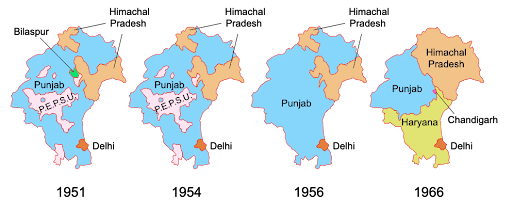
Punjab Reorganisation Act of 1966 led to the formation of two states Punjab and Haryana, certain areas were transferred to Himachal Pradesh, Chandigarh was designated as a Union territory and made provisional capital for both Punjab and Haryana. This article discusses the formation of “Haryana, Chandigarh and Himachal Pradesh which is important for the UPSC prelim as well as the mains examination.
|
Table of Contents |
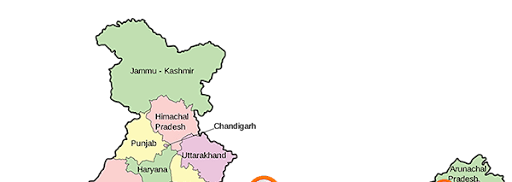
Haryana
A Brief History
- Haryana is the origin place of the Vedas, ancient manuscripts of the Vedic religion. Considered as the birthplace of Hinduism. It was also a sight of pivotal battles, notably the Battles of Panipat.
- It was acquired by the British East India Company in 1803, transferred to North-Western Provinces in 1832, and to Punjab in 1858.
Formation of State of Haryana
- By the early twentieth century, agitation for a distinct state of Haryana was well underway, driven by major players in the Indian national movement such as Lala Lajpat Rai and Asaf Ali, as well as Neki Ram Sharma.
- After India's Independence in 1947, Haryana remained a part of Punjab, but the desire for separate states persisted.
- Hindi language movement was started in Punjab in 1957 in Hindi-speaking areas of Punjab. Movement started after the government of post-independence Punjab tried to promote Punjabi as state language but many groups in modern Haryana considered Punjabi as a threat.
- Finally, on November 1, 1966, 1966, Haryana was carved out as a separate state from East Punjab on linguistic basis with majorly consisting of the "Hindi Speaking areas".
- Chandigarh became the union territory at the same time it was made capital of both the states of Haryana and Punjab.
|
Punjab Reorganisation Act of 1966 led to the formation of two states Punjab and Haryana, certain areas were transferred to Himachal Pradesh, Chandigarh was designated as a Union territory and made provisional capital for both Punjab and Haryana. |
Chandigarh
-
Following the rearrangement of the East Punjab state into Punjab, Haryana, and Himachal Pradesh on November 1, 1966, Chandigarh was made a Union Territory and made provisional capital for both Punjab and Haryana.
Himachal Pradesh
- Himachal Pradesh is located in the western Himalayas. The name translates to "snowy slopes".
- It borders Jammu and Kashmir and Ladakh Union Territories to the northwest and northeast, the Tibet Autonomous Region of China to the east, and Uttarakhand, Haryana, and Punjab to the southeast.
Brief History of Himachal Pradesh
- Aryan clans moved into fertile regions, assimilating the pre-Aryan population.
- The Mauryan, Gupta and Mughal empires sought control over trade and pilgrimage routes into the region.
- After the Mughal Empire's decline in the mid-18th century, the region temporarily came under Sikh sovereignty until the early 1840s.
- Following the Sikh Wars of the 1840s, the British dominated the region for about 100 years.
- A public campaign against feudalism led to the peaceful surrender of the princely state of Suket around Indian independence in 1947.
- Himachal Pradesh became a province in 1948 which was ruled by a chief commissioner representing the Indian government.
- The Indian constitution of 1950 made it a sub-state. It merged with Bilaspur in 1954 and became a union territory in 1956.
Formation of Himachal Pradesh
- After independence, many of the hilly territories were organised as the Chief Commissioner's province of Himachal Pradesh, which later became a Union Territory.
- In 1966, hilly areas of the neighbouring Punjab state were merged into Himachal Pradesh. On 18th December, 1970 the State of Himachal Pradesh Act was passed by Parliament and the new state came into existence on 25th January, 1971.
Conclusion
The formation of Haryana and Himachal Pradesh marks significant milestones in the reorganization of Indian states post-independence, reflecting the country's efforts to accommodate diverse cultural, linguistic, and geographical identities within its federal structure.
FAQs
Question. What is the history behind the formation of Haryana?
Answer: Haryana was carved out from the state of Punjab on November 1, 1966, following the Punjabi Suba movement, which was based on linguistic lines. The state was formed with Hindi as its official language, and Chandigarh was designated as its capital.
Question. What is the significance of Chandigarh in the context of Haryana and Punjab?
Answer: Chandigarh serves as the capital of both Haryana and Punjab. It was created as a Union Territory after the bifurcation of Punjab and remains the shared capital of these two states.
Question. How did Himachal Pradesh come into existence?
Answer: Himachal Pradesh became a separate state on January 25, 1971, after the merger of various princely states and territories. It was made a Union Territory in 1956 before becoming a full-fledged state.
Question. What were the major historical developments in Himachal Pradesh?
Answer: Himachal Pradesh’s history includes being part of various empires, including the Mauryas, Guptas, and Mughals. The region was later controlled by the Sikhs and then the British. After independence, it was merged with several princely states and became a Union Territory before gaining statehood in 1971.
Question. What is the geographical significance of Haryana?
Answer: Haryana is strategically located in India's north-central region and borders Punjab, Himachal Pradesh, Uttarakhand, Uttar Pradesh, Rajasthan, and Delhi. Its proximity to the national capital, Delhi, makes it a critical area for economic, social, and political activities.
MCQs
- When was Haryana formed as a separate state?
A) 1947
B) 1956
C) 1966
D) 1971
Answer: (C) See the Explanation
Haryana was formed on November 1, 1966, when Punjab was divided based on linguistic lines.
- Which city is the capital of both Haryana and Punjab?
A) Delhi
B) Ambala
C) Chandigarh
D) Shimla
Answer: (C) See the Explanation
Chandigarh serves as the capital of both Haryana and Punjab.
- Which state became a part of India in 1971 after merging with princely states?
A) Uttar Pradesh
B) Himachal Pradesh
C) Kerala
D) Punjab
Answer: (B) See the Explanation
Himachal Pradesh became a state in 1971 after merging with princely states.
- Which of the following states was not part of the initial reorganization in 1966?
A) Haryana
B) Punjab
C) Himachal Pradesh
D) Jammu and Kashmir
Answer: (D) See the Explanation
Jammu and Kashmir was not part of the Punjab reorganization in 1966.
- Who was the chief architect of Chandigarh?
A) M. K. Gandhi
B) Jawaharlal Nehru
C) Le Corbusier
D) B. R. Ambedkar
Answer: (C) See the Explanation
The famous French architect Le Corbusier planned and designed the city of Chandigarh.
GS Mains Questions and Model Answers
Q1. Discuss the historical and political significance of the formation of Haryana and Himachal Pradesh in the post-independence era.
Answer: The formation of Haryana and Himachal Pradesh represents the importance of linguistic and geographical considerations in India’s post-independence state reorganization. Haryana was formed in 1966 after the Punjab Reorganization Act, which divided Punjab into two states based on language—Hindi-speaking Haryana and Punjabi-speaking Punjab. This division aimed to address the demands for administrative efficiency and cultural representation. Himachal Pradesh, on the other hand, was formed as a state in 1971 after merging various princely states. This reorganization not only helped address regional aspirations but also contributed to the social and economic development of these states.
Q2. Explain the role of Chandigarh in the Indian political and administrative landscape.
Answer: Chandigarh holds a unique position as a Union Territory and the capital of both Punjab and Haryana. Its establishment as a planned city under the vision of Jawaharlal Nehru and architect Le Corbusier was intended to symbolize modern India. The city is a critical administrative and political hub for both states and plays a central role in their governance. Moreover, its strategic location between the two states makes it a focal point for political, economic, and cultural exchanges in northern India.
Q3. How has the creation of Haryana and Himachal Pradesh contributed to India's federal structure?
Answer: The creation of Haryana and Himachal Pradesh contributed to India's federal structure by accommodating linguistic, cultural, and geographical diversity. The establishment of these states helped ensure greater administrative efficiency and representation of regional identities within the Union. The linguistic division of Punjab led to the creation of Haryana, catering to the Hindi-speaking population, while Himachal Pradesh’s formation helped integrate the hill regions into the mainstream national framework. Both states contributed to the strengthening of India’s federal system by addressing local governance issues while adhering to national integration.
Previous Year Questions on Haryana Chandigarh and Himachal Pradesh
1. UPSC CSE 2023
Question: "Discuss the formation of Haryana and Himachal Pradesh and its impact on the political structure of India."
Answer: The formation of Haryana in 1966 and Himachal Pradesh in 1971 helped address regional aspirations and reinforced the federal structure of India. Haryana was formed to satisfy the demand of the Hindi-speaking population in Punjab, while Himachal Pradesh was created to integrate the hill regions into India’s political mainstream, improving administrative efficiency.
2. UPSC CSE 2022
Question: "Explain the significance of Chandigarh as a shared capital and Union Territory in India."
Answer: Chandigarh’s designation as the capital of both Punjab and Haryana and its status as a Union Territory make it a symbol of India’s pluralism and unity in diversity. Its planning and design, led by Le Corbusier, reflect the modern aspirations of India while serving as a key administrative and political hub for the region.
*email: contactus@prepp.in
Download the PREPP App and attempt FREE IAS Exam Mock Tests and get complete study material!
UPSC IAS : CSAT - Mini Live Test

Live Test : UPSC CSE Prelims CSAT (Paper-II) (Oct 20 - 23)
Full Test - 04: UPSC CSE Prelims CSAT (Paper-II)
Full Test - 03: UPSC CSE Prelims CSAT (Paper-II)
UPSC CSE Prelims 2026 GS Paper 1 Question Paper (24-May-2026)
UPSC CSE Prelims 2026 CSAT Paper 2 Question Paper (24-May-2026)

17 February 2025 | The Hindu Must Read Articles | Current Affairs

16 February 2026 | The Hindu Must Read Articles | Current Affairs

13 February 2026 | The Hindu Must Read Articles | Current Affairs









Comments