Soil - Agriculture Notes
Soil is the loose surface layer that covers the majority of land. It is made up of inorganic particles and biological materials. Soil offers structural support for agricultural plants as well as a source of water and nutrients. Soil chemical and physical qualities vary widely. Leaching, weathering, and microbial activity all work together to create a wide range of soil types. This article will explain to you about Soil which will be helpful in preparing the Agriculture Syllabus for the UPSC Civil Service exam.
|
Table of Contents |
What is Soil?
- Water covers an estimated 70% of the earth's surface, with land accounting for the remaining 30%.
- The pedosphere is the layer of the earth that is made up of soil and is influenced by the process of soil formation.
- Soils are a thin layer that covers the majority of the Earth's land surface.
- This thin layer is a basic natural resource that has a significant impact on the rest of the ecosystem.
- Soil is the uppermost layer of the continental crust that contains weathered rock fragments. The soils of India are the product of physical forces as well as human influences.
- Soils are made up of three main components: different sizes of minerals, organic materials from the remains of dead plants and animals, and open space that can be filled with water or air.
- A good soil for most plants should contain about 45% minerals (sand, silt, and clay), 5% organic matter, 25% air, and 25% water.
- Parent material, relief, climate, vegetation, life forms, and time are the key variables that impact soil formation.
Soil
Formation of Soil
- Weathering is the process by which soil is formed.
- Weathering is a natural process that happens as a result of the interaction of various atmospheric influences.
- Weathering is a natural process that involves the continuous physical and chemical breakdown of rocks.
- This can be accomplished by a variety of agents such as wind, water, or climate.
- The breakdown of pebbles produces microscopic particles that mingle with the humus. The soil is fertilised by this combination of tiny pebbles and humus.
- The five major factors that influence soil formation are climate, parent material, topography, organisms, and time.
- Solid rock can weather away into the soil in one of three ways
- Mechanical Weathering: This is commonly observed near the earth's surface. This process is also known as physical weathering because it is influenced by physical forces such as wind, water, and temperature.
- Chemical Weathering: Chemical weathering occurs when rocks are broken down by chemical reactions, as the name implies. Such weathering can frequently alter the chemical composition of the soil.
- Biological weathering: Though not a weathering process in and of itself, living organisms weaken and eventually disintegrate rocks, frequently by initiating mechanical or chemical weathering.
- Tree roots, for example, can grow into rock cracks, prying them apart and causing mechanical fractures.
- Microorganisms can secrete chemicals that make rocks more susceptible to weathering.
Factors Affecting Soil Development
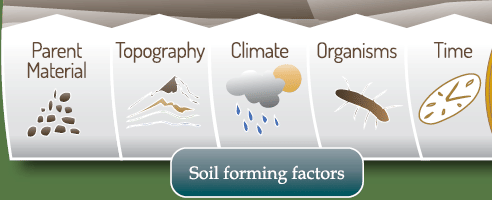
Factors of Soil Formation
Parent Material
- This refers to the rock and minerals that make up the soil.
- The nature of the parent rock, which can be native to the area or transported by wind, water, or glacier, has a direct effect on the final soil profile.
- The parent materials are those that give rise to the layers of soil. It influences the properties of the formed soil because it is the foundational material.
- Lava Rock, for example, is the parent rock of sandy soil. This is why the sandy soil is so dark.
Climate
- Precipitation and temperature are used to determine this.
- It causes partial weathering of the parent material, which serves as the soil's substrate.
- Temperature and precipitation have a direct impact on the rate of weathering of the parent rock.
- The soil with the most moisture will be the most weathered. The more moisture there is in the soil, the more minerals move.
- Warm temperatures increase the amount of weathering as well.
Living Organisms
- These include nitrogen-fixing bacteria like Rbizobium, as well as fungi, insects, worms, and snails that help decompose litter and recycle nutrients.
- The organisms that live in the soil also have an impact on their nature.
- Some organisms, for example, aid in the chemical reactions that occur within the soil. This will result in water infiltration.
Topography
- This refers to the physical characteristics of the soil's formation location.
- Drainage, slope direction, elevation, and wind exposure are all topographic factors that influence a soil's profile.
- The type of soil is also affected by the region where it grows. Water, for example, flows faster down a slope.
- As a result, the amount of water present on the slope will be less than the amount of water present at the slope's foot. This means that the soil will be poor on the slopes and rich at the slope's base.
Time
- Time is a crucial factor in the formation of soil. It takes thousands of years for soil to form.
- The younger soil shares properties with the parent rock, but as time passes, the soil ages and its properties diverge from those of the parent rock.
- As a result, one type of soil can change into another over time.
Soil Components
- Soil is a dynamic natural body with properties derived from the combined effects of climate and biotic activities, as modified by topography, acting on parent materials over time.
- Soil is one of the most significant components of an ecosystem, containing both biotic and abiotic constituents.
- These soil components are classified into two types.
- The first group includes biotic factors, which include all living and once-living entities in the soil, such as plants and insects.
- Abiotic variables, which encompass all non-living substances such as minerals, water, and air, make up the second group.
- There are five basic soil components that, when present in sufficient quantities, form the foundation of all terrestrial plant ecosystems.
- Minerals
- Water
- Organic Matter
- Gases
- Microorganisms
*For detailed notes on this topic, check this link Soil Components
Soil Profile
- A soil profile is a vertical section of the soil that shows the various layers from the surface to the unaffected parent material.
- The order of these layers, which are referred to as horizons, makes up the soil profile.
- The colour and size of the soil's particles make it simple to identify the different soil layers.
- The Parent Rock, the topsoil, and the subsoil are the three primary layers of soil.
- The soil profile contains five master horizons. Because not all soil profiles contain all five horizons, soil profiles differ from one location to the next.
- The depth, colour, texture, and chemical makeup of each layer vary. A horizon is the name given to each stratum of soil.
- The surface horizon, subsoil, and substratum—the three main soil surfaces made up of A, B, and C—are depicted in the soil profile diagram.
- The surface of the soil has an organic mineral covering (O). The soil receives all of the natural minerals from this surface.
*For detailed notes on this topic, check this link Soil profile
Soil Texture
- The proportion of sand, silt, and clay-sized particles that make up the mineral fraction of the soil is referred to as soil texture.
- Sand, clay, and silt are the three types of separation. Sand and silt are unimportant to the soil since they contribute nothing to the soil's ability to recover water or nutrients.
- Clay is an active component of soil texture because of its tiny size, high surface area per unit mass, and ability to store ions and water.
- Texture matters because it influences:
- the amount of water that the soil can store;
- the rate at which water moves through the soil;
- how fertile and workable the soil is.
- Soil texture has a strong influence on the physical and chemical behaviour of a soil, which varies due to differences in the type and mineral composition of the parent material, the soil's position in the landscape, and the physical and chemical weathering processes involved in soil formation.
- Soil texture influences the movement and availability of air, nutrients, and water in a soil, and it is frequently used to estimate other soil properties, particularly soil water properties, when direct measurements are not available.
*For detailed notes on this topic, check this link Soil texture
Soil Structure
- The structure is one of the distinguishing features of a soil horizon. A soil horizon has only one structure, but different horizons within a soil may have different structures.
- The type of structure that develops at each depth is influenced by all soil-forming factors, particularly climate.
- The granular and crumb structure is typically found near the soil surface in the A horizon.
- The structure of the subsoil, particularly the B horizon, is subangular blocky, blocky, columnar, or prismatic.
- Platy structures can be found on the surface or in the subsoil, whereas single grain and structureless structure are typically associated with the C horizon.
- Soil Structure is the arrangement of soil separated into units known as soil aggregates.
- The structure of soil is determined by the arrangement of soil particles into various shapes.
- Soil structure refers to the visible clods and aggregates, as opposed to soil texture, which is felt.
- Soils with poor structure produce low yields and are difficult to manage owing to a narrow range of soil moisture for tillage operations.
- The arrangement of pores and fissures (porosity) within a matrix of solid materials is referred to as soil structure (soil particles and organic matter).
- The pores and fissures are formed when solid materials bond and aggregate.
- Water holding capacity, infiltration, permeability, root penetration, and respiration are all determined by the number, distribution, and arrangement of pores.
*For detailed notes on this topic, check this link Soil structure
Types of Soil
Sandy Soil
- Sandy soil, the most prevalent type of soil, has the largest particles.
- When touched, it feels gritty and dry due to the large voids between the particles, and it will not be able to contain water.
- Water drains quickly and directly to regions where roots, particularly seedlings, cannot reach.
- Plants have little chance of successfully using the nutrients contained in this soil since they are washed away by runoff.
- Sandy soils, which are common in desert environments, warm fast in the sunshine and hold less moisture and nutrients than other soil types.
Silty Soil
- When opposed to sandy soil, silty soil is smaller in size, smoother, and becomes soapy and slick when moistened.
- When we roll silty soil between our fingers, it deposits dirt on our skin. Silt, as opposed to sand, has smaller particles.
- It also includes rock and mineral pieces. Because of its fine texture, it also retains water better than sand.
- Because of the aforementioned qualities, it is also beneficial to agriculture.
- Suitable for almost every form of fruit and vegetable, crop may thrive on this soil if the drainage is adequate.
- Grass, perennials, climbers, shrubs, and other plants thrive in this soil.
Clay Soil
- When compared to the other soils listed, clay soil has the lowest particle composition and good water storage characteristics.
- Because of the microscopic size of its particles and their inclination to clump together, only a small amount of air can move through its gaps.
- Because of its slower drainage nature, plant nutrients will be firmly kept, making this soil rich in plant food for improved development.
- This soil is chilly in the spring, and it will take time to warm up since the water within the soil must also warm up.
- When the soil dries up, it becomes quite heavy to work with. During the heat, it may also become hard and compact.
- This soil is excellent for growing decorative plants and fruit trees.
Peaty Soil
- The peaty soil will be either black or dark brown in hue.
- It compresses quickly due to its high water content and feels soft when handled; it is also high in organic materials.
- These soil farmers utilise it to prevent disease by regulating pH levels or soil chemistry, and it also includes acidic water.
- Because the acidic state of the soil delays the breakdown process, fewer nutrients are provided.
- This soil is appropriate for plants that include legumes, salad crops, root crops, and shrubs such as Witch hazel, Lantern trees, Heather, and others.
Saline Soil
- Because of its high salt concentration, this soil is generally brackish under exceptionally dry circumstances.
- Saline soil can harm and even halt plant development, make watering difficult, and delay germination.
- Because of the high salt concentration, the plants are unable to absorb water, resulting in drought stress.
- It is suitable for: Pinks, Lilacs, Mock Oranges, Weigela, Madonna Lillie, Cabbage, sweet corn, spinach, beets, and other vegetables.
Loam Soil
- Loam soil is regarded to be the perfect form of soil since the plants and gardeners really adore it.
- This soil has a balance of three materials: silt, clay, humus, and sand.
- It will have greater calcium and pH levels due to its past organic matter concentration.
- Bamboos, climbers, perennials, tubers, and shrubs such as Dog's tooth violets, Wisteria, Rubus, and others flourish in this soil.
Acid Soils
- If the pH number is less than 7, the soil is considered acidic, and if the pH value is less than 5.5, the soil is considered severely acidic.
- Soils in heavy rainfall areas are acidic because soluble basic salts such as Calcium, Magnesium, Potassium, Sodium are leached away by drainage water, leaving insoluble acidic residues made mostly of oxides and silicates of iron, silicon, and aluminium, which accumulate in significant amounts.
- Soil acidification is caused by the accumulation of hydrogen cations, which lowers the pH of the soil.
- Soil acidity happens naturally as lichens and algae begin to erode rock surfaces. Acids continue to dissolve as soil forms.
Sodic Soils
- Sodic soils form when soil is saturated with sodium salts and the exchange sites contain exchangeable sodium, which generally persists long after the soluble salts have been removed.
- Sodicity in soil is defined as a high concentration of sodium ions in comparison to other cations.
- The main indicator of sodicity is the amount of sodium in the soil, which is referred to as the Exchangeable Sodium Percentage (ESP).
- An ESP of 6% is considered the threshold at which sodium cation in soil has a negative impact on soil structure when in contact with fresh water, causing clay dispersion.
*For detailed notes of this topic, check this link Types of soil
Soil Types in India
- The Indian Council of Agricultural Research (ICAR) has divided soils into eight types in India.
- Alluvial Soil
- Black Cotton Soil
- Red Soil
- Laterite Soil
- Mountainous or Forest Soils
- Arid or Desert Soil
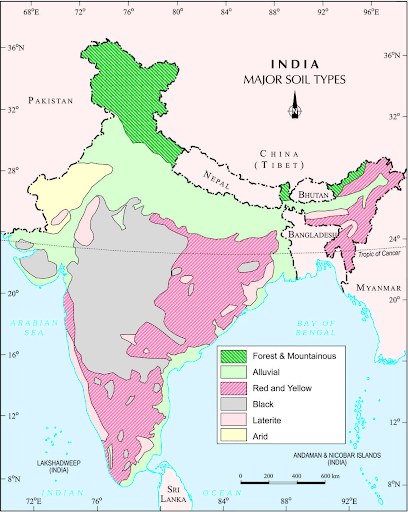
Types of Soil in India
Alluvial Soil
- Alluvial soils are mostly generated by silt deposited by the Indo-Gangetic and Brahmaputra rivers. Wave action causes some alluvial deposits to accumulate in coastal areas.
- The parent material is Himalayan rocks. As a result, the parent material of these soils has been moved.
- They are the biggest soil category, encompassing around 15 lakh square kilometres, or roughly 46 percent of the entire area.
- They provide the most fertile agricultural fields to more than 40% of India's population.
- Sand is the predominant kind of soil, while clayey soils are also widespread.
- In drier areas, they range from loamy to sandy loam, and near the delta, they become clayey loam. Because it is loamy (equal parts sand and clay), the soil is permeable.
- They react well to canal and well/tube-well irrigation and are best suited to irrigation.
- Rice, wheat, sugarcane, tobacco, cotton, jute, maize, oilseeds, vegetables, and fruits are abundant.
- Except in a few areas where the top layer is covered by desert sand, they may be found all over the Indo-Gangetic-Brahmaputra plains.
- They are also found in the Mahanadi, Godavari, Krishna, and Cauvery deltas, where they are known as deltaic alluvium (coastal alluvium)
- Some alluvial soils may be found in Gujarat's Narmada, Tapi, and northern regions.
Black Soil
- Weathering of these basaltic rocks that originated during Cretaceous fissure eruptions resulted in the formation of black soils.
- The volcanic rocks that originated on the Deccan Plateau are the parent material for the majority of the black soil (Deccan and the Rajmahal trap).
- This is an area with high temperatures and low rainfall. As a result, it is a soil category found in the Peninsula's arid and hot areas.
- Titanium-ferromagnetic chemicals present in basalt are responsible for the black colour.
- The dark colour is generated from crystalline schists and basic gneisses in Tamil Nadu and parts of Andhra Pradesh.
- This category of soils may contain many shades of black, including deep black, medium black, shallow black, and a blend of red and black.
- In general, black soils in the uplands are poor in fertility, but those in the lowlands are quite productive.
- The dark dirt retains a lot of moisture. It swells significantly when exposed to dampness. Working on such soil during the rainy season requires a lot of effort since it becomes quite sticky.
- When the rain evaporates in the summer, the earth contracts and becomes seamed with broad and deep fractures. Moisture can still be retained in the bottom layers.
- The fissures allow adequate oxygenation of the soil to reach suitable depths, and the soil is exceptionally fertile.
- When dried, it fractures and has a blocky structure.
- Cotton crops thrive in soils like this. As a result, these soils are known as regur and black cotton soils.
- Wheat, jowar, linseed, virginia tobacco, castor, sunflower, and millets are among the other significant crops produced on black soils.
- Rice and sugarcane are both significant where irrigation is available.
- It is found in India's Deccan lava plateau area.
- Distribution: Maharashtra, Madhya Pradesh, portions of Karnataka, Telangana, Andhra Pradesh, Gujarat, and Tamil Nadu cover 46 lakh square kilometres (16.6 percent of the total area).
Red Soil
- This soil formed on Archean granite covers the country's second greatest area.
- The presence of ferric oxides causes soil to be red, with ferric oxides forming as thin coatings on soil particles. The soil's top layer is red, while the horizon underneath it is yellowish.
- Because the mineral base is rich, it produces a high yield when irrigated and amended with humus.
- It promotes rice, sugarcane, and cotton cultivation.
- Millets and pulses are cultivated in arid climates.
- The Kaveri and Vaigai basins are known for their red alluvium and, if sufficiently watered, are suited for paddy cultivation.
- Red soil zones have emerged in large areas of Karnataka and Kerala for rubber and coffee plantation production.
- Red Alluvial Soil, found along river valleys is very fertile. The soil is well-drained, and the structure is sandy.
- Iron and potash are abundant, while other minerals are scarce.
- They are mostly found on the Peninsula, stretching from Tamil Nadu in the south to Bundelkhand in the north, and from Raj Mahal in the east to Kathiawad in the west.
Laterite Soil
- This soil has evolved in areas where the following requirements are met:
- There must be laterite rock or structure.
- Alternating dry and wet seasons are preferable for the formation of laterite soils.
- It is well-known for crops such as groundnuts and cashew nuts.
- Karnataka's laterite soil is ideal for growing coffee, rubber, and spices.
- Brown in colour, it is mostly made up of hydrated oxides of aluminium and iron.
- Iron oxides are present in the form of nodules.
- It is abundant in iron and aluminium but deficient in nitrogen, phosphorus, potassium, lime, and magnesium.
- It has a moderate humus and water retention capacity.
- Bacterial activity has been quite strong, and excessive precipitation causes humus leaching, resulting in humus concentration that is moderate to low.
- Distribution: It is found in areas throughout the nation, including the Western Ghats (Goa and Maharashtra).
- Karnataka's Belgaum district and Kerala's laterite plateau.
- Orissa's Eastern Ghats, Amarkantak plateau area of MP- Panchmahal district of Gujarat; Santhal Pargana divisions of Jharkhand.
Forest Soil/ Mountain Soil
- It has thin layers and poorly defined profiles and horizons.
- Because of the rapid drainage, it has been prone to soil erosion.
- It has a high organic content and a good humus content, but it lacks other nutrients.
- It is highly beneficial to crops that require good air and water drainage, which this soil provides by virtue of being on a slope.
- Generally utilised for rubber plantation, bamboo plantation, as well as tea, coffee, and fruit cultivation.
- A large area is also dedicated to shifting agriculture, in which soil fertility deteriorates after 2-3 years.
- Silvi pastoral farming (forest+grasses) may be supported due to the limited scope of agriculture.
- These are often found over 900 metres in elevation.
- Distribution: Himalayas, Himalayan foothills, Western Ghats mountain slopes, Nilgiri, Annamalai, and Cardamom hills.
Desert Soil
- It is deficient in moisture content. The humus level is lower, and the nitrogen concentration is initially low, although part of it is accessible in the form of nitrates.
- They are sandy and devoid of biological stuff. The content of living microorganisms is minimal.
- It has a high iron concentration. The phosphorus concentration is roughly enough, and the soil is rich in lime and bases.
- It has minimal soluble salts and moisture retention capability.
- This soil has a good agricultural return when watered.
- These are appropriate for crops that require less water, such as Bajra, pulses, feed, and guar.
- Distribution: Western Rajasthan, Kachchh Rann, and portions of south Haryana and south Punjab.
Soil Moisture
- Soil moisture refers to water in the soil. Several factors influence water absorption in the soil. It is crucial in the formation of soil.
- Waterfalls to the ground as a result of precipitation. Soil's particle size distribution determines its porous nature and causes vertical downward movement of water, known as infiltration.
- This penetration continues deep into the soil layers until saturation occurs.
- Water cannot seep vertically any further once it reaches this barrier, so it moves sideways.
- Surface ponding refers to the formation of puddles as a result of saturation, which can be long-lasting.
- Root zone moisture refers to water available to plants, whereas surface soil moisture refers to water available in the immediate uppermost layer of soil.
- A Tensiometer can be used to measure the moisture content of the soil.
- They are water-filled tubes that are sealed with a porous ceramic tip at the bottom and an air-free gauge at the top.
- They penetrate the soil all the way to the root level. Water flows between the device's tip and the surrounding soil until it reaches equilibrium, at which point tension is recorded on the gauge.
- Readings obtained in this manner provide a measure of soil moisture in that region.
Importance of Soil
- The fertile soil promotes plant growth and development. The plants that result are healthy and can be used to make food, clothing, furniture, and medicines.
- It is home to a wide variety of life forms, including bacteria, fungi, algae, and others. These microbes, in turn, keep the environment in balance by retaining moisture and decomposing dead organisms.
- Topsoil supports a few organisms' life activities such as reproduction, hatching, nesting, breeding, and so on.
- The organic matter in the soil increases the fertility of the soil, which is responsible for plant growth.
- It also contains minerals and elements that plants require to carry out their cellular activities.
- Soil constituents such as gravel, clay, and sand are used in the construction of homes, roads, and buildings, among other things.
- Mineral medicines such as calcium and iron are extracted from the soil, as are other substances such as petroleum jelly for cosmetics.
- Rainwater is absorbed by the soil. During sunny days, this water evaporates and is released into the air, cooling the atmosphere.
Soil Erosion
- Soil erosion is the loosening and displacement of topsoil from the land caused by agents such as wind and water.
- Topsoil is the most fertile layer of soil because it contains the most organic, nutrient-rich materials.
- In nature, soil erosion can be a slow process (geological erosion) or a fast process accelerated by human activities such as overgrazing and deforestation.
- Soil erosion reduces cropland productivity while also polluting nearby watercourses, wetlands, and lakes.
- Soil erosion can be a slow process that goes unnoticed for a long time, or it can happen quickly and cause significant loss of topsoil.
- Other serious soil degradation conditions that can accelerate the soil erosion process include soil compaction, low organic matter, loss of soil structure, poor internal drainage, salinisation, and soil acidity.
Stages of Soil Erosion
Splash Erosion
- Splash erosion is the first stage of erosion. It happens when raindrops hit bare soil.
- The explosive impact breaks up soil aggregates, causing individual soil particles to be 'splashed' onto the soil surface.
- The splashed particles can rise up to 60cm above the ground and travel up to 1.5 metres from the point of impact.
Sheet Erosion
- The removal of soil in thin layers by raindrop impact and shallow surface flow is known as sheet erosion.
- It results in the loss of the finest soil particles, which contain the majority of the soil's available nutrients and organic matter.
- It usually occurs after crusting, which is caused by the previous stage of water damage to the soil.
- Overgrazed and cultivated soils with little vegetation to protect and hold the soil are the most vulnerable to sheet erosion.
- Surface water flows that cause sheet erosion rarely travel more than a few metres before condensing into rills.
Rill Erosion
- Rills are shallow drainage lines that are no deeper than 30cm.
- They form when surface water collects in depressions or low points in paddocks, eroding the soil.
- Rill erosion is common in bare agricultural land, especially overgrazed land, and in freshly cultivated soil with a loosened soil structure.
- Rills are typically removed with farm machinery.
Gully Erosion
- Gully erosion is a visible type of soil erosion that reduces soil productivity and restricts land access and use.
- Gully soil can also cause infrastructure damage by burying fence lines, silting up waterways, clogging road culverts, and filling dams and reservoirs.
- Controlling gully erosion can be challenging and expensive. It may be justified on higher-quality soils where there is a reasonable chance of success, or in strategic locations such as where a road or building is under threat by an advancing gully.
- Gully erosion is a more advanced stage of rill erosion in which surface channels have eroded to the point where tillage operations cannot remove them.
*For detailed notes of this topic, check this link Stages of Soil Erosion
Prevention and Management of Soil Erosion
- Build soil organic matter: For soil to be healthy, the right combination of water, air, minerals, and organic matter is required.
- Soil organic matter, which is composed of decomposing plant and animal material, is the glue that holds soil together and keeps it in place.
- Plant vegetation: Trees, shrubs, hedgerows, and ground plants can provide wind protection. Ensuring continuous ground cover, such as by planting cover crops, also aids in the binding of soil to roots.
- Use erosion control matting: This ground covering, also known as an erosion control blanket, is often made of open-weave, biodegradable materials that shield the soil and provide support for growing vegetation on bare ground.
- No-Till/Minimum Tillage Methods: Farmers have been ploughing farm fields for centuries, but agriculture scientists have helped prove that a no-till approach may offer more benefits in recent decades.
- Farmers have been able to reduce erosion and runoff by not disturbing the soil, which benefits crop productivity and water quality.
- No-till practices can also help to reduce nitrogen and other important soil nutrient loss.
- Erosion-reducing grazing practises: Rotational grazing is a method of moving livestock from one pasture paddock to the next. Each paddock is given a rest period and is allowed to regrow naturally, reducing soil compaction and erosion.
- Terracing is an extremely effective method of erosion control that has been used for thousands of years by people all over the world.
- Windbreaks (also known as shelterbelts) are rows of trees and shrubs planted along the edges of agricultural fields to provide wind protection.
Conclusion
Soils are a scarce natural resource. Because they are constantly forming, they are considered renewable. Though this is true, they form at extremely slow rates. In fact, one inch of topsoil can take hundreds of years or more to form. Soil formation rates vary across the globe, with cold, dry regions having the slowest rates (1000+ years) and hot, wet regions having the fastest rates (several hundred years).
FAQs
Question. What is soil in the context of agriculture?
Answer: Soil is a natural resource composed of minerals, organic matter, water, and air that supports plant growth. It provides essential nutrients and water for crops and is crucial for agriculture as it serves as the foundation for crop cultivation.
Question. What are the different types of soils in agriculture?
Answer: There are several types of soil that influence agricultural productivity, including:
- Alluvial Soil: Fertile soil found in river valleys, ideal for crops like rice and wheat.
- Black Soil: Rich in iron, lime, and magnesia, suitable for cotton cultivation.
- Red Soil: Poor in nutrients but good for crops like groundnut and pulses when managed properly.
- Laterite Soil: Found in tropical areas, good for crops like cashew and rubber.
- Desert Soil: Sandy soil with limited nutrients, requiring irrigation for cultivation.
Question. What are the essential nutrients in soil for crops?
Answer: Essential nutrients for crops include nitrogen (N), phosphorus (P), potassium (K), calcium (Ca), magnesium (Mg), sulfur (S), and trace elements like iron, zinc, and manganese.
Question. How does soil health affect crop productivity?
Answer: Soil health directly impacts crop productivity. Healthy soil improves water retention, nutrient availability, and root growth. Degraded or poor soil can lead to poor crop yields, lower nutritional value, and greater vulnerability to pests and diseases.
Question. What are the common soil conservation practices in agriculture?
Answer: Common soil conservation practices include:
- Contour plowing: Plowing along the contours to prevent soil erosion.
- Terracing: Creating steps on slopes to reduce water runoff.
- Afforestation: Planting trees to protect soil from erosion.
- Crop rotation: Growing different crops in succession to improve soil structure and fertility.
- Use of organic fertilizers: Incorporating organic matter like compost to improve soil health.
MCQs
- Which soil type is ideal for cotton cultivation in India?
A) Alluvial Soil
B) Black Soil
C) Red Soil
D) Laterite Soil
Answer: (B) See the Explanation
Black soil, rich in iron, lime, and magnesia, is particularly suitable for growing cotton due to its ability to retain moisture.
- Which of the following is an essential nutrient for plant growth found in soil?
A) Oxygen
B) Nitrogen
C) Hydrogen
D) Helium
Answer: (B) See the Explanation
Nitrogen is an essential nutrient that plants require for growth, primarily for the formation of proteins and chlorophyll.
- What is the major benefit of using organic fertilizers in agriculture?
A) It increases soil acidity
B) It improves soil health and fertility
C) It reduces plant growth
D) It reduces the need for irrigation
Answer: (B) See the Explanation
Organic fertilizers improve the structure of the soil, increase its water-holding capacity, and provide essential nutrients for plants.
- Which soil conservation practice is most effective in preventing soil erosion on slopes?
A) Irrigation
B) Afforestation
C) Terracing
D) Fertilization
Answer: (C) See the Explanation
Terracing, which involves creating steps on hilly terrain, helps reduce water runoff and soil erosion by slowing down the flow of water.
- Which of the following is NOT a type of soil commonly found in agricultural regions?
A) Desert Soil
B) Forest Soil
C) Clay Soil
D) Rocky Soil
Answer: (D) See the Explanation
Rocky soil is not ideal for agriculture because it lacks the necessary nutrients and structure for supporting plant growth.
GS Mains Questions and Model Answers
Q1: Discuss the role of soil health in sustainable agriculture.
Answer: Soil health is crucial for sustainable agriculture as it impacts crop yield, water retention, nutrient cycling, and the prevention of diseases. Healthy soil supports diverse organisms that aid in the decomposition of organic matter, enrich the soil with nutrients, and improve plant growth. Sustainable agricultural practices, such as crop rotation, organic farming, and the use of minimal chemical inputs, are essential for maintaining soil health and ensuring long-term agricultural productivity.
Q2: Explain the relationship between soil erosion and agricultural productivity.
Answer: Soil erosion leads to the loss of the topsoil, which is the most fertile layer of soil containing essential nutrients for plant growth. The erosion of topsoil reduces soil fertility, decreases crop yields, and leads to desertification. Agricultural productivity is highly dependent on maintaining the integrity of soil, and soil conservation techniques such as contour farming, terracing, and afforestation are critical to prevent soil erosion and sustain agricultural output.
Q3: What are the environmental implications of improper use of soil in agriculture?
Answer: Improper use of soil in agriculture, such as overuse of chemical fertilizers, excessive irrigation, and monoculture farming, can lead to soil degradation, loss of soil fertility, and pollution of water resources. Overuse of fertilizers can lead to nutrient imbalances, while excessive irrigation can cause salinization and waterlogging. The long-term environmental impacts include reduced agricultural productivity, loss of biodiversity, and increased vulnerability to climate change.
Previous Year Questions on Soil
1. UPSC CSE 2017
Question: "Examine the different types of soils found in India and their significance for agriculture."
Answer: India has diverse soil types, each suited to specific crops. Alluvial soils, found in the Ganga and Brahmaputra basins, are highly fertile and suitable for rice and wheat. Black soils, rich in nutrients, are ideal for cotton cultivation. Red soils, often found in semi-arid regions, require proper irrigation and are suitable for crops like groundnut. Understanding the soil types is essential for planning agricultural activities and managing resources efficiently.
2. UPSC CSE 2020
Question: "Discuss the challenges faced by Indian agriculture due to soil degradation and suggest measures to address them."
Answer: Soil degradation, caused by over-farming, deforestation, and improper use of fertilizers, is a major challenge for Indian agriculture. It leads to reduced crop yields and environmental pollution. Measures to address soil degradation include adopting sustainable farming practices, increasing the use of organic fertilizers, promoting agroforestry, and implementing soil conservation techniques like terracing and afforestation. Soil health monitoring and policy support are essential for reversing the trends of degradation and improving agricultural productivity.
Download the PREPP App and attempt FREE IAS Exam Mock Tests and get complete study material!

Full Test - 04: UPSC CSE Prelims CSAT (Paper-II)
Full Test - 03: UPSC CSE Prelims CSAT (Paper-II)
UPSC CSE Prelims 2026 CSAT Paper 2 Question Paper (24-May-2026)
UPSC CSE Prelims 2026 GS Paper 1 Question Paper (24-May-2026)

17 February 2025 | The Hindu Must Read Articles | Current Affairs

16 February 2026 | The Hindu Must Read Articles | Current Affairs

13 February 2026 | The Hindu Must Read Articles | Current Affairs









Comments