Watershed Management - Agriculture Notes
Watershed Management is an adaptable, comprehensive, integrated multi-resource management planning process that aims to balance healthy ecological, economic, and cultural/social conditions within a watershed. It serves to combine land and water planning. Watershed management includes a wide range of stakeholders, including communities, landowners, land use authorities, stormwater management specialists, environmental experts, and water usage surveyors. This article will explain to you about Watershed Management which will be helpful in preparing the Agriculture Syllabus for the UPSC Civil Service exam.
What is a Watershed?
- A watershed is simply the geographical area where water flows across land and drains into a common body of water, such as a stream, river, lake, or ocean.
- The watershed boundary will follow the highest ridgeline around the stream channels and meet at the bottom or lowest point of land where water flows out of the watershed, known as the waterway's mouth.
- A watershed is a body of land and water that is surrounded by a drainage divide.
- Surface runoff accumulates within a watershed and exits by a single outlet into a larger river (or lake).
- Rainfall and stormwater runoff provide the majority of the water.
- All changes to the land—mining, agriculture, roadways, urban development, and human activities within a watershed—have an impact on the quality and quantity of stormwater.
- The size of a watershed region should ideally be 1,000 to 2,500 hectares for adequate planning and execution.
- If the area falls within this range, a well-balanced strategy can be created and put into action in two to three years.
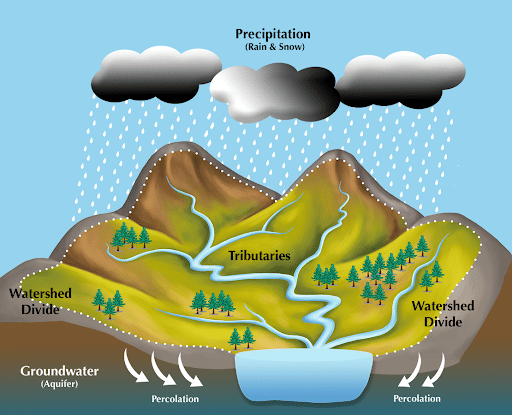
A Typical Watershed
What is Watershed Management?
- Watershed management is an attempt to halt land degradation and a comprehensive process for maximizing land productivity.
- Watershed management entails the rational use of land and water resources for optimum and sustained production while posing the least amount of risk to natural resources.
- With a little foresight and good judgment, rainwater can be made to move slowly down the slopes, ensuring maximum infiltration and percolation and thus solving the problem of soil erosion.
- Some of the procedures that could be used include reducing the impact of rain on the soil, checking its speed at various intervals, taking up all operations on the contour, and diverting the excess to prevent pressure.
- Watershed management is the process of creating and implementing plans, programs, and projects to sustain and enhance watershed functions that have an impact on the plant, animal, and human communities within the watershed boundary.
- It also involves studying the relevant characteristics of a watershed to distribute its resources sustainably.
- Water supply, water quality, drainage, stormwater runoff, water rights, and overall planning and exploitation of watersheds are characteristics of a watershed that should be managed.
- Watershed is the best way to safeguard the resources in the best way for usage in the future and contributes to the improvement of the resources' quality.
- The most effective method for wise resource management is watershed management.
Watershed Management - Principles
The core principles of watershed management are as follows:
- Using the land in accordance with its potential in light of land use classification.
- Conserving as much rainfall as possible in situ, or in the spot where it falls.
- Removing extra water at a safe speed and redirecting it to a storage area (like a tank or pond on a farm) for later use.
- Preventing the creation of gullies and building check dams in appropriate locations to manage soil erosion, collect rainwater, and rehydrate the groundwater.
- Determining the best cropping system for the watershed.
- Achieving the most productivity possible per unit of space, time, and water.
Watershed Management - Objectives
The watershed management has the following objectives:
- To successfully conserve soil, and rainwater, and harness the extra water to develop new water sources in addition to groundwater recharge.
- To encourage the use of sustainable farming practices and stabilize agricultural yield through the use of appropriate crop management and cropping systems.
- To effectively cover non-arable land through horticulture, grazing land development, and afforestation based on the site's potential.
- To increase peoples' incomes through the use of alternative businesses.
- To rebalance the environment.
- To improve cropping intensity and land equivalent ratio through intercropping and sequence cropping.
- To utilize marginal and wastelands safely through alternative land-use practices like agroforestry.
- To preserve the ecology that supports the complex of humans, animals, plants, and water in the watershed.
- To reduce the risk and stabilization of overall income during extreme weather conditions and
- To enhance storage, transportation, and marketing infrastructure facilities.
Watershed Management - Planning
- The first step in thorough planning for watershed management is to acquire sufficient maps using remote sensing methods.
- With the help of remote sensing, it is possible to characterize natural resources, including land, water, vegetation, and their interrelationships.
- Along with identifying natural resources, satellite imaging can estimate the area devoted to important crops, crop output, the area afflicted by pests and diseases, and, if applicable, the presence of drought.
- Using satellite photography, the locations of buildings such as check dams, farm ponds, etc., may also be identified.
- Satellite images can be used to determine resource distribution patterns and status evaluations. Then, detailed planning for a variety of activities is done.
- Then, mechanical, agronomical, agroecological, and forestry strategies for conserving soil and rainwater are devised and put into action.
Watershed Management - Significance
- Controls Pollution: Runoff from snowmelt or rains can add a large quantity of pollution to a lake or river. Watershed management thus aids in reducing contamination of the watershed's natural resources, including its water.
- Identifies and Regulates Ecologically Hazardous Activities: Every activity that takes place inside a watershed has some impact on the water's natural resources.
- Such activities are thoroughly identified in watershed management planning, and recommendations are made on how to effectively handle them in order to lessen their negative effects.
- Enhances Partnership Among the Stakeholders: It enhances the partnership among all watershed stakeholders as a result of watershed management planning which is crucial for the effective management of land and water resources.
- Aids in Implementation During the Availability of Limited Resources: In scenarios when resources may be limited, it is also a helpful tool to organize the implementation of watershed management plans according to priority.
- Inclusive Growth: Management of watersheds is essential for inclusive and sustainable growth.
- For instance, watershed management has demonstrated the capacity to boost water availability, diversify crops and farming systems, and support rural families by increasing agricultural production and providing varied revenue sources in drought-prone rainfed areas.
- Improve Water Quality: Water collected directly from rain is contaminated and useless; thus, Watershed Management can help improve water quality, which can then be used in households, agriculture, and industry.
- Agriculture Productivity: Watershed management increases agricultural productivity; it gives farmers more options by offering a variety of cropping systems, which can ultimately increase rural farmers' income and make the land suitable for further agriculture.
- It also helps to improve agriculture in drought-prone areas where rain is less likely; in such cases, land can make use of rain from another region and thus support farmers in their livelihood, making their lives easier.
- Economic Growth: It is the most promising way to use waste forest land to generate livelihood, income, and jobs for many people. This method allows us to use land for a variety of purposes, which benefits the country's economy.
Watershed Management - Challenges
- Project Related Issues: The underperformance of watershed management programs has been attributed to a number of factors, including outdated approaches, poor project design, insufficient and/or unsustainable financial resources, very short time frames for project interventions, and a lack of adequate knowledge of the connections between upland and lowland areas.
- Lack of Legal Support: Although many nations have broad environmental regulations in place, the creation of watershed management policies rarely receives any attention.
- The main obstacles to implementing sustainable watershed management programs are acknowledged to be the absence or inadequacy of national policies, strategies, and action plans.
- Weak Institutional Base: Once these programs are over, it has been observed that watershed-based institutions are on the verge of collapsing since the inputs they got are frequently insufficient to support the institutional framework.
- Self-Help Groups are also not effectively incorporated into the watershed programs.
- The sustainability of natural resources, communities' capacity for diversification, and their ability to receive assistance from various programs are all influenced by the institutional base.
- Initiatives Excluding Reserved Forestlands: The establishment of entitlements over the forest produce and the inclusion of reserve forestlands in watershed development plans are not yet included in watershed development programs.
- A significant obstacle is the lack of practical agreement between the departments of rural development and forestry.
Watershed Management in India
- A national system of Watershed Delineation and Codification has been developed by the Department of Agriculture's All India Soil and Land Use Survey Organization.
- The watershed has been split into four categories, depending on its size namely: Basins, Catchments, Sub-catchments, and Watersheds.
- There are 3200 watersheds, 112 catchments, 35 rivers, and 500 sub-catchments in India.
- The 3200 watersheds have been grouped into the following three categories for planning and development purposes based on the area:
- Sub-watersheds (10,000 to 50,000 hectares)
- Milli-Watershed (1000 to 10,000 hectares)
- Micro-Watershed (100 to 1000 hectares)
- Mini-Watershed (1 to 100 hectares)
Integrated Watershed Management Programme (IWMP)
- The Integrated Watershed Management Programme (IWMP), which was launched in 2009–10 by the Ministry of Rural Development, aims to encompass 55 million hectares of rain-fed land by 2027.
- The Department of Land Resources has been implementing it since 2009-10, after integrating three area development programmes, namely:
- Desert Development Programme (DDP)
- Drought Prone Areas Programme (DPAP)
- Integrated Wastelands Development Programme (IWDP)
- After China's, the IWMP of India is the largest watershed program in the world.
- The main goals of the IWMP are to harness, conserve, and develop degraded natural resources such as soil, vegetative cover, and water; to prevent soil run-off; to collect rainwater and recharge the groundwater table; to increase crop productivity; to introduce multi-cropping and diverse agro-based activities; to promote sustainable livelihoods, and to increase household incomes.
- By utilizing, protecting, and improving damaged natural resources like soil, vegetative cover, and water through watershed management activities, it seeks to reestablish the ecological balance.
- The initiative is being carried out in every state in the nation, and it is being funded 90:10 by the central and state governments.
- Gram Panchayat has been effectively involved in the IWMP to perform important functions at the Village / Watershed level to maintain transparency and people's participation.
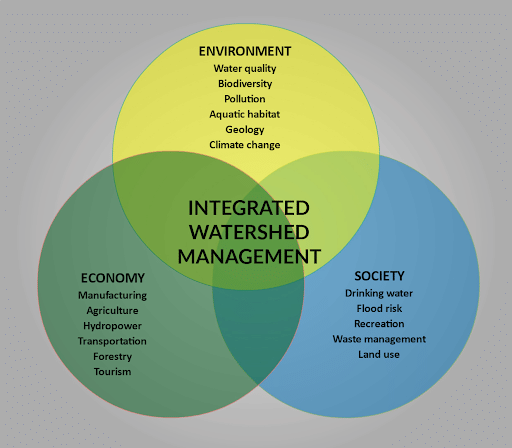
Integrated Watershed Management
Watershed Management - Related Initiatives
- Haryali Watershed Development Project: The Central Government is funding the Haryali watershed development project, which intends to make it possible for the rural population to save water for drinking, irrigation, fisheries, and afforestation.
- With the assistance of the public, Gram Panchayats are carrying out this project.
- Neeru-Meeru (Water and You) Program: With the help of the public, the Neeru-Meeru (Water and You) initiative in Andhra Pradesh and Arvary Pani Sansad in Alwar, Rajasthan, have begun building various water-harvesting structures like percolation tanks, dug-out ponds (Jihad), check dams, etc.
- Tamil Nadu's Mandate for water Harvesting Structures: In Tamil Nadu, water harvesting systems for homes are required. Without building structures for water harvesting, no building can be built.
Conclusion
Watersheds are significant because the surface water features and stormwater runoff within them eventually drain to other bodies of water. When developing and implementing water quality protection and restoration actions, it is critical to consider these downstream effects. The greatest way to encourage people to participate in these techniques is through appropriate information and awareness; people support will strengthen the capabilities and advantages of such management strategies. Local partnerships and alliances between the government and the people must be improved in order to increase awareness.
|
|
|
|---|---|
| Agriculture Notes | Tillage |
| Farming Systems | Sustainable Agriculture |
| Organic Farming | Integrated Farming System |
| Factors determining cropping pattern in India | Major Crops of India |
FAQs
Question: What is watershed management?
Answer: Watershed management refers to the process of managing land and water resources within a watershed to enhance water quality, prevent soil erosion, and sustain ecosystems while promoting agricultural productivity and community welfare.
Question: Why is watershed management important?
Answer: Watershed management is crucial for ensuring the sustainable use of water resources, reducing soil erosion, preventing floods, and maintaining biodiversity. It helps improve agricultural yields and enhances the overall resilience of communities against environmental changes.
Question: What are some key practices involved in watershed management?
Answer: Key practices in watershed management include soil conservation techniques (like contour farming), afforestation and reforestation, efficient water harvesting and storage, promoting sustainable agricultural practices, and community involvement in resource management.
Question: How does climate change affect watershed management?
Answer: Climate change impacts watershed management by altering precipitation patterns, increasing the frequency of extreme weather events, and affecting water availability. This necessitates adaptive management strategies to address these challenges and ensure sustainable water resource management.
Question: What role do communities play in watershed management?
Answer: Communities play a vital role in watershed management by participating in decision-making processes, implementing conservation practices, and maintaining local water resources. Community involvement ensures that management strategies are tailored to local needs and ecological conditions, enhancing the effectiveness of watershed initiatives.
MCQs
1. What is the primary goal of watershed management?
A. Urban development
B. Soil conservation
C. Sustainable land and water resource management
D. Industrial growth
Answer: (C) See the Explanation
The primary goal of watershed management is to ensure sustainable land and water resource management to enhance productivity and maintain ecological balance.
2. Which of the following is a practice associated with watershed management?
A. Deforestation
B. Contour farming
C. Urban sprawl
D. Intensive mining
Answer: (B) See the Explanation
Contour farming is a sustainable agricultural practice used in watershed management to reduce soil erosion and improve water retention.
3. How does reforestation benefit watershed management?
A. Increases soil erosion
B. Decreases biodiversity
C. Improves water quality and retention
D. Diminishes local flora
Answer: (C) See the Explanation
Reforestation improves water quality and retention by stabilizing soil, enhancing biodiversity, and regulating the hydrological cycle.
4. Which of the following factors poses a challenge to effective watershed management?
A. Community participation
B. Climate change
C. Proper land use
D. Effective policy implementation
Answer: (B) See the Explanation
Climate change poses significant challenges to effective watershed management by altering precipitation patterns and increasing the frequency of extreme weather events.
5. What is a critical aspect of successful watershed management?
A. Government regulation only
B. Community involvement and participation
C. Industrial expansion
D. Sole reliance on technology
Answer: (B) See the Explanation
Community involvement and participation are critical for the success of watershed management, ensuring that strategies align with local needs and ecological conditions.
GS Mains Questions and Model Answers
1. Discuss the significance of watershed management in ensuring sustainable agriculture in India.
Answer: Watershed management is vital for sustainable agriculture in India, a country heavily reliant on monsoonal rains for its agricultural productivity. By implementing effective watershed management practices such as rainwater harvesting, soil conservation, and afforestation, farmers can improve water availability during dry seasons and enhance soil health. Sustainable practices lead to increased agricultural productivity while reducing the negative impacts of soil erosion and water scarcity. Moreover, watershed management promotes biodiversity, supports ecosystems, and contributes to overall rural development by empowering communities to manage their resources effectively.
2. Evaluate the impact of climate change on watershed management practices in India.
Answer: Climate change significantly affects watershed management practices in India by altering rainfall patterns, increasing the frequency and intensity of extreme weather events, and affecting water availability. These changes necessitate adaptive management strategies that can accommodate the unpredictability of weather patterns. Additionally, climate change may exacerbate existing challenges such as soil erosion, pollution, and resource depletion. Therefore, integrating climate resilience into watershed management practices is crucial for sustaining agricultural productivity and ensuring water security in the face of climate uncertainties.
3. Analyze the role of community participation in the success of watershed management programs.
Answer: Community participation is essential for the success of watershed management programs as it fosters a sense of ownership and responsibility among local stakeholders. Engaging communities in decision-making processes, implementation of practices, and monitoring of resources ensures that management strategies are culturally appropriate and contextually relevant. Additionally, local knowledge contributes to identifying specific challenges and solutions tailored to the watershed's needs. Successful watershed management programs often rely on community cooperation to sustain efforts over time, ultimately leading to improved water management and ecosystem health.
Previous Year Questions on Watershed Management
1. UPSC CSE Prelims 2019
Question: What is the primary objective of watershed management?
A. Urbanization
B. Soil conservation
C. Integrated water resource management
D. Industrial development
Answer: C
Explanation: The primary objective of watershed management is integrated water resource management, focusing on sustainable land and water resource use within a watershed.
2. UPSC CSE Mains 2021 (GS Paper 3)
Question: Discuss the challenges and opportunities in implementing watershed management in India.
Answer: Implementing watershed management in India presents various challenges, including climate variability, lack of awareness, and insufficient community involvement. However, opportunities exist in the form of government initiatives, increased focus on sustainable practices, and the integration of modern technology. By leveraging these opportunities, India can enhance water resource management, mitigate the impacts of climate change, and improve agricultural productivity through effective watershed management strategies.
Download the PREPP App and attempt FREE IAS Exam Mock Tests and get complete study material!

Full Test - 04: UPSC CSE Prelims CSAT (Paper-II)
Full Test - 03: UPSC CSE Prelims CSAT (Paper-II)
UPSC CSE Prelims 2026 GS Paper 1 Question Paper (24-May-2026)
UPSC CSE Prelims 2026 CSAT Paper 2 Question Paper (24-May-2026)

17 February 2025 | The Hindu Must Read Articles | Current Affairs

16 February 2026 | The Hindu Must Read Articles | Current Affairs

13 February 2026 | The Hindu Must Read Articles | Current Affairs









Comments