Manures - Agriculture Notes
Manure is a complex mixture of numerous organic and inorganic particles, suspended in water, and dissolved in it. Plant and animal wastes are used as a source of plant nutrients in manures. After decomposition, they release nutrients. It consists of all excreta, including feces, urine, and/or uric acid (in the case of chickens), mixed with other components in varying proportions. Manures are classified as bulky organic manures or concentrated organic manures. This article will explain to you about Manures which will be helpful in preparing the Agriculture Syllabus for the UPSC Civil Service exam.
|
Table of Contents |
What are Manures?
- Manure is the degraded form of dead plants and animals that are spread on the soil to boost productivity.
- Manures are a cost-effective and natural source of fertilizer.
- Excreta from humans and animals are also utilized as manure. The nitrogen, phosphorus, and potassium content in livestock manure is high.
- Because manure is high in organic matter and humus, it promotes soil fertility.
- These are more cost-effective in the long term. It is a resource that is both valuable and renewable.
- Manures are plant and animal wastes used to provide plant nutrients. After decomposition, they release nutrients.
- The practice of collecting and utilizing waste from animal, human, and vegetable sources to improve crop productivity is as old as agriculture itself.
- Organic materials derived from animal, human, and plant residues that contain plant nutrients in complex organic forms are referred to as manures.
- Manures with low nutrient content per unit quantity have a longer residual effect than fertilizers with high nutrient content, in addition to improving soil physical properties.
- Manuring is the process of adding manures to a garden. Manuring should be done on a regular basis, or the plants will get feeble.
- Based on the concentration of nutrients, manures can also be classified as bulky organic manures or concentrated organic manures.
|
|
|
|---|---|
| Fertilizers | Classification of Organic manures |
| Concentrated organic manures | Integrated Nutrient Management (INM) |
| Elements Required In Plant Growth | Permaculture |
Manures - Major Sources
The major sources of manures are as follows:
- Cattle shed wastes from biogas plants, including dung, urine, and slurry.
- Wastes from human habitation, include dark soil, human urine, trash, sewage, sludge, and sullage.
- Jitter from the poultry, sheep, and goat fecal matter.
- Bone meal, meat meal, blood meal, horn and hoof meal, and other slaughterhouse wastes and fish wastes.
- Byproducts of agro-industries, such as oil cakes, bagasse and press mud, and waste from the processing of fruits and vegetables.
- Crop wastes, including sugarcane debris, stubs, and other materials, weeds, tank silt, water hyacinth, and
- Crops that use green manure and green leaf manure.
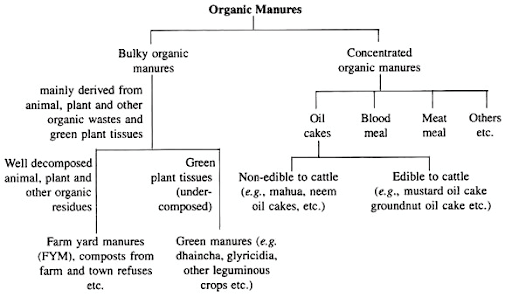
Types of Organic Manures
Bulky Organic Manures
- Bulky organic manures have a low nutrient content and are applied in large quantities.
- The most important and widely used bulky organic manures are farmyard manure (FYM), compost, and green manure.
- There are several advantages to using bulky organic manures:
- They provide plant nutrients such as micronutrients.
- They improve soil's physical properties such as structure, water retention capacity, and so on.
- They improve nutrient availability.
- Carbon dioxide produced during decomposition serves as a CO2 fertilizer.
- Plant parasitic nematodes and fungi can be controlled to some extent by changing the soil microorganism balance.
Types of Bulky Organic Manures
Green Manure
- Green manure raises the organic matter content of the soil.
- Such manures have deep roots that penetrate the soil.
- These aid in the control of weeds as well as the avoidance of soil erosion.
- Legumes such as vetch, clover, beans, and peas; grasses such as annual ryegrass, oats, rapeseed, winter wheat, and winter rye; and buckwheat are examples of green manures.
*To know more about the topic, click this link Green Manuring
Farmyard Manure
- Farmyard manure is a natural fertilizer that helps to improve the soil structure.
- It expands the capacity of the soil to hold more water and minerals.
- It also boosts the soil's microbial activity, which improves mineral delivery and plant nutrition.
- Examples of farmyard manures include cattle shed wastes-dung, urine, sewage, sludge, poultry wastes, droppings of sheep and goat and fish wastes.
Compost Manure
- It improves the soil structure as well as its water and nutrient retention capacity.
- As a result, the nutrient value increases, and the plants' health improves.
- Examples of compost manures include food scraps, grass clippings, leaves, wood chippings, and coffee grounds.
*To know more about the topic, click this link Compost Manure
Concentrated Organic Manures
- Concentrated organic manures contain more nutrients than bulky organic manures.
- Oilcakes, blood meal, bone meal, fish manure, and other concentrated organic manures are important.
- These are also referred to as organic nitrogen fertilizers.
- Before organic nitrogen is used by crops, it is converted into readily usable ammoniacal and nitrate nitrogen by bacterial action.
- As a result, these organic fertilizers are relatively slow acting, but they provide available nitrogen for a longer period of time.
*To know more about the topic, click this link Concentrated Organic Manures
Manures - Benefits
- Manures improve the water-holding capacity of the soil.
- Manure makes the soil porous and allows gases to flow freely.
- The soil improves in texture with the application of manures. In the soil, the number of bacteria grows as a result of applying manures.
- They add plant nutrients in small amounts as well as micronutrients that are necessary for plant growth.
- Microbial activity is increased, which aids in the availability of plant nutrients.
- Because of the slow release of nutrients, organic manures should be incorporated before sowing or planting.
- Manure may be utilized to produce various kinds of biofuels because it is rich in carbon and other components.
- There is a lot of fiber content in manure. The fiber comes from both unprocessed animal feed and other bedding materials like straw or sawdust that are mixed in with the manure.
- Numerous specialized consumer goods, including plant growth media (comparable to peat moss), seed starter pots, fertilizer garden sculptures, paper, and building materials, have been made using manure fiber.
- Additionally, worms, bug larvae, algae, and other living things can be grown using the nutrients in manure.
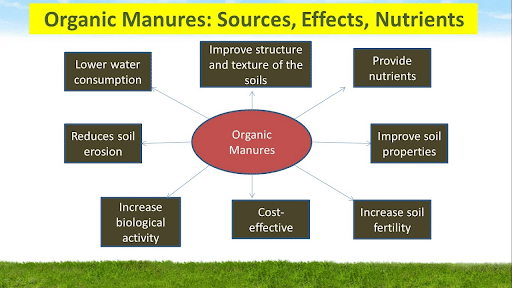
Benefits of Manure
Manures - Harmful Effects
- Manure has long been used in farms and kitchen gardens since it is considered organic and something that people believe is great for food production due to the concept that "it originates from nature and returns to nature."
- However, according to research produced by the United Nations Food and Agriculture Organization (FAO), livestock manure is the second most common source of soil pollution.
- Despite their potential agricultural benefits, there is enough scientific evidence that manure contains growing amounts of heavy metals, pathogen organisms, and veterinary antibiotic residues, which may lead to the expansion of antimicrobial-resistant bacteria in soils.
- Nitrate levels in the manure above a certain threshold can be hazardous to cattle and humans.
- In some cases, high nitrate concentrations have been created by stored or land-applied manures or nitrogen fertilizers.
- Nitrogen that is not utilized for crop or plant growth can quickly reach the groundwater because nitrates freely leach down through the soil profile.
- They ultimately pollute the soil apart from other implications.
- Untreated manure is a major source of veterinary antibiotics, which can lead to an increase in antibiotic resistance in soils.
Conclusion
Manure is an excellent soil conditioner. It acts as a field residue when applied to agricultural fields. Farmers can sell the manure to people who want to improve the fertility of their soil. As a result, it has the potential to generate revenue for farmers. They improve the overall capability and sustainability of the soil. Manure improves the soil's ability to hold water. The organic content of the soil can also be increased by using raw manure such as biochar, compost, and so on. Manure is environmentally friendly and has significantly increased food production. It was extremely difficult to feed an expanding population. The application of manure improved soil fertility and increased crop yield.
FAQs
Question. What are manures in agriculture?
Answer: Manures are organic materials, typically derived from plants or animals, used to enrich soil fertility. They improve soil structure, water retention, and nutrient content, promoting healthy plant growth. Manures are a key component of sustainable farming practices, reducing the reliance on chemical fertilizers.
Question. What are the different types of manures used in agriculture?
Answer: There are two main types of manures: Farmyard manure (FYM) and green manure. FYM is decomposed organic matter from animals, including dung, urine, and bedding. Green manure refers to plants grown specifically to be tilled into the soil to improve its fertility. Both types help in replenishing soil nutrients and organic matter.
Question. How does farmyard manure improve soil fertility?
Answer: Farmyard manure (FYM) is rich in essential nutrients such as nitrogen, phosphorus, and potassium, which are crucial for plant growth. When added to the soil, it enhances microbial activity, improves soil texture, and boosts water-holding capacity, making the soil more fertile and productive over time.
Question. What is green manure, and how does it benefit the soil?
Answer: Green manure is a type of plant grown primarily to be plowed under the soil to enrich its nutrient content. Plants like legumes (e.g., clover, vetch) are commonly used as green manure because they fix nitrogen in the soil, enriching the soil with this essential nutrient and improving its structure.
Question. What is the difference between manures and chemical fertilizers?
Answer: Manures are organic in nature, derived from natural sources such as animals and plants, whereas chemical fertilizers are synthesized from chemical compounds. Manures improve soil structure and provide long-term benefits by increasing organic matter, while chemical fertilizers are fast-acting but can degrade soil health over time if used excessively.
MCQs
- Which of the following is a primary source of farmyard manure?
A) Plant residues
B) Animal excreta
C) Industrial waste
D) Household waste
Answer: (B) See the Explanation
Farmyard manure is primarily composed of animal excreta, including dung, urine, and bedding materials, which are rich in nutrients like nitrogen, phosphorus, and potassium.
- What is the main benefit of adding green manure to the soil?
A) Increases water retention
B) Fixes nitrogen in the soil
C) Adds heavy metals
D) Prevents soil erosion
Answer: (B) See the Explanation
Green manure plants, especially legumes, are able to fix nitrogen from the atmosphere and add it to the soil, improving soil fertility and reducing the need for synthetic nitrogen fertilizers.
- Which of the following is a characteristic of organic manures?
A) Quick release of nutrients
B) High solubility in water
C) Slow-release nutrients
D) High nutrient concentration
Answer: (C) See the Explanation
Organic manures release nutrients slowly over time, enhancing soil health and ensuring long-term fertility. Unlike chemical fertilizers, their effects are gradual and sustainable.
- Which of the following is a common crop used for green manure?
A) Wheat
B) Soybean
C) Clover
D) Maize
Answer: (C) See the Explanation
Clover is commonly used as green manure because it is a leguminous plant that fixes nitrogen in the soil, enhancing soil fertility for subsequent crops.
- Why is farmyard manure considered beneficial for soil structure?
A) It increases water infiltration
B) It reduces organic matter
C) It decreases microbial activity
D) It promotes the growth of weeds
Answer: (A) See the Explanation
Farmyard manure improves soil structure by increasing organic matter, enhancing microbial activity, and improving the soil's ability to retain moisture and nutrients.
GS Mains Questions and Model Answers
Q1: Discuss the role of manures in sustainable agricultural practices.
Answer: Manures play a pivotal role in sustainable agriculture by replenishing the soil with essential nutrients and organic matter. Unlike chemical fertilizers, manures are derived from natural sources and provide a long-term solution to soil fertility management.
- Farmyard Manure (FYM): The addition of FYM enhances soil structure, increases the microbial population, and improves water-holding capacity. This helps in creating a balanced environment for plant roots, which is essential for healthy plant growth. The slow release of nutrients from FYM ensures a continuous supply of nutrients to plants over a long period.
- Green Manure: Growing crops specifically to improve soil fertility is an age-old practice. Green manure plants, particularly legumes, fix nitrogen in the soil, reducing the need for synthetic nitrogen fertilizers. When these plants are plowed under, they decompose, adding organic matter and enhancing soil health.
- Nutrient Cycle: By recycling organic waste through composting or other forms of manure, farmers can reduce the reliance on synthetic inputs. This also minimizes environmental pollution associated with chemical fertilizers and pesticides.
- Environmental Impact: The use of manures reduces soil erosion, improves soil structure, and enhances biodiversity in the soil ecosystem. These benefits support the broader goals of environmental sustainability, such as carbon sequestration and reduced greenhouse gas emissions from agriculture.
Incorporating manures into farming practices is an integral part of sustainable agriculture, ensuring soil fertility, environmental health, and long-term agricultural productivity.
Q2: What are the environmental impacts of excessive use of chemical fertilizers, and how can manures mitigate these effects?
Answer: The excessive use of chemical fertilizers has significant environmental consequences, leading to soil degradation, water pollution, and loss of biodiversity. Some key impacts include:
- Soil Acidification: The continuous use of chemical fertilizers, especially nitrogen-based fertilizers, leads to soil acidification. This reduces soil health and fertility, making it less suitable for crop growth.
- Eutrophication of Water Bodies: Runoff from fields treated with excess chemical fertilizers leads to the leaching of nutrients like nitrogen and phosphorus into nearby rivers and lakes. This causes eutrophication, which depletes oxygen levels in water and harms aquatic life.
- Greenhouse Gas Emissions: The production and use of synthetic fertilizers release nitrous oxide, a potent greenhouse gas, contributing to climate change.
- Decline in Soil Microbial Activity: Chemical fertilizers disrupt the balance of soil microorganisms, which play a crucial role in nutrient cycling and soil health. Over time, this can lead to decreased soil fertility and reduced crop yields.
Manures can mitigate these environmental effects by:
- Enhancing Soil Health: Manures improve soil structure, increase organic matter, and promote healthy microbial activity, leading to better soil fertility and water retention.
- Slow Release of Nutrients: Unlike chemical fertilizers, manures release nutrients slowly, reducing the risk of nutrient leaching and minimizing water pollution.
- Carbon Sequestration: Organic manures, especially when used in combination with cover crops and crop rotations, help sequester carbon in the soil, reducing greenhouse gas emissions.
- Sustainable Fertility Management: The use of manures reduces dependency on chemical fertilizers, making agriculture more sustainable in the long term.
Thus, the use of manures is a critical practice for sustainable soil and environmental management, balancing nutrient availability with minimal environmental harm.
Q3: Analyze the challenges associated with the use of manures in modern agriculture.
Answer: While manures offer numerous benefits, their widespread adoption in modern agriculture faces several challenges:
- Availability and Accessibility: Manure is often not available in large quantities, especially in urban or industrial areas. The supply of animal manure is limited, and in many cases, it is insufficient to meet the nutrient needs of large-scale commercial farming.
- Cost of Transportation: The transportation of manure from farms or livestock areas to agricultural fields can be expensive, particularly in regions where livestock farming is not prevalent. This increases the overall cost of manure as a farming input.
- Nutrient Imbalance: Manures, particularly farmyard manure, may not provide the full spectrum of nutrients needed for crop growth. For instance, they may be deficient in specific micronutrients or may have imbalanced nitrogen-to-phosphorus ratios, requiring farmers to supplement with other fertilizers.
- Handling and Storage: Manure handling requires careful attention to prevent contamination and loss of nutrients. If not composted or stored properly, manure can become a source of pathogen transmission, creating health risks for farmers and consumers.
- Labor Intensive: The application of manure requires more labor and time compared to chemical fertilizers, which are easy to apply and require less human effort. This can be a deterrent for farmers, particularly those with limited labor resources.
Despite these challenges, the use of manures remains a vital practice for sustainable agriculture. Government incentives, education on proper manure management, and advancements in manure processing technologies can help overcome these barriers and promote more widespread use.
Previous Year Questions on Manures in Agriculture
1. UPSC CSE 2016
Question: What are the advantages of using organic fertilizers like manures over synthetic fertilizers in agriculture?
Answer: Organic fertilizers such as manures improve soil structure, increase microbial diversity, and provide a slow release of nutrients, reducing the risk of nutrient leaching and environmental contamination. They enhance soil fertility over the long term, unlike synthetic fertilizers that provide quick but short-lived results. Additionally, organic fertilizers promote sustainable agricultural practices, reducing dependency on chemicals and improving food security.
2. UPSC CSE 2018
Question: How can the government encourage the use of organic manures among farmers?
Answer: The government can promote the use of organic manures through subsidies, providing training on composting techniques, establishing organic farming certification programs, and ensuring access to organic manure at affordable prices. Incentives for green manure cultivation and composting can also be implemented. This would help farmers shift towards sustainable practices, improving soil health and reducing reliance on chemical inputs.
Download the PREPP App and attempt FREE IAS Exam Mock Tests and get complete study material!

Full Test - 04: UPSC CSE Prelims CSAT (Paper-II)
Full Test - 03: UPSC CSE Prelims CSAT (Paper-II)
UPSC CSE Prelims 2026 CSAT Paper 2 Question Paper (24-May-2026)
UPSC CSE Prelims 2026 GS Paper 1 Question Paper (24-May-2026)

17 February 2025 | The Hindu Must Read Articles | Current Affairs

16 February 2026 | The Hindu Must Read Articles | Current Affairs

13 February 2026 | The Hindu Must Read Articles | Current Affairs









Comments