Organic Farming - Agriculture Notes
Organic farming is a farming method that focuses on cultivating the land and raising crops in a natural manner. It aims to keep the soil alive and healthy by using organic wastes (crop, animal and farm wastes, aquatic wastes) and other biological materials, as well as beneficial microbes (biofertilizers), to release nutrients to crops for increased sustainable production in an environmentally friendly, pollution-free environment. In this article, we will discuss Organic Farming which will be helpful for UPSC exam preparation.
| To Read update on this topic: |
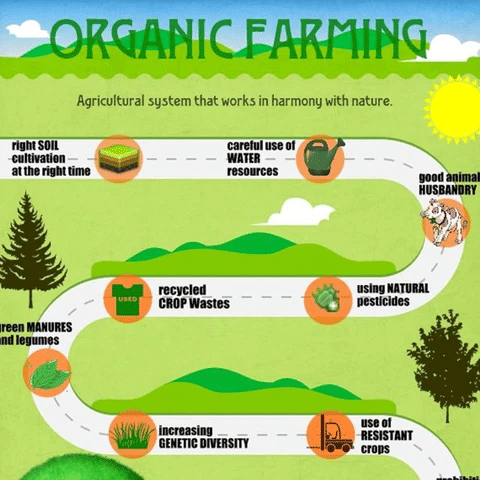
Organic Farming
What is Organic Farming?
- Organic farming, also known as ecological farming or biological farming, is an agricultural system that uses organic fertilisers such as compost manure, green manure, and bone meal and emphasises techniques such as crop rotation and companion planting.
- Organic farming is an agricultural practice that makes use of biological pesticides and fertilizers derived from plant or animal waste.
- The goal of organic farming is to create foods that are of the highest quality, have a high nutritional value, and are free of chemicals.
- It strives to develop a sustainable system that conserves energy, soil, and water; while at the same time providing general care for the environment.
- In fact, the use of chemical pesticides and synthetic fertilizers was the cause of the environmental harm that organic farming was intended to address.
- Or to put it another way, organic farming is a new type of agriculture or farming that improves, maintains, and repairs the ecological balance.
- Organic standards are intended to allow the use of naturally occurring substances while prohibiting or strictly limiting the use of synthetic substances.
- For example, naturally occurring pesticides such as pyrethrin are permitted, whereas synthetic fertilizers and pesticides are generally prohibited.
- Copper sulphate, elemental sulphur, and Ivermectin are examples of permitted synthetic substances.
- Genetically modified organisms, nanomaterials, human sewage sludge, plant growth regulators, hormones, and antibiotic use in livestock husbandry are all prohibited.
- Organic farming advocates benefits such as sustainability, openness, self-sufficiency, autonomy and independence, health, food security, and food safety.
Need of Organic Farming
- With the increase in population, we would be compelled not only to stabilise agricultural production, but also to increase it in a sustainable manner.
- Scientists have recognised that the 'Green Revolution,' with its high input use, has reached a plateau and is now being sustained with a diminishing return of falling dividends.
- Thus, a natural balance must be maintained at all costs in order for life and property to exist.
- The obvious choice would be more relevant in the current era, when these agrochemicals are produced from fossil fuels, are not renewable, and are becoming scarce.
- It may also have a significant impact on our foreign exchange in the future.
Features of Organic Farming
- Long-term soil fertility is protected by maintaining organic matter levels, encouraging soil biological activity, and using caution in mechanical intervention.
- Indirect crop nutrition is provided by using relatively insoluble nutrient sources that are made available to the plant by soil microorganisms.
- Nitrogen self-sufficiency via legumes and biological nitrogen fixation, as well as effective recycling of organic materials such as crop residues and livestock manures
- Crop rotations, natural predators, diversity, organic manuring, resistant varieties, and limited (preferably minimal) thermal, biological, and chemical intervention are used to control weeds, diseases, and pests.
- Comprehensive livestock management that takes into account evolutionary adaptations, behavioural needs, and animal welfare issues such as nutrition, housing, health, breeding, and rearing.
- It pays close attention to the farming system's impact on the larger environment, as well as the conservation of wildlife and natural habitats.
Components of Organic Farming
Crop Rotation
- Crop rotation entails changing the species grown on the same field from season to season.
- It is a systematic arrangement for growing various crops in a more or less regular sequence on the same land for a period of two years or more.
- A mixed cropping, pasture, and livestock system is desirable, if not required, for the success of sustainable agriculture.
- Crop rotation, as opposed to monoculture farming practises:
- eliminates pest and weed infestations, as well as chemical contaminations, to address the issues (because different species are affected by different pests);
- prevents soil erosion by using various root systems;
- protects soil from depletion by increasing nutrient release through diverse plants, thereby eliminating synthetic fertiliser applications, which are prohibited in organic agriculture;
- increases yields while decreasing costs.
Cover Cropping
- This farming method entails covering the field with any plant species, either for a specific season or perennially, partially or completely between crop rows.
- With their roots, cover crops reduce soil erosion and improve water filtration and aeration.
- They also eliminate weeding with upper parts by shielding undesirable vegetation from sunlight.
Green Manure
- Mixing green plants with soil enriches it with organic matter, particularly nitrogen.
- It also improves soil quality by increasing moisture levels and adding nutrients for microorganisms.
- Weed infestation is also reduced by the agricultural method described.
Animal Manure
- This organic farming practise enriches the soil with natural animal components, either raw or composted (excluding slaughter by-products).
- However, the method is limited in that the material must not contain any synthetic additives, the soil must be tested before applications, and manures must be applied at least three months before harvesting.
- Composted forms are preferable because they are less bulky and contain fewer potential pathogens and contaminants.
Integrated Weed Management
- Organic farming does not allow the use of harsh chemicals. As a result, weed control is carried out through other methods of integrated weed management, such as:
- preventing weed penetration onto the field with machinery, animals, and irrigation waters;
- manual weeding;
- crop rotation;
- mulching;
- natural chemicals to stop germination;
- haymaking prior to weed seeding;
- introducing populations of birds/insects to consume weed seeds.
Integrated Pest Management
- Organic farming does not intend to eradicate pests completely because doing so would disrupt the ecosystem.
- This agricultural concept heavily relies on alternative pest control methods such as prevention, natural barrier construction, physical removal, and combating pest invasions with biological enemies (predators) such as ladybugs vs aphids.
- In terms of synthetic additives, the concept allows only mild pesticides approved for organic farming that have no disputable properties and cause the least amount of harm to humans and nature.
- Soap, hydrogen peroxide, baking soda, sulphur, or natural pest repellents such as neem, citronella, and lavender oil are examples of such additives.
Livestock Management
- The organic agriculture guidelines for breeding poultry and cattle prohibit the use of dangerous and questionable additives such as synthetic medications, growth-promoting drugs and hormones, antibiotics, non-organic forage, GMOs, clones, and so on.
- Farming practises must provide adequate conditions for raising and grazing livestock, as well as create an environment conducive to natural livestock behaviour both indoors and outdoors.
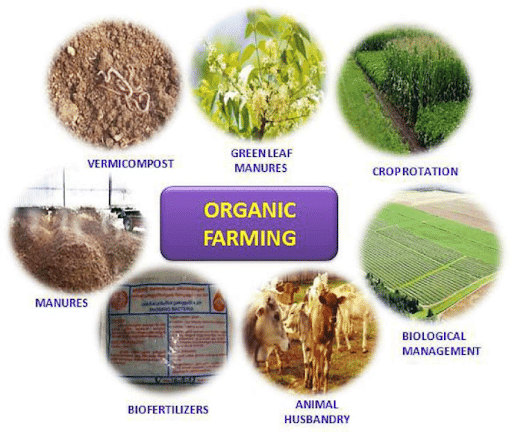
Components of Organic Farming
Concepts of Organic Farming
- Organic farming has been a way of life and a tradition in our Indian farming system for centuries; it is not a new concept.
- Organic farming has its own system for controlling pests and diseases in crop and livestock production, which avoids the use of various synthetic chemicals or gene manipulation.
- There are various types of organic farming that are practised in the country's diverse climate, with forest produce falling under this category by default.
- Organic farming, among other types of farming systems, is gaining popularity due to its positive impact on the environment.
- Furthermore, organic farming is labour intensive, which increases rural employment and long-term improvements in resource quality.
- Organic farming is based on an intimate understanding of nature's laws and rules.
- In today's terminology, it is a farming system method that primarily aims at cultivating the land and raising crops in such a way that the soil remains alive and healthy through the use of organic wastes and other biological materials, as well as beneficial microbes (biofertilizers).
- They release nutrients to increase crop yield and sustainability. "Organic agriculture is a production system that promotes the health of soils, ecosystems, and people."
- Organic agriculture combines tradition, innovation, and science to benefit the shared environment and promote fair relationships and a good quality of life for all involved.
*For detailed notes on this topic, check this link Concepts of Organic Farming
Principles of Organic Farming
- The four organic farming principles — health, fairness, ecology, and care — offer a vision for agriculture that encourages environmentally friendly cultivation and production.
- Organic farming aims to produce superior quality products that are high in nutritional value and free of chemicals, with the goal of promoting good health.
- It aims to create a sustainable system that conserves energy, soil, and water while also providing general environmental maintenance.
*For detailed notes on this topic, check this link Principles of Organic Farming
Ecological Farming
- Ecological farming is based on the premise that crops use natural resources to fight pests, maintain or increase soil fertility, and so on, without the use of synthetic chemicals such as fertilisers, pesticides, antibiotics, or organisms that have been genetically modified.
- This results in more natural, healthy, and nutritious foods. Furthermore, it contributes to greater environmental sustainability while having a low environmental impact.
- Biodynamic agriculture, natural agriculture or Fukuoka, synergistic agriculture, messianic agriculture, permaculture, and other types of ecological farming are based on balance and respect for the environment.
- Ecological farming is similar to organic farming, but it goes a step further by considering the entire ecosystem and acting only in accordance with the natural life cycle.
- Ecological farming is founded on a number of goals and principles, as well as good practises designed to reduce man's impact on the environment.
*For detailed notes on this topic, check this link Ecological Farming
Organic vs Inorganic Fertilizers
- Fertilizers are substances that are applied to crops in order to boost their yield.
- An inorganic fertilizer or a chemical fertilizer is defined as any inorganic substance that is given to soil to support plant growth and is completely or partially synthetic in nature.
- Examples include potassium sulphate, ammonium nitrate, and ammonium phosphate.
- Organic fertilizers are substances that are made from the byproducts or remains of living things and are rich in the nutrients needed for plant growth.
- Blood meal, compost, seaweed, and worm castings are a few examples.
*For detailed notes on this topic, check this link Organic vs Inorganic Fertilizers
Advantages of Organic Farming
- Farmers can cut production costs because they don't have to buy expensive chemicals or hire healthier farm workers.
- A farmer can achieve a good return on investment by using less expensive local inputs.
- Organic products are in high demand in India and around the world, which increases export revenue.
- Organic products are more nutrient-dense, palatable, and healthy than those made with chemicals and fertilizers.
- Organic farming uses no fertilizers or chemicals, so it has no negative effects on the environment.
- It can support significantly more wildlife, especially in lowlands where animals can roam in pastures or graze on grassland.
- Organic farms save energy and protect food by containing fewer residues.
- Organic farming practices not only benefit dairies, but when dairies feed organic feed to their cows, the cows experience better health.
- In a natural setting, more animals and plants can coexist.
- Groundwater pollution has been stopped.
Disadvantages of Organic Farming
- Organic manure is not widely available, and if organic inputs are purchased, it may be more expensive than chemical fertilisers in terms of plant nutrients.
- Organic farming production declines, particularly in the first few years, so farmers should be paid a premium for organic produce.
- The guidelines for organic production, processing, transportation, and certification, among other things, are beyond the comprehension of the average Indian farmer.
- Organic produce marketing is also not well-organized.
- There are a number of farms in India that have never been chemically managed or cultivated or have returned to organic farming due to farmers' beliefs or purely for economic reasons.
- Thousands of farmers cultivating millions of acres of land are not classified as organic, despite the fact that they are.
- Because of the costs involved, as well as the extensive documentation required by certifiers, these farmers may never opt for certification.
- Organic food is more expensive because farmers do not get as much from their land as conventional farmers do. Organic products can cost up to 40% more.
- Organic food is produced in smaller quantities, making marketing and distribution inefficient.
- Food poisoning could become more common.
- Organic farming is incapable of producing enough food to feed the world's population. This could lead to starvation in countries that currently produce just enough food.
Organic Farming in India
|
Government Initiatives to Promote Organic Farming
Mission Organic Value Chain Development in the NorthEast Region (MOVCD-NER)
- MOVCD-NER is a Central Sector Scheme and a sub-mission of the National Mission for Sustainable Agriculture (NMSA).
- It was launched in 2015 by the Ministry of Agriculture and Farmers Welfare for implementation in the states of Arunachal Pradesh, Assam, Manipur, Meghalaya, Mizoram, Nagaland, Sikkim, and Tripura.
- The scheme aims to develop certified organic production in a value chain mode, connecting growers with consumers and supporting the development of the entire value chain.
Paramparagat Krishi Vikas Yojana (PKVY)
- The Paramparagat Krishi Vikas Yojana, which was launched in 2015, is an elaborated component of the major project National Mission of Sustainable Agriculture's Soil Health Management (NMSA-SHM).
- Organic farming is promoted under PKVY through the cluster approach to organic villages and Participatory Guarantee System (PGS) certification.
Schemes for Certification
- The Food Safety and Standards Authority of India (FSSAI) is the country's food regulator, and it is also in charge of organic food regulation in the domestic market and imports.
- Participatory Guarantee System (PGS) is a process of certifying organic products to ensure that they are produced in accordance with quality standards.
- PGS Green is applied to chemical-free produce during the three-year transition to "organic." It is primarily used for domestic purposes.
- National Program for Organic Production (NPOP) provides organic farming certification through a third-party certification process for export purposes.
- The Soil Health Card Scheme has resulted in an 8-10% decrease in the use of chemical fertilisers while increasing productivity by 5-6%.
Agri-export Policy
- The emphasis on clusters, as well as marketing and promotion of "Produce of India," have had a positive impact on organic farming in India.
One District - One Product (ODOP)
- The programme aims to increase the visibility and sale of indigenous and specialised products/crafts from Uttar Pradesh, thereby creating jobs at the district level.
- Aggregators are required to achieve economies of scale for small and marginal farmers.
PM Formalization of Micro Food Processing Enterprises (PM FME)
- The Ministry of Food Processing Industries (MoFPI) launched the PM FME scheme as part of the 'Atmanirbhar Bharat Abhiyan.'
- It aims to bring in new technology, as well as affordable credit, to assist small entrepreneurs in entering new markets.
Zero Budget Natural farming
- Zero Budget Natural farming is a chemical-free agriculture method based on traditional Indian practises.
Conclusion
Farmers in India have been tilling their land without the use of chemicals for millennia, relying primarily on organic residues, cow dung, composts, and so on. This is also in line with the Sustainable Development Goal 2 of 'ending hunger, achieving food security, improving nutrition, and promoting sustainable agriculture.' As a result, with increased awareness and capacity building among producers in accordance with international standards, Indian organic farmers will soon be reaffirming their rightful place in global agri trade.
FAQs
Question: What is organic farming?
Answer: Organic farming is an agricultural method that uses natural inputs like compost and manure, avoiding synthetic chemicals, to cultivate crops sustainably and promote ecological balance.
Question: How does organic farming benefit the environment?
Answer: Organic farming reduces pollution, conserves water, enhances soil fertility, and promotes biodiversity by avoiding harmful pesticides and synthetic fertilizers.
Question: What are the principles of organic farming?
Answer: Organic farming is based on principles of health, ecology, fairness, and care, aiming to sustain ecosystems and produce nutritious, chemical-free food.
Question: Is organic farming more labor-intensive than conventional farming?
Answer: Yes, organic farming often requires more labor for activities like composting, weed control, and pest management, making it more labor-intensive than conventional farming.
Question: What challenges does organic farming face?
Answer: Challenges include higher costs, lower yields initially, lack of awareness, and limited market access, as well as dependency on organic inputs, which may not be readily available.
MCQs
1. Which of the following is NOT used in organic farming?
A) Compost
B) Chemical pesticides
C) Crop rotation
D) Biological pest control
Answer: (B) See the Explanation
Explanation: Organic farming avoids synthetic chemical pesticides, relying instead on natural pest control methods.
2. Organic farming primarily promotes:
A) Chemical fertilizers
B) Soil health
C) High pesticide use
D) Monoculture practices
Answer: (B) See the Explanation
Explanation: Organic farming focuses on enhancing soil health through natural inputs like compost and organic fertilizers.
3. Which principle is NOT a part of organic farming?
A) Fairness
B) Health
C) Monoculture
D) Ecology
Answer: (C) See the Explanation
Explanation: Organic farming opposes monoculture, favoring crop diversity to maintain soil health and ecological balance.
4. Organic farming reduces:
A) Biodiversity
B) Soil fertility
C) Pollution
D) Crop variety
Answer: (C) See the Explanation
Explanation: By eliminating chemical pesticides and synthetic fertilizers, organic farming reduces soil and water pollution.
5. Organic farming emphasizes:
A) Genetic modification
B) Natural pest control
C) Chemical inputs
D) Heavy irrigation
Answer: (B) See the Explanation
Explanation: Organic farming utilizes natural pest control methods, such as biological controls, instead of chemical pesticides.
GS Mains Questions and Model Answers
Q1: Describe the principles of organic farming. How does it contribute to sustainable agriculture?
Answer: Organic farming relies on the principles of health, ecology, fairness, and care, prioritizing soil and plant health, biodiversity, and ecological balance. It avoids synthetic inputs, promoting crop rotation, composting, and biological pest control. By enhancing soil fertility, reducing pollution, and supporting biodiversity, organic farming contributes to sustainable agriculture, fostering long-term soil productivity and resilience to climate change while ensuring a safe food supply.
Q2: Discuss the challenges faced by organic farmers in India. Suggest measures to address these challenges.
Answer: Organic farmers in India face challenges like higher production costs, limited organic input access, lack of awareness, and market constraints. Government support for subsidies on organic inputs, farmer training, and awareness campaigns can ease these difficulties. Developing certification processes and organic markets would incentivize farmers, while improving research and extension services could boost productivity, ensuring organic farming’s sustainable growth.
Q3: Evaluate the environmental benefits of organic farming compared to conventional farming practices.
Answer: Organic farming offers significant environmental benefits over conventional methods, including reduced pollution, enhanced soil health, and greater biodiversity. By avoiding chemical inputs, organic farming protects soil microbes and reduces water contamination. Its emphasis on crop rotation and diversity fosters ecological balance. Although organic farming has lower yields initially, its sustainable approach makes it environmentally friendly, contributing to the long-term health of agro-ecosystems and reducing the carbon footprint.
Previous Year Questions on Organic Farming
1. UPSC CSE Prelims 2021:
Question: Which of the following is a key feature of organic farming?
A) High pesticide usage
B) Use of synthetic fertilizers
C) Crop rotation
D) Intensive chemical application
Answer: (C)
Explanation: Crop rotation is a core practice in organic farming, improving soil health and reducing pest issues naturally, without reliance on chemical inputs.
2. UPSC CSE Mains 2020 (GS Paper 3):
Question: "Evaluate the importance of organic farming in promoting sustainable agriculture in India. Discuss the steps required to make it economically viable."
Answer: Organic farming promotes sustainability by preserving soil health, reducing pollution, and supporting biodiversity. To enhance its economic viability, India must strengthen organic markets, offer subsidies, and streamline certification. Educating farmers on productivity-enhancing practices is crucial to scaling organic farming as a sustainable agricultural alternative.
Download the PREPP App and attempt FREE IAS Exam Mock Tests and get complete study material!

Full Test - 04: UPSC CSE Prelims CSAT (Paper-II)
Full Test - 03: UPSC CSE Prelims CSAT (Paper-II)
UPSC CSE Prelims 2026 GS Paper 1 Question Paper (24-May-2026)
UPSC CSE Prelims 2026 CSAT Paper 2 Question Paper (24-May-2026)

17 February 2025 | The Hindu Must Read Articles | Current Affairs

16 February 2026 | The Hindu Must Read Articles | Current Affairs

13 February 2026 | The Hindu Must Read Articles | Current Affairs









Comments