Sustainable Agriculture - Agriculture Notes
Sustainable Agriculture is farming in a way that allows for more effective use of natural resources, reduces the environmental impact of agriculture, and increases capacity for climate change and climatic variability adaptation without endangering the ability of present or future generations to meet their own needs. Understanding ecological services may serve as the foundation of sustainable agriculture. Since the 1987 release of the Brundtland Report, the concept of sustainable agriculture has grown in popularity. This article will explain to you about Sustainable Agriculture which will be helpful in preparing the Agriculture Syllabus for the UPSC Civil Service exam.
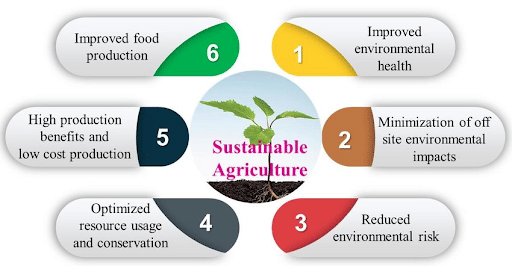
Various Dimensions of Sustainable Agriculture
What is Sustainable Agriculture?
- Sustainable agriculture is the practise of producing enough food to meet current needs without jeopardising future generations' ability to meet their own needs, such as by depleting soil fertility or irreversibly harming the environment.
- It combines three major objectives: environmental health, economic profitability, and social equity.
- It is regarded as a method of farming that uses manure, rotates the crops, uses little tillage, and relies as little as possible on artificial fertilizers, pesticides, and antibiotics.
- It is a well-balanced system of managing renewable resources, such as soil, wildlife, forests, crops, fish, livestock, plant genetic resources, and ecosystems, without compromising their productivity or ability to provide ecosystem services or food for present and future generations.
- Sustainable agriculture must stop soil erosion and land degradation. It must use biological and cultural techniques to replace nutrients and manage weeds, pests, and illnesses.
- The biggest problem endangering agriculture's sustainable development is the degradation of natural resources.
Sustainable Agriculture - Principles
- Environmental Sustainability: Sustainable environmental practices include safeguarding, recycling, replacing, and sustaining the natural resource base, which includes the land (soil), water, and animals.
- Economic Sustainability: Economic sustainability is achieved through enhancing crop rotation and soil management, which increases yields.
- Social Sustainability: Maintaining social justice and cultural unity is essential for achieving social sustainability.
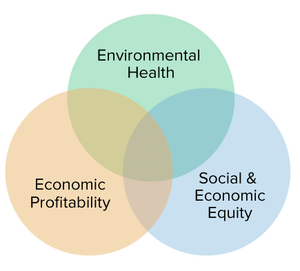
Principles of Sustainable Agriculture
Sustainable Agriculture - Different Methods
- Crop Rotation: Crop rotation is the methodical planting of various crops in the same growing space over a period of years, in a specific order. It contributes to the preservation of soil nutrients, the reduction of soil erosion, and the prevention of pests and diseases in plants.
- Planting Cover Crops: Cover crops are planted in bare soils that could otherwise remain there throughout the lean seasons. By preventing erosion, restoring soil nutrients, and controlling weeds, these crops safeguard and improve soil health, lowering the demand for pesticides.
- Biointensive Integrated Pest Management (IPM): It focuses on the use of crop rotation to prevent pest issues, the reintroduction of disease-fighting, naturally occurring microorganisms into plants and soil, and the discharge of beneficial organisms that feed on pests. There is no use of chemical pesticides.
- Agroforestry: It entails the development of trees and shrubs alongside agricultural or grazing land. For long-lasting, fruitful, and varied land use, agroforestry systems can mix both agricultural and forestry techniques.
- Permaculture: The term "permaculture" refers to a planned system of farming and habitation that tries to emulate the interdependencies and sustainability of natural ecosystems. The goal of permaculture is to maximize the use of land so that it can be used productively for food production or personal subsistence by future generations.
- Organic Farming: Organic farming is a farming method that focuses on cultivating the land and raising crops in a natural manner. It aims to keep the soil alive and healthy by using organic wastes (crop, animal and farm wastes, aquatic wastes) and other biological materials, as well as beneficial microbes (biofertilizers), to release nutrients to crops for increased sustainable production in an environmentally friendly, pollution-free environment.
- LEISA (Low External Input Sustainable Agriculture): Low-synthetic insecticides and fertilizers are used. By placing more focus on cultural practices, IPM, and the use of agricultural resources and management, yields are maintained.
- Zero Budget Natural farming: Natural farming on a "Zero Budget" means that no credit is used and that no money is spent on input purchases. Natural farming entails using only natural methods and no chemicals.
- Biodynamic agriculture: In biodynamic farming, the farm is viewed as a living system. The integration of animals to form a closed nutrient cycle, the impact of agricultural planting dates in relation to the calendar, and awareness of spiritual forces in nature are all highly valued components of the system.
- Conservation Agriculture: Permanent organic mulch cover, a longer crop rotation, and a significant reduction in tillage are all components of this agricultural technique.
Sustainable Agriculture - Advantages
- Environmental Protection: Sustainable agriculture places a strong emphasis on techniques and procedures that raise soil productivity while reducing negative effects on the environment, including the air, water, biodiversity, and climate.
- Saving Energy: It emphasizes minimizing the usage of petroleum-based products and other inputs and substituting them with those derived from renewable resources.
- Food Security: It aims to ensure that the basic dietary needs of the present and future generations are satisfied, both in terms of quantity and quality.
- Economic Profitability: It not only provides a sustainable rise in agricultural output, but also lessens the sector's susceptibility to perilous social and economic elements, such as sharp price swings, and other risks.
- Economic and Social Equity: It aims to provide those working in the agriculture value chain with stable employment, a living wage, and respectable living and working conditions.
- Other Benefits: Additionally, it emphasizes the demands, knowledge, abilities, sociocultural values, and institutional structures of the local population.
Sustainable Agriculture - Challenges
- Organic Farming and Food Security: As the world's population continues to expand, there is growing concern about our ability to support the current level of population.
- Switching to organic farming often results in a substantial decline in yields when compared to intensive farming.
- As a result, organic farming will need to be integrated with other sustainable production techniques in order to feed the globe in its current state.
- Feasibility of Conservation Agriculture for Soil Management: Since conservation agriculture does not include ploughing, it calls for modifications to weed control practices, the use of herbicides, and specialized equipment for sowing.
- The adoption of conservation agriculture by smallholders in developing nations is difficult. As a result, this practice has been mostly centered in North America, Europe, and Australia.
- Issues with Small Land Holdings: A lot of academics and environmentalists argue that cultivation based on small holdings is more environmentally friendly and sustainable than intensive, industry-based production models.
- However, smallholders can also harm the soil and the ecosystem due to a lack of knowledge and access to contemporary sustainable farming methods.
- These practices are not only typical of industrial or intense large agricultural operations.
- Debate on High Yield Variety (HYV) Seeds Usage: High-yielding hybrid seeds are recognized to be risky for both human and environmental health, as well as being unsustainable economically for farmers. However, given the growing worry about food security, these seeds are vital to boost output.
- Use of Chemical Pesticides: It might not be possible to totally abandon chemical pesticides given the rising frequency of insect infestations and resulting crop loss. Less toxic substances should be utilized instead of excessive amounts of chemical pesticides.
Sustainable Agriculture in India
Government Initiatives
- National Mission on Sustainable Agriculture: One of the eight objectives listed in the National Action Plan on Climate Change (NAPCC) is the National Mission on Sustainable Agriculture.
- Its goal is to increase agricultural productivity, particularly in rainfed regions, by emphasizing integrated farming, managing soil health, and coordinating resource conservation.
- Paramparagat Krishi Vikas Yojana (PKVY): The PKVY program intends to encourage commercial organic production by involving a group of farmers certified in organic farming (cluster farming).
- Network Project on Organic Farming of ICAR: The Network Project on Organic Farming of the ICAR aims to compare the performance of significant agricultural systems that are peculiar to a given place under organic and conventional farming and evaluates the agronomic effectiveness of various production methods.
Other Initiatives
- Sustainable Sugarcane Initiative (SSI): The Sustainable Sugarcane Initiative is a strategy for increasing sugarcane yields by using fewer seeds, less water, and the best possible use of fertilizers and land.
- System of Rice Intensification (SRI): This agro ecological methodology alters how plants, soil, water, and nutrients are managed to increase the yield of irrigated rice.
- It is a time-consuming, low-water approach that uses younger seedlings spread apart.
- In the Indian Cauvery delta region, a variation of SRI known as the Kadiramangalam System of Rice Intensification is used.
Challenges to Sustainable Agriculture in India
- Rising Population and Degraded Ecosystems: Growing populations and damaged ecosystems have made intensive, conventional farming (using HYV seeds and chemical fertilizers) and deforestation more resilient.
- Lack of Capital: Large portions of the agricultural community (small and medium farmers) lack the funds necessary to make the switch to sustainable agricultural production.
- Lack of Access to Information & Technology: There is a lack of access to information and technology to enhance agriculture practices, processing, and marketing of agricultural products.
- Lack of Economic Incentives: Farmers are uncertain of the benefits of switching to sustainable farming due to a lack of economic incentives.
- Lack of Public Policy & Infrastructure: Public policies and fundamental infrastructure are insufficient to encourage the use of sustainable agriculture methods.
Strategies for Making Agriculture More Sustainable
- Appropriate production systems: A shift in agricultural policy to match the agro-ecological resources is critical for sustainability.
- For example, in arid and semi-arid areas, promote dry land agriculture rather than input-intensive farming, and promote less water-intensive crops such as pulses and millets.
- Similarly, crops that require a large amount of water, such as rice, can be relocated to other regions that are relatively more water-rich.
- Polycultures and Crop Rotation: Shifting farmers from monocultures to polycultures and crop rotation can reduce the need for fertilisers and pesticides.
- Such diverse systems are likely to be more productive, labour intensive, and provide enhanced ecosystem services, making them much more sustainable.
- Emphasis on nurturing the soil: Greater emphasis on soil nurturing rather than plants will provide greater benefits in terms of sustaining yields, improving ecosystem health, and carbon sequestration.
- Promotion of Zero Budget Natural Farming: Initiatives such as Zero Budget Natural Farming, with low external input and production costs, could help restore ecosystem health and diversify smallholder farmers' livelihoods.
- Reducing food waste and promoting sustainable consumption patterns: To reduce food waste, more investments are needed in post-production infrastructure, such as storage space in rural areas, as well as improved harvesting techniques and transportation.
Conclusion
Sustainable agriculture must incorporate social, economic, and environmental sustainability, which is essential. With a growing population, depleting resources, and the growing threat of climate change, it will be impossible to meet future needs unless we transition to sustainable food and agricultural systems that ensure global food security, provide economic and social opportunities, and protect the ecosystem services on which our future depends.
|
|
|
|---|---|
| Agriculture Notes | Cropping |
| Land Reforms in India | Watershed Management |
| Tillage | Different Types of Irrigation and Irrigation Systems |
FAQs
Question: What is sustainable agriculture?
Answer: Sustainable agriculture refers to farming methods that maintain productivity while protecting the environment, enhancing soil fertility, and reducing reliance on harmful inputs.
Question: What are the main principles of sustainable agriculture?
Answer: The principles include environmental sustainability, economic viability, and social equity, focusing on long-term agricultural productivity.
Question: How does sustainable agriculture protect the environment?
Answer: By reducing chemical inputs, promoting crop rotation, conserving soil, and managing water resources responsibly.
Question: What are the benefits of organic farming within sustainable agriculture?
Answer: Organic farming enhances soil health, reduces pollution, conserves biodiversity, and provides healthier food options.
Question: How does sustainable agriculture address climate change?
Answer: It builds resilience against climate variability by improving water management, reducing soil degradation, and fostering biodiversity.
MCQs
1. Which of the following is a core objective of sustainable agriculture?A. Maximizing crop yields
B. Reducing food prices
C. Maintaining soil fertility
D. Increasing pesticide use
Answer: (C) See the Explanation
Sustainable agriculture aims to maintain soil fertility through crop rotation, organic inputs, and conservation techniques.
A. Prevents erosion
B. Enhances soil nutrients
C. Reduces pests
D. All of the above
Answer: (D) See the Explanation
Crop rotation helps prevent soil erosion, maintains nutrient balance, and controls pest populations.
A. Agroforestry
B. Intensive monoculture
C. Permaculture
D. Organic farming
Answer: (B) See the Explanation
Intensive monoculture depletes soil nutrients and relies heavily on chemical inputs, opposing sustainable practices.
A. Green Revolution
B. National Mission on Sustainable Agriculture
C. Make in India
D. Swachh Bharat Abhiyan
Answer: (B) See the Explanation
The National Mission on Sustainable Agriculture (NMSA) promotes sustainable practices like soil health management and resource conservation.
A. Excess rainfall
B. Lack of modern technology
C. Small land holdings
D. Surplus food production
Answer: (C) See the Explanation
Small land holdings limit the application of advanced sustainable techniques, making it challenging for farmers to adopt best practices.
GS Mains Questions and Model Answers
Q1: Discuss the role of sustainable agriculture in ensuring food security in India.
Answer: Sustainable agriculture plays a crucial role in food security by promoting practices that conserve resources, increase crop resilience, and enhance soil health. It helps ensure a stable supply of food by reducing dependency on chemical inputs, improving water management, and addressing climate change impacts. In India, initiatives like the National Mission on Sustainable Agriculture support these goals by encouraging organic farming, crop diversification, and conservation techniques.
Q2: Examine the challenges faced by sustainable agriculture in India and suggest measures to overcome them.
Answer: Sustainable agriculture in India faces challenges such as small land holdings, limited access to modern technologies, and financial constraints for small farmers. To overcome these, the government must provide economic incentives, increase access to sustainable farming technologies, and promote farmer awareness through training programs. Strengthening infrastructure for storage and distribution can also help improve the adoption of sustainable practices.
Q3: Analyze the impact of sustainable agriculture on rural livelihoods in India.
Answer: Sustainable agriculture positively impacts rural livelihoods by promoting practices that improve soil health, increase yields, and reduce production costs. Organic farming, agroforestry, and water-efficient techniques help small farmers achieve higher profits while protecting the environment. Government programs such as Paramparagat Krishi Vikas Yojana further support sustainable practices, providing long-term benefits for rural economies.
Previous Year Questions
1. UPSC CSE Prelims 2019
Question: Which of the following is a major component of sustainable agriculture?
A. Chemical fertilizers
B. Crop rotation
C. Pesticides
D. Monocropping
Answer: B
Explanation: Crop rotation is a core component of sustainable agriculture, maintaining soil health and reducing pest infestations.
2. UPSC CSE Mains 2018 (GS Paper 3)
Question: Evaluate the role of sustainable agriculture in reducing environmental degradation in India.
Answer: Sustainable agriculture reduces environmental degradation by minimizing the use of chemical fertilizers and pesticides, promoting organic farming, and enhancing biodiversity. Techniques such as crop rotation, agroforestry, and water conservation reduce soil erosion, improve fertility, and lower pollution levels. These practices help restore ecological balance, ensuring that agriculture contributes to environmental protection rather than degradation.
Download the PREPP App and attempt FREE IAS Exam Mock Tests and get complete study material!

Live Test : UPSC CSE Prelims CSAT (Paper-II) (Oct 08 - 11)
Full Test - 04: UPSC CSE Prelims CSAT (Paper-II)
Full Test - 03: UPSC CSE Prelims CSAT (Paper-II)
UPSC CSE Prelims 2026 GS Paper 1 Question Paper (24-May-2026)
UPSC CSE Prelims 2026 CSAT Paper 2 Question Paper (24-May-2026)

17 February 2025 | The Hindu Must Read Articles | Current Affairs

16 February 2026 | The Hindu Must Read Articles | Current Affairs

13 February 2026 | The Hindu Must Read Articles | Current Affairs









Comments