Major Crops of India - Agriculture Notes
India has a long history of agrarian culture. Agriculture is the heart of rural India. It is an ancient form of economic activity in our country. It also contributes significantly to the Gross Domestic Product (GDP). Agriculture employs roughly two-thirds of India's population. It is a primary activity that generates food grains as well as raw materials for industries. Since India is geographically vast, it has a diverse range of food and non-food crops that are grown during three main cropping seasons: rabi, Kharif, and zaid. In this article, we will discuss Major Crops of India which will be helpful for UPSC exam preparation.
|
Table of Contents |
Crops of India
- India is one of the world's largest producing countries of agricultural commodities. Agriculture is regarded as a way of life, and farmers are worshiped as Gods.
- In India, there are several major crops such as rice, wheat, maize, millets, and pulses, cash crops such as cotton, jute, sugarcane, tobacco, and oilseeds, plantation crops such as tea, coffee, coconut, and rubber, and horticulture crops such as fruits and vegetables.
- Cotton, the natural fiber, grows on plants, and Gujarat is India's leading cotton producer. Similarly, crops are divided appropriately based on seasons and cultivation.
- India is now the world's second-largest agricultural product producer. India is an agricultural country, with agriculture employing more than 60% of the population.
- While we may not realize the significance of agriculture while living in cities, it is a well-known fact that agriculture is the primary source of income for the majority of our country's people.
- India's population is outstripping the country's ability to produce rice and wheat, the country's main crops. The cost of building marketing, storage, and cold storage infrastructure is expected to be enormous.
- Throughout the country, a variety of crops, ranging from medicinal to grain crops, are grown. These commodities are used for a variety of purposes such as human consumption, industry, and animal feed.
Types of Major Crops in India Based on Season
Kharif Crop
- The Kharif crops are also known as the monsoon crops because they are usually sown in the months of June-October.
- The monsoon months are regarded as ideal for seeding since the crops need a warm, humid temperature for germination.
- As monsoon arrives at a different time in the different states of the country, the exact months vary from state to state.
- For instance, seeds may be seeded in the southern states by the end of May, whereas they are often shown in the northeastern states by the end of June.
- Major crops planted during this season are paddy, maize, jowar, bajra, tur (arhar), moong, urad, cotton, jute, groundnut, and soya bean.
*To know more about this topic, click this link Kharif.
Rabi Crop
- Rabi crops, also known as winter crops, are agricultural crops that are sown in the winter and harvested in the spring
- The Arabic word for spring, Rabi, is commonly used to refer to the winter months of October through December when seeds are sowed, and the spring months of April through May when harvesting takes place.
- The Rabi crops are an important source of income for the agricultural economy.
- Rainfall patterns have no effect on rabi crops. Some of the major Rabi crops are wheat, barley, peas, gram, and mustard.
*To know more about the topic, click this link, Rabi.
Zaid Crops
- Zaid crops are grown in the summer and thus they are commonly called summer crops.
- They develop over a long period of time, primarily from March to June.
- They require warm, dry weather during their primary growth period, as well as longer day length during flowering.
- The crop season of Zaid falls between the Rabi and Kharif crop seasons. These crops mature as well.
- Watermelon, muskmelon, cucumber, vegetables, and fodder crops are common examples of zaid crops.
*To know more about this topic, click this link Zaid.
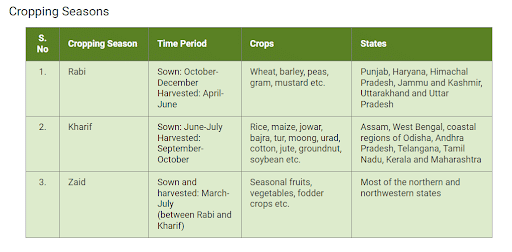
Difference Between Kharif, Rabi, And Zaid Crops
Types of Crops Based on Cultivation
- Cash Crops: A crop that is cultivated solely for commercial purposes is known as a cash crop or profit crop. Example: Spices, Tobacco, Cotton, Oilseeds
- Plantation Crops: Plantation crops are those that are grown on a large scale in a single, contiguous area and are either owned or managed by an individual or a company. Example: Rubber, coffee, coconut, and tea
- Food Crops: Food crops or subsistence crops are the ones that are meant for human consumption. Example: Rice, Wheat, Maize, Pulses, and Millets
- Horticulture: Crops that are grown in an enclosure, such as a garden, are referred to as horticulture crops. It is the cultivation of plants for use in food production, comfort, and aesthetics. Vegetables, trees, flowers, turf, bushes, fruits, and nuts are the principal plant varieties under horticultural crops.
India's Changing Cropping Patterns
- Cropping pattern is a dynamic concept that changes over time and space. It is defined as the proportion of land under various crops at any given time. Over time, a variety of crops may be grown in combinations and rotations.
- Rainfall, climate, temperature, soil type, technology, and farmers' socioeconomic conditions all influence cropping patterns in India.
- These changes in cropping patterns were primarily caused by an increase in crop prices. Cropping patterns in India have changed dramatically since independence.
- Cropping patterns changed as a result of the Green Revolution. Rice was introduced to the states of Punjab, Haryana, and Uttar Pradesh.
- Because of the introduction of new technologies in Indian agriculture, crop cultivation has become very profitable and productive.
- Farmers are shifting away from traditional non-cash/non-commercial crops such as cereals and pulses and toward cash/commercial crops such as oilseeds, fruits, vegetables, spices, and so on.
- Farmers have altered their crop patterns in order to reap the benefits of economic expansion as well.
- Climate change has influenced the Indian monsoon, causing cropping patterns to shift.
- Population growth and urbanization have resulted in land conversion, increased intensive farming, and altered cropping patterns.
Conclusion
The world's second-most populous country, where Indian lands are considered the best source of irrigation and the agricultural crop year runs from July to June. Different Major Crops in India are grown as the climate and seasons change, enhancing the country's economic growth and harmony. It has attained self-sufficiency, and a variety of essential crops are harvested to ensure sustainability. India's agricultural sector has expanded livelihood opportunities and is becoming more resilient over time.
FAQs
Question: What are the major types of crops grown in India?
Answer: India cultivates a diverse range of crops categorized into food grains (such as rice, wheat, millets), commercial crops (like cotton, sugarcane, tea), pulses, oilseeds, and horticultural crops. These crops vary based on climatic conditions, soil type, and irrigation facilities across different regions.
Question: Which regions in India are known for rice cultivation?
Answer: Rice cultivation is prominent in states with high rainfall and fertile alluvial soils, such as West Bengal, Punjab, Uttar Pradesh, Odisha, and Tamil Nadu. These regions have suitable conditions for both Kharif and Rabi rice production.
Question: What is the significance of Kharif and Rabi crops in India?
Answer: Kharif crops are sown with the onset of monsoon and harvested in autumn, while Rabi crops are sown after the monsoon and harvested in spring. This cropping pattern allows farmers to maximize production and efficiently use seasonal rainfall and irrigation resources.
Question: Which crop is primarily grown as a commercial crop in India?
Answer: Cotton is a major commercial crop in India, grown primarily in states like Maharashtra, Gujarat, and Andhra Pradesh. It is a significant export crop and supports the textile industry by providing raw material for cotton-based products.
Question: How has the Green Revolution impacted crop production in India?
Answer: The Green Revolution introduced high-yielding varieties (HYVs) of seeds, improved irrigation facilities, and modern agricultural techniques, significantly increasing the production of staple crops like wheat and rice. It transformed agriculture in states like Punjab and Haryana, enhancing food security in India.
MCQs
1. Which crop is widely grown as a Kharif crop in India?
A) Wheat
B) Rice
C) Mustard
D) Barley
Answer: (B) See the Explanation
Explanation: Rice is primarily grown as a Kharif crop in India, sown with the monsoon rains and harvested in the autumn season, especially in regions with heavy rainfall.
2. Which state is the largest producer of wheat in India?
A) Maharashtra
B) Punjab
C) Uttar Pradesh
D) West Bengal
Answer: (C) See the Explanation
Explanation: Uttar Pradesh is the largest producer of wheat in India, contributing significantly to the country's total wheat output, followed by Punjab and Haryana.
3. Which crop is considered a major oilseed in India?
A) Cotton
B) Mustard
C) Sugarcane
D) Tea
Answer: (B) See the Explanation
Explanation: Mustard is one of the major oilseed crops grown in India, primarily cultivated during the Rabi season in states like Rajasthan, Haryana, and Uttar Pradesh.
4. The Green Revolution primarily focused on which crops in India?
A) Rice and Wheat
B) Cotton and Sugarcane
C) Pulses and Millets
D) Tea and Coffee
Answer: (A) See the Explanation
Explanation: The Green Revolution in India focused on increasing the production of rice and wheat through high-yielding varieties, fertilizers, and improved irrigation, significantly boosting food grain production.
5. Which crop is majorly associated with the textile industry in India?
A) Jute
B) Tea
C) Cotton
D) Coffee
Answer: (C) See the Explanation
Explanation: Cotton is a crucial crop for the textile industry in India, as it provides raw material for a wide range of cotton-based products and is primarily grown in Maharashtra, Gujarat, and Andhra Pradesh.
GS Mains Questions and Model Answers
Q1: Explain the significance of the Kharif and Rabi cropping seasons in India. How do they influence crop diversity and agricultural planning?
Answer: The Kharif and Rabi cropping seasons are crucial for India's agricultural cycle, maximizing crop production based on seasonal rainfall and temperature. Kharif crops, like rice and maize, are sown with the arrival of the monsoon, while Rabi crops, such as wheat and mustard, are sown after the monsoon. This seasonal division allows farmers to utilize different climatic conditions and grow diverse crops throughout the year. It promotes crop rotation, reduces soil depletion, and supports sustainable agricultural practices. The Kharif and Rabi seasons also help in planning irrigation needs and input distribution, ensuring efficient resource utilization and increased productivity.
Q2: Discuss the impact of the Green Revolution on Indian agriculture, focusing on crop production and food security.
Answer: The Green Revolution significantly transformed Indian agriculture, particularly in the 1960s and 1970s, by introducing high-yielding varieties (HYVs) of wheat and rice, increased use of chemical fertilizers, and improved irrigation facilities. This revolution enhanced crop productivity, particularly in Punjab, Haryana, and western Uttar Pradesh, helping India achieve self-sufficiency in food grains and addressing food security concerns. However, it also led to issues like soil degradation, water depletion, and increased chemical dependency. Despite these challenges, the Green Revolution played a pivotal role in reducing hunger and stabilizing food availability in India, though there is now a shift towards sustainable practices to mitigate its long-term ecological impact.
Q3: Evaluate the importance of oilseed crops in India’s agriculture and economy. How does the government support oilseed production?
Answer: Oilseed crops, including mustard, groundnut, and soybean, are crucial for India's agriculture and economy, providing raw materials for edible oils and contributing to the food processing sector. The demand for edible oils has made India one of the largest importers, prompting the government to boost domestic oilseed production. Programs like the National Mission on Oilseeds and Oil Palm (NMOOP) support farmers with subsidies, better seed varieties, and efficient cultivation practices. Oilseed crops also offer crop diversification benefits, contributing to soil health and agricultural income stability, especially in semi-arid regions.
Previous Year Questions on Major Crops in India
1. UPSC CSE Prelims 2021:
Question: Which of the following crops is primarily grown as a Rabi crop in India?
A) Rice
B) Wheat
C) Cotton
D) Maize
Answer: (B)
Explanation: Wheat is a major Rabi crop in India, sown after the monsoon season and harvested in spring, primarily grown in states like Punjab, Haryana, and Uttar Pradesh.
2. UPSC CSE Mains 2020 (GS Paper 3):
Question: "Analyze the role of crop diversity in Indian agriculture. How do Kharif and Rabi crops contribute to sustainable agriculture?"
Answer: Crop diversity is essential in Indian agriculture, supporting food security, biodiversity, and soil health. The division into Kharif and Rabi crops enables farmers to cultivate different crops seasonally, allowing effective use of resources. Kharif crops, grown with monsoon rains, and Rabi crops, cultivated post-monsoon, promote crop rotation and soil fertility. This diversity minimizes pest cycles and reduces soil depletion, contributing to sustainable agriculture practices, which are crucial for India’s long-term agricultural productivity and ecological balance.
Download the PREPP App and attempt FREE IAS Exam Mock Tests and get complete study material!

Full Test - 04: UPSC CSE Prelims CSAT (Paper-II)
Full Test - 03: UPSC CSE Prelims CSAT (Paper-II)
UPSC CSE Prelims 2026 GS Paper 1 Question Paper (24-May-2026)
UPSC CSE Prelims 2026 CSAT Paper 2 Question Paper (24-May-2026)

17 February 2025 | The Hindu Must Read Articles | Current Affairs

16 February 2026 | The Hindu Must Read Articles | Current Affairs

13 February 2026 | The Hindu Must Read Articles | Current Affairs









Comments