Land Reforms in India - Agriculture Notes
The term "land reforms" encompasses a variety of unique programs and actions intended to improve the governance and use of land for the benefit of the community at large. The major goals of the land reforms are to boost agricultural productivity and eliminate the disparities in the landholding system. The delayed rate of land reform policies being put into action made this goal more difficult to achieve. The measures through which land reforms were implemented in India include the Abolition of the Intermediaries (Zamindari System), Tenancy Reforms, Ceilings on Landholdings, Consolidation of Landholdings, and more. This article will explain to you about the Land Reforms in India which will help prepare the Agriculture Syllabus for the UPSC Civil Service exam.
What are Land Reforms in India?
- Reforms regarding land tenure are particularly referred to as "land reforms."
- Land reforms are seen as a tool for social justice since they aim to end exploitative relationships characterized by stark disparities between wealthy landowners and poor peasants without a secure place to live.
- Through the imposition of limits on the extent of holdings that can be owned by a family, it is a move against the concentration of landholdings in the hands of a small number of absentee/non-cultivating owners.
- Although redistribution of land is the common understanding of land reforms, their scope is far broader.
- Land reforms alter the economic and political power structure because the land has always been a source of wealth, income, status, and power.
- It empowers the actual tillers of the soil, organizing and enabling them to seek State development benefits.
- Land reforms also increase agricultural production through land development because the peasant develops a long-term interest in investing in the land he owns. He is also motivated to acquire new form technologies and innovations.
- The small farmer benefits most from land reform, particularly from the massive inputs provided by the state.
|
|
|
|---|---|
| Ceilings on Landholdings | Tenancy Reforms |
| Gramdan Movement | Bhoodan Movement |
| Reasons for Failure of Land reforms | Cooperative Farming |
Need for Land Reforms
- By the time British rule ended, an unproductive agrarian structure with unproductive interest groups in control had developed due to intermediary tenures in the zamindari and jagirdari areas as well as subleasing in the ryotwari districts.
- Landlessness, hunger, unemployment, and indebtedness increased to previously unheard-of levels and at the same time the concentration of land in the hands of a small number of people grew.
- In independent India, the issues that needed to be addressed right away were made worse by eviction and tenancy instability.
- Extreme peasant indebtedness as a result of exorbitant taxation.
- The formation of a class of wealthy individuals who primarily exploited the poor peasantry.
- Peasants were constantly afraid of being evicted.
- Poverty was deeply ingrained in the farmer class.
Land Reforms - Objectives
- To make systematic and comprehensive changes to the country's agrarian structure.
- To eliminate the intermediaries of India's semi-feudal landlordism system, i.e. the zamindars.
- Bring about economic and social equity, as well as social justice for past atrocities against farmers.
- Land reforms would also prevent landlords from exploiting tenant farmers.
- Farmers must be motivated and practises to increase agricultural output implemented.
- To ensure the rational or scientific use of limited agricultural lands by imposing land holding limits, consolidating land holdings, and creating economic land holdings.
- India's land reform policy had the following specific goals:
- The first is to remove any impediments to increasing agricultural production that arises from the agrarian structure that has been passed down from generation to generation.
- The second goal, which is closely related to the first, is to eliminate all elements of exploitation and social injustice from the agrarian system.
- To provide security to the soil tiller, and to ensure equality of status and opportunity to all sections of the rural population.
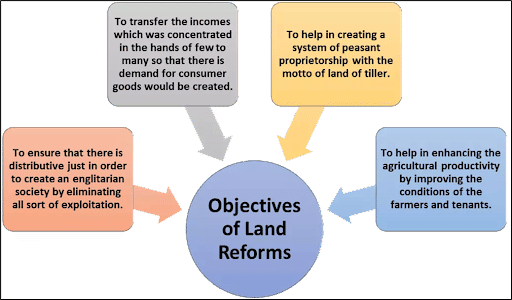
Objectives of Land Reforms
Abolition of the Intermediaries (Zamindari System)
- The most significant land reform following Independence was the abolition of the Zamindari System.
- Even before the Indian Constitution was adopted, multiple Zamindari Abolition Bills were introduced.
- Zamindari Abolition Measures were introduced by Uttar Pradesh, Madhya Pradesh, Bihar, Assam, and Bombay; however, the zamindars resisted the bills and the agrarian reforms were postponed.
- As a result, the First Amendment Act of the Constitution altered the right to property.
- The zamindari system was eliminated in Independent India shortly after the Indian Constitution altered the right to property under Articles 19 and 31.
- The zamindars disputed the validity of the laws when various zamindari-related legislation was created.
- Many zamindars kept their land because they were permitted to keep it in specific places for their own personal cultivation.
- The goal of the Zamindari System Abolition was to eliminate zamindars, or middlemen, between the government and the peasantry.
- And after the State reclaimed the land ownership title from the zamindars, compensation was given to them.
*To know more about the topic, click this link Abolition of the Intermediaries(Zamindari System)
Tenancy Reforms
- Tenancy reform serves two purposes, as does land reform.
- On the one hand, it tries to change holding parameters, imposing ceilings and floors on holdings so that cultivation can be done in the most efficient manner, i.e., without any waste of labor and capital, in order to make more sensible use of the precious land resources.
- On the other hand, it is a way to stop exploitation by redistributing agricultural land in favor of less privileged classes and by improving the terms and conditions under which the actual tillers are granted access to the land for cultivation.
- The national policy suggestions led to different tenancy reform laws in each state because the land is subject to state authority in India and the relationship between output and land tenure differs from state to state.
*To know more about the topic, click this link Tenancy Reforms
Ceilings on Landholdings
- India introduced land ceiling laws in the early years following Independence to deal with the zamindars and enforce restrictions on land ownership.
- Setting a limit on the amount of land that any one person or family may own is known as a ceiling on land holdings.
- The primary purpose of ceiling limits is to restrict land ownership. Surplus land is defined as any land that exceeds the ceiling limit.
- Land that a family or person owns in excess of the ceiling amount is classified as surplus land.
- The success of a restriction on land ownership resides in a number of factors, such as reducing the likelihood of inequality or preventing wealthy people from acquiring more land for their own gain.
*To know more about the topic, click this link Ceilings on Landholdings
Consolidation of Landholdings
- The distribution of a single plot into fragments was caused by the growing demand for land combined with partition based on inheritance laws.
- Basically, consolidation is the reorganization of fragmented lands into a single plot.
- The plan involved pooling all the land in the villages into a single, compact block, then dividing it into smaller chunks and eventually allocating them to individual farmers.
- Farmers were more productive as a result of this decision since they could concentrate on their resources in one location.
- It decreased the cost of farming, decreased litigation, lowered labor costs by cultivating land sooner and in fragmented land holdings, and
- Except in Punjab, Haryana, and western Uttar Pradesh, the progress made in terms of holding consolidation was not very good due to a lack of significant political and administrative backing.
Bhoodan Movement
- Acharya Vinoba Bhave, a revered religious leader in India, founded the Bhoodan movement and started this at Pochampally.
- Bhoodan literally translates as a land donation.
- As suggested by the movement's name, landowners voluntarily give up their property so that it can be transferred to labourers who are without land, who will subsequently cultivate it.
- The gap between the rich and the poor is meant to be closed through this. In this case, there is no payment made to the land givers.
- Bhave travelled all over India over the 13-year duration of this movement. He gathered 4.4 million acres of land to give to farmers who were without land.
- He founded the Gramdan movement in 1954, which called for the voluntary surrender of entire villages.
- These movements won praise from all over the world for setting the bar so high for selfless social justice.
*To know more about the topic, click this link Bhoodan Movement
Gramdan Movement
- The Gramdan initiative involves giving an entire village to the community. There is no longer any private ownership of the land.
- The villagers cooperate to the best of their abilities and are given all they require.
- The surplus is used to enhance society as a whole.
- This movement is founded on the concepts of communism and collective ownership.
- The movement has spread beyond Orissa. However, it has also kept on spreading in other States at the same time.
*To know more about the topic, click this link Gramdan Movement
Cooperative Farming
- A cooperative farming group is considered to have been created when several farmers in a village pool their land and agree to consider the combined plot as one large farm for cultivation, buy the necessary inputs for cultivation, and market the crops cooperatively.
- One member, one vote is how such a society chooses its office holders to ensure proper operation.
- The ability of farmers to pool produce and/or resources is a useful justification for the formation of agricultural cooperatives.
- It is frequently simply too expensive for farmers to produce goods or provide services in the field of agriculture.
- Cooperatives give farmers a way to join an "association" through which they can achieve better results—generally financial ones—than they might on their own.
- Under this scheme, all land owners in the village form a co-operative society to cultivate land in the village
- To increase the size of the operational unit and benefit from economies of scale, small holdings should be pooled and cultivated jointly. The land is pooled, but each cultivator retains ownership.
- The harvest is divided among the members in proportion to the amount of land and labour contributed by each. It can be used to increase the size of the cultivation unit.
*To know more about the topic, click this link Cooperative Farming
Reasons for Failure of Land Reforms
Poor Land Records
- The major obstacle to the failure of land reforms is the lack of concurrent evaluation and reliable (current) records.
- There hasn't been a regular, organized evaluation of development.
- There are no efforts being made to conduct thorough contemporaneous reviews.
- With purposeful malice aforethought, incorrect records are maintained.
Lack of Financial Support
- Another obstacle standing in the way of land reform is a lack of financial backing.
- The Five Year Plans did not provide any funding specifically for financing land reform.
- Many states refused to include even the cost of such necessary items as the creation of surveys and records in their budgetary plans.
Lack of Integrated Approach
- The absence of an integrated approach, such as the elimination of intermediary tenures, tenancy reforms, holdings ceilings, etc., was another factor in India's failed land reforms.
Improper Implementation
- In almost all states, the revenue administration is in charge of implementing land reforms into action.
- On the other side, maintaining public order, collecting land taxes, and other regulatory duties were given top attention.
- Land reforms do not receive the needed attention as a result.
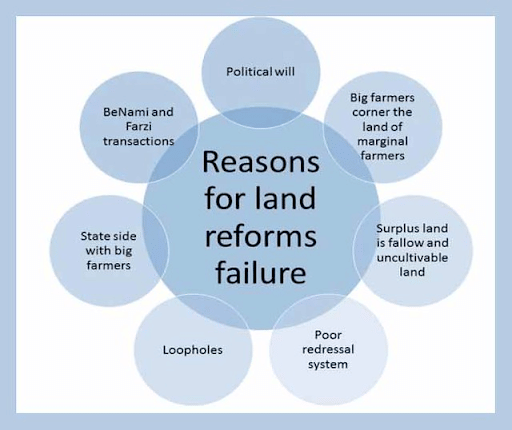
Reasons for Failure of Land Reforms
*To know more about the topic, click this link Reasons for Failure of Land Reforms
Conclusion
Land reforms must be effectively implemented to develop an egalitarian society. Land reforms offer a way to ease rural hardship due to rising suicide rates, declining productivity levels, and growing farmer distress. This agenda has to be thoroughly reviewed and appropriately executed because it is still not complete.
FAQs
Question: What are land reforms in India?
Answer: Land reforms in India refer to the policies aimed at redistributing agricultural land to promote social equity and improve the living conditions of landless laborers and marginal farmers. These reforms were initiated post-independence to dismantle the feudal structure, eliminate intermediaries, and ensure that land ownership is more equitable. Key measures include land ceiling laws, tenancy reforms, and the abolition of zamindari systems, which aimed to empower small farmers and enhance agricultural productivity.
Question: What were the primary objectives of land reforms in India?
Answer: The primary objectives of land reforms in India include reducing rural poverty, improving agricultural productivity, and ensuring social justice. By redistributing land, the government aimed to empower marginalized sections of society, such as landless laborers and small farmers. Another objective was to eliminate exploitative practices associated with zamindari and tenancy systems, which often left tenants with minimal rights and insecure land tenure. Ultimately, the goal was to create a more equitable agrarian structure that supports sustainable rural development.
Question: What impact did land reforms have on Indian agriculture?
Answer: Land reforms significantly impacted Indian agriculture by changing land ownership patterns and promoting agricultural productivity. With land distributed to small farmers, there was an increase in ownership, which incentivized better land management and investment in agriculture. However, the effectiveness of these reforms varied across states due to differences in implementation and local conditions. In some regions, reforms led to improved livelihoods and increased agricultural output, while in others, challenges such as land fragmentation and inadequate support services persisted.
Question: How did the abolition of zamindari system influence land ownership?
Answer: The abolition of the zamindari system was a crucial aspect of land reforms in India, fundamentally altering land ownership structures. This system, which had empowered landlords (zamindars) to collect taxes from tenants, often resulted in exploitative practices. By abolishing it, the government aimed to transfer land ownership directly to the tillers, enhancing their rights and providing them with security. This shift promoted a more equitable distribution of land, aimed at empowering farmers and reducing poverty in rural areas.
Question: What challenges have land reforms faced in India?
Answer: Land reforms in India have faced several challenges, including bureaucratic inefficiencies, corruption, and lack of political will. Inconsistent implementation across states has resulted in uneven progress. Additionally, resistance from landlords and powerful interest groups has hindered reforms. Issues such as land fragmentation, inadequate infrastructure, and access to credit further complicate the situation. Furthermore, despite reforms, many small farmers still struggle with poor productivity and market access, highlighting the need for comprehensive agricultural policies beyond land reforms.
MCQs
1. What was a major objective of land reforms in India?
A) Increase zamindari control
B) Promote social equity
C) Encourage large landholdings
D) Limit agricultural production
Answer: (B) See the Explanation
Explanation: A major objective of land reforms in India was to promote social equity by redistributing land to landless laborers and marginal farmers. This aimed to reduce poverty and empower disadvantaged sections of society.
2. Which system was abolished to enhance land ownership for farmers?
A) Zamindari system
B) Tenancy system
C) Sharecropping system
D) Cooperative farming
Answer: (A) See the Explanation
Explanation: The zamindari system was abolished as part of land reforms to enhance land ownership for farmers. This shift aimed to empower tenants by eliminating intermediaries who exploited them.
3. What is one of the challenges faced in implementing land reforms?
A) Universal acceptance
B) Bureaucratic inefficiencies
C) Excess land availability
D) High agricultural productivity
Answer: (B) See the Explanation
Explanation: Bureaucratic inefficiencies have been a significant challenge in implementing land reforms in India. These inefficiencies often result in delays, corruption, and inconsistent enforcement of reform policies.
4. How did land reforms aim to improve agricultural productivity?
A) By reducing land ownership
B) By promoting cooperative farming
C) By increasing small landholdings
D) By encouraging zamindars
Answer: (C) See the Explanation
Explanation: Land reforms aimed to improve agricultural productivity by increasing small landholdings, which incentivized owners to invest in their land and manage it more efficiently, leading to enhanced agricultural output.
5. What was the effect of land ceiling laws?
A) Increased land consolidation
B) Limited land ownership
C) Encouraged land leasing
D) Reduced agricultural output
Answer: (B) See the Explanation
Explanation: Land ceiling laws were enacted to limit land ownership and prevent the concentration of land in the hands of a few individuals. This aimed to promote equitable distribution and reduce rural inequalities.
GS Mains Questions and Model Answers
Q1: Analyze the impact of land reforms on the socio-economic landscape of rural India. How have these reforms changed agricultural practices?
Answer: Land reforms in India have profoundly influenced the socio-economic landscape of rural areas, primarily by redistributing land from landlords to landless laborers and marginal farmers. This redistribution has enabled greater ownership of land, leading to improved livelihoods for many rural families. With more secure land tenure, farmers are incentivized to invest in their land, adopt modern agricultural practices, and enhance productivity. Moreover, reforms aimed at abolishing exploitative practices, such as the zamindari system, have empowered small farmers, allowing them to participate more actively in agricultural decision-making. However, challenges remain, such as land fragmentation and inadequate support systems, which hinder the full realization of these reforms. Overall, while land reforms have initiated positive changes in agricultural practices and rural economics, continuous efforts are needed to address existing gaps and ensure sustainable development in the agricultural sector.
Q2: Discuss the challenges encountered during the implementation of land reforms in India. What measures could improve their effectiveness?
Answer: The implementation of land reforms in India has faced numerous challenges, including bureaucratic inefficiencies, corruption, and lack of political will. Many states have experienced inconsistent enforcement of reform policies, leading to uneven progress and disparities in land distribution. Resistance from powerful landowners and vested interests has also complicated the reform process. Additionally, inadequate infrastructure and support services, such as credit and technical assistance, have limited the potential benefits of reforms for small farmers. To improve the effectiveness of land reforms, it is crucial to strengthen administrative capacities, enhance transparency in implementation, and engage in grassroots mobilization to foster community support. Additionally, integrating land reforms with broader agricultural policies that provide necessary resources and training can ensure that the benefits of land reforms translate into tangible improvements in farmers' livelihoods and agricultural productivity.
Q3: Evaluate the role of land ceiling laws in shaping land ownership patterns in India. What has been their overall impact on agricultural productivity?
Answer: Land ceiling laws have played a critical role in shaping land ownership patterns in India by limiting the maximum amount of land that an individual or family can own. This legislative measure aimed to break the concentration of landholdings among a few affluent landowners, promoting a more equitable distribution of land. By redistributing excess land to landless laborers and marginal farmers, these laws sought to empower disadvantaged sections of society. However, the impact of land ceiling laws on agricultural productivity has been mixed. While they have succeeded in reducing inequality and promoting land ownership among the poor, challenges such as land fragmentation and lack of access to resources have limited their effectiveness in enhancing productivity. Therefore, while land ceiling laws are essential for social equity, there is a need for complementary policies that support small farmers through access to credit, technology, and market linkages to realize the full potential of land reforms.
Previous Year Questions on Land Reforms
1. UPSC CSE Prelims 2021:
Question: Which of the following is a significant aspect of land reforms in India?
A) Increase in zamindari landholdings
B) Promotion of equitable land distribution
C) Consolidation of agricultural land
D) Decrease in smallholder farms
Answer: (B)
Explanation: A significant aspect of land reforms in India is the promotion of equitable land distribution, aiming to reduce inequality and empower marginalized farmers by redistributing land ownership.
2. UPSC CSE Mains 2019 (GS Paper 1):
Question: Assess the effectiveness of land ceiling laws in achieving their intended objectives. Discuss the challenges faced in their implementation.
Answer: Land ceiling laws were intended to prevent the concentration of land in a few hands and promote equitable distribution. While these laws have made strides toward social equity, challenges such as bureaucratic inefficiencies, resistance from landlords, and inadequate implementation have limited their effectiveness. Despite some successes, the persistence of land fragmentation and limited access to resources continues to hinder the realization of the laws’ objectives, necessitating ongoing reforms and supportive policies to ensure their impact on agricultural productivity and rural livelihoods.
Download the PREPP App and attempt FREE IAS Exam Mock Tests and get complete study material!

Full Test - 04: UPSC CSE Prelims CSAT (Paper-II)
Full Test - 03: UPSC CSE Prelims CSAT (Paper-II)
UPSC CSE Prelims 2026 CSAT Paper 2 Question Paper (24-May-2026)
UPSC CSE Prelims 2026 GS Paper 1 Question Paper (24-May-2026)

17 February 2025 | The Hindu Must Read Articles | Current Affairs

16 February 2026 | The Hindu Must Read Articles | Current Affairs

13 February 2026 | The Hindu Must Read Articles | Current Affairs









Comments