Bhoodan Movement - Agriculture Notes
The Bloodless Revolution, also known as the Bhoodan Movement (Land Gift Movement), was an unforced land reform movement in India. Vinoba Bhave, a follower of Gandhi, started it in 1951 in Pochampally village. The Bhoodan movement made an effort to persuade wealthy landowners to voluntarily donate a portion of their property to others who were without land. Bhave was philosophically influenced by Gram Swarajya and the Sarvodaya movement of Mahatma Gandhi. This article will explain to you about Bhoodan Movement which will be helpful in preparing the Agriculture Syllabus for the UPSC Civil Service exam.
|
Table of Contents |
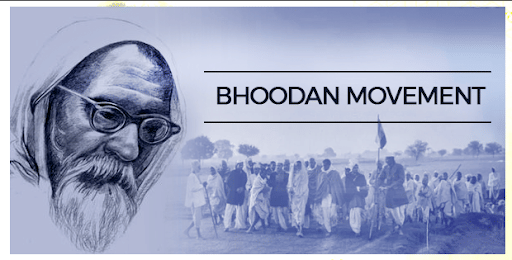
Acharya Vinoba Bhave and Bhoodan Movement
What is Bhoodan Movement?
- Acharya Vinoba Bhave, a revered religious leader in India, founded the Bhoodan movement and started this at Pochampally.
- Bhoodan translates as a land donation.
- As suggested by the movement's name, landowners voluntarily give up their property so that it can be transferred to labourers who are without land, who will subsequently cultivate it.
- The gap between the rich and the poor is meant to be closed through this. In this case, there is no payment made to the land givers.
- Bhave traveled all over India over the 13-year duration of this movement. He gathered 4.4 million acres of land to give to farmers who were without land.
- He founded the Gramdan movement in 1954, which called for the voluntary surrender of entire villages.
- These movements won praise from all over the world for setting the bar so high for selfless social justice.
|
|
|
|---|---|
| Ceilings on Landholdings | Tenancy Reforms |
| Gramdan Movement | Abolition of the Intermediaries(zamindari System) |
| Reasons for Failure of Land reforms | Cooperative Farming |
Vinaba Bhave
|
Bhoodan Movement - Core Objectives
- To ensure an economic distribution that is balanced in order to create a social order based on equality of opportunity.
- Decentralization of power and economic interests.
- When explaining the objectives of the Bhoodan movement, Vinobaji states, "In reality, objectives are of three fold."
- To begin with, power should be distributed across the villages.
- Everyone ought to have a right to own land and property.
- Thirdly, there should not be any distribution of wages or other benefits.
Bhoodan Movement - Approach
- Taking into account the 50 million farmers without land in India and In order to provide one acre to each landless farmer with family of five, Vinobaji set himself the goal of amassing land contributions totaling 50 million acres.
- Each of these households was supposed to wind up with 5 acres.
- He exhorted landowners in Gandhian terms to sympathize with the plight of the landless and to show their support by donating one-sixth of their lands to it.
- Given that India now has 300 million acres in production, if these contributions were spread out across the entire nation, the required 50 million acres would be reached.
Bhoodan Movement - Strategy
- The small plots were offered to landless labourers so they may settle and raise their crops there.
- The Bhoodan Acts, which were passed, prohibited the beneficiary from selling the property or using it for forestry or non-agricultural purposes.
- For instance, the Maharashtra State Bhoodan Act's Section 25 specifies that the beneficiary (who must be a landless person) may only cultivate the land for subsistence.
- The government would have the authority to seize the land if the "owner" tried to use it for purposes other than agriculture or neglected to cultivate it for more than a year.
- Bhave wished for peasants to stop using bullocks, tractors, and other agricultural machinery.
- In Hindi, this was referred to as rishi-kheti. Additionally, he urged the populace to stop utilising kanchan-dan as money.
Bhoodan Movement - Outcomes
- Bhoodan Movement was very successful, particularly in UP and Bihar in northern India.
- By 1957, donations totaled over 4.5 million acres of land in India.
- Everyone adopted the fundamental idea that land was a gift from the earth that belonged to them all.
- With time, numerous issues crept into the movement, including sluggish growth, bribery, the donation of fictitious land, greed for additional land, or improper implementation in some areas.
- The movement quickly came to an end because a small number of people started using it more and more for their own selfish ends.
Bhoodan Movement - Advantages
- It is a brave move toward finding a peaceful solution to the issues facing landless labourers.
- It aids in putting more land under cultivation. Even unusable ground is used for agriculture.
- It contributes to reducing the tax burden. When there is no compensation to be paid, less money will be required for that account, which, when regarded as a whole, equals less stress.
- It represents a lot in the context of India, where the population is already heavily taxed.
- It aids in lessening the wealthier zamindars' exploitation of the impoverished peasants.
Conclusion
It is very important to recall this remarkable movement with admirable goals. Due to a decline in land ownership and a rise in the concentration of land in the hands of the wealthy, poor farmers continue to face difficulties still now. Today, India may require a Bhoodan movement to address the problem of underprivileged farmers and farmer suicide. Vinoba Bhave's initiative gave our country a peaceful approach to fixing India's land problem by the core idea of sharing land to grow together as a society, despite its waning importance and stagnation over time.
FAQs
Q1: What is the Bhoodan Movement?
Answer: The Bhoodan Movement, also known as the Land Gift Movement, was initiated by Vinoba Bhave in 1951. It aimed to persuade wealthy landowners to voluntarily donate a portion of their land to landless peasants, thereby addressing issues of land inequality and rural poverty in India.
Q2: Who started the Bhoodan Movement and why?
Answer: The Bhoodan Movement was started by Vinoba Bhave, a disciple of Mahatma Gandhi. He launched the movement to promote voluntary land redistribution, inspired by Gandhian principles of non-violence, social justice, and equality, to reduce rural poverty and bridge land ownership disparities.
Q3: How did the Bhoodan Movement work?
Answer: In the Bhoodan Movement, Vinoba Bhave traveled across rural India, asking large landowners to donate a part of their land to landless farmers. The donated land was then distributed among the landless to promote equitable land ownership and uplift rural communities.
Q4: What was the role of Gramdan in the Bhoodan Movement?
Answer: Gramdan, a later extension of the Bhoodan Movement, encouraged entire villages to collectively donate land, which was then managed by the village community for equitable distribution. This approach sought to create a community-owned land system.
Q5: What was the impact of the Bhoodan Movement?
Answer: The Bhoodan Movement made significant contributions to land reform in India. While it did not entirely solve land inequality, it helped redistribute thousands of acres of land and raised awareness about rural poverty, contributing to subsequent land reform policies in India.
MCQs
- Who was the founder of the Bhoodan Movement?
a) Mahatma Gandhi
b) Sardar Vallabhbhai Patel
c) Vinoba Bhave
d) Jawaharlal Nehru
Answer: (C) See the Explanation
- The Bhoodan Movement was inspired by which of the following ideologies?
a) Marxism
b) Gandhian philosophy
c) Socialism
d) Capitalism
Answer: (B) See the Explanation
- What does the term "Bhoodan" mean?
a) Land acquisition
b) Land donation
c) Land auction
d) Land purchase
Answer: (B) See the Explanation
- Which village marked the beginning of the Bhoodan Movement?
a) Pochampally
b) Sevagram
c) Wardha
d) Ahmedabad
Answer: (A) See the Explanation
- The concept of Gramdan under the Bhoodan Movement referred to the donation of what?
a) Money
b) Land by an entire village
c) Agricultural produce
d) Livestock
Answer: (B) See the Explanation
GS Mains Questions and Model Answers
Q1: Discuss the objectives and impact of the Bhoodan Movement in addressing land inequality in India.
Answer: The Bhoodan Movement, launched by Vinoba Bhave in 1951, aimed to address land inequality in rural India by encouraging wealthy landowners to voluntarily donate portions of their land to landless farmers. The movement’s primary objective was to reduce rural poverty and bridge the gap between landowners and the landless through non-violent means. While the Bhoodan Movement succeeded in raising awareness about land inequality and contributed to the redistribution of thousands of acres of land, its impact was limited by the voluntary nature of donations and the reluctance of many large landowners to part with substantial amounts of land. Nevertheless, the movement laid the groundwork for later land reform initiatives in India, promoting the idea of land as a resource that should be equitably shared for the benefit of all.
Q2: Evaluate the significance of Gramdan as an extension of the Bhoodan Movement.
Answer: Gramdan, introduced as an extension of the Bhoodan Movement, sought to involve entire villages in land redistribution by encouraging communities to donate all or part of their village land for collective ownership and management. The significance of Gramdan lies in its emphasis on community ownership and decision-making, promoting a more equitable distribution of resources within villages. While Gramdan gained traction in some parts of India, it faced challenges due to resistance from landowners and the complexities of managing community-owned land. Despite these challenges, Gramdan represented an innovative approach to land reform, combining traditional communal values with modern ideas of social justice and equality.
Q3: Analyze the limitations of the Bhoodan Movement and its role in influencing later land reform policies in India.
Answer: The Bhoodan Movement, despite its noble intentions, faced several limitations. Since it relied on voluntary land donations, it did not compel landowners to donate substantial portions of their land, leading to uneven results. In some cases, the land donated was either of poor quality or too small to significantly benefit the recipients. Moreover, the lack of proper legal mechanisms to enforce the distribution and management of land further hindered the movement’s effectiveness. However, the Bhoodan Movement played a crucial role in bringing the issue of land inequality to the forefront of national discourse. It influenced later government-led land reform policies, which introduced more formalized methods of land redistribution, including land ceiling acts and the provision of legal rights to landless farmers.
Previous Year Questions on Bhoodan Movement
1. UPSC CSE 2018
Question: Examine the role of the Bhoodan and Gramdan movements in India’s land reform efforts.
Answer: The Bhoodan and Gramdan movements, led by Vinoba Bhave, played a significant role in India’s land reform efforts by promoting voluntary land redistribution. The Bhoodan Movement, which began in 1951, aimed to persuade large landowners to donate portions of their land to the landless. This movement gained momentum and later evolved into the Gramdan Movement, where entire villages donated land for communal use. Although both movements made valuable contributions by redistributing thousands of acres of land, their voluntary nature and the reluctance of many landowners to participate limited their overall impact. Nevertheless, these movements brought attention to the issue of land inequality and laid the groundwork for more comprehensive government-led land reforms in the future.
2. UPSC CSE 2017
Question: Discuss the effectiveness of the Bhoodan Movement in addressing land distribution and rural poverty in India.
Answer: The Bhoodan Movement, initiated by Vinoba Bhave in 1951, sought to address land distribution and rural poverty by encouraging landowners to voluntarily donate land to landless peasants. While the movement succeeded in raising awareness about land inequality and resulted in the donation of over 4 million acres of land, its overall effectiveness was limited. The voluntary nature of the donations meant that many landowners were unwilling to part with significant portions of their land, and much of the land donated was either of poor quality or unsuitable for cultivation. Additionally, the lack of legal and administrative mechanisms to ensure the proper distribution of the donated land further hindered the movement’s impact. Despite these limitations, the Bhoodan Movement remains an important chapter in India’s land reform efforts, influencing subsequent government policies on land redistribution.
Download the PREPP App and attempt FREE IAS Exam Mock Tests and get complete study material!

Full Test - 04: UPSC CSE Prelims CSAT (Paper-II)
Full Test - 03: UPSC CSE Prelims CSAT (Paper-II)
UPSC CSE Prelims 2026 GS Paper 1 Question Paper (24-May-2026)
UPSC CSE Prelims 2026 CSAT Paper 2 Question Paper (24-May-2026)

17 February 2025 | The Hindu Must Read Articles | Current Affairs

16 February 2026 | The Hindu Must Read Articles | Current Affairs

13 February 2026 | The Hindu Must Read Articles | Current Affairs









Comments