Reasons for Failure of Land Reforms - Agriculture Notes
Land reform refers to efforts in India to reform land ownership and regulation. Land Reform refers to the government's redistribution of land from landowners to landless people for agricultural or special purposes. There are many reasons for the failure of land reforms in India which include the lack of financial support and integrated approach, improper implementation, lack of political will, legal hurdles, and more. This article will explain to you about Reasons for the Failure of Land Reforms which will help prepare the Agriculture Syllabus for the UPSC Civil Service exam.
|
Table of Contents |
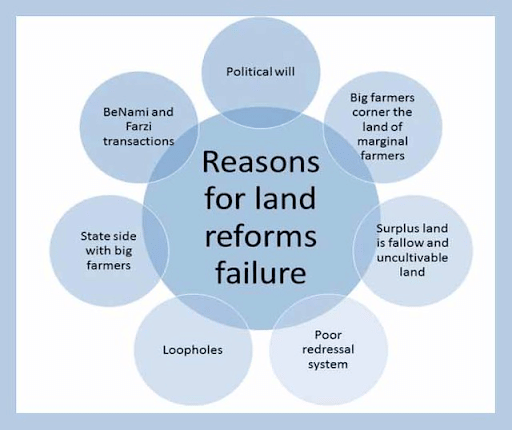
Reasons for Failure of Land Reforms
What are Land Reforms in India?
- Reforms regarding land tenure are particularly referred to as "land reforms."
- The term "land reforms" encompasses a variety of unique programs and actions intended to improve the governance and use of land for the benefit of the community at large.
- The major goals of the land reforms are to boost agricultural productivity and eliminate the current disparities in the landholding system.
- The delayed rate of land reform policies being put into action makes this goal more difficult to achieve.
- Land reforms are seen as a tool for social justice since they aim to end exploitative relationships characterized by stark disparities between wealthy landowners and poor peasants without a secure place to live.
- Through the imposition of limits on the extent of holdings that can be owned by a family, it is a move against the concentration of landholdings in the hands of a small number of absentee/non-cultivating owners.
- Although redistribution of land is the common understanding of land reforms, their scope is far broader.
|
|
|
|---|---|
| Ceilings on Landholdings | Tenancy Reforms |
| Gramdan Movement | Bhoodan Movement |
| Abolition of the Intermediaries(zamindari System) | Cooperative Farming |
Need for Land Reforms
- By the time British rule ended, an unproductive agrarian structure with unproductive interest groups in control had developed due to intermediary tenures in the zamindari and jagirdari areas as well as subleasing in the ryotwari districts.
- Landlessness, hunger, unemployment, and indebtedness increased to previously unheard-of levels and at the same time the concentration of land in the hands of a small number of people grew.
- In independent India, the issues that needed to be addressed right away were made worse by eviction and tenancy instability.
- Extreme peasant indebtedness as a result of exorbitant taxation.
- The formation of a class of wealthy individuals who primarily exploited the poor peasantry.
- Peasants were constantly afraid of being evicted.
- Poverty was deeply ingrained in the farmer class.
Land Reforms - Objectives
- To make systematic and comprehensive changes to the country's agrarian structure.
- To eliminate the intermediaries of India's semi-feudal landlordism system, i.e. the zamindars.
- Bring about economic and social equity, as well as social justice for past atrocities against farmers.
- Land reforms would also prevent landlords from exploiting tenant farmers.
- Farmers must be motivated and practices to increase agricultural output implemented.
- To ensure the rational or scientific use of limited agricultural lands by imposing land holding limits, consolidating land holdings, and creating economic land holdings.
- India's land reform policy had the following specific goals:
- The first is to remove any impediments to increasing agricultural production that arises from the agrarian structure that has been passed down from generation to generation.
- The second goal, which is closely related to the first, is to eliminate all elements of exploitation and social injustice from the agrarian system.
- To provide security to the soil tiller, and to ensure equality of status and opportunity to all sections of the rural population.
Reasons for Failure of Land Reforms
Poor Land Records
- The major obstacle to the failure of land reforms is the lack of concurrent evaluation and reliable (current) records.
- The reporting system is unstable and unreliable after 45 years of land changes.
- There hasn't been a regular, organized evaluation of development. There are no efforts being made to conduct thorough contemporaneous reviews.
- With purposeful malice aforethought, incorrect records are maintained. As a result, it is impossible to pinpoint obstacles to the implementation of land reform.
Lack of Financial Support
- Another obstacle standing in the way of land reform is a lack of financial backing.
- The Five Year Plans did not provide any funding specifically for financing land reform.
- Many states refused to include even the cost of such necessary items as the creation of surveys and records in their budgetary plans.
- Therefore, the poor results of its implementation are mostly attributable to the lack of proper fiscal assistance in whatever manner.
Lack of Integrated Approach
- The absence of an integrated approach, such as the elimination of intermediary tenures, tenancy reforms, holdings ceilings, etc., was another factor in India's failed land reforms.
- The programs are not properly coordinated. It means that programs for land reform have been seen as separate from the primary initiatives for economic development.
Improper Implementation
- In almost all states, the revenue administration is in charge of implementing land reforms into action.
- On the other side, maintaining public order, collecting land taxes, and other regulatory duties were given top attention.
- Land reforms do not receive the needed attention as a result.
Legal Hurdles
- Land reform implementation in the nation is also hampered by legal issues and limitations.
- The Task Force has made it clear that "whatever small prospect of success there may have been, has entirely vanished due to the gaps in the laws and protracted litigation."
- The land reform laws had numerous flaws; some were intentional loopholes, while others were the result of poor drafting.
Lack of Pressure from Below
- Except in a few scattered and isolated areas, basically all over the country, the poor peasants and agricultural laborers are passive, unorganized, and non-cooperative.
- The primary issue is that those who benefit from land reforms do not belong to a uniform social or economic class.
- Given these facts, it is understandable why there hasn't been much downward pressure for the proper implementation of land reforms.
Lack of Political Will
- The Task Force believed that the effective enactment of progressive land reform measures and their implementation was hindered by a lack of political will.
- Effective political support, direction, and control are necessary for efficient implementation.
- The problem of political will is vividly evidenced by the wide gaps between policy and legislation and between law and implementation.
- It is a well-known reality that the lack of political stems from the country's democratic political power structure.
Indifferent Attitude of the Administration
- The revenue administration is solely responsible for implementing any land reform initiatives in each state.
- But it is a sad condition of affairs because the administrative staff's attitude and even their behavior are quite apathetic.
- In addition, landlords have a lot of power over village officials like Patwaries, Karamcharies, Karnams, Symbols, etc.
- In actuality, they have shown to be uncooperative.
Excessive advance publicity and delays in enacting land laws
- The leaders of the ruling party have given much advance publicity to the proposed land reforms after independence.
- Again, the time it takes for a bill to become an Act has been unusually long in many states.
- This has allowed landowners to make the necessary adjustments in order to avoid various provisions of land reform legislation.
Loose definition of the term "personal cultivation"
- Under the definition, one could resume personal cultivation while sitting 200 miles away.
- The Zamindars have been given permission to cultivate large areas of land.
- Again, the laws have provided for numerous exemptions, such as land awarded for gallantry, land under orchards, tea estates, well-managed farms, and so on.
Nature of the laws
- The majority of the laws granting tenants ownership rights are optional. Tenants must petition the government for ownership rights. They will not be delivered automatically.
- Many tenants are afraid to approach the law courts for this purpose because they are afraid of their landlords.
Malafide land transfer
- To avoid the laws governing land ceilings, Zamindars have engaged in large-scale land transfers to family members or kinsmen.
Lack of social consciousness among tenants
- The importance of tenant social consciousness has been emphasised as a factor responsible for the successful implementation of land reforms.
- Small farmers and landless people were not only disorganised, but they were also often unaware of legal and constitutional processes.
State governments have sided with the big farmers
- State governments, which control land operations, have sided with the big farmers. Small farmers' interests have been severely harmed.
Bureaucratic corruption
- Land reforms provide a golden opportunity for the Patwari and other Revenue Department functionaries to make money.
- Again, in many cases, high-ranking officials are landlords.
- Furthermore, lands acquired to be distributed among landless farmers are cheaply acquired by politicians and bureaucrats.
Surplus land is fallow and uncultivable land
- Surplus land owners manipulate land data so that the excess land in their possession is usually barren and uncultivable.
- Such surplus land provides no benefit to landless peasants.
Absence of records
- The lack of records regarding land ownership and possession, as well as actual cultivators, makes it difficult to properly identify the beneficiaries of land reforms.
Inconsistency in land reform laws
- Land reform laws are not consistent across India. They differ depending on the state. This also explains why land reform measures are moving slowly.
Emergence of new agricultural technology
- Adoption of the new seed-cum-fertilizer technology requires ample resources and dynamic entrepreneurship.
- Only large farmers can meet these requirements.
Conclusion
Land reform initiatives might "lead to a true burst of enthusiasm, a genuine release of energy among the working peasantry" in a nation like India that has a history of inequality and exploitation of the poor. Land reforms must be properly implemented for them to succeed. It takes a government with strong political will and a bureaucracy with the dedication to achieve the desired objectives. In order to overcome the obstacles, the poor should be inspired through education and persuasion and the rich should be coerced to cooperate.
FAQs
Question: What were the main objectives of land reforms in India?
Answer: The main objectives of land reforms in India were to redistribute land to landless farmers, eliminate feudal landholdings, and promote equitable agricultural development.
Question: Why did land reforms face political resistance in India?
Answer: Political resistance came from powerful landowners and zamindars, who had significant influence in both local and national politics, leading to the dilution of reform efforts.
Question: How did legal loopholes affect the success of land reforms?
Answer: Many landowners exploited legal loopholes in the land reform laws through practices like benami transactions and falsified land records, avoiding land redistribution.
Question: Why was the implementation of land reforms ineffective?
Answer: The implementation of land reforms was ineffective due to bureaucratic inefficiency, lack of proper land records, and the absence of political will.
Question: What role did the judiciary play in delaying land reforms?
Answer: Judicial delays in resolving land disputes and legal challenges from landowners resulted in protracted litigation, which slowed down the redistribution of land.
MCQs
1. Which of the following was a significant factor in the failure of land reforms in India?
A. High population density
B. Political resistance from landowners
C. Rapid urbanization
D. Lack of fertile land
Answer: (B) See the Explanation
The political influence of landowners and their opposition to land redistribution efforts were major factors in the failure of land reforms.
2. What was a common method used by landowners to avoid land redistribution under land reforms?
A. Leasing land to corporations
B. Falsifying land records
C. Selling land at lower prices
D. Converting agricultural land into urban land
Answer: (B) See the Explanation
Landowners often falsified land records or engaged in benami transactions to avoid land redistribution under land reforms.
3. Why did judicial delays contribute to the failure of land reforms?
A. Courts supported the tenant farmers
B. Lack of legal framework for land reforms
C. Slow resolution of land disputes
D. Fast-tracked land redistribution
Answer: (C) See the Explanation
Judicial delays in resolving land disputes resulted in slow progress in land redistribution, contributing to the failure of land reforms.
4. Which group was the intended beneficiary of land reforms in India?
A. Urban dwellers
B. Large landowners
C. Industrialists
D. Landless farmers and tenants
Answer: (D) See the Explanation
The primary beneficiaries of land reforms were supposed to be landless farmers and tenant farmers.
5. What was one of the key bureaucratic issues that affected land reforms?
A. Inaccurate land records
B. Excessive taxation
C. Lack of agricultural subsidies
D. Poor quality of fertilizers
Answer: (A) See the Explanation
Inaccurate land records were a major bureaucratic issue that hindered the effective implementation of land reforms.
GS Mains Questions and Model Answers
Q1: Discuss the reasons for the failure of land reforms in India.
Answer: Land reforms in India failed primarily due to political resistance from powerful landowning elites, who used their influence to dilute reform laws. Bureaucratic inefficiency further delayed the implementation of land reforms, as many land records were incomplete or inaccurate. Loopholes in legislation allowed landowners to evade redistribution through benami transactions and falsified records. Additionally, the lack of awareness and organizational strength among tenant farmers, along with judicial delays in resolving land disputes, contributed to the overall failure of land reforms in achieving their objectives.
Q2: Analyze how legal loopholes and judicial delays hindered the success of land reforms in India.
Answer: Legal loopholes in land reform laws provided opportunities for landowners to exploit the system and avoid redistributing their land. Benami transactions, where property was transferred to family members or proxies, were commonly used to circumvent the laws. The judicial system, which often favored the interests of landowners, contributed to the failure of land reforms by delaying decisions on land disputes. The slow adjudication of cases allowed landowners to continue controlling vast tracts of land, preventing effective redistribution.
Q3: Evaluate the role of bureaucratic inefficiency in the failure of land reforms in India.
Answer: Bureaucratic inefficiency played a significant role in the failure of land reforms in India. The lack of proper land records and the inability of local administrations to enforce land reform laws resulted in delays and ineffective implementation. Corruption within the bureaucratic system further exacerbated the problem, as officials often colluded with landowners to circumvent the laws. This inefficiency hindered the redistribution process, leaving tenant farmers and landless peasants without access to land.
Previous Year Questions from Failure of Land Reforms
1. UPSC CSE Prelims 2019
Question: Which of the following was a significant challenge to the successful implementation of land reforms in India?
A. Lack of fertile land
B. Political opposition from landowners
C. Technological advancements
D. Rapid urbanization
Answer: B
Explanation: Political opposition from powerful landowners was a major challenge that hindered the successful implementation of land reforms in India.
2. UPSC CSE Mains 2020 (GS Paper 3)
Question: Examine the reasons for the failure of land reforms in India. What steps can be taken to overcome these challenges in the future?
Explanation: Land reforms in India faced several challenges, including political opposition, bureaucratic inefficiency, legal loopholes, and judicial delays. The powerful influence of landowners at both local and national levels prevented the proper implementation of reform laws. Benami transactions and falsified land records allowed landowners to evade land redistribution, while the lack of awareness among tenant farmers further hindered reform efforts. Going forward, steps such as improving land records, addressing judicial delays, and ensuring political commitment to land redistribution can help overcome these challenges and make land reforms more effective.
Download the PREPP App and attempt FREE IAS Exam Mock Tests and get complete study material!

Full Test - 04: UPSC CSE Prelims CSAT (Paper-II)
Full Test - 03: UPSC CSE Prelims CSAT (Paper-II)
UPSC CSE Prelims 2026 CSAT Paper 2 Question Paper (24-May-2026)
UPSC CSE Prelims 2026 GS Paper 1 Question Paper (24-May-2026)

17 February 2025 | The Hindu Must Read Articles | Current Affairs

16 February 2026 | The Hindu Must Read Articles | Current Affairs

13 February 2026 | The Hindu Must Read Articles | Current Affairs









Comments