Agriculture Allied Sectors - Agriculture Notes
India is a major player in the global agriculture sector, and agriculture provides a primary source of income for approximately 58% of the Indian population. India has the world's largest herd of cattle (buffaloes), the largest area planted for wheat, rice, and cotton, and is the world's largest producer of milk, pulses, and spices. It ranks second in the production of fruits and vegetables, tea, farmed fish, cotton, sugarcane, wheat, rice, cotton, and sugar. India's agriculture sector has the world's second-largest agricultural land, employing approximately half of the country's population. As a result, farmers become an essential component of the sector in order to provide us with food. In this article, we will discuss Agriculture Allied Sectors which will be helpful for UPSC exam preparation.
|
Table of Contents |
What is Agriculture?
- Agriculture is the practice of cultivating natural resources for human survival and economic gain.
- It combines the creativity, imagination, and skill required for crop planting and animal husbandry with modern production methods and new technologies.
- Agriculture is also a business that provides commodities to the global economy, such as grain, livestock, dairy, fibre, and raw materials for fuel.
|
|
|
|---|---|
| Livestock | Horticulture |
| Poultry | Animal husbandry |
| Fisheries | Dairy |
Why is Agriculture Important?
Provides Raw Material
- Raw materials are an essential component of the global economy. Manufacturers cannot produce goods unless they have access to raw materials.
- Steel, minerals, and coal are examples of nonagricultural raw materials
- Many raw materials, however, are derived from agriculture, ranging from lumber for construction materials to herbs for flavouring food.
- Corn, for example, is used in food production and as a foundation for ethanol.
Creates Strong Supply Chain
- Importing and exporting agricultural products necessitates the use of shipping methods such as ocean freight, rail, and trucking.
- Delays in shipping crops, on the other hand, could be detrimental to regions expecting shipment, limiting product availability on store shelves and affecting livelihoods.
Encouraging Economic Development
- Agriculture has an impact on global trade because it is linked to other sectors of the economy, promoting job creation and economic development.
- Countries with strong agricultural sectors see employment growth in other sectors.
- Countries with high agricultural productivity growth and well-developed agricultural infrastructure have higher per capita incomes, as producers in these countries innovate through technology and farm management practises to increase agricultural productivity and profitability.
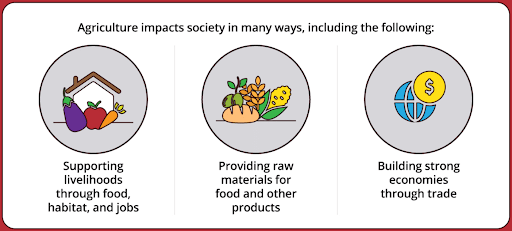
Impact of Agriculture
Features of Indian Agriculture
- Source of livelihood: Agriculture is the main source of income. It employs nearly 61% of the total population. It contributes 25% of national income.
- Dependence on monsoon: Agriculture in India is heavily reliant on the monsoon. If the monsoon is good, the crops will produce more; if the monsoon is poor, the crops will fail. Agriculture is dependent on the monsoon because irrigation facilities are inadequate.
- Labor-intensive cultivation: As the population has grown, so has the demand for land. Land holdings become fragmented and subdivided, making them uneconomical. On such farms, machinery and equipment are not permitted.
- Underemployment: Farmers find work only a few months of the year due to insufficient irrigation facilities and unpredictable rainfall. Their work capacity is underutilised. Agriculture has both underemployment and disguised unemployment.
- Small holding size: Due to large scale sub-division and fragmentation of holdings, land holding size is quite small.
- Traditional methods of production: Agriculture production methods and equipment are traditional in India. It is due to people's poverty and illiteracy. Traditional technology is the primary cause of low output.
- Low agricultural production: India's agricultural production is low. Per hectare, India produces 27 quarts of wheat. France produces 71.2 Qtls per hectare, while the United Kingdom produces 80 Qtls per hectare.
- Dominance of food crops: Food crops such as wheat, rice, and bajra account for 75% of cultivated land, while commercial crops account for 25%. Backward agriculture is caused by this pattern.
Allied Sectors of Agriculture
Livestock
- Livestock is vital to the Indian economy. The livestock sector in India contributes 4.35% of GDP and 29.35% of total Agriculture GDP.
- About 20.5 million people rely on livestock for a living.
- Livestock contributed 16% of income to small farm households, compared to an average of 14% for all rural households.
- Livestock provides a living for two-thirds of rural communities. It also employs approximately 8.8% of the Indian population.
*For detailed notes of this topic, check this link Livestock - Agriculture Allied Sector
Poultry
- Poultry is one of India's most important and fastest-growing agricultural sectors.
- The poultry industry primarily meets protein and nutrition requirements.
- Today, India is one of the world's largest producers of eggs and broiler meat.
- The poultry industry in India has undergone an exemplary transformation in structure and operation over the last two decades, evolving from a simple backyard poultry farming that appears to be very fast into a mega-industry with a large number of workers.
- India is the world's third largest egg producer and sixth largest broiler producer.
- Commercial poultry farms contribute 75% of egg production, while household/backyard poultry farms contribute the remaining 25%, and broiler production is 4.9 million MT (4th in Broiler Production).
- During the fiscal year 2021-22, the country exported 320,240.46 MT of poultry products to the world for a total value of Rs. 529.81 Crores/71.04 USD Millions.
- Oman, Maldives, Indonesia, Vietnam, Bhutan, Japan, and Russia are the major export destinations for India.
*For detailed notes of this topic, check this link Poultry - Agriculture Allied Sector
Fisheries
- Fisheries is a fast-growing sector in India, providing nutrition and food security to a large population as well as income and employment to more than 28 million people.
- The fishing industry has been designated a 'Sunrise Sector,' with an outstanding double-digit average annual growth rate of 10.87% since 2014-15.
- The sector produced a record 142 lakh tonnes of fish in fiscal year 2019-20 and has enormous growth potential.
- The fisheries sector has been identified as a powerful income and employment generator because it stimulates the growth of a number of subsidiary industries and provides a source of cheap and nutritious food while also providing a source of income for a large portion of the country's economically disadvantaged population.
- Fish, as an inexpensive and abundant source of animal protein, is one of the healthiest options for reducing hunger and nutrient deficiency.
- The sector has enormous potential to double its exports; it is critical that the sector receives sustained and focused attention through policy and financial support to accelerate its development in a sustainable, responsible, inclusive, and equitable manner.
- India is the world's third largest producer of fish and the world's second largest aquaculture nation after China.
- The Blue Revolution in India demonstrated the importance of the Fisheries and Aquaculture sector.
- The sector is considered to be in its early stages and is expected to play a significant role in the Indian economy in the near future
*For detailed notes of this topic, check this link Fisheries - Agriculture Allied Sector
Horticulture
- India is currently producing approximately 320.48 million tonnes of horticulture produce, which has surpassed food grain production, albeit on a much smaller scale (25.66 million Ha. for horticulture against 127.6 M. ha. for food grains).
- Horticulture crop productivity is much higher than food grain productivity (12.49 tones/ha vs. 2.23 tones/ha).
- India has risen as a world leader in the production of a variety of fruits such as mango, banana, guava, papaya, sapota, pomegranate, lime, and aonla.
- India is the second largest producer of fruits and vegetables in the world.
- Furthermore, India has retained its dominance in the production of spices, coconut, and cashew nuts.
- Among the new crops successfully introduced for commercial cultivation in the country are kiwi, gherkins, kinnow, date palm, and oil palm.
- The launch of the National Horticulture Mission has increased horticultural crop production and productivity.
- Horticulture crops currently account for approximately 10% of the country's gross cropped area, yielding approximately 160 million tonnes.
- As it is more profitable than agriculture, the horticulture sector has emerged as a major driver of growth (food grains mainly).
- This industry provides employment opportunities in the primary, secondary, and tertiary sectors.
- This industry enables people to eat a diverse and balanced diet in order to live a healthy lifestyle.
- It has become a key driver of economic development in many of the states where the Division of Horticulture of the Indian Council of Agricultural Research plays an important role.
*For detailed notes of this topic, check this link Horticulture - Agriculture Allied Sector
Animal Husbandry
- Animal husbandry is the agricultural practise of selective breeding and raising livestock such as cattle, dogs, sheep, and horses.
- It entails animal management and care in which the genetic qualities and regular behaviour of animals are developed for profit.
- It aids in the proper administration of animals by providing adequate food, shelter, and disease protection for domestic animals.
- It promotes the development of high-yielding animal breeds through crossbreeding and boosts the production of various food products such as milk, eggs, and meat.
- Animal husbandry provides a living for a large number of farmers. It provides employment for nearly 55% of the rural population.
- According to the Economic Survey 2021, livestock's contribution to total agriculture and allied sector Gross Value Added (at Constant Prices) has risen from 24.32% in 2014-15 to 28.63% (2018-19).
- According to the 20th Livestock Census, the total livestock population in the country is 535.78 million, a 4.6% increase from the Livestock Census 2012.
*For detailed notes of this topic, check this link Animal Husbandry - Agriculture Allied Sector
Dairy
- A dairy is a business that harvests or processes (or both) animal milk for human consumption, typically from cows or buffaloes, but also from goats, sheep, horses, or camels.
- Dairy, as an attributive, refers to milk-based products, derivatives, and processes, as well as the animals and workers involved in their production: for example, dairy cattle and dairy goat.
- Dairy sector in India contributes 5% to the GDP and provides direct employment to nearly 80 million dairy farmers.
- India's success story in milk production was scripted by Dr. Verghese Kurien, known as the "Father of the White Revolution" in India.
- India ranks first in milk production, accounting for 23% of global milk production.
- Milk production in the country has increased at a compound annual growth rate of about 6.2 percent, from 146.31 million tonnes in 2014-15 to 209.96 million tonnes in 2020-21.
*For detailed notes of this topic, check this link Dairy - Agriculture Allied Sector
Conclusion
Many structural and institutional issues must be addressed in order to accelerate agricultural growth. This is vital for promoting the welfare of masses, arresting the widening inequality and achieving the growth of the economy at a higher and sustainable level. A multifaceted agricultural reform agenda should be developed in order to improve incentives to produce, rationalise subsidies, and promote investment, as well as extend protective cover to the poor.
|
|
|
|---|---|
| Agriculture Notes | Land Reforms in India |
| Scope and Importance of Agriculture | Problems of Indian Agriculture |
| Farming Systems | Agricultural Revolutions in India |
FAQs
Q1: What are the allied sectors of agriculture?
Answer: The allied sectors of agriculture include forestry, fisheries, dairy farming, poultry, and sericulture, which contribute to the agricultural economy and food security.
Q2: How does agroforestry benefit agriculture?
Answer: Agroforestry combines agriculture and forestry practices, enhancing biodiversity, improving soil health, and providing additional income through the sale of timber and non-timber products.
Q3: What role does aquaculture play in food security?
Answer: Aquaculture is crucial for food security as it increases fish production, provides a source of protein, and supports rural livelihoods, thus contributing to nutritional needs.
Q4: How does dairy farming contribute to the economy?
Answer: Dairy farming supports the economy by providing employment, contributing to rural incomes, and producing milk, which is a vital source of nutrition for many people.
Q5: What is the significance of sericulture in agriculture?
Answer: Sericulture involves the production of silk from silkworms and is significant as it provides livelihoods to many farmers, promotes rural development, and contributes to the textile industry.
MCQs
- Which of the following is NOT considered an allied sector of agriculture?
(a) Dairy Farming
(b) Aquaculture
(c) Mining
(d) Poultry
Answer: (c) See the Explanation
- Agroforestry is a practice that combines which two sectors?
(a) Agriculture and Animal Husbandry
(b) Agriculture and Forestry
(c) Agriculture and Fisheries
(d) Agriculture and Mining
Answer: (b) See the Explanation
- What is the primary benefit of aquaculture?
(a) Decrease in soil fertility
(b) Increase in fish production
(c) Reduction of agricultural jobs
(d) None of the above
Answer: (b) See the Explanation
- Sericulture primarily involves the cultivation of which organism?
(a) Fish
(b) Silkworms
(c) Chickens
(d) Cows
Answer: (b) See the Explanation
- Dairy farming is significant because it:
(a) Only produces milk
(b) Supports rural economies and livelihoods
(c) Decreases agricultural productivity
(d) Is not related to agriculture
Answer: (b) See the Explanation
GS Mains Questions and Model Answers
Q1: Discuss the significance of allied sectors of agriculture in enhancing food security and rural livelihoods in India.
Answer: The allied sectors of agriculture, including dairy, fisheries, and agroforestry, play a crucial role in enhancing food security and providing livelihoods in rural areas. By diversifying agricultural production, these sectors reduce dependency on traditional crops and mitigate risks associated with climate change and market fluctuations. Dairy farming, for instance, not only ensures a steady source of nutrition but also provides income and employment opportunities to millions of farmers. Similarly, aquaculture contributes significantly to fish production, addressing the growing demand for protein in diets while improving nutritional outcomes. Furthermore, agroforestry practices enhance soil health and biodiversity, thereby improving overall agricultural productivity. By integrating these sectors into the agricultural framework, India can achieve sustainable development, improve rural economies, and ensure food security for its growing population.
Q2: Analyze the role of aquaculture in promoting sustainable agricultural practices in India.
Answer: Aquaculture has emerged as a key component in promoting sustainable agricultural practices in India, particularly in addressing food security and environmental conservation. As the demand for fish and seafood continues to rise, aquaculture provides a viable alternative to overfishing, ensuring the sustainability of aquatic ecosystems. By utilizing innovative practices, such as integrated aquaculture, farmers can enhance productivity while minimizing environmental impacts. This involves cultivating multiple species, including plants and fish, in a synergistic manner that improves water quality and promotes biodiversity. Moreover, aquaculture contributes to rural development by creating job opportunities and providing a source of income for coastal and inland communities. By supporting local economies and ensuring a stable food supply, aquaculture plays a pivotal role in fostering sustainable agricultural practices that align with India's development goals.
Q3: Examine the potential of agroforestry in addressing climate change challenges in India.
Answer: Agroforestry is increasingly recognized as a vital strategy for addressing climate change challenges in India. This practice integrates trees and shrubs into agricultural landscapes, creating a multifunctional land-use system that enhances both ecological resilience and agricultural productivity. By increasing carbon sequestration, agroforestry can significantly mitigate greenhouse gas emissions. Trees absorb carbon dioxide during photosynthesis, and when integrated with crops, they can improve soil health, enhance biodiversity, and provide shade, thereby reducing heat stress on crops.
Previous Year Questions on Agriculture
1. UPSC CSE Prelims 2022
Question: What are the key features of the National Fisheries Policy of India?
Answer: The National Fisheries Policy aims to enhance fish production, improve livelihoods for fishermen, and ensure sustainable management of fisheries resources. Key features include promoting aquaculture, establishing fishery cooperatives, and encouraging investments in the fishing sector. The policy also emphasizes the need for research and development, technology transfer, and capacity building among fishermen to ensure sustainable practices. The focus on community participation and empowerment of traditional fishers is crucial for achieving long-term sustainability and improving the socio-economic status of the fishing community.
2. UPSC CSE Mains 2021
Question: Critically evaluate the impact of the Pradhan Mantri Kisan Samman Nidhi (PM-KISAN) scheme on agricultural productivity and rural income.
Answer: The PM-KISAN scheme, which provides direct financial assistance to smallholder farmers, has significantly impacted agricultural productivity and rural income. By alleviating the financial burden on farmers, the scheme enables them to invest in better seeds, fertilizers, and agricultural practices, which can enhance crop yields. Furthermore, the direct cash transfer model ensures that financial support reaches the farmers promptly, improving their purchasing power. However, the scheme's effectiveness is contingent upon its implementation and the farmers' ability to utilize the funds productively. Critics argue that while the scheme provides immediate relief, it does not address systemic issues such as land fragmentation and access to markets, which are critical for sustainable agricultural growth. A holistic approach that combines financial assistance with capacity building and infrastructure development is essential for maximizing the PM-KISAN scheme's benefits.
Download the PREPP App and attempt FREE IAS Exam Mock Tests and get complete study material!

Full Test - 04: UPSC CSE Prelims CSAT (Paper-II)
Full Test - 03: UPSC CSE Prelims CSAT (Paper-II)
UPSC CSE Prelims 2026 CSAT Paper 2 Question Paper (24-May-2026)
UPSC CSE Prelims 2026 GS Paper 1 Question Paper (24-May-2026)

17 February 2025 | The Hindu Must Read Articles | Current Affairs

16 February 2026 | The Hindu Must Read Articles | Current Affairs

13 February 2026 | The Hindu Must Read Articles | Current Affairs









Comments