Horticulture - Agriculture Allied Sector - Agriculture Notes
India is the world's second-largest producer of horticulture crops, accounting for approximately 12% of global fruit and vegetable production. India is a global leader in the production of fruits such as mango, banana, pomegranate, sapota, acid lime, and aonla. The Indian horticulture sector accounts for approximately 33% of agricultural GVA, making a significant contribution to the Indian economy. Andhra Pradesh led the way in fruit production in 2018-19, followed by Maharashtra and Uttar Pradesh. In 2018-19, the area under horticulture crops increased to 25.5 million hectares, accounting for 20% of total foodgrain area, producing 314 million tonnes. In this article, we will discuss Horticulture which will be helpful for UPSC exam preparation.
|
Table of Contents |
What is Horticulture?
- Horticulture is the agricultural branch concerned with intensively cultured plants that are directly used by man for food, medicine, and aesthetic gratification.
- It is the cultivation, production, and sale of vegetables, fruits, flowers, herbs, and ornamental, or exotic plants.
- It entails expanding the area and productivity of farming lands, introducing technological aspects into agriculture, and serving as a source of employment opportunities.
- Horticulture is derived from the Latin words hortus (garden) and cultra (cultivation).
- L.H. Bailey is regarded as the "Father of American Horticulture," while M.H. Marigowda is regarded as the "Father of Indian Horticulture."
|
|
|
|---|---|
| Livestock | Crop and its Classifications |
| Poultry | Animal husbandry |
| Fisheries | Dairy |
Horticulture Sector in India
- India is currently producing approximately 320.48 million tonnes of horticulture produce, which has surpassed food grain production, albeit on a much smaller scale (25.66 million Ha. for horticulture against 127.6 M. ha. for food grains).
- Horticulture crop productivity is much higher than food grain productivity (12.49 tones/ha vs. 2.23 tones/ha).
- India has risen as a world leader in the production of a variety of fruits such as mango, banana, guava, papaya, sapota, pomegranate, lime, and aonla.
- India is the second largest producer of fruits and vegetables in the world.
- Furthermore, India has retained its dominance in the production of spices, coconut, and cashew nuts.
- Among the new crops successfully introduced for commercial cultivation in the country are kiwi, gherkins, kinnow, date palm, and oil palm.
- The launch of the National Horticulture Mission has increased horticultural crop production and productivity.
- Horticultural crop productivity increased by about 38% between 2004-05 and 2019-20.
- Fresh fruit and vegetable exports increased by 14% in value, while processed fruits and vegetables increased by 16.27%.
- Horticulture crops currently account for approximately 10% of the country's gross cropped area, yielding approximately 160 million tonnes.
- The total fruit production from 5.7 million hectares has been estimated to be around 63 million tonnes.
- Vegetables cover 7.8 million hectares and produce 125 million tonnes.
- India's share of global fruit and vegetable production is 12.6 percent and 14.0 percent, respectively.
- As it is more profitable than agriculture, the horticulture sector has emerged as a major driver of growth (food grains mainly).
- This industry provides employment opportunities in the primary, secondary, and tertiary sectors.
- This industry enables people to eat a diverse and balanced diet in order to live a healthy lifestyle.
- It has become a key driver of economic development in many of the states where the Division of Horticulture of the Indian Council of Agricultural Research plays an important role.
Significance of Horticulture in India
- India's diverse agro-climatic conditions allow for the production of a wide range of fresh fruits, vegetables, and medicinal plants.
- Horticulture crops play an important role in the Indian economy by creating jobs, supplying raw materials to various food processing industries, and increasing farm profitability due to increased production and export earnings from foreign exchange.
- Horticultural crops outperform field crops in terms of production per unit area.
- Such crops are high-value, labor-intensive, and provide employment all year.
- It has gained prominence as a growing contributor to agriculture's Gross Value Addition.
- They are in high demand both nationally and internationally, and they are a good source of foreign exchange.
- It is critical to meet the country's estimated demand for 650 MT of fruits and vegetables by 2050.
Indian Council of Agricultural Resources (ICAR)
|
Horticulture Sector - Challenges
- Horticulture does not have a safety net like Minimum Support Price (MSP) as foodgrains do.
- Horticulture products such as mangoes, bananas, cucumber, pomegranate, and custard apples, as well as other Horticulture crops, have no Minimum Support Price set by the government.
- These fruits fall into the category of perishable goods. Despite the fact that horticulture farmers have raised their voices numerous times, the problem persists.
- Extending the life of perishable products has become difficult due to a lack of a reliable transportation network and a scarcity of good cold chain storage.
- As most of the machinery and equipment are obsolete and thus provide very little value and input, adhering to time constraints becomes a challenge in and of itself.
- Higher input costs than foodgrains make it a difficult setup, especially when there is no support from local governments for smaller farmers.
- It becomes difficult for marginal farmers to cope with the high price fluctuations.
- Horticultural export is one of the critical challenges impeding the growth of India's horticulture sector. The lack of market intelligence, particularly for exports, makes it the most difficult decision to make.
Horticulture vs. Agriculture
- Horticulture differs from agriculture in two ways.
- Firstly, it generally involves a smaller scale of cultivation, employing small plots of mixed crops rather than large fields of single crops.
- Second, horticultural cultivations generally include a wide range of crops, including fruit trees and ground crops.
- From 2012-13 to 2017-18, the horticulture sector in India grew faster than the agriculture sector.
Mission for Integrated Development of Horticulture (MIDH)
- Centrally Sponsored Scheme for the holistic growth of the horticulture sector, including fruits, vegetables, and other crops.
- Under MIDH, the Government of India contributes 60% of the total outlay for developmental programmes in all states (except North Eastern and Himalayan states, where the GOI contributes 90%) and state governments contribute 40%.
- It has five major horticulture schemes:
- National Horticulture Mission (NHM),
- Horticulture Mission for North East and Himalayan States (HMNEH),
- National Horticulture Board (NHB),
- Coconut Development Board (CDB), and
- Central Institute of Horticulture (CIH), Nagaland.
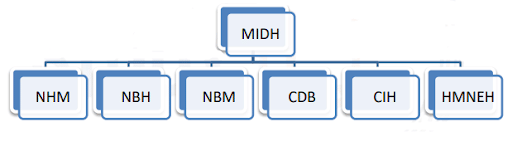
*For detailed note sof this topic, check this link Mission for Integrated Development of Horticulture (MIDH)
What is National Horticulture Mission (NHM)?
|
Conclusion
The country has plenty of sunshine all year, plenty of labor, and a wide range of agro-climatic regions, all of which offer a high potential for successful and profitable commercial horticulture. However, the sector continues to face numerous challenges, including high post-harvest losses and gaps in post-harvest management and supply chain infrastructure. Some of the new initiatives, such as the emphasis on planting material production, the cluster development program, credit push through the Agri Infra Fund, and the formation and promotion of FPOs, are steps in the right direction.
FAQs
Question: What is horticulture?
Answer: Horticulture refers to the practice of cultivating fruits, vegetables, flowers, and ornamental plants. It is a branch of agriculture focused on growing plants for food, medicine, and aesthetic purposes.
Question: How does horticulture contribute to the economy?
Answer: Horticulture contributes significantly to the economy by providing employment, improving food security, supporting agro-processing industries, and promoting exports of fruits, vegetables, and ornamental plants.
Question: What are the allied sectors of agriculture?
Answer: Allied sectors of agriculture include activities like animal husbandry, dairy farming, fisheries, beekeeping, and sericulture, which complement crop farming and enhance agricultural productivity.
Question: How does the horticulture sector support food security?
Answer: Horticulture plays a vital role in food security by producing a wide variety of fruits and vegetables, which are key sources of essential nutrients like vitamins, minerals, and fiber.
Question: What is the role of government schemes in promoting horticulture?
Answer: Government schemes like the National Mission on Horticulture (NMH) and Pradhan Mantri Kisan Sampada Yojana (PMKSY) aim to boost production, improve storage facilities, and provide financial support to farmers in the horticulture sector.
MCQs
1. What is the primary focus of horticulture?
A) Livestock farming
B) Growing fruits, vegetables, and ornamental plants
C) Crop rotation
D) Forest management
Answer: (B) See the Explanation
Explanation: Horticulture primarily focuses on growing fruits, vegetables, flowers, and ornamental plants, which are essential for food, medicinal, and aesthetic purposes.
2. Which of the following is an allied sector of agriculture?
A) Animal husbandry
B) Textile industry
C) Industrial automation
D) Mining
Answer: (A) See the Explanation
Explanation: Animal husbandry is one of the allied sectors of agriculture, which involves breeding and raising livestock for milk, meat, and other products.
3. Which government scheme supports horticulture development in India?
A) Pradhan Mantri Fasal Bima Yojana
B) National Mission on Horticulture (NMH)
C) Atal Mission for Rejuvenation and Urban Transformation
D) National Rural Livelihood Mission
Answer: (B) See the Explanation
Explanation: The National Mission on Horticulture (NMH) is a key government initiative to support and promote the development of the horticulture sector in India, focusing on enhancing production and productivity.
4. How does horticulture contribute to the agro-processing industry?
A) By providing raw materials for agro-processing
B) By manufacturing processing equipment
C) By organizing marketing campaigns
D) By reducing the need for chemical fertilizers
Answer: (A) See the Explanation
Explanation: Horticulture contributes to the agro-processing industry by providing raw materials like fruits, vegetables, and flowers, which are processed into products such as juices, jams, and canned goods.
5. What is a key benefit of government schemes in the horticulture sector?
A) Reduction of crop prices
B) Improvement in storage and processing infrastructure
C) Promotion of synthetic fertilizers
D) Disincentivization of organic farming
Answer: (B) See the Explanation
Explanation: Government schemes in the horticulture sector focus on improving infrastructure for storage, processing, and marketing, which helps reduce post-harvest losses and enhances the value chain.
GS Mains Questions and Model Answers
Q1: Discuss the significance of the horticulture sector in India's agricultural economy.
Answer: The horticulture sector plays a vital role in India’s agricultural economy, contributing significantly to food security, nutrition, and economic growth. It supports the production of a wide range of fruits, vegetables, flowers, and medicinal plants, which are vital for the country's food consumption and exports. Horticulture also provides substantial employment opportunities in rural areas and contributes to the rural economy. Additionally, the sector has been key in promoting the growth of the agro-processing industry, further adding to India’s export potential and economic development. Government initiatives like the National Mission on Horticulture (NMH) have been instrumental in improving productivity, infrastructure, and the marketing of horticultural produce.
Q2: Evaluate the challenges faced by the horticulture sector in India and suggest measures to address them.
Answer: The horticulture sector in India faces several challenges, including inadequate infrastructure for storage and transportation, limited access to modern farming techniques, pest and disease management issues, and market access. Additionally, the lack of cold storage facilities results in significant post-harvest losses. To address these challenges, there is a need for more investments in storage and cold chain infrastructure, implementation of advanced pest control measures, and increased access to quality inputs such as seeds and fertilizers. Furthermore, the government should focus on improving market linkages for farmers and provide training on modern farming techniques to enhance productivity and sustainability in the sector.
Q3: How can the integration of allied sectors like animal husbandry and dairy farming benefit the horticulture sector?
Answer: The integration of allied sectors like animal husbandry and dairy farming with the horticulture sector can provide multiple benefits. Livestock farming can help in the production of organic fertilizers, which can improve soil health and productivity in horticultural farming. Additionally, dairy farming can provide a source of income for farmers, making them more resilient to market fluctuations in horticultural products. Moreover, integrated farming systems (IFS) that combine horticulture, livestock, and aquaculture can enhance the sustainability of farming by optimizing resource use, reducing waste, and increasing overall farm productivity.
Previous Year Questions on Horticulture
1. UPSC CSE Mains 2020 (GS Paper 3):
Question: "Evaluate the role of horticulture in improving food security and nutrition in India."
Answer: Horticulture plays a crucial role in improving food security and nutrition by providing a diverse range of nutrient-rich fruits, vegetables, and medicinal plants. These contribute to improving the diet of the population by offering essential vitamins, minerals, and fiber. The sector also helps in enhancing food availability throughout the year, reducing seasonal shortages, and contributing to the diversification of food production. The development of the horticulture sector through improved production techniques, post-harvest management, and market linkages can address nutritional deficiencies in India.
2. UPSC CSE Mains 2019 (GS Paper 3):
Question: "What are the challenges in the development of the horticulture sector in India, and how can they be mitigated?"
Answer: The horticulture sector in India faces challenges such as limited access to modern technology, inadequate cold storage and transportation infrastructure, and issues related to pest and disease management. The lack of organized markets and low prices for produce are also significant issues. These challenges can be mitigated by investing in cold chain infrastructure, improving farmer access to quality inputs, training farmers on modern techniques, and promoting contract farming models to ensure better prices for farmers. Additionally, strengthening market linkages and ensuring timely access to pest control measures can further enhance the sector’s productivity and profitability.
Download the PREPP App and attempt FREE IAS Exam Mock Tests and get complete study material!

Full Test - 04: UPSC CSE Prelims CSAT (Paper-II)
Full Test - 03: UPSC CSE Prelims CSAT (Paper-II)
UPSC CSE Prelims 2026 GS Paper 1 Question Paper (24-May-2026)
UPSC CSE Prelims 2026 CSAT Paper 2 Question Paper (24-May-2026)

17 February 2025 | The Hindu Must Read Articles | Current Affairs

16 February 2026 | The Hindu Must Read Articles | Current Affairs

13 February 2026 | The Hindu Must Read Articles | Current Affairs









Comments