Mission for Integrated Development of Horticulture (MIDH) - Agriculture Notes
The Mission for Integrated Development of Horticulture (MIDH) is a Centrally Sponsored Scheme that promotes the holistic growth of the horticulture sector, which includes fruits, vegetables, root and tuber crops, mushrooms, spices, flowers, aromatic plants, coconut, cashew, cocoa, and bamboo. The Government of India (GOI) contributes 60% of total outlay for developmental programmes in all states except the North East and the Himalayas, and state governments contribute 40%. In the case of North Eastern and Himalayan states, the Government of India contributes 90%. The GOI contributes 100% to the National Horticulture Board (NHB), Coconut Development Board (CDB), Central Institute for Horticulture (CIH), Nagaland, and National Level Agencies (NLA). In this article, we will discuss the Mission for Integrated Development of Horticulture (MIDH) which will be helpful for UPSC exam preparation.
|
Table of Contents |
Mission for Integrated Development of Horticulture
What is Horticulture?
- Horticulture is derived from the Latin words hortus (garden) and cultra (cultivation).
- Horticulture is the branch of agriculture concerned with intensively cultured plants directly used by man for food, medicinal purposes, and aesthetic gratification, or, in simpler terms, the cultivation, production, and sale of vegetables, fruits, flowers, herbs, ornamental or exotic plants.
- Growers of flowers, fruits, nuts, vegetables, herbs, ornamental trees, and lawns are known as horticulturists.
- Horticulture aided in the transition of human populations from nomadic to sedentary or semi-sedentary lifestyles.
- Horticulture is broken down into a number of sections that concentrate on growing and preparing various kinds of plants and foods for certain uses.
- Numerous organizations from all over the world educate, encourage, and promote the development of horticulture in order to preserve the science.
- L.H. Bailey is regarded as the Father of American Horticulture, while M.H. Marigowda is regarded as the Father of Indian Horticulture.
What is Mission for Integrated Development of Horticulture (MIDH)?
- The Mission for Integrated Development of Horticulture (MIDH) is a plan for the holistic growth and development of the Indian horticulture sector.
- MIDH is a Centrally Sponsored Scheme that was implemented by the Agriculture Ministry in 2014-15 as part of the Green Revolution - Krishonnati Yojana.
- This Centrally Sponsored Scheme includes vegetables, fruits, roots and tuber crops, aromatic plants, flowers, spices, bamboo, coconut, cashew, and cocoa.
- MIDH also provides technical assistance and advice to state horticultural missions, the Rashtriya Krishi Vikas Yojana (RKVY), the Saffron Mission, and the National Mission for Sustainable Agriculture (NMSA).
- The scheme's horticulture improvement strategies include technology promotion, research, post-harvest management, extension, processing, and marketing.
- The scheme emphasises the use of differentiated strategies for different states based on the region's agro-climatic characteristics.
Objectives of MIDH
- Promote holistic growth of the horticulture sector, including bamboo and coconut, through area-based regionally differentiated strategies that include research, technology promotion, extension, post-harvest management, processing, and marketing, in accordance with the comparative advantage of each State/region and its diverse agro-climatic features.
- Encourage farmer aggregation into farmer groups such as FIGs/FPOs and FPCs to bring economies of scale and scope.
- Improve horticulture production, increase farmer income, and strengthen nutritional security.
- Improve productivity by using high-quality germplasm, planting materials, and micro irrigation to save water.
- Support rural youth skill development and job creation in horticulture and post-harvest management, particularly in the cold chain sector.
Strategy of MIDH
- Adopt an end-to-end holistic approach that includes pre-production, production, post-harvest management, processing, and marketing to ensure appropriate returns to growers/producers.
- Promote R&D technologies for cultivation, production, post-harvest management, and processing, with a special emphasis on cold chain infrastructure for extending the shelf life of perishables.
- Improve productivity through quality by:
- Diversification of crops, including plantations, orchards, vineyards, flowers, and vegetable gardens.
- Farmers are being given appropriate technology for high-tech horticulture, such as protected cultivation and precision farming.
- Increased acreage of orchards and plantation crops, particularly in states where horticulture accounts for less than 50% of agricultural land.
- Improve post-harvest management, value-added processing, and marketing infrastructure.
- Adopt a coordinated approach and encourage collaboration, convergence, and synergy among R&D, processing, and marketing agencies in the public and private sectors at the national, regional, state, and sub-state levels;
- Encourage the use of FPOs and their collaboration with Market Aggregators (MAs) and Financial Institutions (FIs) to provide assistance and adequate returns to farmers.
- Support capacity-building and human resource development at all levels, including changes in graduation course syllabus and curriculum at colleges, universities, ITIs, and polytechnics, as appropriate.
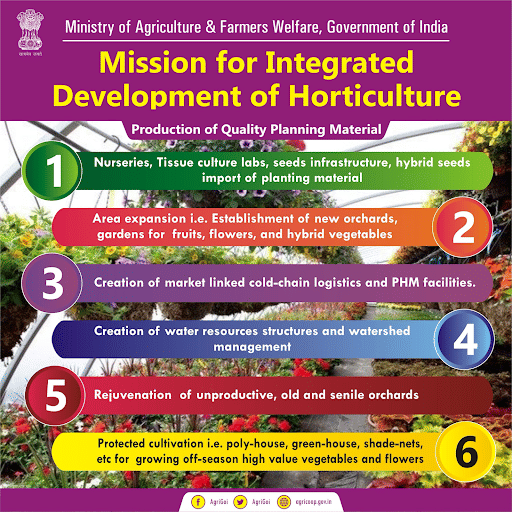
Major Activities under MIDH
- Establishment of nurseries and tissue culture units for the production of high-quality seed and planting material.
- Expansion of the area, i.e. planting of new orchards and gardens for fruits, vegetables, and flowers.
- Rejuvenation of senile, old, and unproductive orchards.
- Protected cultivation, such as poly-houses and green houses, is used to increase productivity and grow high-value vegetables and flowers during the off-season.
- Organic agriculture and certification.
- Water resource structure development and watershed management.
- Pollination is achieved through beekeeping.
- Mechanization in Horticulture.
- Infrastructure for Post-Harvest Management and Marketing is being built.
MIDH Sub-Schemes
- National Horticulture Mission (NHM): It is implemented by the State Horticulture Missions and aims to increase production in the horticulture sector.
- National Horticulture Board (NHB): The NHB implements the various MIDH schemes at the state and UT levels.
- Horticulture Mission for the North East and Himalayan States (HMNEH): It is carried out by the State Horticulture Missions of the Northeastern and Himalayan states.
- The Coconut Development Board (CDB): It implements the MIDH's schemes in all of the country's coconut-growing states.
- Central Institute for Horticulture (CIH), Nagaland: The institute was founded in Medizipehima, Nagaland in 2006-07 to provide technical assistance to farmers and field functionaries in the North Eastern Region through capacity building and training.
Performance of MIDH
- The MIDH scheme has played a significant role in increasing the area under horticulture crops such as:
- Between 2014-15 and 2019-20, the area and production of horticulture crops increased by 9% and 14%, respectively.
- In 2019-20, the country recorded its highest-ever horticulture production of 320.77 million tonnes from an area of 25.66 million hectares.
- However, the sector still faces numerous challenges. For example,
- High post-harvest loss
- Post-harvest Management Gaps
- Infrastructure for the supply chain
Conclusion
There is enormous potential for increasing Indian horticulture productivity, which is required to meet the country's estimated demand of 650 million MT of fruits and vegetables by 2050. Some of the new initiatives, such as the emphasis on planting material production, cluster development programmes, credit pushes through the Agri Infra Fund, and the formation and promotion of FPOs (Farmers Producer Organizations), are steps in the right direction.
FAQs
Question: What is MIDH?
Answer: Mission for Integrated Development of Horticulture (MIDH) is a government initiative aimed at the holistic growth of the horticulture sector in India. It focuses on fruits, vegetables, tubers, flowers, and other horticultural crops to increase production, improve farmers' income, and enhance nutritional security.
Question: What are the objectives of MIDH?
Answer:
- Promote the growth of the horticulture sector through region-specific strategies.
- Encourage farmer aggregation via Farmer Producer Organizations (FPOs).
- Increase productivity using quality planting materials and micro-irrigation.
- Support rural skill development and job creation, especially in cold chain management.
Question: What is the strategy of MIDH?
Answer: The strategy includes an end-to-end approach that integrates pre-production, production, and post-harvest management. It promotes R&D technologies, cold chain infrastructure, and market linkages for horticulture development.
Question: What are the major activities under MIDH?
Answer:
- Establishment of nurseries and tissue culture units.
- Rejuvenation of old orchards.
- Protected cultivation such as poly-houses.
- Organic agriculture, watershed management, and pollination through beekeeping.
Question: What are the sub-schemes under MIDH?
Answer:
- National Horticulture Mission (NHM)
- National Horticulture Board (NHB)
- Horticulture Mission for North Eastern and Himalayan States (HMNEH)
- Coconut Development Board (CDB)
MCQs
- What is the main goal of the Mission for Integrated Development of Horticulture (MIDH)?
A) Promoting organic farming in India
B) Holistic growth of the horticulture sector
C) Boosting the dairy industry
D) Promoting mechanization in agriculture
Answer: (B) See the Explanation
MIDH focuses on the holistic development of the horticulture sector, including fruits, vegetables, and other crops.
- Which of the following is a major activity under MIDH?
A) Establishment of new agricultural markets
B) Expansion of organic farming certification
C) Establishment of nurseries and tissue culture units
D) Only increasing crop area
Answer: (C) See the Explanation
The establishment of nurseries and tissue culture units is a core activity under MIDH to ensure high-quality planting materials.
- What is the role of Farmer Producer Organizations (FPOs) under MIDH?
A) Focus on soil health improvement
B) Promote the aggregation of farmers to achieve economies of scale
C) Focus on mechanization
D) Promote the export of fruits
Answer: (B) See the Explanation
FPOs under MIDH enable farmers to aggregate, access economies of scale, and improve productivity and market access.
- Which sub-scheme of MIDH focuses on the horticulture sector in North Eastern and Himalayan states?
A) National Horticulture Mission (NHM)
B) Coconut Development Board (CDB)
C) Horticulture Mission for North Eastern and Himalayan States (HMNEH)
D) National Horticulture Board (NHB)
Answer: (C) See the Explanation
HMNEH focuses specifically on improving horticulture in the North Eastern and Himalayan states.
- What is one key feature of MIDH's strategy?
A) Focus only on water conservation
B) Adopting an end-to-end approach for horticulture development
C) Only promoting large-scale commercial farms
D) Focus on monoculture farming
Answer: (B) See the Explanation
MIDH adopts an end-to-end approach covering production to post-harvest management for comprehensive horticulture development.
GS Mains Questions and Model Answer
Q1: Discuss the role of MIDH in improving India’s horticulture sector and its impact on farmers' income.
Answer: MIDH plays a vital role in improving India’s horticulture sector through strategies like technology promotion, skill development, and post-harvest management. It encourages FPOs to aggregate smallholder farmers, ensuring better productivity and market access. The adoption of micro-irrigation and value-added processing enhances farmers' income, making horticulture a lucrative sector while improving nutritional security.
Q2: Explain how the MIDH’s strategy of using region-specific agro-climatic approaches benefits the horticulture sector.
Answer: MIDH’s region-specific approach aligns agricultural practices with local climatic conditions, ensuring efficient use of resources. It promotes crops suited to the region, adopts water-efficient irrigation systems, and supports technological interventions like poly-houses and watershed management. These tailored strategies enhance productivity and sustainability in the horticulture sector.
Q3: Evaluate the potential of MIDH in achieving sustainable growth in the horticulture sector.
Answer: MIDH promotes sustainable growth by conserving resources through water-efficient irrigation and organic farming. Its emphasis on cold chain infrastructure reduces wastage, while skill development and market linkages ensure economic viability. The program aligns economic growth with environmental sustainability, fostering a resilient horticulture ecosystem.
Previous Year Questions on Mission for Integrated Development of Horticulture (MIDH)
1. UPSC CSE 2021
Question: Explain the objectives and strategies of the Mission for Integrated Development of Horticulture (MIDH) and its role in enhancing farmer livelihoods.
Answer: This question assesses the objectives of MIDH, including holistic horticulture development and strategies such as infrastructure support and FPO aggregation. It evaluates how these initiatives improve farmer incomes and enhance agricultural sustainability.
2. UPSC CSE 2020
Question: Discuss the major activities under MIDH and how they contribute to the overall development of the horticulture sector.
Answer: This question explores key MIDH activities like nursery establishment, poly-house cultivation, and post-harvest management, focusing on their impact on boosting horticulture production and farmers' economic well-being.
Download the PREPP App and attempt FREE IAS Exam Mock Tests and get complete study material!

Full Test - 04: UPSC CSE Prelims CSAT (Paper-II)
Full Test - 03: UPSC CSE Prelims CSAT (Paper-II)
UPSC CSE Prelims 2026 GS Paper 1 Question Paper (24-May-2026)
UPSC CSE Prelims 2026 CSAT Paper 2 Question Paper (24-May-2026)

17 February 2025 | The Hindu Must Read Articles | Current Affairs

16 February 2026 | The Hindu Must Read Articles | Current Affairs

13 February 2026 | The Hindu Must Read Articles | Current Affairs









Comments