Soil Health Card (SHC) Scheme - Agriculture Notes
The Government of India introduced the Soil Health Card Scheme on February 19, 2015. According to the scheme, the government will provide farmers with soil health cards that contain crop-specific recommendations for the nutrients and fertilizers needed for their particular farms. This will enable farmers to increase productivity through the careful use of inputs. All soil samples must be analyzed at several soil testing facilities across the nation. This article will explain to you about Soil Health Card (SHC) Scheme which will help prepare the Agriculture Syllabus for the UPSC Civil Service exam.
|
Table of Contents |
Need for Soil Health Card Scheme
- Even after utilising the maximum capability of the fertiliser industry, Indian soils are operating with a negative nutrient balance of 12–14 million tonnes annually, and the negative balance is anticipated to increase in the future.
- Accordingly, India has a 95, 94, 48, 25, 41, 20, 14, 8 and 6% nutrient shortage for N, P, K, S, Zn, B, Fe, Mn, and Cu.
- The crop productivity and fertiliser response are decreased because the limiting nutrients prevent other nutrients from expressing themselves fully.
- Indian farmers are unsure of the best crops to produce to yield the most. In essence, they are unaware of the nature and quality of their soil.
- This is the basic notion behind introducing the soil health card scheme.
What is Soil Health Card Scheme?
- The Ministry of Agriculture and Farmers' Welfare Department of Agriculture & Co-operation promotes the Soil Health Card (SHC), a programme of the Government of India.
- The Department of Agriculture of each State and Union Territory Government is responsible for implementing its action.
- The Soil Health Card programme aims to educate each farmer about the status of their farm's soil nutrients and provide guidance on the amount of fertiliser to use and how to apply soil amendments in order to preserve soil health over the long term.
- This programme is being implemented across all the States and Union Territories,.
- The Soil Health Card SHC programme calls for the State Governments to analyse the composition of the soil once every three years so that corrective action can be taken to improve soil nutrients.
- A Soil Health Card (SHC) is a printed report that a farmer receives for each of his land holdings.
- It will include information about his soil's condition concerning 12 factors, including N, P, K (Macro nutrients), S (Secondary nutrient), Zn, Fe, Cu, Mn, and Bo (Micro-nutrients) and pH, EC, OC (Physical parameters).
- The SHC administered in the succeeding cycle of two years will be able to document any changes in the soil health during that time period.
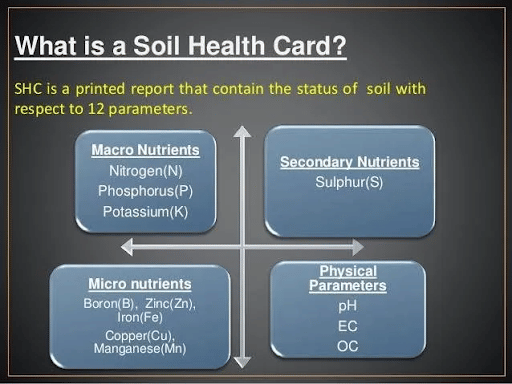
Soil Health Card
Soil Health Card Scheme - Salient Features
- The government intends to implement the program for all farms.
- Every region of the country will be covered by the programme.
- The farmers will receive a report with all the information about the soil of their specific farm in the form of a soil health card. The soil health card will be issued to a farmer once every three years.
- With the aid of GPS instruments and revenue maps, soil samples will be drawn in grids of 2.5 ha in the irrigated area and 10 ha in the rain-fed area.
- The staff of the state government's department of agriculture or that of a contracted organisation will be used to gather samples.
- Students from nearby agriculture and science colleges may also be included by the state government.
- In general, soil samples are collected twice a year, either when there is no standing crop in the field or after the harvest of the Rabi and Kharif crops, respectively.
Soil Health Card Scheme - Benefits
- The plan will carefully monitor the farmers' soil and provide them with a prepared report so they can choose which crops to develop and which ones to forgo.
- Once every three years, the authorities will monitor the soil and give farmers a report on any changes to the soil's characteristics and related issues.
- Farmers will receive assistance from government-employed experts in implementing corrective actions to raise the soil's quality.
- Farmers can prepare for the future of their crops and land using accessible soil health cards. They can study soil management techniques as well.
- The government makes sure that the same individual does the soil study for the farmer, which increases the program's effectiveness.
- Farmers will be able to make informed decisions about crop investments because they will have a clear understanding of the nutrients missing from their soil. Thus, the crop yield would eventually increase.
- Farmers will also be aware of the type of fertiliser their soil requires.
- Discovering the type of a particular soil was the primary goal of the soil health card programme. and then suggest ideas to make it better.
- The Soil Health Management Scheme has proven to be beneficial for farmers and is giving jobs to young people in rural areas.
Soil Health Card Scheme - Challenges
- The inadequate infrastructure for soil testing is the biggest challenge for this scheme.
- The Soil Health Card does not include moisture retention or microbial activity, which are crucial.
- Many farmers are unable to comprehend the information, making it impossible for them to implement the suggested procedures.
- Some significant indications, such as cropping history, soil moisture or water availability, slope, depth, soil colour and texture, micro-biological activity, etc., are left out.
- Agricultural extension agents and farmers lack coordination.
- There are more soil samples per unit area than there is variability in the soil.
- Only soil colour is listed among physical and biological characteristics in the soil health card, which is primarily focused on chemical nutrient indicators.
Soil Health Card Scheme - Way Forward
- Before the planting season, distribution of Soil Health Cards and awareness-raising programmes should be set up to encourage farmers to use the suggested fertilisers and crop selection.
- By using a thorough strategy and the recommended doses, it is necessary to experimentally demonstrate the benefits of SHC in each block.
- For soil management and assessing the degree of service provided by various authorities, a specialised body is required at both the central and state levels.
Conclusion
Farmers in India may be unsure of which crops to grow for maximum yield, or they may need to test soil quality. The government has created the 'Soil Health Card' to assist them. The SHC scheme is open to all farmers in India. The SHC scheme was launched by the government as an initiative to reduce the overuse of urea or nitrogenous fertilisers, which causes nutrient deficiencies in the soil such as potassium, nitrogen, sulphur, zinc, boron, copper, and phosphorus.
FAQs
Question. What is the Soil Health Card (SHC) Scheme?
Answer: The Soil Health Card (SHC) Scheme is an initiative launched by the Government of India under the Ministry of Agriculture and Farmers Welfare. The primary objective of the scheme is to promote sustainable agriculture and enhance soil fertility by providing farmers with personalized information about the health of their soil. The scheme involves the issuance of soil health cards to farmers, which provide detailed information about soil quality and the necessary amendments (such as fertilizers and organic inputs) to improve soil health. By regularly monitoring the soil and offering scientific recommendations, the SHC scheme aims to improve soil productivity, increase crop yields, and reduce the dependency on chemical fertilizers.
Question. What does a Soil Health Card contain?
Answer: A Soil Health Card contains the following critical information:
- Soil Nutrient Status: It provides information about the levels of macronutrients like nitrogen (N), phosphorus (P), potassium (K), and micronutrients such as zinc and boron in the soil.
- pH level: It includes information on the soil pH, which helps farmers understand whether the soil is acidic, neutral, or alkaline.
- Soil Texture: It may provide details on the soil texture (e.g., sandy, loamy, or clayey), which affects the soil's water retention and aeration.
- Recommended Fertilizer Use: The card offers recommendations on fertilizers, including the right type and quantity, based on the soil's nutrient deficiencies.
- Soil Amendments: It may suggest organic amendments or micronutrient supplements to enhance soil health.
- Season-wise Advice: The card provides advice based on the season and cropping patterns to optimize crop production.
Question. How does the Soil Health Card (SHC) Scheme benefit farmers?
Answer: The Soil Health Card (SHC) Scheme offers several benefits to farmers:
- Improved Soil Fertility: By identifying soil deficiencies, the scheme helps farmers apply the right fertilizers and amendments, leading to improved soil fertility and better crop yields.
- Cost Reduction: By recommending the correct amount and type of fertilizers, the scheme helps reduce the overuse of fertilizers, saving farmers money and preventing environmental damage.
- Increased Crop Productivity: By following the recommendations on improving soil health, farmers can achieve higher crop yields and better-quality produce.
- Sustainable Agriculture: The SHC promotes eco-friendly farming practices by encouraging the use of organic fertilizers and reducing chemical dependency, ensuring long-term soil health.
- Better Water Retention: Improved soil health leads to better water retention and reduced soil erosion, helping farmers in drought-prone areas.
Question. What is the process of issuing Soil Health Cards to farmers?
Answer: The process of issuing Soil Health Cards involves the following steps:
- Soil Sampling: Soil samples are collected from the fields of farmers by trained professionals, typically agriculture extension workers or soil scientists. Samples are taken at various locations and depths to get an accurate representation of the soil's health.
- Soil Testing: The collected soil samples are tested in soil testing laboratories to assess their nutrient levels, pH, and other physical and chemical properties.
- Soil Health Assessment: Based on the test results, experts analyze the soil's nutrient deficiencies and health status.
- Card Preparation: The information is compiled into a Soil Health Card and shared with the farmers, along with recommendations on how to improve soil health, including the correct fertilizer application and other soil amendments.
- Periodic Monitoring: Soil samples are tested periodically, and farmers are encouraged to use the Soil Health Card for regular monitoring and follow-up actions.
Question. How does the Soil Health Card (SHC) Scheme contribute to sustainable agriculture?
Answer: The Soil Health Card (SHC) Scheme significantly contributes to sustainable agriculture by:
- Reducing Chemical Fertilizer Use: By advising farmers on the precise amount and type of fertilizers, the scheme prevents overuse and promotes the use of organic fertilizers, which reduces the environmental impact.
- Enhancing Soil Biodiversity: Proper management of soil health supports soil microorganisms, which are essential for maintaining soil fertility and ensuring sustainable agricultural practices.
- Promoting Crop Rotation: The SHC encourages practices like crop rotation and organic farming, which help maintain soil structure and health.
- Long-Term Soil Management: The scheme encourages regular monitoring and proper nutrient management, ensuring that soil health is maintained for future generations of farmers.
MCQs
- What is the main objective of the Soil Health Card (SHC) Scheme?
A) To increase the cost of fertilizers
B) To improve soil fertility and promote sustainable agriculture
C) To monitor air quality in agricultural areas
D) To develop new irrigation techniques
The SHC Scheme aims to improve soil fertility by providing farmers with tailored recommendations, thus promoting sustainable agriculture.
- Which of the following information is NOT included in a Soil Health Card?
A) Soil pH level
B) Fertilizer recommendation
C) Seed variety
D) Micronutrient deficiency
A Soil Health Card provides information about soil pH, fertilizer recommendations, and nutrient deficiencies, but it does not provide details on seed varieties.
- Who issues the Soil Health Cards to farmers?
A) The Ministry of Finance
B) Local Agricultural Extension Officers
C) Private Fertilizer Companies
D) The Ministry of Rural Development
Local Agricultural Extension Officers collect soil samples and issue Soil Health Cards to farmers based on soil test results.
- What is the primary benefit of using a Soil Health Card?
A) Increase in pesticide use
B) Accurate fertilizer application based on soil needs
C) Increase in crop price
D) Reduction in farm mechanization
Soil Health Cards help farmers apply the correct amount of fertilizers, leading to improved soil health and higher productivity.
- Which of the following is a key component of the Soil Health Card (SHC) Scheme?
A) Development of irrigation infrastructure
B) Training in crop management practices
C) Soil testing and recommendation of corrective actions
D) Providing financial loans for farmers
The SHC Scheme involves soil testing and provides recommendations for corrective actions to improve soil health and productivity.
GS Mains Questions and Model Answers
Q1: Evaluate the role of the Soil Health Card (SHC) Scheme in improving agricultural productivity in India.
Answer: The Soil Health Card (SHC) Scheme plays a crucial role in improving agricultural productivity in India by addressing soil health issues and promoting sustainable farming practices. The scheme provides farmers with personalized soil health data, which enables them to understand the nutrient status of their soil and apply fertilizers accordingly, thus avoiding the overuse of chemical inputs and improving soil fertility. By recommending the appropriate amount and type of fertilizers, the SHC reduces input costs for farmers while ensuring better crop yields. The scheme also promotes the use of organic fertilizers, enhancing the soil's biological activity and structure. Additionally, it encourages crop rotation and the use of soil amendments, leading to long-term soil health. Overall, the SHC scheme contributes to sustainable agriculture by balancing productivity with environmental protection.
Q2: How does the Soil Health Card Scheme contribute to the overall sustainability of Indian agriculture?
Answer: The Soil Health Card Scheme contributes significantly to the sustainability of Indian agriculture by promoting scientifically-based farming practices that prioritize long-term soil health. The scheme helps reduce the excessive use of chemical fertilizers, which often lead to soil degradation and pollution. By advising farmers on the correct application of nutrients based on soil testing, it minimizes nutrient imbalances and supports the use of organic fertilizers and biological amendments, which are better for the soil ecosystem. The SHC also encourages diversified farming practices such as crop rotation and integrated pest management, which enhance biodiversity and improve soil structure. Additionally, by fostering sustainable farming techniques, the scheme reduces the environmental impact of agriculture, ensuring that soil resources are preserved for future generations.
Q3: Discuss the challenges in implementing the Soil Health Card Scheme effectively in India.
Answer: Despite its potential benefits, the Soil Health Card Scheme faces several challenges in effective implementation in India:
- Awareness: Many farmers, particularly in rural areas, are not fully aware of the importance of soil health and the advantages of using soil health cards. Effective awareness campaigns are required to encourage farmers to adopt the scheme.
- Infrastructure: The implementation of the SHC scheme requires access to proper soil testing laboratories and trained personnel to collect soil samples and analyze them. In some areas, the infrastructure may be lacking.
- Timely Distribution: Soil health tests need to be carried out regularly to maintain the relevance of the recommendations. Delays in issuing soil health cards can result in farmers missing the opportunity to apply corrective measures in time.
- Quality of Soil Testing: Inconsistent or inaccurate soil testing can lead to incorrect recommendations, undermining the effectiveness of the scheme.
- Financial Constraints: Although the scheme is subsidized by the government, farmers may still face financial barriers to implementing recommendations, especially in the case of organic amendments or micro-nutrient fertilizers.
Previous Year Questions on Soil Health Card (SHC) Scheme
1. UPSC 2020
Question: "How does the Soil Health Card Scheme help in promoting sustainable agriculture in India?"
Answer: This question focuses on evaluating the role of the Soil Health Card Scheme in promoting sustainable agriculture through improved soil health, nutrient management, and environmental protection.
2. UPSC 2019
Question: "Discuss the challenges faced in implementing the Soil Health Card Scheme and the measures to overcome them."
Answer: This question requires an analysis of the challenges faced in the effective implementation of the Soil Health Card Scheme, including infrastructure, awareness, and testing quality, and how these challenges can be addressed.
Download the PREPP App and attempt FREE IAS Exam Mock Tests and get complete study material!

Full Test - 04: UPSC CSE Prelims CSAT (Paper-II)
Full Test - 03: UPSC CSE Prelims CSAT (Paper-II)
UPSC CSE Prelims 2026 CSAT Paper 2 Question Paper (24-May-2026)
UPSC CSE Prelims 2026 GS Paper 1 Question Paper (24-May-2026)

17 February 2025 | The Hindu Must Read Articles | Current Affairs

16 February 2026 | The Hindu Must Read Articles | Current Affairs

13 February 2026 | The Hindu Must Read Articles | Current Affairs









Comments