WTO and Agricultural Subsidies - Agriculture Notes
The World Trade Organisation (WTO) is the sole worldwide international organisation that deals with international trade regulations. Subsidies in general are indicated by "Boxes" that are coloured like traffic lights in WTO language. The Agriculture Agreement (AoA) is a WTO instrument that was negotiated during the Uruguay Round of the General Agreement on Tariffs and Trade (GATT). This article will explain to you about the WTO and Agricultural Subsidies which will help prepare the Agriculture Syllabus for the UPSC Civil Service exam.
| To Read update on this topic: |
|
Table of Contents |
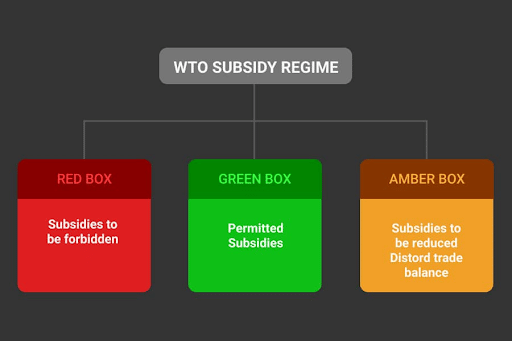
WTO Subsidy Regime
What is Agreement on Agriculture (AoA)?
- The Agreement on Agriculture (AoA) is a World Trade Organisation convention that aims to reduce agricultural assistance and subsidies provided by governments to local producers.
- It is one of the most controversial WTO accords.
- The Agriculture Agreement (AoA) was formally adopted in 1994 in Marrakesh, Morocco. The AoA went into effect in 1995.
- According to its terms, developing nations were to achieve their reduction pledges by 2000, and developing countries by 2004.
- The Least Developed Countries were not compelled to make any cuts.
- The agreement includes agricultural goods but excludes forestry and fisheries products, as well as rubber, sisal, jute, coir, and abaca.
- The AoA's primary goal is to eliminate "trade distorting" agricultural subsidies.
- The ultimate goal of the Agreement, according to the WTO, is "to develop a fairer trading system that will promote market access and improve the livelihoods of farmers throughout the world."
World Trade Organisation
|
Agreement on Agriculture (AoA) - Features
The terms of the WTO Agriculture Agreement are primarily concerned with three major categories of agriculture and trade policy, which are:
- Market Access
- Domestic Support
- Export Subsidies
Market Access
- Tariffication entails the elimination of all non-tariff obstacles in favour of tariffs.
- Variable taxes, minimum import prices, quotas, state trade measures, discretionary licensing, and other non-tariff obstacles are examples of non-tariff barriers.
- Tariff reduction - Developing nations were required to lower tariffs by 24% over a 10-year period.
- Opportunities for access - Minimum access of 3% of domestic consumption in 1986-88 will be required for 1995, rising to 5% at the conclusion of the implementation period.
- This category involves reducing trade obstacles to improve market access.
Domestic Support
- Policy help and subsidies offered by countries to increase local production.
- Agriculture subsidies and policies have been classified by the World Trade Organisation (WTO).
Export Subsidies
- Provisions related to member nations' pledges to reduce export subsidies may be found here.
- Over the next six years, developed nations must reduce export subsidies by 21% while increasing spending by 36% in equal increments (from 1986 to1990 levels).
- Over a ten-year period, developing countries must cut export subsidies by 14% and spending by 24% in equal increments.
The Agriculture Committee
|
WTO Agricultural Subsidy Boxes
- Subsidies in general are denoted by "boxes" with colours such as green (allowed), amber (slow down — i.e. need to be reduced), and blue.
- Many of the boxes have exclusions, particularly those geared at assisting poor nations in becoming more competitive in the global marketplace.
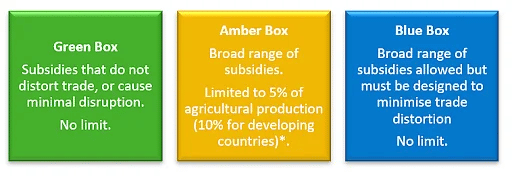
Agricultural Subsidy Boxes
| Green Box Subsidy |
|
| Blue Box Subsidy |
|
| Amber Box Subsidy |
|
Special and Differential Treatment (SDT)
- Aside from the three boxes, there is a fourth box of subsidies that provide developing nations and Least developed countries (LDCs) with unique and unequal treatment.
- This is sometimes referred to as the Development Box.
- Countries are allowed to use untargeted subsidised food distribution to meet the needs of the urban and rural poor.
- They may also provide agricultural investment subsidies as well as agricultural input subsidies to low-income and resource-poor farmers.
- Purchases and sales of food security inventories at administered prices are included, provided that the producer subsidy is included in the computation of the Aggregate Measure of Support (AMS).
- Under SDT, developed nations may be granted a ten-year reprieve from executing their AoA reduction obligations.
- At the AoA, LDCs are not yet obligated to make any form of reduction promise.
- The SDT is not available to developed countries.
Agreement on Agriculture - Criticism
- Opponents of the Agreement claim that it diminishes tariff protection for small farmers, who provide a significant source of income in developing nations, while allowing affluent countries to continue subsidising their farmers.
- Developed nations manage to extensively subsidise agriculture in their countries while accusing emerging countries, particularly India, of engaging in trade-distorting activities through cunning categorisation of subsidies into trade-distorting (amber box) and non-trade distorting (green box).
- According to a joint India-China research, developed countries such as the United States, Canada, and EU countries provide several times more subsidies to farmers than the rest of the world.
- Developed countries continue to give trade-distorting subsidies while avoiding WTO fines.
- The Amber Box gave industrialised nations the option of accepting either a product-specific ceiling of 5% or an overall cap. Most affluent countries have been able to better focus sops for specific crops by opting for the latter approach.
- Even with minimal subsidies, India should be concerned about exceeding the 10% subsidy cap.
- The industrialised nations regularly criticise developing countries for policies such as the Minimum Support Price (MSP), even as they continue to support their farmers and erect trade and market entrance obstacles.
- The World Trade Organisation's push for globalisation jeopardises three components of a sustainable and equitable agriculture policy: ecological security, livelihood security, and food security.
- Globalisation will harm producers with little or no money and investment.
Way Forward
- This extremely unequal arrangement arose because relatively few nations, including India, grasped the consequences of the Uruguay Round (1985).
- Even if the rules appear to be democratically framed, they must be questioned.
- India believes that the next WTO ministerial conference in Buenos Aires would address its long-standing concerns about food security and weak protections against import surges.
- It can only do so if it can put wealthy countries on the defensive.
- The collaborative study on AMS with China might be the first move in this approach.
- It must maintain momentum and take a more aggressive stance by exposing additional similar disparities in AoA, which are often swept under the rug by the strong.
India and WTO
- India is a significant member of the WTO and is often regarded as the developing and underdeveloped world's leader.
- As a result, there is a slim chance that anything seriously detrimental to India's interests can be enforced unilaterally.
- India stands to benefit from many topics being negotiated at the forum if it engages with various interest groups constructively while protecting its developmental priorities.
- In the absence of such a group, we risk losing a forum for mobilising the views of like-minded countries against the selfish intentions of the West.
- Because rich countries have great resources, they may readily sway smaller countries to their side.
- The WTO provides a venue for such developing countries to band together and exert pressure on wealthier countries.
Conclusion
The WTO's agriculture agreement was signed in 1994, with the goal of removing trade barriers and promoting transparent market access and global market integration. The AoA includes three types of subsidies, ranging from those considered "non-distorting" or "minimally distorting" (the "Green Box" and "Blue Box") to those that seriously "distorted" markets (the "Amber Box" subsidies). There is no red box in the Agriculture Agreement, but domestic support that exceeds the reduction commitment levels in the amber box is prohibited; and there is a blue box for subsidies tied to production-limiting programmes.
FAQs
Question. What is the role of the World Trade Organization (WTO) in agricultural subsidies?
Answer: The World Trade Organization (WTO) plays a significant role in regulating and addressing agricultural subsidies within its global trade framework. The Agreement on Agriculture (AoA), established during the Uruguay Round of trade negotiations (1986–1994), sets out rules regarding subsidies, market access, and domestic support for agricultural products. The WTO aims to reduce trade distortions caused by subsidies, ensuring a level playing field in global agricultural markets. Through the AoA, WTO members are required to adhere to certain limits on subsidies, with the goal of reducing trade barriers and improving market access for agricultural goods.
Question. What are agricultural subsidies, and why do they matter in international trade?
Answer: Agricultural subsidies are financial assistance programs provided by governments to support their domestic agriculture sectors. These subsidies can take various forms, including price supports, direct payments, and input subsidies such as fertilizers and seeds. Agricultural subsidies are crucial in shaping global agricultural trade because they affect the production costs and market prices of agricultural commodities. By lowering the cost of production, subsidies can make agricultural products from subsidizing countries more competitive in the global market, leading to market distortions. Countries that heavily subsidize their agriculture sectors may gain an unfair advantage over producers in other nations, often resulting in trade disputes at the WTO.
Question. How does the WTO regulate agricultural subsidies?
Answer: The WTO regulates agricultural subsidies through the Agreement on Agriculture (AoA), which divides subsidies into three categories:
- Green Box Subsidies: These are subsidies that have minimal impact on trade and are exempt from reduction commitments. They include spending on programs like rural development, environmental protection, and food security.
- Amber Box Subsidies: These subsidies are considered to distort trade, as they directly affect the price and production of agricultural goods. Amber box subsidies are subject to reduction commitments. These include subsidies for price supports and market price controls.
- Blue Box Subsidies: These are subsidies linked to production limits, such as those that involve payments to farmers who restrict their output or set aside land for environmental purposes. They are less trade-distorting than Amber Box subsidies but are still subject to some WTO regulations.
The WTO encourages countries to reduce trade-distorting subsidies (Amber Box) and limit overall spending on agricultural subsidies to promote fair competition.
Question. Why is there controversy over agricultural subsidies in the WTO?
Answer: The issue of agricultural subsidies is a major point of contention in WTO negotiations, particularly between developed and developing countries. Developed countries often provide significant subsidies to their agricultural sectors, which can make their products artificially cheap and more competitive in global markets. This creates unfair competition for developing countries whose agricultural sectors may not be as well subsidized. Developing countries argue that these subsidies undermine their agricultural markets, leading to poverty and food insecurity. On the other hand, developed countries argue that subsidies are necessary to ensure food security, support farmers, and stabilize domestic agricultural markets. The WTO aims to reform these practices but has faced challenges in reaching a fair agreement that satisfies all parties, particularly in sectors like rice, cotton, and sugar.
Question. What are the challenges in reforming agricultural subsidies at the WTO?
Answer: Reforming agricultural subsidies at the WTO presents several challenges:
- Disparity between Developed and Developing Countries: Developed countries tend to provide substantial subsidies, while developing countries often lack the resources to do so. This disparity leads to disagreements over the need for reform.
- Domestic Political Pressures: In many countries, agriculture is a politically sensitive sector. Subsidies are often used to protect local farmers from market fluctuations, making it difficult for governments to reduce them, especially in the face of opposition from farmer unions.
- Trade Distortions: Agricultural subsidies can significantly distort international markets, leading to overproduction in subsidizing countries and underproduction in others, making it harder to reach equitable agreements at the WTO.
- Lack of Consensus: While there is broad agreement on the need to reduce trade-distorting subsidies, countries have differing views on how to implement these reductions. Developed countries argue for gradual reductions, while developing countries push for more substantial cuts, particularly in the most harmful sectors.
MCQs
- Which of the following is a category of agricultural subsidies under the WTO’s Agreement on Agriculture (AoA)?
A) Red Box Subsidies
B) Green Box Subsidies
C) Yellow Box Subsidies
D) Purple Box Subsidies
Answer: (B) See the Explanation
Green Box Subsidies are those that have minimal impact on trade and are exempt from reduction commitments, including subsidies for rural development and food security programs.
- Which of the following is the primary concern regarding agricultural subsidies in international trade?
A) They always help increase global trade
B) They lead to trade distortions and unfair competition
C) They encourage sustainable agricultural practices
D) They only affect agricultural products within one country
Answer: (B) See the Explanation
Agricultural subsidies, particularly in developed countries, can distort trade by making their agricultural products artificially cheaper and less competitive for developing countries.
- Which of the following is an example of an Amber Box subsidy under the WTO?
A) Rural development programs
B) Price supports for agricultural products
C) Payments for environmental conservation
D) Investment subsidies
Answer: (B) See the Explanation
Amber Box Subsidies include subsidies for price supports and other direct payments that distort trade and are subject to reduction commitments under the WTO’s Agreement on Agriculture.
- What is the main goal of the WTO’s Agreement on Agriculture (AoA) regarding agricultural subsidies?
A) To eliminate all subsidies
B) To reduce trade-distorting subsidies
C) To increase subsidies for developing countries
D) To reduce agricultural production globally
Answer: (B) See the Explanation
The WTO’s AoA aims to reduce trade-distorting subsidies (Amber Box) and ensure that agricultural trade remains fair and competitive.
- What is the primary reason for the WTO’s focus on agricultural subsidies?
A) To promote the use of genetically modified crops
B) To prevent overproduction of agricultural goods
C) To ensure fair competition and reduce market distortions
D) To increase agricultural productivity in developed countries
Answer: (C) See the Explanation
The WTO’s focus on agricultural subsidies is to reduce the trade distortions caused by subsidies, ensuring fair competition in global agricultural markets.
GS Mains Questions and Model Answers
Q1: Discuss the role of the WTO in regulating agricultural subsidies and its impact on global trade.
Answer: The World Trade Organization (WTO) plays a central role in regulating agricultural subsidies through its Agreement on Agriculture (AoA). The AoA aims to reduce trade-distorting subsidies that give an unfair advantage to certain countries, particularly developed nations that provide large-scale subsidies to their agricultural sectors. The WTO’s regulation of subsidies includes the categorization of subsidies into Green, Amber, and Blue Box, each with different levels of trade impact and reduction commitments. While Green Box Subsidies are not subject to cuts, Amber Box Subsidies that distort trade are required to be reduced. The impact of WTO regulations on global trade is profound, as they seek to create a level playing field, ensuring that countries are not unfairly subsidizing their agricultural sectors at the expense of others. However, there is significant debate over the fairness of subsidy reductions, with developing countries arguing that developed nations should make deeper cuts in their subsidy programs to ensure equitable trade opportunities for all.
Q2: Examine the challenges in reforming agricultural subsidies within the framework of the WTO.
Answer: Reforming agricultural subsidies within the framework of the World Trade Organization (WTO) faces several challenges. One of the key challenges is the disparity between developed and developing countries. Developed countries often provide large subsidies to their agricultural sectors, which undermine the competitiveness of agricultural products from developing countries, leading to trade imbalances. Developing nations argue that these subsidies hinder their economic development and agricultural growth. Another challenge is the political sensitivity of agricultural subsidies, as they are often deeply tied to domestic political agendas, especially in countries with large agricultural sectors. Reducing subsidies can lead to political backlash from farmer groups, making reforms difficult. Additionally, disagreements over how subsidies should be measured and whether they cause significant trade distortion further complicate negotiations. While there is broad agreement on the need to reduce harmful subsidies, balancing interests remains a significant hurdle.
Q3: How do agricultural subsidies affect developing countries in the context of international trade?
Answer: Agricultural subsidies in developed countries have a significant negative impact on developing countries in the context of international trade. Developed countries provide extensive subsidies to their farmers, which allow them to sell agricultural goods at artificially low prices in global markets. This makes it difficult for farmers in developing countries to compete, as they cannot produce goods at such low costs without similar subsidies. As a result, agricultural products from developing nations are often priced out of international markets, leading to economic disadvantages. Moreover, these subsidies often distort local agricultural markets in developing countries, making it harder for farmers to earn a fair price for their products. In the WTO negotiations, developing countries have consistently argued that the removal of subsidies in developed nations would lead to more equitable agricultural trade, providing them with better access to global markets and supporting their agricultural sectors’ growth.
Previous Year Questions on WTO and Agricultural Subsidies
1. UPSC 2020
Question: "Analyze the role of the WTO in regulating agricultural subsidies and its impact on global trade."
Answer: This question focused on evaluating the role of the WTO in regulating agricultural subsidies and how these regulations impact the fairness of global agricultural trade.
2. UPSC 2019
Question: "Discuss the challenges faced by developing countries in addressing agricultural subsidies within the WTO framework."
Answer: Candidates were asked to examine the challenges developing countries face in addressing subsidy issues and their impact on agricultural markets under the WTO framework.
Download the PREPP App and attempt FREE IAS Exam Mock Tests and get complete study material!

Live Test : UPSC CSE Prelims CSAT (Paper-II) (Oct 08 - 11)
Full Test - 04: UPSC CSE Prelims CSAT (Paper-II)
Full Test - 03: UPSC CSE Prelims CSAT (Paper-II)
UPSC CSE Prelims 2026 GS Paper 1 Question Paper (24-May-2026)
UPSC CSE Prelims 2026 CSAT Paper 2 Question Paper (24-May-2026)

17 February 2025 | The Hindu Must Read Articles | Current Affairs

16 February 2026 | The Hindu Must Read Articles | Current Affairs

13 February 2026 | The Hindu Must Read Articles | Current Affairs









Comments