Agricultural Marketing - Agriculture Notes
Agricultural marketing encompasses the services required to transport an agricultural product from the farm to the consumer. These services include agricultural produce planning, organisation, directing, and handling in order to satisfy farmers, intermediaries, and consumers. Planning production, growing and harvesting, grading, packing and packaging, transport, storage, agro and food processing, market information, distribution, advertising, and sale are all interconnected activities. In practise, the term refers to the entire range of agricultural product supply chain operations, whether conducted through ad hoc sales or through a more integrated chain, such as one involving contract farming. In this article, we will discuss Agricultural Marketing which will be helpful for UPSC exam preparation.
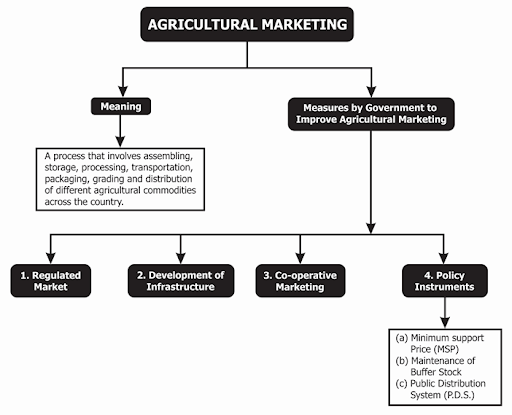
Agricultural Marketing
What is Agricultural Marketing?
- Agricultural marketing is a method that includes gathering, storage, preparation, shipping, and delivery of different farming materials across the country.
- Agricultural marketing, which is essentially a subset of the overall marketing system, refers to all of the activities, agencies, and policies involved in farmers procuring farm inputs and moving agricultural produce from farms to consumers/manufacturers/exporters.
- An effective marketing system reduces costs while increasing benefits to all segments of society.
- It should provide remunerative prices to farmers, food of sufficient quality at reasonable prices to consumers, and adequate margins to middlemen to ensure their continued participation in the trade.
- Agricultural marketing has an essential function to play in the overall agricultural growth.
- It provides farmers with economic security through fair and remunerative compensation for agricultural produce.
- At the same time, it ensures affordable and accessible food products to consumers thereby reducing inflation.
- Agricultural marketing is a comprehensive system that involves a wide range of functions in the movement of agricultural commodities from producer to consumer.
- Various marketing functions are classified into three categories: exchange functions, physical functions, and facilitating functions.
- This function categorization is important because it will aid in the understanding of other concepts such as the National Agricultural Market which deals with the integration of functions such as storage, transportation, grading and assaying, and market information.
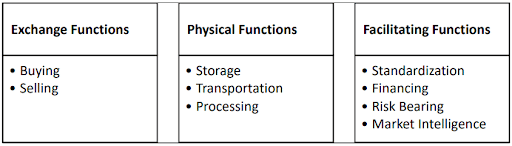
Categorization of Marketing Functions
Key Aspects of Agricultural Marketing
- Agricultural marketing encompasses all activities involved in the supply of farm inputs to farmers and the movement of agricultural products from farms to consumers.
- The agricultural marketing system is divided into two major subsystems: product marketing and input (factor) marketing.
- Farmers, village/primary traders, wholesalers, processors, importers, exporters, marketing cooperatives, regulated marketing committees, and retailers comprise the product marketing sub-system.
- The input subsystem includes input manufacturers, distributors, related associations, importers, exporters, and others who make various farm production inputs available to farmers.
- The agricultural marketing system is understood and developed as a link between the farm and non-farm sectors.
- A dynamic and expanding agriculture sector necessitates fertilisers, pesticides, farm equipment, machinery, diesel, electricity, packing material, and repair services, all of which are produced and supplied by industry and non-farm enterprises.
- The expansion of farm output stimulates forward linkages by providing surpluses of food and natural fibres that require transportation, storage, milling or processing, packing, and retailing to consumers.
- Furthermore, if an increase in agricultural production is accompanied by an increase in farm families' real incomes, the demand for non-farm consumer goods rises, as the proportion of income spent on non-food consumables and durables tends to rise with an increase in real per capita income.
- The marketing system should be designed to benefit all segments of society (producers, consumers, middlemen, and traders).
- The government acts as a watchdog to ensure the interests of all parties involved in marketing.
- The overall goal of agricultural marketing in a developing country like India is to assist primary producers, namely farmers, in obtaining remunerative prices for their produce and, on the other hand, to provide the right type of goods at the right place, in the right quantity and quality, at the right time, and at the right price to processors and/or ultimate consumers.
Importance of Agricultural Marketing
- Increase in marketable surplus - India now has a surplus in many agricultural commodities. The availability of high-quality seeds and other technological advancements have aided in increasing production and productivity, resulting in an increase in the marketable surplus of most agricommodities.
- Market demand for horticultural crops - Another shift in Indian agriculture has been a shift toward higher-value horticultural crops.
- Horticultural crops are bulky and perishable in nature, so they must be handled carefully throughout the food supply chain until they reach the final consumer.
- Price discovery and price signals - Agricultural marketing is concerned with price discovery at various stages of marketing as well as the transmission of price signals in the marketing chain, specifically from consumers to farmers.
- Focus shift to market-led production - Economic development, urbanisation, liberal trade policies, and consumer awareness of safe and high-quality food have all led to an increase in agricultural opportunities.
- Feeding the urban population - As a result of economic growth, urbanisation has increased significantly, necessitating the feeding of an increasing number of people in urban areas by rural people.
- This will necessitate not only production but also an effective marketing system to facilitate the efficient movement of agricultural commodities from point of production to point of consumption.
- Making smallholdings a viable option - Small and marginal farmers play an important role in meeting the food needs of a growing, increasingly wealthy, and urbanised population.
- Adopting a market-oriented approach can greatly increase the earning potential of such smallholders.
- Marketing system that is open and integrated - The GoI's Doubling Farmers' Income (DFI) report emphasises the development of an integrated marketing system by transforming Rural Periodic Markets (RPMs) into Gramin Agricultural Markets (GrAMs) to function as collection and distribution centres in rural areas, as well as by integrating markets with knowledge centres and other services such as warehouse/cold storage and banks.
Characteristics of Agricultural Products and Production
- Product perishability: Most farm products are perishable in nature, but the duration of their perishability ranges from a few hours to a few months.
- Because of their perishability, producers find it difficult to set a reserve price for their farm-grown products.
- The more perishable products necessitate prompt handling and, in some cases, specialised refrigeration, raising the marketing cost.
- Production seasonality: Farm products are produced during a specific season of the year. They cannot be manufactured all year.
- Farm product prices fall during the harvest season. However, the supply of manufactured goods can be adjusted or made consistent throughout the year.
- Bulkiness of products: The bulkiness of most farm products makes transportation and storage difficult and costly.
- This also limits the location of production to somewhere close to the point of consumption or processing.
- Bulky products have a wider price spread due to the higher costs of transportation, handling, and storage.
- Variation in product quality: There is a wide range of quality in agricultural products, making grading and standardisation difficult.
- Irregular agricultural product supply: Because agricultural production is dependent on natural conditions, agricultural product supply is uncertain and irregular.
- With varying supply and nearly constant demand, agricultural product prices fluctuate significantly more than manufactured product prices.
- Small holding size and dispersed production: Farm products are produced across the country, and the majority of producers are small in size. This complicates supply estimation and causes problems in marketing.
- Product pricing: Aside from the issue of estimating total supply in small-farm agriculture, an individual farmer faces a typical marketing situation. Because his share of total supply is so small, he has no influence over market supply.
- Furthermore, because most farm products have inelastic demand, the market price for his product is determined independently of his supply.
- Processing: Most farm products require some sort of processing before they are consumed by the final consumers. Although the processing function adds value, it increases the price spread of agricultural commodities.
Agricultural Marketing in India
- India is an agricultural country, with one-third of the population directly or indirectly dependent on agriculture.
- Agriculture has been the backbone of the Indian economy since time immemorial.
- The contribution of Indian agriculture to the national gross domestic product (GDP) is approximately 25%.
- With food being humanity's most basic need, much emphasis has been placed on commercialising agricultural production. As a result, adequate food production and distribution has recently become a high priority global concern.
- Agricultural marketing is primarily concerned with the purchase and sale of agricultural products.
- When the village economy was more or less self-sufficient, marketing agricultural products was simple because the farmer sold his produce to the consumer for cash or barter.
- Several central government organisations in India are involved in agricultural marketing, including the Commission of Agricultural Costs and Prices, the Food Corporation of India, the Cotton Corporation of India, the Jute Corporation of India, and others.
- There are also specialised marketing organisations for rubber, tea, coffee, tobacco, spices, and vegetables.
- More than forty primary commodities are compulsorily graded for export and voluntarily graded for domestic consumption under the Agricultural Produce (grading and marketing) Act of 1937.
- Although commodity market regulation is a function of state government, the directorate of marketing and inspection provides marketing and inspection services as well as financial assistance down to the village level to assist in the establishment of commodity grading centres in selected markets.
*For detailed notes of this topic, check this link Agricultural Marketing in India
Problems in Agricultural Marketing in India
- Improper Warehouses: There are no proper warehousing facilities in the villages. As a result, the farmer is forced to store his products in pits, mud-vessels, "Kutcha" storehouses, and other similar structures. These unscientific storage methods result in significant waste.
- Lack of Grading and Standardization: Different varieties of agricultural produce are not properly graded. The most common practise is "dara" sales, in which a large quantity of all types of produce is sold in a single lot.
- As a result, the farmer producing higher quality is not guaranteed a higher price and there is no incentive to use better seeds and produce better varieties.
- Inadequate Transportation: India's transportation facilities are woefully inadequate. Only a few villages are connected to mandies by railways and pucca roads.
- Presence of a large number of middlemen: The agricultural market's chain of middlemen is so extensive that farmers' share is significantly reduced.
- Malpractices in Unregulated Markets: The country still has a large number of unregulated markets. Arhatiyas and brokers take advantage of farmers' ignorance and illiteracy to defraud them.
- Inadequate Market Information: Farmers are frequently unable to obtain information on exact market prices in different markets. As a result, they accept whatever price the traders offer.
- Inadequate Credit Facilities: Because Indian farmers are poor, they try to sell their produce as soon as it is harvested, even though prices are very low.
- Average land holding size - More than 85 percent of farmers operate on small and marginal land holdings. Because of the small size of operational holdings, farmers have a low marketable surplus and cannot achieve economies of scale.
Need for Market Regulation
- Producer sellers faced high marketing costs under the traditional system of agricultural product marketing, as well as unauthorised deductions of marketing charges and the prevalence of various malpractices.
- Market regulation is desperately needed to improve marketing conditions and create fair competition conditions.
- A regulated market is one that aims to eliminate unhealthy and unethical practises, reduce marketing costs, and provide facilities to market producers and sellers.
- Market regulation encompasses any legislative measure designed to regulate agricultural produce marketing in order to establish, improve, and enforce standard marketing practises.
- The primary goal has been to create conditions for efficient private trade performance by facilitating free and informal competition.
- The farmer can sell his marketed surplus in the presence of several buyers in regulated markets through open and competitive bidding.
- The legislation establishing regulated markets makes it optional for farmers to sell their produce in the regulated market yard.
- The basic philosophy of establishing regulated markets is the elimination of systemic malpractices and the delegation of dominating power to farmers or their representatives in the functioning of the markets.
APMC Acts
- Agricultural Produce Market Committees (APMC) are marketing boards set up by state governments to eliminate farmer exploitation by intermediaries, in which farmers are forced to sell their produce at extremely low prices.
- Because agricultural marketing is a state subject, the Agricultural Produce Market Committee (APMC) is a system that operates under the State Government.
- The APMC has Yards/Mandis in the market area that regulate the notified agricultural produce and livestock.
- The goal of implementing APMC was to reduce the number of Distress Sales made by farmers who were being pressured and exploited by creditors and other intermediaries.
- Model APMC Act 2003 divides the state into several market areas, each of which is overseen by a separate Agricultural Produce Market Committee (APMC) with its own set of marketing regulations (including fees).
- The Model Agriculture Produce and Livestock Marketing (Promotion and Facilitation) Act, 2017 (APLM act) was proposed in April 2017 to replace the APMC Act (Agricultural Produce Marketing Committee) 2003.
- The act aims to be an agricultural reform by assisting farmers in directly connecting buyers in order for them to discover the best price for their commodities.
*For detailed notes of this topic, check this link APMC Acts
Agricultural Marketing Reforms
- Agricultural Reforms are inititaed in order to transition to sustainable food production, respond to global change, and ensure food and nutritional security.
- Agrarian reforms can refer to either government-initiated or government-backed redistribution of agricultural land (see land reform) or, more broadly, to an overall redirection of the country's agrarian system, which frequently includes land reform measures.
- Following are some of the reforms undertaken by the Government of India:
- e-NAM
- Model APMC Act 2017
- Essential Commodities Act (ECA), 1955
- Model Contract Farming Act 2018
- Farmers' Produce Trade and Commerce (Promotion and Facilitation) Act
- Farmers (Empowerment and Protection) Agreement on Price Assurance and Farm Services Act
*For detailed notes of this topic, check this link Agricultural Marketing Reforms
Small Farmers’ Agribusiness Consortium (SFAC)
- Small Farmers Agri-Business Consortium (SFAC) was established as a society under the Societies Registration Act of 1860 on January 18, 1994.
- Currently, members include the RBI, SBI, IDBI, EXIM Bank, Oriental Bank of Commerce, NABARD, Canara Bank, NAFED, United Phosphorous Ltd., and others.
- The society's mission is to encourage private investment in agri-business projects in order to support innovative ideas for generating income and employment in rural areas.
- SFAC is implementing a Central Sector Scheme for Agribusiness Development in close collaboration with Commercial Banks to provide:
- venture capital for agribusiness projects; and
- assistance to farmers/producer groups in preparing quality Detailed Project Reports (DPR).
- SFAC has already signed MOUs with 21 commercial banks in order to effectively implement the scheme. The scheme is also open to female entrepreneurs.
- SFAC has been charged with promoting FPOs and procuring oilseeds and pulses under MSP, as well as promoting vegetable clusters.
Directorate of Marketing and Inspection
- The Directorate of Marketing and Inspection (DMI) is an attached office of the Ministry of Agriculture.
- It was founded in 1935 to carry out the Central Government's agricultural marketing policies and programmes.
- Since its inception, the Directorate has been in charge of bringing about an integrated development of marketing of agricultural and allied produce in the country in order to protect the interests of both producer-sellers and consumers.
- It acts as a liaison between the Central and State Governments in the implementation of agricultural marketing policies in the country.
- The European Commission has approved the Agmark pre-shipment inspection procedure for fruit and vegetable exports to EU countries.
- DMI has also been designated as an inspection and certification body for fruit and vegetable exports to EU countries by the Directorate General of Foreign Trade. Inspection and certification are entirely voluntary.
- DMI inspects and certifies fruits and vegetables such as grapes and onions. The inspection and certification are carried out in accordance with the grade standards specified in the Fruit and Vegetables Grading and Marking Rules, 2004.
- Aside from statutory grading, DMI is involved in the issuance of health certificates for grapes, okra, and groundnuts for export to the European Union under European Commission Regulation.
Farmer Producer Organisations (FPO)
- FPOs are non-profit organisations governed by farmer-members who actively participate in policy development and decision-making.
- They are open to anyone who can use their services and is willing to accept the responsibilities of membership, regardless of gender, social, racial, political, or religious affiliation.
- FPO operatives educate and train their farmer members, elected representatives, managers, and employees so that they can effectively contribute to the development of their FPOs.
- Farmer Producer Organisations are based on the idea that farmers who produce agricultural products can form groups and register themselves under the Indian Companies Act.
- The Small Farmers' Agribusiness Consortium (SFAC) was established by the Department of Agriculture and Cooperation, Ministry of Agriculture, Government of India, to assist state governments in the formation of Farmer Producer Organisations (FPOs).
- The goal is to increase farmers' competitiveness and advantage in emerging market opportunities.
- The FPO's main operations will include seed, fertiliser, machinery supply, market linkages, training and networking, and financial and technical advice.
*For detailed notes of this topic, check this link Farmer Producer Organisations (FPO)
Contract Farming
- Contract farming is agricultural production that is carried out in accordance with an agreement between a buyer and farmers that establishes conditions for the production and marketing of a farm product or products.
- In most cases, the farmer agrees to supply agreed-upon quantities of a specific agricultural product.
- These should meet the purchaser's quality standards and be delivered at the time specified by the purchaser.
- In turn, the buyer commits to purchasing the product and, in some cases, to assisting production by providing farm inputs, land preparation, and technical advice.
- Contract farming typically consists of the following basic elements: a pre-agreed-upon price, quality, quantity or acreage (minimum/maximum), and time.
- Contract farming has been used to produce agricultural products for decades, but its popularity appears to be growing in recent years.
- Contracts have become appealing to many farmers because they can provide both a guaranteed market and access to production support.
- Contract farming is also appealing to buyers looking for products to sell further up the value chain or for processing.
*For detailed notes of this topic, check this link Contract Farming
Futures Trading in Agricultural Commodities
- Farmers can use futures markets to deliver their crop at a later date at a predetermined price.
- These contracts are guaranteed by commodity exchange clearing houses.
- If a farmer is worried about the price of his produce, he can hedge his bets by selling a futures contract before harvest.
- Farmers can easily obtain futures prices because commodity exchanges continuously disseminate prices through various channels.
- If the price available in the futures market is not profitable for the farmer, he can change his cropping plan before production begins.
- They also provide a forum for exchanging information about supply and demand conditions, making them a low-cost, highly efficient, and transparent mechanism for determining future prices.
- Future market hedging and price discovery functions promote more efficient production, storage, marketing, and agro-processing operations and aid in overall agricultural marketing performance improvement.
- Farmers will be forced to sell their produce in the cash market at the prevailing price in the absence of a futures market, which may not be advantageous.
- Alternatively, they must store their produce and wait for a reasonable price, during which time they will run out of money.
*For detailed notes of this topic, check this link Futures Trading in Agricultural Commodities
Cooperative Marketing
- Cooperative marketing is essentially an agreement or understanding between two businesses to promote or sell the products of the other company.
- When it comes to cooperative marketing in India, it gives an idea of collective efforts to achieve specific objectives to carry out marketing strategy for agricultural products.
- The existence of numerous flaws in the private and open marketing systems gives rise to cooperative marketing.
- This idea was first popularised in European countries.
- It is defined as a type of organisation in which individuals voluntarily associate together as human beings on the basis of equality for the promotion of their own economic interests.
- In cooperative marketing, where multiple players collaborate to create valuable benefits for all parties, what is ensured is that the combined efforts produce a synergy, which results in superior products, and the entire ecosystem results in enormous value-addition, for both members and end customers.
*For detailed notes of this topic, check this link Cooperative Marketing
Warehousing
- Warehousing is the storage or preservation of large quantities of goods from the time they are purchased or manufactured until they are used or sold.
- The agricultural warehousing and food processing industries make significant contributions to warehousing.
- They are typically large plain buildings located on the outskirts of cities, towns, or villages.
- For most types of businesses that deal in physical goods, warehousing is an essential part of the supply chain.
- This could be a consumer business storing a product that will eventually make its way to a retail customer, or it could be a business to business (B2B) company storing products that will eventually make their way to business customers.
- Warehousing is critical to promoting agriculture marketing, rural banking and financing, and ensuring the county's food security.
- It allows markets to relieve pressure during harvest season while maintaining an uninterrupted supply of agricultural commodities during the off season.
*For detailed notes of this topic, check this link Warehousing
Role of Food Corporation of India
- Food Corporation of India (FCI) is a Public Sector Undertaking that reports to the Ministry of Consumer Affairs, Food and Public Distribution.
- The Food Corporations Act of 1964 established the FCI as a statutory body in 1965.
- It was founded against the backdrop of a severe grain shortage, particularly wheat. Its primary responsibility is to buy, store, move/transport, distribute, and sell food grains and other foodstuffs.
- FCI plays a critical role in ensuring food security.
- It entails maintaining a reasonable price to ensure that people of all income levels can buy them, as well as purchasing grains from farmers who have a surplus at a standardised price to avoid mismanagement.
- During its first decade, the FCI was at the forefront of India's quest for rice and wheat self-sufficiency following the Green Revolution, managing grain procurement and stocking to support a vast Public Distribution System (PDS).
- It has played an important role in India's food security since the Food Security Act was passed.
- The main functions of FCI are effective price support operations to protect farmers' interests by providing remunerative prices for their food grains and distribution of food grains throughout the country via the Public Distribution System.
- To contribute to the transformation of crisis-oriented food security into a stable security system that ensures the availability, accessibility, and affordability of food grains to all people at all times, so that no one, nowhere, and at no time goes hungry.
- Ensure national food security by maintaining adequate operational buffer stocks of food grains.
- Food grain distribution throughout the country for the Public Distribution System.
- Effective Price Support Operations to protect farmers' interests.
*For detailed notes of this topic, check this link Role of Food Corporation of India
Conclusion
Every grain, ounce, and drop from the agricultural sector must find a profitable end-use. Demand-driven agricultural production, rather than production-driven marketing, is now required. India is one of the largest agricultural produce markets, and markets must function as a unified platform to make all consumers accessible to all farmers in the country.
FAQs
Question: What is agricultural marketing, and why is it important?
Answer: Agricultural marketing refers to the process of selling agricultural products from the farm to the consumer. It encompasses various activities, including grading, packaging, transportation, and selling. Agricultural marketing is crucial because it ensures that farmers receive fair prices for their produce, reduces post-harvest losses, and improves food security. An efficient agricultural marketing system connects farmers with consumers, enabling the flow of goods and providing essential market information that helps in making informed decisions.
Question: What are the key components of agricultural marketing?
Answer: The key components of agricultural marketing include: 1. **Production:** The cultivation of crops and raising of livestock. 2. **Processing:** Activities that transform raw agricultural products into marketable goods. 3. **Packaging:** Ensuring products are suitably packed for transportation and sale. 4. **Transport:** Moving agricultural goods from farms to markets or processing units. 5. **Market Information:** Gathering and disseminating information on prices, demand, and supply to help farmers make informed decisions. 6. **Market Infrastructure:** The physical and institutional framework supporting marketing activities, including markets, warehouses, and cold storage facilities.
Question: How do market intermediaries affect agricultural marketing?
Answer: Market intermediaries, such as traders, wholesalers, and retailers, play a significant role in agricultural marketing by bridging the gap between producers and consumers. While they help in distributing products and providing access to larger markets, their involvement can sometimes lead to higher prices for consumers and lower returns for farmers due to markup costs. Efficient agricultural marketing systems aim to reduce the number of intermediaries or enhance their transparency to ensure fairer pricing for both producers and consumers.
Question: What challenges do farmers face in agricultural marketing?
Answer: Farmers face several challenges in agricultural marketing, including: 1. **Price Fluctuations:** Unpredictable price changes can lead to financial instability. 2. **Lack of Market Access:** Small farmers often struggle to access larger markets due to inadequate infrastructure. 3. **Information Asymmetry:** Limited access to information regarding market prices and demand can disadvantage farmers. 4. **High Transaction Costs:** Costs associated with transportation, storage, and marketing can eat into profits. 5. **Dependence on Middlemen:** Reliance on intermediaries can result in lower returns for farmers.
Question: What measures can improve agricultural marketing in India?
Answer: Several measures can enhance agricultural marketing in India, including: 1. **Infrastructure Development:** Improving roads, storage facilities, and transportation systems to facilitate market access. 2. **Digital Platforms:** Utilizing technology to provide real-time market information and direct selling options. 3. **Cooperative Marketing:** Encouraging farmers to form cooperatives to collectively market their produce and negotiate better prices. 4. **Policy Support:** Implementing government policies that promote fair pricing, reduce intermediaries, and support direct marketing initiatives. 5. **Financial Support:** Providing credit and insurance options to mitigate risks associated with agricultural marketing.
MCQs
1. What is the primary goal of agricultural marketing?
A) To increase production
B) To enhance food security
C) To connect farmers with consumers
D) To promote organic farming
Answer: (C) See the Explanation
Explanation: The primary goal of agricultural marketing is to connect farmers with consumers, ensuring fair prices and efficient distribution of agricultural products.
2. Which of the following is NOT a component of agricultural marketing?
A) Production
B) Processing
C) Land ownership
D) Packaging
Answer: (C) See the Explanation
Explanation: Land ownership is not a direct component of agricultural marketing; rather, it relates to property rights and access to farming.
3. How can digital platforms enhance agricultural marketing?
A) By increasing middlemen
B) By providing real-time market information
C) By restricting access to information
D) By promoting traditional methods
Answer: (B) See the Explanation
Explanation: Digital platforms enhance agricultural marketing by providing real-time market information, helping farmers make informed decisions.
4. What is a significant challenge for small farmers in agricultural marketing?
A) High profitability
B) Access to credit
C) Limited market access
D) Advanced technology
Answer: (C) See the Explanation
Explanation: Limited market access is a significant challenge for small farmers, hindering their ability to sell produce effectively.
5. Which measure can help improve farmers' bargaining power in markets?
A) Individual selling
B) Cooperative marketing
C) Increasing middlemen
D) Reducing transportation options
Answer: (B) See the Explanation
Explanation: Cooperative marketing can help improve farmers' bargaining power by allowing them to pool resources and negotiate better prices collectively.
GS Mains Questions and Model Answers
Q1: Discuss the significance of agricultural marketing in enhancing farmers' income and ensuring food security in India.
Answer: Agricultural marketing plays a vital role in enhancing farmers' income and ensuring food security in India. Effective marketing systems facilitate the smooth transition of produce from farms to consumers, thereby minimizing post-harvest losses and maximizing profits for farmers. By providing timely information on market prices and demand, agricultural marketing enables farmers to make informed decisions, ensuring they sell their products at competitive rates. Furthermore, a robust marketing system promotes food security by ensuring a stable supply of agricultural products in the market. It helps prevent price fluctuations that can lead to food scarcity and inflation, contributing to a more resilient agricultural economy.
Q2: Analyze the challenges faced by farmers in agricultural marketing and suggest potential solutions.
Answer: Farmers face several challenges in agricultural marketing, including price volatility, lack of access to markets, high transaction costs, and information asymmetry. Price fluctuations can lead to unstable incomes, making it difficult for farmers to plan their financial futures. Additionally, inadequate infrastructure often limits farmers' ability to access larger markets, forcing them to rely on local markets that may offer lower prices. To address these challenges, solutions such as improving market infrastructure, providing digital platforms for price information, and promoting cooperative marketing can be implemented. By enhancing connectivity and information access, farmers can negotiate better prices and reduce dependency on intermediaries.
Q3: Evaluate the role of government policies in shaping agricultural marketing in India.
Answer: Government policies play a crucial role in shaping agricultural marketing in India by establishing frameworks that regulate prices, promote fair practices, and enhance market infrastructure. Initiatives such as the Agricultural Produce Market Committees (APMC) Act aim to create regulated markets where farmers can sell their produce directly to consumers and traders, thereby reducing the role of intermediaries. Policies supporting minimum support prices (MSP) help ensure that farmers receive a fair return on their investments. Moreover, the promotion of digital platforms and e-NAM (National Agricultural Market) seeks to enhance market access and transparency. These policies collectively contribute to a more efficient and equitable agricultural marketing system, benefiting both farmers and consumers.
Previous Year Questions on Agricultural Marketing
1. UPSC CSE Prelims 2021:
Question: What is the primary objective of the Agricultural Produce Market Committees (APMC) Act?
A) To promote corporate farming
B) To establish regulated markets for farmers
C) To control prices of agricultural products
D) To encourage export of crops
Answer: (B)
Explanation: The primary objective of the Agricultural Produce Market Committees (APMC) Act is to establish regulated markets for farmers to sell their produce directly, ensuring fair prices and reducing the role of intermediaries.
2. UPSC CSE Mains 2019 (GS Paper 1):
Question: "Examine the challenges faced by the agricultural marketing system in India." Discuss in detail.
Answer: The agricultural marketing system in India faces multiple challenges, including price volatility, inadequate market access for small farmers, high transaction costs, and lack of timely information. Price volatility can lead to significant income fluctuations for farmers, affecting their economic stability. Many small farmers are unable to access larger markets due to poor infrastructure and lack of transportation facilities, often resulting in dependence on local markets that offer lower prices. High transaction costs associated with intermediaries further reduce farmers' profits. To overcome these challenges, initiatives to improve infrastructure, provide market information, and promote cooperative marketing models should be prioritized, enhancing the overall efficiency of the agricultural marketing system.
Download the PREPP App and attempt FREE IAS Exam Mock Tests and get complete study material!

Full Test - 04: UPSC CSE Prelims CSAT (Paper-II)
Full Test - 03: UPSC CSE Prelims CSAT (Paper-II)
UPSC CSE Prelims 2026 GS Paper 1 Question Paper (24-May-2026)
UPSC CSE Prelims 2026 CSAT Paper 2 Question Paper (24-May-2026)

17 February 2025 | The Hindu Must Read Articles | Current Affairs

16 February 2026 | The Hindu Must Read Articles | Current Affairs

13 February 2026 | The Hindu Must Read Articles | Current Affairs









Comments