National Agriculture Market (eNAM) - Agriculture Notes
The National Agriculture Market, also known as eNAM, is an online trading platform in India for agricultural commodities. Farmers, traders, and buyers can trade commodities online through the market. The market facilitates better price discovery and the smooth marketing of produce. The e-NAM project would function through an online portal linked to the states' Mandis (Wholesale markets). All participating states will provide free software (website and mobile application) for e-NAM. This article will explain to you about the eNAM which will be helpful in preparing the Agriculture Syllabus for the UPSC Civil Service exam.
|
Table of Contents |
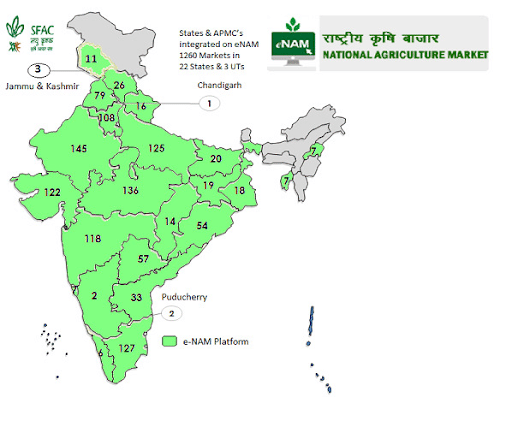
Coverage of e-NAM
What is eNAM?
- The National Agriculture Market (NAM) is a pan-India electronic trading portal that connects the existing APMC mandis to create a unified national agricultural market.
- It was launched in April 2016.
- The Small Farmers' Agribusiness Consortium (SFAC) manages it under the Department of Agriculture, Cooperation, and Farmers' Welfare.
- The NAM Portal serves as a one-stop shop for all Agricultural Produce Market Committee (APMC)-related information and services.
- It currently connects 1260 markets from 22 states and 3 UTs, and various commodities such as staple food grains, vegetables, and fruits are on its list of commodities available for trade.
- To use the portal's services, traders and exporters must first register with it.
- This includes, among other things, commodity arrivals and prices, buy and sell trade offers, and the ability to respond to trade offers.
Objectives of eNAM
- To promote agricultural marketing uniformity by streamlining procedures across integrated markets, eliminating information asymmetry between buyers and sellers, and encouraging real-time price discovery based on actual demand and supply.
- Integration of APMCs across the country via a common online market platform to facilitate pan-India trade in agricultural commodities, better price discovery through a transparent auction process based on product quality, and timely online payment.
- Farmers can showcase their produce online from their local market on this platform, and traders can quote prices from anywhere.
- It aims to increase competition among traders while also ensuring open price discovery and higher returns for farmers.
Working Mechanism of e-NAM
- Under e-NAM, willing states must enact appropriate provisions in their APMC Act to promote e-trading by their State Agricultural Marketing Board/APMC.
- States must undertake reforms before applying for assistance under the scheme in order for a single license to be valid throughout the state.
- The market fee levied in a single location (i.e. on the first wholesale purchase from the farmer will be charged).
- Provision for electronic auction as a price discovery method.
- Only states and territories that have completed these three requirements will be eligible for assistance under the scheme.
- Aside from that, the State Marketing Boards/APMCs must allow for the promotion of the e-auction platform.
- States must ensure that the mandis that are integrated with NAM have the necessary online connectivity, hardware, and assaying equipment.
- State APMCs will make payments to farmers who have a valid licence that is linked to Aadhaar via DBT.
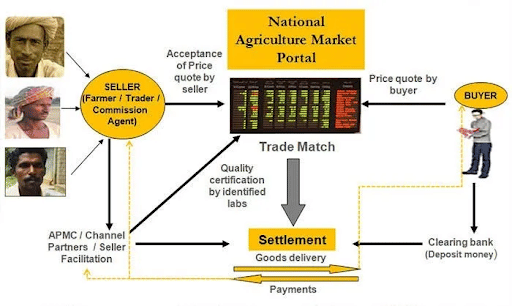
Working Mechanism of eNAM
Advantages of e-NAM
- A unified market is achieved through the use of an online trading platform at both the state and national levels, which promotes uniformity and the streamlining of procedures across the integrated markets.
- e-NAM eliminates buyer-seller information asymmetry and promotes real-time price discovery.
- It promotes transparency in the auction process by using estimations based on actual demand and supply.
- It gives farmers access to a nationwide market at prices commensurate with the quality of their produce.
- It also enables online payment and the availability of higher-quality produce at more affordable prices to consumers.
Challenges of e-NAM
- State agricultural departments have struggled to persuade all stakeholders, including farmers, traders, and commission agents, to migrate to the online platform.
- Because there are no scientific sorting/grading facilities or quality testing machines, the platform is not fully functional in any state.
- The State Agricultural Departments' lack of technical expertise and internet access has also slowed the establishment of grading/assaying facilities.
- The vast majority of trade recorded in the e-NAM portal was actually conducted offline, and the values were fed into the portal to appear as genuine online transactions.
- This completely defeats the purpose of an online auction portal, which is to aid in price discovery.
eNAM - Recent updates
- Three new features of the National Agriculture Market (e-NAM) Platform were recently launched by the Ministry of Agriculture and Farmers' Welfare.
- Integration of Negotiable Warehouse Receipt System (e-NWRs) Module with e-NAM
- FPO Trading Module
- Logistic Module
- The new features will improve agriculture marketing by eliminating the need for farmers to physically go to wholesale mandis to sell their harvested produce.
Negotiable Warehouse Receipt System (e-NWRs)
- It introduces a warehouse trading module with a payment feature.
- It will allow small and marginal farmers to trade their stored produce directly from selected Warehousing Development and Regulatory Authority (WDRA) registered warehouses that the State has designated as deemed markets.
- Farmers will be able to store their crops in WDRA-approved warehouses.
- Already, Telangana (14 warehouses) and Andhra Pradesh (23 warehouses) have declared designated warehouses to be deemed markets.
- The depositor will save money on logistics and earn more money.
- Farmers can sell their products across the country at a higher price without having to go to a mandi.
- Farmers who store their produce in WDRA-accredited warehouses can apply for a pledge loan if necessary.
- Price stability is achieved by matching supply and demand using time and place utility.
FPO Trading Module
- It will allow Farmer Producer Organisations (FPOs) to bid by uploading a picture of their products as well as quality parameters from their premise/collection centers.
- Remote bidders can see the pictures and quality of the product before bidding.
- Following a successful bid, FPOs can deliver the produce from their premises or bring it to mandi.
- This will help to clear the mandis and reduce the hassle.
- This will benefit FPOs by lowering logistics costs and increasing bargaining power.
- Allows FPOs to accept online payments with ease of doing business.
Logistic Module
- A provision has been made for connecting large logistic aggregator platforms, giving users options.
- Currently, e-NAM provides traders with a database of individual transporters.
- Traders will be able to use the link to navigate to the logistics provider’s website and select appropriate services.
- More than 3,75,000 trucks from large logistic providers would be added as a result of these additions.
- This will aid in the smooth transportation of agricultural products.
- This will encourage interstate trade by making online transportation available to distant buyers.
Conclusion
The National Agriculture Market, also known as eNAM, is an online agricultural commodity trading platform in India. Commodities can be traded online by farmers, traders, and buyers using the market. The NAM Portal is a one-stop shop for all information and services related to the Agricultural Produce Market Committee (APMC). It currently connects 450 APMCs from 13 states, and its list of commodities available for trade includes staple food grains, vegetables, and fruits.
FAQs
Question 1: What is the National Agriculture Market (eNAM)?
Answer: The National Agriculture Market (eNAM) is an online trading platform launched by the Government of India to promote the seamless trade of agricultural commodities across the country. It aims to create a unified national market for agricultural products by connecting farmers with buyers, thus eliminating barriers such as middlemen and regional market inefficiencies.
Question 2: What are the main objectives of eNAM?
Answer: The key objectives of eNAM include:
- Market Integration: To integrate local agricultural markets (mandis) across India to create a national market.
- Transparent Pricing: To provide transparent pricing based on real-time data, allowing farmers to make informed decisions.
- Better Price Discovery: To improve price discovery for farmers by allowing them to access multiple buyers.
- Improved Market Access: To provide farmers with access to larger markets, increasing the competition and the possibility of better prices.
- Reduction in Intermediaries: To reduce the number of middlemen and ensure better prices for farmers.
Question 3: What are the benefits of eNAM to farmers?
Answer: The eNAM offers several benefits to farmers:
- Access to Wider Markets: Farmers can connect to buyers beyond their local mandis.
- Better Price Realization: By eliminating middlemen, eNAM helps farmers get better prices for their produce.
- Increased Transparency: The platform provides real-time data on prices, helping farmers make informed decisions.
- Reduced Marketing Costs: The elimination of intermediaries leads to a reduction in marketing costs for farmers.
- Timely Payments: eNAM ensures that farmers receive payments in a timely manner for their produce.
Question 4: How does eNAM work?
Answer: eNAM operates through a web-based platform that connects the Agriculture Produce Market Committee (APMC) mandis across the country. Farmers can register on the platform, upload their produce details, and connect with buyers in other regions. The system allows for:
- Electronic Bidding: Buyers bid for produce, and farmers can accept the highest bid.
- Payment System: Transactions are managed through secure payment systems, ensuring timely payments for farmers.
- Real-Time Price Information: The platform provides up-to-date information on prices in different mandis, helping farmers decide the best market to sell in.
Question 5: What challenges does eNAM face?
Answer: While eNAM has transformed agricultural marketing in India, it faces several challenges:
- Technological Barriers: Limited internet access and digital literacy in rural areas hinder farmers' ability to use the platform effectively.
- State-Level Regulations: Different state regulations and market practices may affect the integration of local markets into the national platform.
- Lack of Infrastructure: Inadequate infrastructure in some regions, such as cold storage and transportation, can limit the full potential of eNAM.
- Awareness and Training: Farmers need better awareness and training to use the platform effectively.
MCQs
- What is the primary purpose of the National Agriculture Market (eNAM)?
A) To eliminate the agricultural sector entirely
B) To create a unified national market for agricultural products
C) To reduce the role of farmers in agriculture
D) To restrict the movement of agricultural goods
Answer: (B) See the Explanation
The primary purpose of eNAM is to integrate local agricultural markets into a national market, improving access for farmers and buyers.
- Which of the following is a major benefit of eNAM for farmers?
A) Increased middlemen involvement
B) Reduced transparency in pricing
C) Access to better prices and markets
D) Limited market access
Answer: (C) See the Explanation
eNAM helps farmers access wider markets, increasing competition and leading to better prices for their produce.
- How does eNAM help in price discovery for farmers?
A) By offering fixed prices set by the government
B) By providing real-time price data from different markets
C) By increasing middlemen involvement
D) By restricting the number of buyers
Answer: (B) See the Explanation
eNAM provides real-time price information, helping farmers discover the best price for their produce based on market conditions.
- What role do Agriculture Produce Market Committee (APMC) mandis play in the eNAM system?
A) They control the prices of agricultural products
B) They are the only entities allowed to buy produce
C) They serve as the local marketplaces that connect to the eNAM platform
D) They do not play any role in eNAM
Answer: (C) See the Explanation
APMC mandis are integrated into eNAM, serving as the local marketplaces where farmers can register and connect with buyers across the country.
- What is a major challenge of implementing eNAM in rural areas?
A) Excessive government intervention
B) Lack of internet access and digital literacy
C) Overabundance of middlemen
D) The high cost of marketing
Answer: (B) See the Explanation
Limited internet access and digital literacy in rural areas are significant challenges in effectively using the eNAM platform.
GS Mains Questions and Model Answers
Q1: Explain the concept of the National Agriculture Market (eNAM) and its significance in transforming agricultural marketing in India.
Answer: National Agriculture Market (eNAM) is a digital platform initiated by the Government of India to connect local agricultural markets, or APMC mandis, into a unified national market. Its significance lies in the following aspects:
- Market Integration: eNAM integrates local markets across India, allowing farmers to access larger markets and multiple buyers, thus facilitating better price discovery.
- Increased Transparency: By providing real-time price data and electronic bidding, eNAM ensures transparency in the pricing of agricultural products.
- Reducing Intermediaries: eNAM minimizes the role of middlemen, allowing farmers to directly connect with buyers, which leads to higher profits for them.
- Cost-Effective Marketing: The platform reduces the marketing costs of farmers by eliminating the need for physical travel to markets and reducing the reliance on brokers.
- Better Accessibility: Farmers can sell their produce to buyers beyond their local markets, improving their market access and increasing competition for better prices.
- Sustainable Growth: By promoting efficiency and fair pricing, eNAM helps in building a more sustainable agricultural market in India.
In conclusion, eNAM represents a transformative shift in the way agriculture is marketed in India, driving economic benefits for farmers and promoting agricultural growth.
Q2: Evaluate the impact of eNAM on the agricultural sector in India and the challenges it faces.
Answer: The eNAM initiative has had a profound impact on the agricultural sector in India:
- Enhanced Market Access: eNAM provides farmers with access to a wider pool of buyers, overcoming the limitations of local markets and enabling them to fetch better prices for their produce.
- Improved Price Transparency: The platform ensures transparency in pricing, which empowers farmers with information to make better selling decisions.
- Reduction in Intermediaries: By connecting farmers directly with buyers, eNAM reduces the role of middlemen, leading to better price realization for farmers.
- Boost to Digital Infrastructure: The initiative also fosters digital literacy in rural areas, enhancing the digital infrastructure of agricultural markets.
However, eNAM faces several challenges:
- Technological Barriers: Many rural areas have limited access to internet connectivity and digital devices, hindering the widespread adoption of the platform.
- Awareness and Training: A lack of awareness and proper training on how to use the platform is another challenge faced by farmers.
- State-Level Regulations: Different states have their own regulations and market practices, which may slow down the integration of local markets into the eNAM system.
- Infrastructure Gaps: Lack of adequate infrastructure such as cold storage and transportation facilities can limit the effectiveness of eNAM in certain regions.
In conclusion, while eNAM has brought significant improvements in agricultural marketing, its success depends on overcoming challenges related to digital access, state regulations, and infrastructure development.
Q3: How does eNAM contribute to the growth of the agricultural economy in India?
Answer: eNAM contributes to the growth of India's agricultural economy in several ways:
- Increased Efficiency: By eliminating middlemen and enabling electronic trading, eNAM makes agricultural markets more efficient, ensuring fairer prices for both farmers and buyers.
- Better Price Discovery: Farmers can compare prices across various mandis, ensuring they sell at the most competitive prices, which boosts their income.
- Attracting Investments: By creating a transparent market system, eNAM attracts private sector investments in agriculture and infrastructure, such as warehousing and logistics.
- Market Integration: The platform connects farmers from various regions to national and international markets, providing wider access to agricultural goods, thus contributing to the growth of agricultural trade.
- Boost to Farmer Empowerment: eNAM empowers farmers by providing them with the necessary tools and information to make informed decisions, thus improving market participation.
In conclusion, eNAM is an essential tool for driving growth in India’s agricultural sector by improving market access, price realization, and fostering sustainability in agricultural trade.
Previous Year Questions on eNAM
1. UPSC CSE 2020
Question: "Explain the objectives and advantages of the National Agriculture Market (eNAM) in transforming agricultural marketing in India."
Answer: eNAM aims to create a unified national market for agricultural produce by integrating local mandis. Its objectives include enhancing market access, improving price discovery, and reducing intermediaries. The advantages include better pricing for farmers, greater transparency, access to a wider pool of buyers, and reduced marketing costs.
2. UPSC CSE 2019
Question: "What are the challenges faced by eNAM in achieving its full potential?"
Answer: The challenges include limited digital access in rural areas, lack of awareness and training among farmers, state-specific regulations hindering market integration, and insufficient infrastructure in some regions. Overcoming these challenges requires investment in digital literacy, infrastructure development, and policy harmonization across states.
Download the PREPP App and attempt FREE IAS Exam Mock Tests and get complete study material!

Full Test - 04: UPSC CSE Prelims CSAT (Paper-II)
Full Test - 03: UPSC CSE Prelims CSAT (Paper-II)
UPSC CSE Prelims 2026 GS Paper 1 Question Paper (24-May-2026)
UPSC CSE Prelims 2026 CSAT Paper 2 Question Paper (24-May-2026)

17 February 2025 | The Hindu Must Read Articles | Current Affairs

16 February 2026 | The Hindu Must Read Articles | Current Affairs

13 February 2026 | The Hindu Must Read Articles | Current Affairs









Comments