Supply Chain Management - Agriculture Notes
Supply chain management is the management of the flow of goods and services, which includes all processes that transform raw materials into finished products. It entails actively streamlining a company's supply-side activities in order to maximize customer value and gain a competitive advantage in the market. A supply chain manager is in charge of controlling and reducing costs as well as avoiding supply shortages. This article will explain to you Supply Chain Management which will be helpful in preparing the Agriculture Syllabus for the UPSC Civil Service exam.
|
Table of Contents |
What is Supply Chain Management?
- The management of the flow of goods is known as supply chain management (SCM).
- It entails the transportation and storage of raw materials, inventory, and finished goods from their point of origin to their point of consumption.
- The efficiency of the supply chain is critical to profitability and safety in the food industry.
- When one link in the food supply chain, such as a farmer or a packaging plant, is not performing optimally, every other link in the chain suffers.
- Companies can reduce costs and deliver products to customers faster and more efficiently by managing the supply chain.
- Good supply chain management keeps businesses out of the news and away from costly recalls and lawsuits.
- The supply chains of various agricultural commodities in India are fraught with difficulties due to the inherent problems of the agriculture sector.
- The country's Agri supply chain system is determined by various sartorial issues such as the dominance of small/marginal farmers, fragmented supply chains, the absence of scale economies, a low level of processing/value addition, the inadequacy of marketing infrastructure, and so on.
- The five most important aspects of SCM are strategy development, raw material sourcing, production, distribution, and returns.
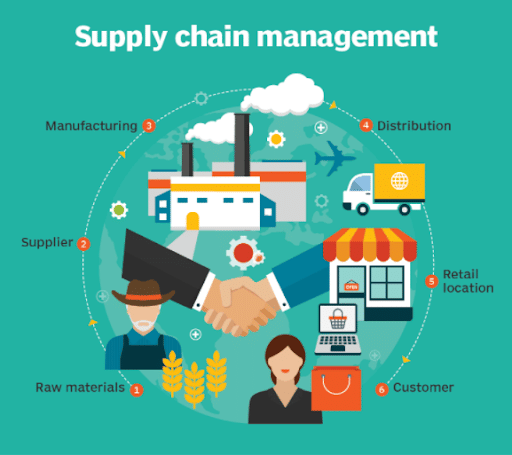
Aspects of Supply Chain Management
Supply Chain Management - Working
- Supply chain management (SCM) refers to suppliers' efforts to design and implement supply chains that are as efficient and cost-effective as possible.
- Supply chains encompass everything from manufacturing to product development to the information systems required to manage these endeavours.
- SCM is based on the premise that nearly every product that enters the market is the result of the efforts of numerous organisations that comprise a supply chain.
- Although supply chains have existed for centuries, most businesses have only recently recognised them as a value-add to their operations.
- Raw materials such as grains, raw meat, and fish are collected at various locations by various sources.
- These sources may undergo preliminary processing to create components of a food product before passing them on to the main manufacturer via numerous middlemen.
- The final processing of these components to make the food product is done by the manufacturer.
- The finished product must now be delivered to the consumer. There will be a number of middlemen and stages here as well.
- Furthermore, the manufacturer typically transfers the food product to a wholesaler.
- The wholesaler sells the product to a retailer, from whom the consumer purchases the processed food item for personal consumption.
- As a result, Supply Chain Management is the management of the upstream and downstream, with value added at each stage.

Working of Supply Chain Management
Supply Chain Management - Importance
- Supply chain management is important because it can help achieve a variety of business goals.
- Controlling manufacturing processes, for example, can improve product quality while lowering the risk of recalls and lawsuits and assisting in the development of a strong consumer brand.
- Controls over shipping procedures can improve customer service by avoiding costly shortages or periods of inventory oversupply.
- Supply chain management allows companies to improve their profit margins in a variety of ways, and it is especially important for companies with large and international operations.
- When a country has good Supply Chain Management practises, the economy as a whole benefits.
- Farmers, manufacturers, wholesalers, retailers, and consumers benefit from strong supply chain connections.
- Everyone in the supply chain link will receive inputs more quickly, at the right time, and at a lower cost.
Supply Chain Management - Challenges
- Fragmented supply chain: A long and fragmented supply chain leads to waste and price increases. This is due to the high proportion of unorganized players in the supply chain, as well as operational commercial viability issues.
- Insufficient cold storage and warehousing: Warehousing is a critical component of the overall supply chain, and it is largely dominated by unorganized players.
- Currently, 20% of warehousing is organized, with the government controlling 70% of the organized market.
- Problems with Logistics: In India, logistics still faces quality and connectivity challenges:
- National highways in India account for only 2% of the total road network but transport 40% of all cargo.
- Although port capacity is increasing, a lack of connectivity to these ports causes cost increases and delays in the transfer of goods.
- Rail transporters do not provide last-mile connectivity.
- Slowing of production growth: With approximately 67 percent of landholdings being marginal, with an average size of 0.4 hectares, more than half of marginal farmers are unlikely to have any extra income to spare beyond subsistence, impeding farm-level productivity improvements.
- Informalisation is widespread: More than half of the industries in the food processing sector are informal and small-scale. As a result, they are unable to achieve economies of scale and reap the benefits of the formal financial sector.
- Underdeveloped processed food market: The Indian processed food market is still developing and in its infancy.
- Small traders and Kirana shops continue to dominate the Indian retail sector. This presents a significant challenge in terms of expanding the consumer base.
- Other issues: In addition to the aforementioned concerns, the sector faces other issues such as a lack of applied research, taxation issues, access to credit, obsolete technologies, and so on.
Way Forward in Supply Chain Management
- To maximize profitability in the face of low demand and uncertain supply, an efficient supply chain strategy is required.
- Cost and information coordination can lead to profitability.
- Low costs are achieved by eliminating non-value-added activities, resulting in scale economies and technique and production optimization.
- To cut costs, supply chains with low demand but high supply uncertainty should use the risk-hedging strategy.
- To meet the changing needs of customers with an efficient supply chain, the supply chain must focus on being responsive and flexible.
- Risk-hedging and responsive supply chains should be used together in supply chains.
- To be responsive to unpredictable demand, supply chains must attempt to cope with demand and supply chain uncertainty.
- Logistics bottlenecks should be eliminated, particularly by concentrating on road and port development.
- Each trading partner should have a single point of contact. This ensures that information is not lost or deteriorates during its transmission between trading partners.
- It is critical to ensure continuous information sharing. The importance of maintaining continuous information flow cannot be overstated.
Supply Chain Management - Recent updates
- The Supply Chain Resilience Initiative (SCRI) has been formally launched by the Trade Ministers of India, Japan, and Australia.
- The SCRI seeks to create a virtuous cycle of supply chain resilience in order to achieve strong, sustainable, balanced, and inclusive growth in the Indo-Pacific region.
- The Quad grouping includes India, Japan, and Australia, as well as the United States.
- In the context of international trade, supply chain resilience is a strategy that assists a country in ensuring that its supply risk is spread across a number of supplying countries rather than being reliant on just one or a few.
- It will aid India's manufacturing competitiveness and increase its global trade share. In this pursuit, there is a need to build infrastructure that boosts India's export competitiveness.
- While India appears to be an appealing option for potential investors as both a market and a manufacturing base, it needs to accelerate progress in terms of ease of doing business and skill development.
Conclusion
Supply chain management is important because it can aid in the achievement of a variety of business objectives. The efficiency of the supply chain is critical to the food industry's profitability and safety. The true measure of supply chain success is how well activities across the supply chain coordinate to create value for consumers while increasing the profitability of each link in the supply chain. Supply chain management, in other words, is the integrated process of creating value for the end user or ultimate consumer.
FAQs
Question: What is Supply Chain Management in Agriculture?
Answer: Supply Chain Management in agriculture involves managing the entire process of production, storage, transportation, and distribution of agricultural products, ensuring efficiency from farm to consumer.
Question: Why is supply chain management important in agriculture?
Answer: Effective supply chain management reduces food wastage, optimizes transportation, enhances profitability, and ensures timely delivery of fresh produce to markets, benefiting both farmers and consumers.
Question: What are the challenges faced in agricultural supply chains?
Answer: Key challenges include inadequate infrastructure, fluctuating prices, poor storage facilities, logistical issues, and weather dependency, which can disrupt timely delivery and affect product quality.
Question: How does technology improve agricultural supply chains?
Answer: Technologies like blockchain, IoT, and AI enhance transparency, traceability, and efficiency in agricultural supply chains, reducing costs and improving quality control.
Question: What role does cold storage play in agricultural supply chains?
Answer: Cold storage facilities help preserve perishable agricultural products, reducing spoilage, maintaining quality, and extending shelf life, which is crucial for supply chain efficiency.
MCQs
1. What is the main purpose of supply chain management in agriculture?
A) Increase production
B) Enhance product transportation and delivery
C) Reduce storage costs
D) Increase labor
Answer: (B) See the Explanation
Explanation: Agricultural supply chain management focuses on efficient transportation and timely delivery of products to markets, ensuring minimal loss and maximum quality.
2. Which technology is used to improve traceability in agricultural supply chains?
A) Blockchain
B) Traditional logistics
C) Basic GPS
D) Paper records
Answer: (A) See the Explanation
Explanation: Blockchain technology enhances traceability in supply chains by providing transparent, unchangeable records of product movement from farm to consumer.
3. Which challenge is NOT commonly faced in agricultural supply chains?
A) High storage costs
B) Unpredictable weather
C) Manual labor shortages
D) Demand consistency
Answer: (D) See the Explanation
Explanation: Demand consistency is generally beneficial; however, other factors like high storage costs and unpredictable weather are significant challenges in agricultural supply chains.
4. Cold storage facilities in agriculture primarily help with:
A) Increasing prices
B) Reducing labor
C) Preserving perishable goods
D) Eliminating pests
Answer: (C) See the Explanation
Explanation: Cold storage is essential for preserving perishable goods, maintaining quality, and extending shelf life, crucial for effective supply chain management.
5. What is a key benefit of using IoT in agricultural supply chains?
A) Reducing transport costs
B) Real-time tracking of produce
C) Hiring more labor
D) Increasing soil fertility
Answer: (B) See the Explanation
Explanation: IoT enables real-time tracking of produce, improving monitoring, transparency, and efficiency in the supply chain.
GS Mains Questions and Model Answers
Q1: Discuss the importance of supply chain management in agriculture. How does it impact food security and farmer welfare?
Answer: Supply chain management in agriculture ensures that food products move efficiently from farms to consumers. It reduces waste, enhances storage, and minimizes costs, directly benefiting farmers and ensuring food security. Efficient supply chains prevent product loss, improving market prices and income stability for farmers. Proper management supports timely delivery, reduces spoilage, and ensures that food reaches end consumers at optimal freshness, crucial for food safety and quality, benefiting the entire agricultural ecosystem.
Q2: Analyze the challenges faced in agricultural supply chains in India. How can these challenges be addressed?
Answer: Key challenges include inadequate infrastructure, inefficient logistics, seasonal weather dependency, and limited cold storage. Addressing these challenges requires infrastructure development, investment in cold storage, and implementation of technology like IoT and blockchain for better tracking. Government support, public-private partnerships, and policy reforms are essential to reduce bottlenecks, enhance market access, and increase supply chain transparency, supporting both farmers and consumers.
Q3: Explain the role of technology in transforming agricultural supply chains. What are the benefits and limitations of adopting advanced technology?
Answer: Technology, such as IoT and blockchain, enhances agricultural supply chains by improving traceability, efficiency, and quality control. Benefits include reduced costs, real-time tracking, and transparent processes. However, limitations include high initial costs, training requirements, and accessibility for small farmers. Integrating these technologies requires infrastructure investment and capacity-building programs to ensure widespread adoption and long-term impact in rural areas.
Previous Year Questions on Supply Chain Management in Agriculture
1. UPSC CSE Prelims 2022:
Question: Which technology is crucial for ensuring transparency and traceability in agricultural supply chains?
A) Manual record-keeping
B) Blockchain
C) Traditional logistics
D) Non-digital methods
Answer: (B)
Explanation: Blockchain technology ensures transparency and traceability in supply chains, recording every step securely from farm to consumer.
2. UPSC CSE Mains 2021 (GS Paper 3):
Question: "Evaluate the role of supply chain management in agricultural development in India. What steps can be taken to improve the efficiency of supply chains?"
Answer: Effective supply chain management enhances agricultural efficiency by reducing wastage and optimizing logistics. Improvements require investments in storage facilities, infrastructure, and digital technology for tracking. Additionally, policies supporting small farmers in accessing cold storage and distribution networks are essential for strengthening India’s agricultural supply chains.
Download the PREPP App and attempt FREE IAS Exam Mock Tests and get complete study material!

Full Test - 04: UPSC CSE Prelims CSAT (Paper-II)
Full Test - 03: UPSC CSE Prelims CSAT (Paper-II)
UPSC CSE Prelims 2026 GS Paper 1 Question Paper (24-May-2026)
UPSC CSE Prelims 2026 CSAT Paper 2 Question Paper (24-May-2026)

17 February 2025 | The Hindu Must Read Articles | Current Affairs

16 February 2026 | The Hindu Must Read Articles | Current Affairs

13 February 2026 | The Hindu Must Read Articles | Current Affairs









Comments