E-Technology in the Aid of Farmers (Technology Missions) - Agriculture Notes
E-technology is broadly defined as the internet and related information technologies. Agriculture is a critical sector, and E-technology is attempting to improve it by assisting farmers. Agriculture is an important sector in India for food security, sustainable development, and poverty alleviation. Small and marginal farmers dominate the Indian farming sector, and increasing their productivity and income can contribute significantly to economic advancement while alleviating hunger and poverty. This article will explain to you about E-Technology in the Aid of Farmers, Technology Missions which will be helpful in preparing the Agriculture Syllabus for the UPSC Civil Service exam.
|
Table of Contents |
What is E-Technology in Aid of Farmers?
- Technology plays a critical role in sustaining productivity gains.
- To bring relevant tools, knowledge, and know-how to farmers, innovation mechanisms for technology transfer are required.
- IT promotes new methods for infallible agriculture, such as computerized farm machinery for fertilizers and pesticides.
- Electronic sensors and identification systems feed and monitor farm animals.
- Online selling and buying became increasingly popular around the world
- Its most important role, however, remains communication, and the Internet has provided us with an excellent opportunity to do so.
- Early e-technology intervention to farmers' aid was first introduced in 2007, when the National Policy for Farmers was launched, with a focus on ICTs.
- In addition, the National Telecom Policy was launched in 2012, with a focus on broadband connectivity and mobile penetration.
Role of Technology in Agriculture
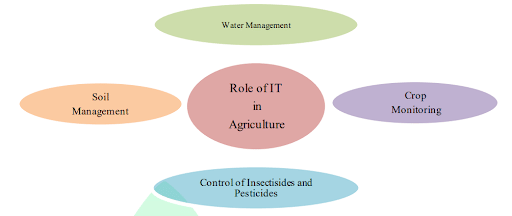
Role of Technology in Agriculture
- Water management can be done efficiently with IT and no water waste by using sensors.
- It aids in the continuous monitoring of the land, allowing precautions to be taken at an early stage.
- It boosts productivity, reduces manual labor, saves time, and makes farming more efficient.
- Crop monitoring is a simple way to observe crop growth.
- Soil management factors such as PH level, moisture content, and so on can be easily identified, allowing farmers to sow seeds based on soil level.
- Sensors and RFID chips help to identify diseases in plants and crops.
- RFID tags transmit the EPC (information) to the reader and are distributed over the internet.
- The farmer or scientist can access this information from a remote location and take the necessary actions, automatically protecting crops from disease outbreaks.
- Crop sales will rise in the global market. Farmers can easily connect to the global market with no geographical restrictions.
Benefits of E-technology for Farmers
- Improved decision-making: Farmers make better decisions about their agricultural activities when they have the necessary information.
- The exchange of knowledge between countries and organisations also increases farmers' awareness of factors to consider before making decisions.
- Planning: IT has paved the way for the development of farming software that determines the best farm aids to use. Obtaining information from their farm is critical for long-term growth.
- Participation of the community: When a community adopts modern agricultural methods, the production of local goods can be increased.
- With IT, local farmers' unions can be strengthened, resulting in higher income for all parties.
- Agricultural innovations: A connected agricultural world promotes greater reach when scientists develop new and improved techniques for growing crops in adverse conditions.
- Better outreach: Not only small and medium farmers but also backyard farmers, play a role in agriculture promotion.
- The use of e-technology will aid in the spread of ideas and innovations to all levels of farming.
Issues Related to E-Technology
- The technology's reach is still very limited, and many farmers are still unaware of such advancements.
- The distribution of technologies is not consistent across the country.
- The use of technology by already large-scale farmers is widening the wealth disparity.
- Small and marginal farmers are once again being left out of the development process.
- Because of the low literacy rate among farmers and the digital divide, a new class of middlemen who provide ICT services to farmers is emerging.
- The rural infrastructure for ICT use is also not uniform, and regional disparities persist.
Government Initiatives to Aid Farmers
AGMARKNET
- The Union Ministry of Agriculture established the Agricultural Marketing Information Network (AGMARKNET) in 2000.
- The Ministry's Directorate of Marketing and Inspection (DMI) connects approximately 7,000 agricultural wholesale markets in India with the State Agricultural Marketing Boards and Directorates for effective information exchange.
- This e-governance portal AGMARKNET, implemented by the National Informatics Centre (NIC), facilitates the transparent and timely generation and transmission of prices, commodity arrival information from agricultural produce markets, and web-based dissemination to producers, consumers, traders, and policymakers.
e-choupal
- ITC's initiative offers alternative marketing channels, weather information, agricultural practices, input sales, and so on.
- It is a village kiosk with computer and internet access that is managed by a trained sanchalak.
Direct Benefit Transfer (DBT) Central Agri Portal
- Launched in 2013, the DBT Agri Portal is a unified central portal for agricultural schemes across the country.
- Through government subsidies, the portal enables farmers to adopt modern farm machinery.
National Agriculture Market (e-NAM)
- The National Agriculture Market, also known as eNAM, is an online trading platform in India for agricultural commodities.
- Farmers, traders, and buyers can trade commodities online through the market.
- The market facilitates better price discovery and the smooth marketing of produce.
- The e-NAM project would function through an online portal linked to the states' Mandis (Wholesale markets).
- All participating states will provide free software (website and mobile application) for e-NAM.
- This innovative market process is revolutionising agricultural markets by ensuring better price discovery, bringing in transparency and competition, and allowing farmers to get better remuneration for their produce as we move towards 'One Nation, One Market.'
*For detailed notes of this topic, check this link e-NAM
Kisan Call Centre
- In order to capitalise on the potential of ICT in agriculture, the Ministry of Agriculture and Farmers Welfare launched this scheme in 2004.
- The project's main goal is to answer farmers' phone calls in their native language.
Village Resource Centres
- In rural areas, Village Resource Centres offer space-based services.
- They are one of the few initiatives that use the Satellite Communication (SATCOM) network and Earth Observation (EO) satellite data to reach out to villages and address the needs of the local people.
Digital Agriculture Mission
- The Digital Agriculture Mission (2021-2025) aims to support and accelerate projects based on new technologies such as AI, blockchain, remote sensing and GIS technology, and the use of drones and robots.
AgriStack
- The Ministry of Agriculture and Farmers Welfare intends to develop 'AgriStack,' a collection of technology-based agricultural interventions.
- It will establish a unified platform for farmers to receive end-to-end services across the agriculture food value chain.
UFSP (Unified Farmer Service Platform)
- UFSP is a collection of Core Infrastructure, Data, Applications, and Tools that enable the seamless interoperability of various public and private IT systems across the country's agriculture ecosystem.
- The UFSP is intended to serve the following functions:
- Serve as a central agency in the agricultural ecosystem (like UPI in the e Payments).
- Allows for the registration of Service Providers (both public and private) and Farmer Services.
- Enforces various rules and validations required for service delivery.
- Serves as a repository for all relevant standards, APIs (Application Programming Interfaces), and formats.
- Act as a data exchange medium between various schemes and services to enable comprehensive service delivery to farmers.
Sandesh Pathak
- The Sandesh Pathak application, developed in collaboration with C-DAC Mumbai, IIT-Madras, IIIT Hyderabad, IIT Kharagpur, and C-DAC Thiruvananthapuram, will allow SMS messages to be read aloud to farmers who may have difficulty reading.
State-level Initiatives
E-Sagu
- eSagu provides personalised expert advice to small and marginal farmers at their doorstep, from sowing to harvest.
- The farm situation is presented to the expert via digital photographs and text information.
- After analysing the situation, expert advice is prepared and delivered to the concerned farmer the same day or the next day.
- Sagu means "cultivation" in Telugu, the local language of Telangana, Andhra Pradesh, where the project began.
AGRISNET
- The AGRISNET project was conceived with the goal of building an interconnected technology-enabled network to effectively deliver informational services to the farming community.
- The project's goal was to integrate cross-functional Department of Agriculture processes in Tamil Nadu in order to effectively and efficiently communicate informational services to the farming community.
Jio Agri (JioKrishi) Platform
- In 2020, a pilot project in Jalna and Nashik, Maharashtra, was launched.
- It digitises the agricultural ecosystem throughout the value chain in order to empower farmers.
- The platform's core function provides advisory using stand-alone application data, while the advanced functions use data from various sources, feed the data into AI/ML algorithms, and provide accurate personalised advice.
Impact of E-Technology on Agriculture
- Information technology is a direct contributor to agricultural productivity and an indirect contributor to empowering agriculturalists to make informed and quality decisions that will benefit agriculture and allied activities.
- It has had an impact on how information is shared in India, and being able to use this information for the advancement of the agricultural sector has a significant positive impact that benefits everyone.
- Agricultural biotechnology and information technology are working together to develop new tools to combat rural poverty, create jobs in farm production, and explore additional income-generating opportunities.
- Furthermore, various IT interventions assist rural and underdeveloped markets in becoming more efficient and productive, for innovative agricultural methods such as precision agriculture, computerised farm machinery, and so on.
- Access to price information, access to agricultural information, access to national and international markets, and increased production efficiency are all positive outcomes that can improve the quality of life for farmers.
- Agriculture technology can be used in a variety of ways, including the application of herbicides, pesticides, fertilisers, and improved seed.
- Farmers are now able to grow crops in previously thought-inaccessible areas, but this is only possible thanks to agricultural biotechnology.
- For example, genetic engineering has enabled the introduction of specific strains into the genes of other crops or animals.
- Such genetic engineering increases crop resistance to pests (for example, Bt Cotton) and droughts.
Conclusion
The penetration of market forces in rural India is increasing and represents a potential market. With India's diverse cultures and languages, E-Technology provides an excellent platform. As a result, there will be significant upliftment and sustainable development in rural areas in the future. ITs can now act as a change agent in agrarian and farmer lives by improving information access and knowledge sharing. Farmers feel empowered and can take appropriate action when necessary. In the aftermath of climate change and a decrease in cultivable land, IT had the potential to transform agriculture into a more promising prospect.
FAQs
Question: What is e-technology in the context of Indian agriculture?
Answer: E-technology in Indian agriculture refers to the use of information and communication technology (ICT) to improve agricultural practices. This includes digital platforms, mobile applications, and online tools that provide farmers with real-time information on weather, crop prices, and modern farming techniques.
Question: How does e-technology benefit farmers?
Answer: E-technology benefits farmers by providing access to timely information on weather forecasts, crop diseases, and market prices. It helps them make informed decisions, reduce crop losses, and improve productivity. Additionally, e-technology platforms allow farmers to access government schemes and services directly.
Question: What are some examples of e-technology initiatives in Indian agriculture?
Answer: Some prominent e-technology initiatives in Indian agriculture include Kisan Suvidha, eNAM (National Agriculture Market), and the Digital India Land Records Modernization Programme (DILRMP). These platforms help farmers with market access, land records management, and real-time agricultural information.
Question: How has e-technology impacted small and marginal farmers?
Answer: E-technology has positively impacted small and marginal farmers by giving them access to critical information and services that were previously unavailable. Mobile apps and digital platforms have enabled these farmers to access agricultural inputs, financial services, and markets more easily, helping them improve their livelihoods.
Question: What challenges do farmers face in adopting e-technology?
Answer: Some challenges farmers face in adopting e-technology include limited digital literacy, lack of reliable internet connectivity in rural areas, and the high cost of smartphones or other digital devices. Additionally, language barriers can prevent farmers from effectively using these tools and platforms.
MCQs
1. Which of the following is NOT an example of e-technology in Indian agriculture?
A) Kisan Suvidha
B) eNAM
C) Pradhan Mantri Fasal Bima Yojana
D) Digital India Land Records Modernization Programme
Answer: (C) See the Explanation
Explanation: Pradhan Mantri Fasal Bima Yojana is an agricultural insurance scheme, not an e-technology initiative. Kisan Suvidha, eNAM, and DILRMP are examples of e-technology platforms that assist farmers through digital services.
2. What is the main purpose of eNAM (National Agriculture Market)?
A) To provide crop insurance
B) To facilitate online trade of agricultural produce
C) To offer weather updates
D) To monitor irrigation systems
Answer: (B) See the Explanation
Explanation: eNAM (National Agriculture Market) is an online trading platform that connects farmers to buyers and markets, allowing them to sell their produce directly. This eliminates middlemen and helps farmers get better prices for their crops.
3. Which e-technology platform offers real-time agricultural information to Indian farmers?
A) Kisan Suvidha
B) MGNREGA
C) Atal Pension Yojana
D) Pradhan Mantri Jan Dhan Yojana
Answer: (A) See the Explanation
Explanation: Kisan Suvidha is a mobile application that provides real-time information to farmers regarding weather, market prices, input dealers, and crop advisories.
4. What challenge affects the adoption of e-technology among farmers?
A) Low crop productivity
B) Lack of digital literacy
C) High input costs
D) Availability of irrigation facilities
Answer: (B) See the Explanation
Explanation: One of the major challenges affecting the adoption of e-technology by farmers is the lack of digital literacy, especially among older or less educated farmers, making it difficult for them to effectively use digital platforms.
5. Which of the following best describes the role of e-technology in agriculture?
A) It increases the use of chemical fertilizers
B) It connects farmers with markets and information
C) It reduces government spending on agriculture
D) It eliminates the need for agricultural machinery
Answer: (B) See the Explanation
Explanation: E-technology in agriculture primarily connects farmers with markets, real-time information, and government services, helping them make informed decisions and improve productivity.
GS Mains Questions and Model Answers
Q1: Analyze the role of e-technology in transforming Indian agriculture.
Answer: E-technology has played a transformative role in Indian agriculture by bridging the information gap and providing farmers with real-time access to essential services. Through platforms like Kisan Suvidha and eNAM, farmers can now access timely weather updates, market prices, and government schemes, which help them make informed decisions.
E-technology also enables farmers to connect directly with buyers, reducing the influence of middlemen and allowing them to get better prices for their produce. Furthermore, digital land records and financial services have made it easier for farmers to access credit and insurance, contributing to the overall modernization of Indian agriculture. However, challenges such as digital illiteracy and lack of infrastructure in rural areas need to be addressed to ensure the full benefits of e-technology reach every farmer.
Q2: Evaluate the impact of e-technology on small and marginal farmers in India.
Answer: E-technology has had a significant impact on small and marginal farmers by giving them access to tools and information that were previously unavailable. Mobile applications like Kisan Suvidha provide these farmers with real-time data on weather, market prices, and crop diseases, allowing them to make informed decisions that reduce risk and increase productivity.
In addition, e-technology platforms like eNAM have enabled small farmers to access larger markets, helping them secure better prices for their crops. However, the adoption of e-technology among small farmers has been hindered by issues such as limited internet connectivity and digital illiteracy. Addressing these challenges through infrastructure improvements and targeted training programs is essential for maximizing the benefits of e-technology for smallholders.
Q3: Discuss the challenges in implementing e-technology in Indian agriculture and suggest solutions.
Answer: The implementation of e-technology in Indian agriculture faces several challenges, including digital illiteracy, inadequate rural internet connectivity, and the high cost of smartphones and other digital devices. Many farmers, especially those in remote areas, lack the necessary skills to use digital platforms effectively.
To address these challenges, the government and private sectors must invest in digital infrastructure, ensuring reliable internet access in rural areas. Additionally, conducting digital literacy programs for farmers and making technology more affordable can enhance the adoption of e-technology. Developing multilingual apps and voice-based interfaces could also help overcome language barriers, making e-technology more accessible to a larger population of farmers.
Previous Year Questions on E-Technology in Agriculture
1. UPSC CSE Prelims 2019:
Question: Which of the following initiatives is a digital platform for the sale of agricultural produce?
A) eNAM
B) Pradhan Mantri Krishi Sinchai Yojana
C) Soil Health Card
D) Kisan Credit Card
Answer: A
Explanation: eNAM (National Agriculture Market) is an online platform that facilitates the sale of agricultural produce by connecting farmers with buyers across India.
2. UPSC CSE Mains 2020 (GS Paper 3):
Question: "E-technology is a game changer in Indian agriculture." Discuss the benefits and challenges of e-technology in Indian agriculture.
Answer: E-technology has revolutionized Indian agriculture by providing farmers with real-time information on weather, market prices, and government schemes. Platforms like Kisan Suvidha and eNAM have made it easier for farmers to access markets and sell their produce directly, reducing the role of middlemen and improving their income.
However, the adoption of e-technology is limited by challenges such as digital illiteracy, lack of internet infrastructure in rural areas, and the high cost of digital devices. To fully realize the potential of e-technology, it is essential to invest in rural digital infrastructure and promote digital literacy programs for farmers, particularly in remote areas.
Download the PREPP App and attempt FREE IAS Exam Mock Tests and get complete study material!

Full Test - 04: UPSC CSE Prelims CSAT (Paper-II)
Full Test - 03: UPSC CSE Prelims CSAT (Paper-II)
UPSC CSE Prelims 2026 GS Paper 1 Question Paper (24-May-2026)
UPSC CSE Prelims 2026 CSAT Paper 2 Question Paper (24-May-2026)

17 February 2025 | The Hindu Must Read Articles | Current Affairs

16 February 2026 | The Hindu Must Read Articles | Current Affairs

13 February 2026 | The Hindu Must Read Articles | Current Affairs









Comments