Food Processing Industries in India - Agriculture Notes
India's food processing sector is one of the largest in the world, with output expected to reach $535 billion by 2025-26. The food processing sector in India plays a critical role in connecting Indian farmers to consumers in both domestic and international markets. The Ministry of Food Processing Industries (MoFPI) is making every effort to encourage investment throughout the value chain. Grain, sugar, edible oils, beverages, and dairy products are major sectors of India's food processing industry. PMKSY has approved 41 Mega Food Parks, 348 Cold Chain projects, 68 Agro-Processing Clusters, Creation of 61 Backward and Forward Linkages Projects, and 6 Operation Green projects across the country. In this article, we will discuss Food Processing Industries in India which will be helpful for UPSC exam preparation.
|
Table of Contents |
What is Food Processing?
- Food processing is the transformation of raw ingredients into food or food into other forms (ie. food processing may denote direct manufacturing of food or value addition on existing food).
- It can include the transformation of raw materials into food through various physical and chemical processes.
- This process includes mincing, cooking, canning, liquefaction, pickling, macerating, and emulsification.
- Clean, harvested crops or butchered and slaughtered animal products are required to produce appealing, marketable, and, in some cases, life-long food products.
- However, food processing can reduce the nutritional value of the food and may include additives that are harmful to health.
|
|
|
|---|---|
| Pradhan Mantri Kisan Sampada Yojana | Mega Food Parks |
| Operation Greens | Food security |
Food Processing Sector - A Sunrise Sector
- With stimulating growth in the food retail sector, favourable economic policies, and attractive fiscal incentives, India's food ecosystem offers enormous opportunities for investment.
- The Government of India (GoI) is taking all necessary steps to increase investment in India's food processing industry through the Ministry of Food Processing Industries (MoFPI).
- The GOI has extended the PMKSY umbrella scheme with an allocation of INR 4600 crores until March 2026.
- The Ministry has also been implementing two additional flagship programmes:
- The Production Linked Incentive (PLI) Scheme aims to modernise and boost the competitiveness of the food processing industry by producing specific categories of food products with a high potential for output growth and value addition over a six-year period until 2026-27.
- PM Formalization of Micro Food Processing Enterprises Scheme (PMFME) for financial, technical, and business support for existing micro food processing enterprises.
- By 2025, India's food processing market could be worth $470 billion. Tier-II and Tier-III cities may follow the lead of metropolitan areas in consuming more processed food in the coming years.
- From 2011-12 to 2020-21, the export of products in the Ready to Eat (RTE), Ready to Cook (RTC), and Ready to Serve (RTS) segments grew at a CAGR of 10.4%.
- India exported more than $ 2.14 bn worth of final food products in 2020-21.
- The United States, the United Arab Emirates, and Nepal are the top three RTE export destinations in 2020-21.
- In 2020-21, the major exporting destinations for RTC are the United States, Malaysia, and the United Arab Emirates.
Classification of Food Processing Industry
A large population and ever-increasing demands in India, combined with the country's suitable climatic, geographic factors, and intelligent human asset, have led to the development of many types of food processing industries, such as:
- Cereal/ pulse milling
- Fruit & vegetable processing
- Milk & milk products
- Beverages (Tea, Coffee & Cocoa)
- Fish, Poultry, & Eggs
- Meat & meat products
- Aerated waters, Soft drinks
- Beer & Alcoholic beverages
- Bread, Biscuits & Bakery products
- Edible oil & Fats
- Confectioneries
- Breakfast cereals, Malt protein, Extruded food products
Importance of Food Processing Sector
- India is well-known for its agricultural output. Agriculture employs more than half of the Indian population.
- Raw materials such as grains or meat can be converted into food for domestic and foreign consumption if India has a good food processing industry.
- Food processing units serve as a link between agriculture and industry.
- Food processing industries can absorb a significant portion of the agricultural sector's unemployed workers. It has the potential to increase productivity and GDP growth.
- Food processing reduces food waste and aids in the achievement of food security.
- Processed foods require less storage space.
- Food in the processing stage can be exported. This could aid us in obtaining foreign exchange reserves.
- Given the current levels of processing, the Indian food processing industry has remarkable potential for growth.
Food Processing Sector - Key Facts
- In 2021-22, total horticulture production is expected to be 341.63 MT.
- India ranks first in milk production and contributes 23% of global milk production, which is expected to grow at a CAGR of about 6.2% to 209.96 MT in 2020-21.
- India ranks third in global egg production, producing at least 122.11 billion eggs in 2020-21, with per capita egg availability of 91 eggs per year in 2020-21.
- India is the world's second largest fish producer, accounting for 7.56% of global output. The total fish production for fiscal years 20-21 is estimated to be 14.73 MMT.
- India's sugar exports stood at 8.6 MT in May of the current 2021-22 marketing year, which ends in September.
- Online grocery retail in India has grown at a CAGR of more than 50% and is expected to reach $10 billion to $12 billion by 2025.
- Despite the sector's difficult circumstances, India's marine product exports reached $7,740 million in 2021-22. It experienced 30% higher growth than in 2020-21.
- The top three favourite destinations for Indian marine exports are the United States, China, and Japan. Exports to these three countries accounted for 63% of total exports.
- Other cereals exports increased from 102 MT in 2019-20 to 521 MT in 2020-21.
- India ranks eighth in the world in terms of meat production. The country's meat production has increased from 6.69 MT in 2014-15 to 8.80 MT in 2020-21.
- According to preliminary estimates, rice production will be 127.93 MT, wheat production will be 111.32 MT, and cereals will be 49.86 MT in 2021-22.
- During the same time period, the CAGR for pulses, oilseeds, and cotton was 7.9, 6.1, and 2.8%, respectively.
- Rice exports in August 2022 are valued at $ 1032.48 million, accounting for 3.13% of total monthly exports.
Food Processing Sector - Growth Potential
- India is the world's second largest producer of fruits and vegetables after China, but only about 2% of the produce is processed.
- Despite a large production base, the level of processing is low (less than 10%). Approximately 2% of fruits and vegetables, 8% of marine products, 35% of milk, and 6% of poultry are processed. The lack of adequate processable varieties remains a significant challenge for this sector.
- India has the world's largest livestock population, with 50% of the world's buffaloes and 20% of the world's cattle, but only about 1% of total meat production is converted to value added products. More than 75% of the industry is unorganised.
- Processing is classified as either primary or secondary.
- Primary processing includes mills for rice, sugar, edible oil, and flour.
- Secondary processing includes the processing of fruits and vegetables, dairy, bakery, chocolates, and other items.
- The majority of processing in India is classified as primary processing, which has lower value addition than secondary processing.
- To increase farmer incomes, processed food products must be moved up the value chain.
- Horticulture products, such as fruits and vegetables, for example, have the potential for greater value-addition than cereal crops.
- At the moment, India's agricultural exports primarily consist of raw materials, which are then processed in other countries, indicating yet another opportunity to move up the value chain.
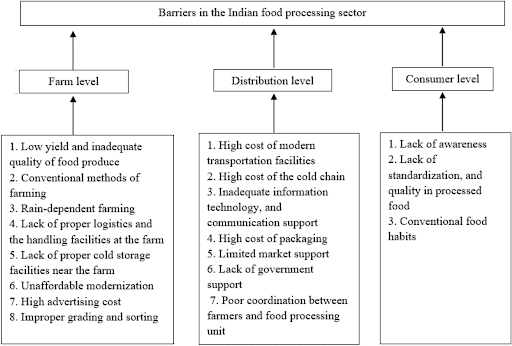
Food Processing Sector - Challenges
- Bottlenecks on supply and demand sides: Small and dispersed marketable surplus due to fragmented holdings, low farm productivity due to lack of mechanisation, high seasonality, perishability, and lack of proper intermediation (supply chain) all contribute to a lack of raw material availability. As a result, food processing and exports are hampered.
- Bottlenecks in the infrastructure: More than 30% of farm-gate produce is lost due to insufficient cold chain infrastructure. Supply is erratic due to a lack of all-weather roads and connectivity.
- The food processing industry has a high concentration of unorganised segments, which account for nearly 75% of all product categories. As a result, the existing production system is inefficient.
- Regulatory Gaps: There are numerous laws that govern food safety and packaging, each under the jurisdiction of a different ministry or department.
- Contradictions in food safety specifications and guidelines result from the proliferation of legislation and administrative delays.
- The widespread use of fertilisers, pesticides, and other chemicals has raised concerns about food quality, which should be investigated. Furthermore, protection from unfair and dangerous practises such as adulteration is required.
- Processed foods may not be nutritionally balanced and may pose a health risk, particularly for children, unless fortified. This could lead to a negative perception of processed foods, potentially affecting the sector's economic gains.
- Limited ability to control quality and safety: The sheer number of players involved in the food value-chain, particularly in the large unorganised segment, makes implementation of quality and safety standards difficult.
- As a result, practises such as milk adulteration and the use of carbide for fruit ripening have become more common.
- Low consumer awareness: Consumer awareness is a critical component of the country's improved nutritional situation. Consumers are currently unaware of several nutritional, food safety, and quality issues.
Major Initiatives of Government - Food Processing Sector
Vision 2015 for Food Processing
- The Ministry of Food Processing Industries (FPI) has funded a study to develop a roadmap for the growth of the food processing sector.
- The adopted Vision 2015 calls for increasing perishable processing from 6% to 20%, increasing value addition from 20% to 35%, and increasing India's share of global food trade from 1.5% to 3% by 2015.
- To meet these targets, an investment of Rs.100,000 crores was estimated by 2015, with the government contributing Rs.10,000 crores.
- As a result, the Ministry of FPI developed its 11th Plan schemes in order to attract the necessary investment in the sector.
National Mission on Food Processing (NMFP)
- On April 1, 2012, the Ministry of Food Processing Industries (MOFPI) launched a new Centrally Sponsored Scheme (CSS) - National Mission on Food Processing (NMFP) for implementation through States/UTs.
- The NMFP envisions the establishment of a National Mission as well as Missions at the State and District levels.
- The primary goal of the NMFP is to decentralise the implementation of food processing-related schemes in order to ensure substantial participation by State Governments/UTs.
- The mission is expected to significantly improve the Ministry's outreach in terms of planning, supervision, and monitoring of various schemes, as well as play a more meaningful role in policy formation.
Pradhan Mantri Kisan SAMPADA Yojana
- The Pradhan Mantri Kisan SAMPADA Yojana is a central government scheme launched by the Ministry of Food Processing Industries (MoFPI).
- PM Kisan Sampada Yojana is a comprehensive package that will result in the development of modern infrastructure and efficient supply chain management from farm gate to retail outlet.
- It will not only help to boost the growth of the country's food processing sector, but it will also help to provide better returns to farmers and is a big step towards doubling farmers' income, creating huge employment opportunities, especially in rural areas, reducing wastage of agricultural produce, increasing the processing level, and enhancing the export of processed foods.
*For detailed notes on this topic, check this link Pradhan Mantri Kisan Sampada Yojana
Mega Food Parks
- The Mega Food Park Scheme aims to provide a mechanism to link agricultural production to the market by bringing together farmers, processors, and retailers in order to maximise value addition, minimise waste, increase farmer income, and create job opportunities, particularly in the rural sector.
- The Mega Food Park Scheme is based on the "Cluster" approach and envisions the development of cutting-edge support infrastructure in a well-defined agri/horticultural zone for the establishment of modern food processing units in the park's industrial plots with a well-established supply chain.
- Mega food parks typically include supply chain infrastructure such as collection centres, primary processing centres, central processing centres, cold chain, and between 25 and 30 fully developed plots for entrepreneurs to establish food processing units.
- The Mega Food Park project is being carried out by a Special Purpose Vehicle (SPV), which is a Body Corporate registered under the Companies Act.
*For detailed notes on this topic, check this link Mega Food Parks
Operation Greens
- Operation Greens is a price-fixing scheme that aims to ensure farmers receive the correct price for their produce.
- It aims to promote Farmer Producer Organizations (FPO), Agri-logistics, processing facilities, and professional agri-produce management.
- It focuses on organised marketing of Tomatoes, Onions, and Potatoes (TOP vegetables) by connecting farmers with consumers.
- State Agriculture and other Marketing Federations, Farmer Producer Organizations (FPO), cooperatives, companies, self-help groups, food processors, and others can apply for financial assistance under it.
- Agriculture Produce Market Committee (APMC) promoted markets will be linked to the e-NAM platform to aid in the structural and infrastructure components of the scheme.
*For detailed notes on this topic, check this link Operation Greens
Modernization of Abattoirs
- The scheme aims to provide facilities for scientific and less painful slaughtering, chilling, effluent treatment plant, by-product utilisation, water, and power, as well as the necessary sanitary/phytosanitary conditions for abattoir modernization.
- It will also increase the essential supply base of hygienic raw materials to the meat processing industry, both for domestic consumption and exports, while discouraging unauthorised slaughtering.
- The scheme for the establishment/modernization of abattoirs calls for the infusion of private capital, improved technology, and backward and forward linkages.
Integrated Cold Chain and Value Addition Infrastructure
- The "Integrated Cold Chain and Value Addition Infrastructure" is to provide continuous integrated cold chain and preservation infrastructure from the farm gate to the consumer.
- This scheme will connect producers to food processors and markets via a well-equipped supply chain and cold chain, ensuring farmers fair prices and year-round availability of food products to consumers.
- Partnership/Proprietorship Firms, Companies, Corporations, Cooperatives, Self Help Groups (SHGs), Farmer Producer Organizations (FPOs), NGOs, Central/State PSUs, and others can set up an integrated cold chain project if they meet the eligibility requirements of the scheme guidelines.
*For detailed notes on this topic, check this link Integrated Cold Chain and Value Addition Infrastructure
Conclusion
The food processing industry in India plays a crucial role in connecting Indian farmers to consumers in both domestic and international markets. The Ministry of Food Processing Industries (MoFPI) is doing everything possible to encourage investment throughout the value chain. In India, the food processing industry has expanded significantly over the last few decades. The rise in working-class income has resulted in more disposable income to spend on processed foods. Another important factor is the change in food habits of the working class, who prefer readily available convenient foods. India is regarded as one of the leading producers of fruits, vegetables, and other food products.
FAQs
Question: What is the importance of the food processing industry in India?
Answer: It helps in reducing agricultural wastage, generating employment, and increasing the export of processed food products.
Question: What government initiatives support food processing in India?
Answer: Initiatives like Pradhan Mantri Kisan SAMPADA Yojana and Mega Food Parks are designed to boost the sector's infrastructure and promote entrepreneurship.
Question: How does the food processing industry reduce wastage?
Answer: By converting raw agricultural products into consumable goods, food processing minimizes post-harvest losses.
Question: What are the main products in the food processing industry?
Answer: The industry processes products like fruits, vegetables, grains, dairy, meat, and fisheries into consumable forms.
Question: How does the food processing industry contribute to employment?
Answer: It generates jobs in production, packaging, distribution, and retail, benefiting both rural and urban populations.
MCQs
1. Which scheme aims to promote food processing in India?A. Pradhan Mantri Awas Yojana
B. Pradhan Mantri Kisan SAMPADA Yojana
C. Smart Cities Mission
D. Make in India
Answer: (B) See the Explanation
Pradhan Mantri Kisan SAMPADA Yojana is designed to boost the food processing industry by improving infrastructure and entrepreneurship.
A. By increasing imports
B. By creating agricultural wastage
C. By generating employment and exports
D. By focusing on urbanization
Answer: (C) See the Explanation
The food processing industry creates jobs and boosts exports, contributing to India’s economic growth.
A. It enhances post-harvest technology
B. It prevents cultivation
C. It stores agricultural inputs
D. It stops food production
Answer: (A) See the Explanation
The industry converts raw agricultural produce into processed products, reducing post-harvest wastage.
A. Electronics
B. Fertilizers
C. Dairy products
D. Automobile parts
Answer: (C) See the Explanation
Dairy products are a key component of India's food processing industry.
A. Reduced income
B. Increased post-harvest losses
C. Better market access and prices
D. Less production
Answer: (C) See the Explanation
Food processing provides farmers with better market access, ensuring better prices for their produce.
GS Mains Questions and Model Answers
Q1: Discuss the role of the food processing industry in reducing agricultural wastage in India.
Answer: The food processing industry plays a crucial role in minimizing post-harvest losses by converting raw agricultural products into consumable items, thus reducing wastage. It ensures better utilization of crops like fruits, vegetables, and grains, thereby enhancing agricultural productivity and profitability. Government schemes like Pradhan Mantri Kisan SAMPADA Yojana further boost infrastructure and market access, contributing to economic growth.
Q2: Analyze the contribution of food processing industries in creating employment in rural India.
Answer: The food processing industry is a key source of employment, especially in rural areas. It provides jobs in production, packaging, and distribution, fostering skill development. The sector also supports agricultural value chains, enabling farmers and rural entrepreneurs to access better opportunities. Government initiatives like Mega Food Parks further enhance job creation by promoting entrepreneurship and improving processing infrastructure.
Q3: Evaluate the impact of government initiatives on the development of the food processing industry in India.
Answer: Government schemes like Pradhan Mantri Kisan SAMPADA Yojana and Mega Food Parks have significantly contributed to the development of India’s food processing sector. These initiatives provide infrastructure, financial support, and incentives for entrepreneurs, helping to reduce wastage and increase exports. While the sector has seen growth, challenges like inadequate cold storage facilities and lack of technological adoption still hinder its full potential.
Previous Year Questions
1. UPSC CSE Prelims 2019
Question: Which of the following is a key objective of Pradhan Mantri Kisan SAMPADA Yojana?
A. Urban housing development
B. Boosting agricultural exports
C. Developing the food processing industry
D. Providing farm subsidies
Answer: C
Explanation: Pradhan Mantri Kisan SAMPADA Yojana focuses on developing food processing industries by creating infrastructure and reducing wastage.
2. UPSC CSE Mains 2017 (GS Paper 3)
Question: "Discuss the challenges and opportunities for the food processing industry in India."
Answer: The food processing industry in India faces challenges like inadequate infrastructure, high wastage, and lack of technological adoption. However, opportunities for growth exist with government support, rising demand for processed food, and increasing export potential. Initiatives like Mega Food Parks aim to overcome these challenges, providing opportunities for employment generation and boosting the economy.
Download the PREPP App and attempt FREE IAS Exam Mock Tests and get complete study material!

Full Test - 04: UPSC CSE Prelims CSAT (Paper-II)
Full Test - 03: UPSC CSE Prelims CSAT (Paper-II)
UPSC CSE Prelims 2026 GS Paper 1 Question Paper (24-May-2026)
UPSC CSE Prelims 2026 CSAT Paper 2 Question Paper (24-May-2026)

17 February 2025 | The Hindu Must Read Articles | Current Affairs

16 February 2026 | The Hindu Must Read Articles | Current Affairs

13 February 2026 | The Hindu Must Read Articles | Current Affairs









Comments