Food Security - Agriculture Notes
Food security is a fundamental human right. In fact, having access to adequate amounts of nutritious food may be considered the most fundamental of all human rights. However, hundreds of millions of people do not have this right, usually for reasons beyond their control. India ranks 101st out of 116 countries with enough data to calculate Global Hunger Index (GHI) scores for 2021. India has a severe level of hunger, with a score of 27.5. According to UN-India, India has nearly 195 million undernourished people, accounting for a quarter of the world's hunger burden. Approximately 43% of children in India are chronically malnourished. In this article, we will discuss Food Security which will be helpful for UPSC exam preparation.
What is Food Security?
- Food security, as defined by the United Nations Committee on World Food Security, means that all people have physical, social, and economic access to sufficient, safe, and nutritious food that meets their food preferences and dietary needs for an active and healthy life at all times.
- Food security can be divided into four major components known as the "four pillars of food security."
- Availability: It is defined as the availability of food in sufficient quantities and on a consistent basis. It takes into account stock and production in a given area, as well as the ability to import food from elsewhere via trade or aid.
- Access: True food security implies that people have the resources they need to obtain a sufficient quantity and quality of nutritious food. A variety of physical, social, and policy factors influence food access.
- Pricing, household proximity to suppliers, and infrastructure all have an impact on our access to food.
- Utilization: Not all food has the same or sufficient nutritional value. It is critical to have access to high-quality food in order to be food secure.
- It is critical that food be nutritious and healthy enough to provide people with the energy they require for their daily activities.
- It is also critical that people have the knowledge and tools they need to properly 'use' the food that is available to them.
- This includes having the means to properly select, prepare, and store readily available and accessible foods.
- Stability: Food stability means that food access, availability, and consumption remain relatively stable over time. It is critical to try to reduce any threats to this stability.
- Natural disasters, climate change, conflict, and economic factors such as volatile price fluctuations are all threats to food stability.
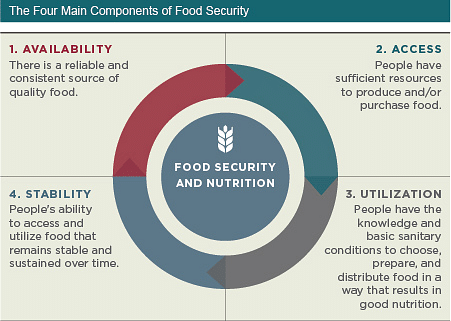
Components of Food Security
Food Security in India
- Concerns about food security can be traced back to the Bengal Famine in 1943, which occurred during British colonial rule and resulted in the deaths of 2 million to 3 million people due to starvation.
- Since gaining independence, an initial rush to industrialise while ignoring agriculture, two consecutive droughts in the mid-1960s, and reliance on food aid from the United States have exposed India's vulnerability to several food security shocks.
- In the late 1960s and early 1970s, the country experienced a Green Revolution, which enabled it to overcome productivity stagnation and significantly increase food grain production.
- Despite its success, the Green Revolution is frequently criticised for being focused on only two cereals, wheat and rice; being confined to a few resource-rich regions in the northwestern and southern parts of the country that benefited mostly rich farmers; and putting too much stress on the ecology of these regions, particularly soil and water.
- The Green Revolution was followed by the White Revolution, which was sparked by Operation Flood in the 1970s and 1980s.
- This national initiative has revolutionised liquid milk production and marketing in India, making it the world's largest producer of milk.
- Lately, particularly since the year 2000, hybrid maize for poultry and industrial use, as well as Bacillus thuringiensis (Bt) cotton, have made significant strides in production, resulting in significant cotton exports, making India the second largest cotton exporter in 2007-2008.
Food Security Programs of India
- Public Distribution System Food Subsidies (Implemented through Targeted Public Distribution System which account for a large portion of government expenditure on food security)
- Mid-Day Meal Program
- Integrated Child Development Services Program
- Mega Food Parks
- Sampada Yojana
National Food Security Act of 2013 (NFSA)
|
Significance of Food Security in a Nation
- It will benefit the agricultural sector.
- A boost in the agricultural sector would result in more job opportunities, as agriculture is a labor-intensive industry.
- This would boost economic growth and reduce poverty.
- It would help the government to regulate prices.
- Access to nutritious food would benefit the public's overall health.
- Food security is also important for national security and stability.
International Organizations Ensuring Food Security
- The Food and Agriculture Organization (FAO): It was founded in 1945 and is headquartered in Rome, Italy.
- It is a United Nations specialised agency that leads international efforts to combat hunger and improve nutrition and food security.
- It is the United Nations' oldest surviving agency.
- World Food Programme (WFP): It is the world's largest humanitarian organisation addressing hunger and promoting food security.
- It was established in 1961 and headquartered in Rome, Italy.
- It is the United Nations' food assistance branch.
- International Fund for Agricultural Development (IFAD): It is an international financial institution and a United Nations specialised agency that works to alleviate poverty and hunger in developing countries' rural areas.
- Its headquarters are located in Rome, Italy.
- World Bank: It was founded in 1944 and is headquartered in Washington DC. It is actively involved in funding food related projects and programmes.
Revolutions in Food Security
- Green Revolution - Agriculture Production
- Pink Revolution - Meat and Poultry Production
- Red Revolution - Meat and Tomato Production
- Silver Revolution - Egg/Poultry Production
- White Revolution - Milk/Dairy Production
- Yellow Revolution - Oil Seed Production
- Blue Revolution - Fish Production
- Brown Revolution - Leather/Cocoa Manufacturing
- Golden Revolution - Horticulture and honey production
Food Security Challenges in India
- Soil degradation caused by excessive or inappropriate agrochemical use, deforestation, and natural disasters poses a significant challenge to sustainable food production. One-third of the world's soil has already degraded.
- Threats from Invasive Weeds: Over the last 15 years, India has faced more than ten major invasive pest and weed attacks.
- In 2018, the Fall Armyworm (Pest) destroyed nearly the entire maize crop in the country. Due to the pest's damage in 2018, India was forced to import maize in 2019.
- A locust attack was reported in Rajasthan and Gujarat districts in 2020.
- Inadequate food distribution via public distribution mechanisms (PDS i.e. Public Distribution System).
- The Public Distribution System faces challenges such as food grain leakage and diversion, inclusion/exclusion errors, fake and bogus ration cards, and a lack of grievance redressal and social audit mechanisms.
- Due to a minimum support price, farmers have diverted land from coarse grain production to rice and wheat production.
- Furthermore, there is a huge waste of around Rs.50,000 crore per year due to both improper accounting and insufficient storage facilities.
- Climate Change: Changing precipitation patterns, as well as an increase in the frequency and intensity of extreme weather events such as heatwaves and floods, are already reducing agricultural productivity in India and thereby posing a serious food security threat.
- Inaccessibility to remote areas: For tribal communities, living in remote, difficult terrains and practising subsistence farming has resulted in significant economic backwardness.
- Increased rural-to-urban migration, a large informal workforce, and unplanned growth of slums with inadequate health and hygiene facilities, insufficient housing, and increased food insecurity.
- Overpopulation, poverty, illiteracy, and gender inequality.
- The expansion of the biofuel market has reduced the amount of land used to grow food crops.
- Food can be used as a weapon in conflict, with enemies cutting off food supplies to gain ground.
- There is a lack of coherence in food and nutrition policies, as well as a lack of intersectoral coordination among various ministries.
- Because of the risk of increased nutritional imbalance in food grains, the government must broaden subsidies to include other protein-rich food items.
- Diverting grains to the open market for a higher margin, selling poor quality grains at ration shops, and irregular shop openings all contribute to the problem of food insecurity.
- Farmers receive government support for crops such as wheat, paddy, and sugarcane. The MSP is higher than the market price.
- The government purchases very few other crops at MSP. Farmers lack the incentive to grow other crops, such as pulses, as a result of this factor.
- Because the crops listed above require a lot of water, this puts a lot of strain on the water table.
Measures to Ensure Food Secutiy in India
- Moving Towards Sustainable Farming: Improving productivity through greater use of biotechnology, intensifying watershed management, using nano-urea and access to micro-irrigation facilities, and bridging crop yield gaps across States through a collective approach should be priorities for ensuring food security in India.
- Adoption of low-water-requirement crops and techniques, such as the System of Rice Intensification (SRI) method of rice production, contributes to resilience by allowing for equal or higher yields with less water withdrawal.
- Crop diversification: Increased profitability and production stability highlight the importance of crop diversification, such as legumes as an alternative to rice and wheat. Non-cereal crops such as oilseeds, fruits and vegetables, and so on must be encouraged.
- Food and nutrition can be obtained from the sea, lakes, and rivers. Fish are an excellent source of protein and do not require fertile soil.
- Precision Agriculture: There is a need to increase the use of information technology (IT) in agriculture in order to ensure that crops and soil receive exactly what they require for optimal health and productivity.
- Farmers' incomes will increase as precision agriculture and high-tech farming practises are implemented, production input costs will be reduced, and many other issues of scale will be addressed.
- Revitalizing Aadhaar Seeding of Ration Cards: To expedite the process of linking Aadhaar to ration cards, ground monitoring measures must be implemented to ensure that no valid beneficiary is denied their share of food grains, which can help to achieve the goal of zero hunger.
- Direct Benefit Transfer (DBT) Through JAM: There is a need to streamline food and fertiliser subsidies into direct benefit transfers to identified beneficiaries' accounts via the JAM trinity platform (Jan Dhan, Aadhaar, and Mobile), which will reduce massive physical movement of foodgrains, provide beneficiaries with greater autonomy to choose their consumption basket, and promote financial inclusion.
- Ensuring Transparency in Food Stock Holdings: Using IT to improve communication channels with farmers can help them get a better deal for their produce, while improving storage houses with cutting-edge technology is critical for dealing with natural disasters.
- Foodgrain banks can be established at the block/village level, from which people can obtain subsidised food grains in exchange for food coupons.
- Umbrella Approach to Problem Solving: India can look forward to a sustainable green economy by viewing disparate issues through a common lens, such as inequality, food diversity, indigenous rights, and environmental justice.
Conclusion
Food security is critical to ensuring that everyone has enough to eat and that families can build their communities without fear of losing their lives. To meet global demand, food production must be doubled in the coming years to address many issues such as starvation, malnutrition, and associated health problems. Food security is a well-established principle of international human rights law.
FAQs
Q1: What is food security?
Answer: Food security refers to ensuring that all people have access to sufficient, safe, and nutritious food to maintain a healthy life.
Q2: What are the pillars of food security?
Answer: Availability, access, utilization, and stability are the four main pillars.
Q3: What is the role of the Public Distribution System (PDS) in India?
Answer: PDS distributes subsidized food grains to improve food access for vulnerable populations.
Q4: How does malnutrition impact food security?
Answer: Malnutrition undermines food utilization, a key aspect of food security.
Q5: What are some global efforts to combat food insecurity?
Answer: Initiatives include the World Food Programme and Sustainable Development Goals (SDG 2 - Zero Hunger).
MCQs
- What is the primary objective of food security?
a) Increasing food exports
b) Achieving surplus food production
c) Ensuring food access for all
d) Reducing agriculture subsidies
Answer: (C) See the Explanation
- Which organization monitors food security globally?
a) World Bank
b) IMF
c) WTO
d) FAO
Answer: (D) See the Explanation
- What is the aim of the National Food Security Act, 2013?
a) Ensure food exports
b) Provide food grains at subsidized rates
c) Improve agricultural technology
d) Promote organic farming
Answer: (B) See the Explanation
- Which is a major challenge to food security in India?
a) Increasing food grain exports
b) Water scarcity and climate change
c) Rising agricultural subsidies
d) Decreasing urban population
Answer: (B) See the Explanation
- What is meant by ‘hidden hunger’?
a) Lack of access to luxury foods
b) Deficiency in essential micronutrients
c) Surplus calorie consumption
d) Overdependence on processed foods
Answer: (B) See the Explanation
GS Mains Questions and Model Answers
Q1: Discuss the significance of food security in India’s development.
Answer: Food security is essential for national stability and human development. Ensuring adequate access to nutritious food reduces poverty, improves health outcomes, and boosts productivity, which is vital for economic growth.
Q2: Examine the impact of climate change on food security in India.
Answer: Climate change disrupts food production by altering rainfall patterns, causing droughts, and increasing extreme weather events. This affects crop yields and livestock, threatening food availability and stability.
Q3: Evaluate the effectiveness of the Public Distribution System (PDS) in improving food security in India.
Answer: PDS plays a crucial role by providing subsidized food grains to vulnerable populations. However, challenges such as corruption, leakage, and uneven access limit its overall effectiveness.
Previous Year Questions on Food Security
1. UPSC CSE 2019
Question: "What are the key challenges to achieving food security in India?"
Answer: Key challenges include climate change, poor storage infrastructure, inefficient distribution systems, and population growth. Addressing these issues requires policy reforms and technological innovation.
2. UPSC CSE 2020
Question: "How does the National Food Security Act contribute to poverty reduction?"
Answer: The Act ensures food access through subsidized grains, improving nutrition and reducing hunger. By targeting economically weaker sections, it directly addresses poverty and malnutrition issues.
Download the PREPP App and attempt FREE IAS Exam Mock Tests and get complete study material!

Full Test - 04: UPSC CSE Prelims CSAT (Paper-II)
Full Test - 03: UPSC CSE Prelims CSAT (Paper-II)
UPSC CSE Prelims 2026 GS Paper 1 Question Paper (24-May-2026)
UPSC CSE Prelims 2026 CSAT Paper 2 Question Paper (24-May-2026)

17 February 2025 | The Hindu Must Read Articles | Current Affairs

16 February 2026 | The Hindu Must Read Articles | Current Affairs

13 February 2026 | The Hindu Must Read Articles | Current Affairs









Comments