Harvest-Plus programme and How India & Africa Can Deal With Food And Nutrition Security Issues Together
Relevance: GS3 - Transport and marketing of agricultural produce and issues and related constraints; e-technology in the aid of farmers, Issues related to direct and indirect farm subsidies and minimum support prices, Food processing and related industries in India- scope’ and significance, location, upstream and downstream requirements, supply chain management. GS1 - Distribution of key natural resources across the world (including South Asia and the Indian subcontinent)
(Source: Indian Express, 09/18/2023)
Click here for Daily Current Affairs
Why in the news?
- This article discusses the steps that the Global South, including India, must take to tackle the various food and nutrition security issues faced by them.
- Recently, the African Union (AU) was added to the G-20 under India’s G-20 Presidency highlighting the country’s efforts in South-South cooperation.
Table of Contents
How can the Global South work towards food and nutrition security?
Open borders for agricultural trade
- In order to ensure global food security, governments must promote open international borders for agricultural trade.
- Over the last three years, India has exported 85 million tonnes of cereals but the recent restrictions on imports of rice and wheat are likely to adversely affect African nations that rely on Indian food exports.
- The restrictions were aimed at regulating domestic availability and prices and preventing hoarding.
Climate change financing
- Developed nations must fulfill their commitment to provide $100 billion to compensate for the losses and damage caused by climate change.
- This will enable developing nations to implement schemes for poverty eradication, climate change mitigation and adaptation, and food security.
- According to the G-20, an additional $3 trillion will be required annually up to 2030 to address these issues.
- Private funds:
- The World Bank can mobilize funds from the private sector to complement funds raised from developed nations.
- Over the next decade, hybrid capital can provide developing countries more than $6-7 billion for climate change mitigation.
International collaboration: Harvest-Plus programme
- The Harvest-Plus programme of the Consultative Group on International Agricultural Research (CGIAR), and the Indian Council for Agriculture Research (ICAR) have developed new nutrient-rich varieties of staple crops like
- iron and zinc bio-fortified pearl millet
- zinc-bio fortified rice and wheat
- iron bio-fortified beans.
- India and 36 African nations are participating in the Harvest-Plus programme, which will help
- Make food systems more nutritious and inclusive,
- Combat malnutrition in chronic malnutrition-affected areas of Asia and Africa,
- Achieve the SDGs related to the elimination of hunger and malnutrition by 2030.
Women empowerment
- Increasing access to nutritious food alone is not sufficient to eliminate malnutrition.
- Education of women can help improve nutritional and healthcare metrics as educated women generally marry older, and have fewer and healthier babies.
- Reduced undernutrition in children was strongly associated with education and healthy BMI of mothers in the NFHS (2019-21) data.
- Investment in women’s higher education will help improve female labor force participation and foster long-term economic growth.
- Liberal and accessible scholarships for girls funded by state governments will lower dropout rates among girls in secondary and higher education.
Investments in WASH Initiatives
- Investments in Water Sanitation and Hygiene (WASH) initiatives have a multiplier effect on nutritional outcomes.
- Between 2015-16 and 2019-21, the implementation of the Swacch Bharat Abhiyaan increased the number of Indian households with improved sanitation facilities from 48.5% to 70%.
- The provision of WASH facilities has led to increased enrolment, regular attendance, and better learning outcomes.
How has climate change affected food security?
- Temperature
- Climate change has led to a rise in average temperatures affecting crop production in seasonally arid and tropical regions.
- Rainfall and groundwater:
- Interseasonal and intraseasonal rainfall patterns have been altered by climate change.
- This has increased the severity of droughts and reduced the rate of groundwater replenishment, thereby reducing crop productivity.
- Extreme weather events:
- Increased extreme weather events due to climate change have altered the length of the crop-growing season.
- This has affected crop output and incomes of small and marginal farmers compromising their access to nutritious food.
- Nutritional quality:
- The nutritional quality of foods, particularly micronutrients such as zinc and iron has been reduced as a result of climate change.
- This has led to “hidden hunger”, particularly in India where pulses are the main source of protein.
- Undernutrition has lowered human immunity and labor productivity, which could turn India’s demographic dividend into a demographic disaster.
Reshaping the Global Mindset
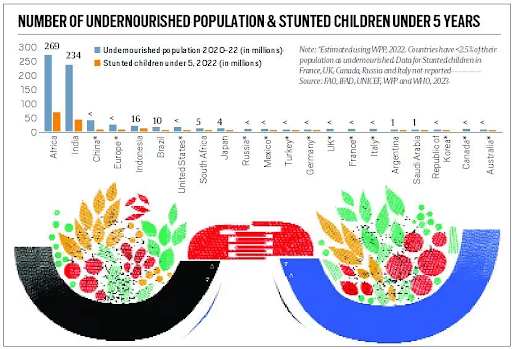
- Following Africa’s addition to the G-20, the “G-21” accounts for 84% of the world’s population, with 36% from India and Africa.
- In 2020-2022, 69.4% of the world’s undernourished population (503 million) were from India and Africa.
- India and Africa also account for 67.0% and 75.8% of the world’s children under five who are affected by malnutrition.
- Africa is a vital partner in India’s strategy for global development and stability.
- India’s G20 presidency helped integrate the aspirations of the Global South into mainstream geopolitics by ensuring the inclusion of the African Union.
South-South collaboration
- South-South cooperation is a collaborative framework of political, economic, social, cultural, environmental, and technical cooperation among countries in the global South.
- It recognizes and responds to the specific challenges faced by the least developed countries.
- The Buenos Aires Plan of Action for Promoting and Implementing Technical Cooperation among Developing Countries (1978) laid the foundation for South-South cooperation.
- It integrated key principles of international relations such as respect for sovereignty, non-interference in internal affairs, and equality.
- Objectives
- Self-Reliance: Empower developing countries to find solutions to their unique developmental challenges.
- Capacity building: Enhance the existing capacities of developing countries.
- Communication: South-South cooperation promotes improved communication and collaboration among developing nations.
- Participation: This form of cooperation facilitates increased participation of developing countries in international development efforts.
- Significance
- Shared Challenges: Developing countries share a colonial past and common challenges like inadequate infrastructure, illiteracy, and poverty, which can be collectively addressed through South-South cooperation.
- Collective Self-Reliance: It helps developing countries achieve collective self-reliance as individual self-reliance is difficult due to poor development.
- Alternative to Traditional Aid: Unlike Developmental assistance from developed countries, South-South cooperation is more flexible and mutually beneficial.
- Knowledge Sharing: It allows developing countries to share knowledge, skills, and resources to achieve their development goals.
(*Click this link to read prelims specific weekly current affairs articles)
FAQs
Question: What is food security?
Answer:
According to the United Nations Committee on World Food Security, food security refers to the situation in which people have physical, social, and economic access to sufficient, safe, and nutritious food that meets their food preferences and dietary needs. It has four pillars - Accessibility, Availability, Stability, and Utilization.
Question: What is the Global South?
Answer:
Global South is a geopolitical term that refers to countries that are generally described as ‘developing’, ‘less developed’, or ‘underdeveloped’. It includes countries from Africa, Asia, and Latin America. Global South countries primarily suffer from high levels of poverty, income inequality, and poor living conditions.
UPSC Mains Practice Question:
|
MCQs
Question: In the context of India’s preparation for Climate-smart Agriculture, consider the following statements:
- The ‘Climate-Smart Village’ approach in India is part of a project led by Climate Change, Agriculture, and Food Security (CCAFS), an international research programme.
- The project of CCAFS is carried out under the Consultative Group on International Agricultural Research (CGIAR) headquartered in France.
- The International Crops Research Institute for the Semi-Arid Tropics (ICRISAT) in India is one of the CGIAR’s research centers.
Which of the statements given above are correct? (UPSC CSE 2021)
(a) 1 and 2 only
(b) 2 and 3 only
(c) 1 and 3 only
(d) 1,2 and 3
Answer: (d) See the Explanation
- The Climate-Smart Village project is part of the CGIAR Research Program on Climate Change, Agriculture, and Food Security (CCAFS) in Africa and South Asia. Hence statement 1 is correct.
- The CCFAS is carried out under the CGIAR, which is headquartered in Montpellier, France.
- The CGIAR is a global partnership that unites international organizations engaged in research about food security. Hence statement 2 is correct.
- The International Crops Research Institute for the Semi-Arid Tropics (ICRISAT) is a non-profit and non-political CGIAR Research Center. Hence statement 3 is correct.
Therefore, option (d) is the correct answer.
Question: With reference to ‘Initiative for Nutritional Security through Intensive Millets Promotion’, which of the following statements is/are correct?
- This initiative aims to demonstrate the improved production and post-harvest technologies and to demonstrate value-addition techniques, in an integrated manner, with a cluster approach.
- Poor, small, marginal, and tribal farmers have a larger stake in this scheme.
- An important objective of the scheme is to encourage farmers of commercial crops to shift to millet cultivation by offering them free kits of critical inputs of nutrients and micro-irrigation equipment.
Select the correct answer using the code given below. (UPSC CSE 2016)
(a) 1 only
(b) 2 and 3 only
(c) 1 and 2 only
(d) 1, 2 and 3
Answer: (c) See the Explanation
- The Initiative for Nutritional Security through Intensive Millet Promotion (INSIMP) was launched in 2011-12 to promote millets as “Nutri-cereals”.
- It aims to demonstrate improved production and post-harvest technologies with a cluster approach to increase millet production in the country. Hence statement 1 is correct
- Small millets are generally low-productivity crops and are produced by poor tribal farmers in remote areas. Hence statement 2 is correct
- Farmers are provided with technology demonstration kits comprising micro-nutrients, fungicides, bio-fertilizers, DAP, urea, potash, pesticides, and weedicides but not micro-irrigation equipment. Hence statement 3 is incorrect.
Therefore, option (c) is the correct answer.
Download the PREPP App and attempt FREE IAS Exam Mock Tests and get complete study material!

Full Test - 04: UPSC CSE Prelims CSAT (Paper-II)
Full Test - 03: UPSC CSE Prelims CSAT (Paper-II)
UPSC CSE Prelims 2026 GS Paper 1 Question Paper (24-May-2026)
UPSC CSE Prelims 2026 CSAT Paper 2 Question Paper (24-May-2026)

17 February 2025 | The Hindu Must Read Articles | Current Affairs

16 February 2026 | The Hindu Must Read Articles | Current Affairs

13 February 2026 | The Hindu Must Read Articles | Current Affairs









Comments