Project Cheetah, A Year On
Relevance: Prelims- Important Species in News, Biodiversity GS3 - Conservation
(Source: The Hindu, 09/18/2023)
Click here for Daily Current Affairs
Why in the news?
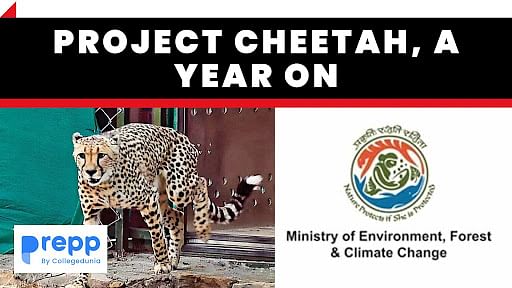
- Recently, Project Cheetah, India's ambitious initiative to reintroduce cheetahs after their extinction in the country, marked its first anniversary.
- It was stated that Cheetahs survival rate in India is a healthy 70% as against anticipated 50%.
Table of Contents
About Cheetah Project
- In 2022, the Ministry for Environment, Forests and Climate Change has launched the ‘Action Plan for Introduction of Cheetah in India’ under which 50 of these big cats will be introduced in the next five years.
- In September 2022, eight cheetahs were introduced to India from Namibia
- In February 2023, twelve cheetahs arrived in Madhya Pradesh from South Africa at the Kuno National Park (KNP), five months after the first batch of eight of these fastest land animals arrived from Namibia.
- The purpose of the Cheetah introduction project in India is to build a healthy cheetah metapopulation in India that allows the cheetah to execute its functional role as a top predator and provides opportunity for the cheetah to expand within its historic range.
Why have African Cheetahs been introduced in India?
- The cheetah was officially declared extinct by the Indian government in 1952.
- The introduction of African cheetahs in India serves the purpose of creating a sustainable cheetah population that can fulfill its crucial role as a top predator.
- This initiative seeks to establish self-sustaining cheetah populations within expansive, unfenced wildlife reserves.
- These reserves are interconnected by wildlife corridors, allowing cheetahs to thrive in their historical range and contribute significantly to global conservation efforts for this endangered species.
What are the causes of Cheetah Extinction in India?
- The big cat population was wiped out in the early 1950s, primarily due to overhunting and habitat loss.
- Cheetah hunting (sport hunting, capture during the Mughal period) dates back to the 1550s.
- However, the final stage of its extinction coincided with British colonial rule (the British declared a bounty for killing it in 1871).
- All of the causes of extinction can be linked to human intervention. Their population has been drastically reduced by issues like human-wildlife conflict, habitat destruction, prey shortages, and illegal trafficking.
- These issues have only gotten worse as a result of the onset of climate change and expanding human populations.
- Because there is less territory available for wildlife, species that need a large home range, like the cheetah, are forced to compete with humans and other animals for limited resources.
Current Status of the Project
- Survival rate: Reproduction and Survival: In late March 2023, one female cheetah gave birth to four cubs, conceived in India. Six cheetahs from Africa have died, with four dying in captivity and two in the wild. Three out of the four cubs have also died, with one being hand-reared due to maternal rejection.
- Currently, 14 adult cheetahs and one cub are surviving and all the cats are in some form of captivity or the other.
- Release and Captivity: Only 12 out of the 20 cheetahs have been released into the wild, with some brought back to Kuno National Park (KNP) multiple times. Four adult cheetahs have never been released to run free. On the project's first anniversary, 14 adult cheetahs and one cub remain in captivity.
- Causes of Death: Various causes were attributed to their deaths, including renal conditions, radio collars, heatwaves, mating attempts, cardio-pulmonary failure, and monsoon-related factors. There are concerns about the rush to mate cheetahs in captivity and the impact of long-term captivity on their fitness for release into the wild.
- Future Plans: There are discussions about radio-collaring the surviving cheetahs for potential release during winter. Plans are in place to prepare additional release sites in Madhya Pradesh, including Gandhi Sagar Wildlife Sanctuary and Nauradehi Wildlife Sanctuary.
About Cheetahs
|
What are the suggested measures?
- High quality habitat: The priority should be the establishment of high-quality habitats covering a substantial area, preferably at least 5,000 square kilometers, before importing more cheetahs. Creating glorified safari parks is insufficient to address the core issue of habitat quality and quantity.
- Avoiding overreliance on importation: Relying solely on importing more cheetahs to establish a viable population without addressing habitat requirements is unsustainable.
- Conservation efforts must focus on both species and their habitats in tandem for long-term success.
- Improving consultation and transparency: Project decision-making should involve wider consultation with experts and stakeholders. Transparency in project planning and execution is essential to build trust and ensure better outcomes for conservation efforts.
(*Click this link to read prelims specific weekly current affairs articles)
FAQs
Question: What is the Cheetah Reintroduction Action Plan?
Answer:
In 2022, the Ministry for Environment, Forests and Climate Change has launched the ‘Action Plan for Introduction of Cheetah in India’ under which 50 of these big cats will be introduced in the next five years.
Question: What is the National Tiger Conservation Authority (NTCA)?
Answer:
The National Tiger Conservation Authority (NTCA) is a statutory body under the Ministry of Environment, Forests, and Climate Change established under the enabling provisions of the Wildlife (Protection) Act, 1972, as amended in 2006, to strengthen tiger conservation in accordance with the powers and functions delegated to it by the Act.
MCQ
Question: Which of the following protected areas is well-known for the conservation of a subspecies of the Indian swamp deer (Barasingha) that thrives well on hard ground and is exclusively graminivorous? (UPSC 2020)
(a) Kanha National Park
(b) Manas National Park
(c) Mudumalai Wildlife Sanctuary
(d) Tal Chhapar Wildlife Sanctuary
Answer: (a) See the Explanation
Barasingha can be seen in the following national parks:
- Dudhwa National Park, Uttar Pradesh
- Kanha National Park, Madhya Pradesh
- Pilibhit Tiger Reserve, Uttar Pradesh
Barasingha is a deer species found in India and Nepal and is extinct in Pakistan and Bangladesh. Kanha National Park is located in Madhya Pradesh and is the largest national park of Madhya Pradesh.
Therefore, option (a) is the correct answer.
Download the PREPP App and attempt FREE IAS Exam Mock Tests and get complete study material!

Full Test - 04: UPSC CSE Prelims CSAT (Paper-II)
Full Test - 03: UPSC CSE Prelims CSAT (Paper-II)
UPSC CSE Prelims 2026 GS Paper 1 Question Paper (24-May-2026)
UPSC CSE Prelims 2026 CSAT Paper 2 Question Paper (24-May-2026)

17 February 2025 | The Hindu Must Read Articles | Current Affairs

16 February 2026 | The Hindu Must Read Articles | Current Affairs

13 February 2026 | The Hindu Must Read Articles | Current Affairs









Comments