Invisible Women Of Science
Relevance: GS1 - Role of women and women’s organizations, their problems and remedies, GS2 - Issues relating to development of Education ; GS3; Achievements of Indians in Science & Technology
(Source: Indian Express, 09/18/2023)
Click here for Daily Current Affairs
Why in the news?
- The Shanti Swarup Bhatnagar Prize, instituted by the Council of Scientific and Industrial Research (CSIR), in 1958, is a prestigious award for scientists under 45 years of age.
- The prizes cover seven domains of science: physical, chemical, biological, medical, engineering, mathematics and atmospheric.
- While it boosts winners' careers and their institutions' profiles, it has consistently overlooked women scientists.
Table of Contents
Gender Disparity in Scientific Awards
- Gender gap: Despite women comprising 14% of the nation's scientific workforce, the Shanti Swarup Bhatnagar Prize has shown a significant gender disparity in its awardees, with only 19 out of the almost 600 awarded Bhatnagar prizes have gone to women scientists.
- Comparison with Nobel Prizes: The Nobel Prizes also have a poor gender ratio, with only 24 out of 343 science prizes awarded to women.
Lack of Gender Diversity in Science Awards Selection Process
- The selection process for prestigious science awards, such as the Bhatnagar award, often contributes to the underrepresentation of women as winners. This issue primarily stems from the opaque nature of the selection process.
- Key decision-makers, including vice-chancellors, directors, presidents of academies, deans, CSIR governing body members, and former winners, predominantly consist of men, who are neglecting to nominate their female colleagues.
- Furthermore, the composition of the Advisory Committee, responsible for selecting awardees, remains shrouded in secrecy, rendering them immune to public scrutiny.
- This stands in stark contrast to the transparency exhibited by awards like the Infosys Science Prize, which openly showcases its jury chairs on its website.
Some of the Statistics in India Regarding Women in Science
- Status of women scientists: Women make up only 16% of the scientists in India.
- In 2021-22 and 2022-23, a total of 172 and 199 women scientists were selected out of 490 and 708 candidates, who applied under the Women Scientists Scheme-A (WOS-A).
- According to a 2020 survey, only 89 of the 1,044 members of the Indian National Science Academy (INSA) are women, accounting for 9% of the total. It was much worse in 2015, with only 6% of the 864 members being women scientists.
- Similarly, in 2020, INSA's governing body had 7 women out of 31 members, whereas there were no women members in 2015.
- Women are still an under-represented population globally in hardcore science, technology, engineering, and mathematics (STEM).
- According to available UNESCO data on some selected countries, India is in the lowest position, having only 14% of female researchers working in STEM areas.
Some notable Women Scientists of India
- Anadibai Goaplrao Joshi (1865-1887): She was the first Indian woman to study and graduate in western medicine in America.
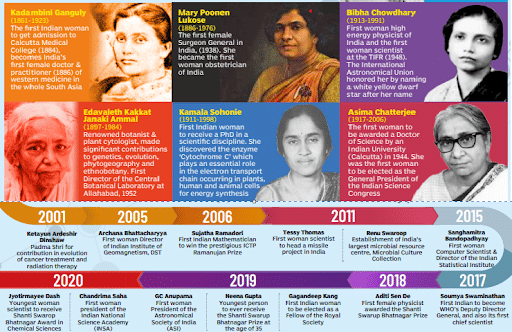
- Kadambini Ganguly (1861-1923): She was South Asia's first Indian female doctor practicing western medicine.
- Mary Poonen Lukose (1886-1976): The first female obstetrician and surgeon general in India.
- Bibha Chowdhary (1913-1991): she was India's first women high energy physicists and scientists at TIFR.
- Rajeshwari Chatterjee (1922-2010): She was the first woman engineer who joined IISC in the department of electrical communication engineering etc and pioneered research in microwave engineering.
- Kamala Sohonie (1911-1998): She was the first Indian woman to receive a PhD in scientific discipline. She discovered the enzyme ‘Cytochrome C’.
- Asima Chatterjee (1917-2006): She was the first woman to earn a doctor of science from Calcutta university and become the first female general president of the Indian Science Congress.
- Iravati Karve (1905-1970): India's first female anthropologist and founder of Pune university's department of anthropology.
- Kamala Ranadive (1917-2001): She established India's first female tissue culture lab, recognizing the link between cancer susceptibility, hormones and tumor virus.
- Anna Mani (1918-2001): She was the first woman to join the meteorological department in Pune and made contributions in the field of solar radiation, ozone and wind energy instrumentation.
Initiatives to Promote Women in Science
- Vigyan Jyoti Programme: It was established to address the country's underrepresentation of women in different fields of Science, Technology, Engineering, and Mathematics (STEM).
- KIRAN scheme: Knowledge Involvement in Research Advancement through Nurturing (KIRAN) is a plan under the Department of Science and Technology to provide opportunities for women scientists in moving up the academic and administrative ladder.
- One of the KIRAN scheme's programs, the 'Women Scientist Scheme,' provides career opportunities to unemployed women scientists and technologists, particularly those who have had a break in their careers.
- GATI program: The Gender Advancement for Transforming Institutions (GATI) program was established in order to develop a comprehensive Charter and a framework for assessing gender equality in STEM.
- SERB – POWER: SERB-POWER (Promoting Opportunities for Women in Exploratory Research) provides structured support in research to ensure equal access and weighted opportunities for Indian women scientists engaged in R&D activities.
- CURIE: Consolidation of University Research for Innovation and Excellence in Women Universities (CURIE) programme aims at improving R&D infrastructure and establishing state-of-the-art research facilities in order to create excellence in S&T in women universities.
- AI labs in universities: The DST (Department of Science and Technology) has also developed Artificial Intelligence (AI) labs in women's universities with the purpose of fostering AI innovations and preparing skilled manpower for future AI-based jobs.
- Indo-US Fellowship for Women in STEMM (WISTEMM) program: Under this bilateral agreement, Indian women scientists can now work in research labs in the US.
Way Ahead
- Transparency in Selection: It is important to implement a transparent selection process for awards like the Shanti Swarup Bhatnagar Prize, including publicly sharing information about nominations and the Advisory Committee's composition.
- Awareness and Advocacy: Promote awareness about gender disparity issues in science awards through advocacy, research, and media campaigns.
- Education and Outreach: It is essential to promote STEM education for girls and young women, encouraging their interest in scientific careers from an early age.
- Recent Initiatives: N. Kalaiselvi has been appointed as the first woman chief of the Council of Scientific and Industrial Research (CSIR) and a gender parity survey conducted by CSIR.
(*Click this link to read prelims specific weekly current affairs articles)
FAQs
Question: What is Shanti Swarup Bhatnagar Awards?
Answer:
The Shanti Swarup Bhatnagar Awards are the highest multidisciplinary science awards in India. They are named after Shanti Swarup Bhatnagar, the founder and director of the CSIR, who was also a renowned chemist and visionary.
Question: What is CSIR?
Answer:
The Council of Scientific and Industrial Research (CSIR) is India's largest research and development (R&D) institution, established in 1942 and headquartered in New Delhi. It operates as an autonomous body under the Societies Registration Act, 1860, and receives funding from the Ministry of Science and Technology.
Question: What is STEM?
Answer:
STEM is an educational program developed to prepare primary and secondary students for college, graduate study and careers in the fields of science, technology, engineering and mathematics (STEM).
MCQ
Question: For outstanding contribution to which one of the following fields is Shanti Swarup Bhatnagar Prize given? (UPSC 2009)
(a) Literature
(b) Performing Arts
(c) Science
(d) Social Service
Answer: (c) See the Explanation
The Shanti Swarup Bhatnagar Prize is given each year for outstanding contributions to science and technology.
Therefore, option (c) is the correct answer.
Download the PREPP App and attempt FREE IAS Exam Mock Tests and get complete study material!

Full Test - 04: UPSC CSE Prelims CSAT (Paper-II)
Full Test - 03: UPSC CSE Prelims CSAT (Paper-II)
UPSC CSE Prelims 2026 GS Paper 1 Question Paper (24-May-2026)
UPSC CSE Prelims 2026 CSAT Paper 2 Question Paper (24-May-2026)

17 February 2025 | The Hindu Must Read Articles | Current Affairs

16 February 2026 | The Hindu Must Read Articles | Current Affairs

13 February 2026 | The Hindu Must Read Articles | Current Affairs









Comments