PM Inaugurates Vishwakarma Scheme, Says Government Is Committed To The Uplift Of The Marginalised
Relevance: GS2 - Government policies and interventions for development in various sectors and issues arising out of their design and implementation GS3 - Indian Economy and issues relating to planning, mobilization, of resources, growth, development and employment. Inclusive growth and issues arising from it.
(Source: The Hindu, 09/17/2023)
Click here for Daily Current Affairs
Why in the news?
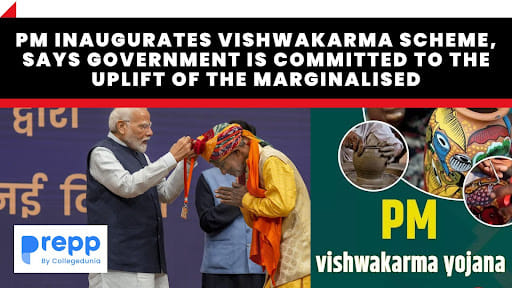
- Recently, Prime Minister Narendra Modi launched the Pradhan Mantri Vishwakarma Yojana (PMVY) to uplift artisans and craftspersons in the country.
- He also inaugurated the first phase of ‘Yashobhoomi’, the ₹5,400 crores India International Convention and Expo Centre at Dwarka, New Delhi.
- He unveiled 18 customized stamp sheets showcasing the 18 traditional trades covered by the scheme and a toolkit e-booklet on the occasion.
Table of Contents
What is the PM Vishwakarma Scheme?
- The Pradhan Mantri Vishwakarma Yojana (PMVY) is a scheme to provide end-to-end holistic support to traditional artisans and craftspeople to scale up their services and products.
- Beneficiaries can register for the scheme for free through the biometric-based PM Vishwakarma portal.
- Objectives:
- Enable the recognition of artisans and craftspeople as Vishwakarma.
- Provide skill upgradation and suitable training opportunities.
- Enhance their capability, productivity, and product quality through support for better and modern tools.
- Ensure easy access to collateral-free credit and reduced cost of credit through interest subvention.
- Incentivize digital transactions to digitally empower the Vishwakarmas.
- Develop new opportunities for growth by providing a platform for brand promotion and market linkages.
- Eligibility:
- Artisans or craftspersons working with hands and tools and engaged in any of the 18 family-based traditional trades, in the unorganized sector or on a self-employment basis.
- At least 18 years of age.
- The beneficiary should not have availed loans under similar credit-based schemes for self-employment/ business development in the past 5 years like the PMEGP, PM SVANidhi, Mudra.
- Registration and benefits are restricted to one member of the family
- Government employees and their family members are not eligible.
- Trades: The Scheme mentions 18 trades such as
- Wood Based: Carpenter (Suthar), Boat Maker
- Iron/Metal Based/ Stone Based: Armourer, Blacksmith (Lohar), Hammer and Tool Kit Maker, Locksmith, Sculptor (Moortikar, stone carver), Stone Breaker, and manufacture of Bronze, Brass, Copper, Dias, Utensils, Figurines, etc.
- Gold/Silver Based: Goldsmith (Sunar)
- Clay Based: Potter (Kumhaar)
- Leather Based: Cobbler (Charmakar)/Shoesmith/ Footwear Artisan
- Architecture/ Construction: Mason (Raajmistri)
- Others: Basket/ Mat/ Broom Maker/ Coir Weaver, Doll & Toy Maker (Traditional), Barber (Naai), Garland Maker (Malakaar), Washerman (Dhobi), Tailor (Darzi), and Fishing Net Maker
- Benefits
- Recognition: A certificate and ID Card recognizing the beneficiary as Vishwakarma will be provided.
- Skilling: Following skill verification, the beneficiary will be provided 5-7 days/Skill Verification followed by 5-7 days (40 hours) of basic training
- Beneficiaries may also enroll for 15 days (120 hours) of advanced training
- Beneficiaries will receive stipends of ₹500/day during the training.
- Toolkit Incentive: Beneficiaries will be provided ₹15,000 as a grant.
- Credit Support:
- Collateral-free enterprise development loans worth ₹1 lakh and ₹2 lakh, with the first tranche having to be repaid in 18 months and the second tranche in 30 months.
- The beneficiary will be charged an interest of 5% while the Union Ministry of Micro, Small and Medium Enterprises will pay an interest subvention cap of 8%
- The Union government will also bear the credit guarantee fees.
- Incentivization: Beneficiaries will be provided incentives worth ₹1 per transaction for a maximum of up to upto100 transactions in a month.
- Marketing Support: The National Committee for Marketing (NCM) will provide Quality Certification, Branding and promotion, E-commerce linkage, Trade fair advertising, publicity, etc.
Significance
- Insufficient training: Traditional craftsmen and skilled artisans often learn their craft through familial relationships.
- There is a deficiency of professional training and access to modern tools which puts them in danger of becoming dominated by cheaper mass-produced alternatives.
- Lack of capital: Traditional artisans also suffer from the lack of capital for investment in tools, facilities, raw materials, etc.
- Marketability: Most of the time, these traditional artisans are from rural communities that are geographically separated from relevant markets and lack awareness of adequate marketing techniques.
- Skills Preservation and Succession: Ensuring the preservation of traditional skills and passing them on to the next generation can be a challenge, as younger generations may not always be interested in pursuing these crafts.
- Financial Insecurity: Irregular income patterns common in traditional crafts can lead to financial instability, especially due to seasonal demand or market fluctuations.
- Preserving Cultural Heritage: By supporting traditional crafts and skills, the scheme contributes to the preservation of India’s rich cultural heritage. It ensures that age-old craftsmanship is not lost to modernization.
Vishwakarma
|
Yashobhoomi
- The state-of-the-art Conference center is part of India’s efforts to tap the ₹25 crore conference tourism sector.
- It is one of the world’s largest MICE(meetings, incentives, conferences, and exhibitions) facilities with a total project area of over 8.9 lakh square meters and a built-up area of more than 1.8 lakh square meters.
- It will include a complete ecosystem for organizing conferences and exhibitions and will be connected to the Delhi Airport Metro Express line to enable easy access.
- The Yashobhoomi Convention Center is expected to generate several lakhs of job opportunities.
(*Click this link to read prelims specific weekly current affairs articles)
FAQs
Question: What is the aim of the Vocal for local campaign?
Answer:
The Vocal for Local campaign aims to promote local industries and build the habit of consuming local commodities wherever possible. This will increase domestic demand, help develop domestic industries, and make them self-reliant in the long term. It will also upscale domestic production facilities and make India a global manufacturing hub.
Question: What is the Mudra scheme?
Answer:
The Prime Minister Mudra Yojana (PMMY) was launched to provide affordable loans to non-corporate, non-farm micro and small enterprises and ensure financial inclusion of beneficiaries. Eligible enterprises receive up to ₹10 lakhs in loans at low-interest rates. The scheme has been implemented through commercial banks, RRBS, Cooperative Banks, NBFC, and MFIs.
UPSC Mains Practice Question:
|
MCQs
Question: Which of the following grants / grant direct credit assistance to rural households? (UPSC CSE 2013)
- Regional Rural Banks
- National Bank for Agriculture and Rural Development
- Land Development Banks
Select the correct answer using the codes given below.
(a) 1 and 2 only
(b) 2 only
(c) 1 and 3 only
(d) 1, 2 and 3
Answer: (c) See the Explanation
- Land development banks finance long-term loans for significant rural development activities like rural and cottage industries, rural artisans, etc.
- RRBs aim to mobilize financial resources from rural or semi-urban areas and grant loans and advances mostly to small and marginal farmers, agricultural laborers, and rural artisans.
- NABARD does not provide “direct” credit assistance. Instead, it provides credit through intermediaries such as microfinance companies, cooperative societies, and RRBs. Hence statement 2 is incorrect.
Therefore, option (c) is the correct answer.
Download the PREPP App and attempt FREE IAS Exam Mock Tests and get complete study material!

Full Test - 04: UPSC CSE Prelims CSAT (Paper-II)
Full Test - 03: UPSC CSE Prelims CSAT (Paper-II)
UPSC CSE Prelims 2026 GS Paper 1 Question Paper (24-May-2026)
UPSC CSE Prelims 2026 CSAT Paper 2 Question Paper (24-May-2026)

17 February 2025 | The Hindu Must Read Articles | Current Affairs

16 February 2026 | The Hindu Must Read Articles | Current Affairs

13 February 2026 | The Hindu Must Read Articles | Current Affairs









Comments