India Is At A Pivotal Moment In Its Healthcare Journey
Relevance: GS2 - Issues relating to development and management of Social Sector/Services relating to Health, GS3 -Science and Technology- developments and their applications and effects in everyday life. Achievements of Indians in science & technology
(Source: The Hindu, 09/18/2023)
Click here for Daily Current Affairs
Why in the news?
- This article discusses the developmental and demographic challenges faced by India from non-communicable diseases and the opportunities offered by AI to transform healthcare in the country.
- India’s non-communicable diseases (NCD) burden is projected to be around $4 trillion by 2030.
Table of Contents
What is the healthcare challenge that India is facing?
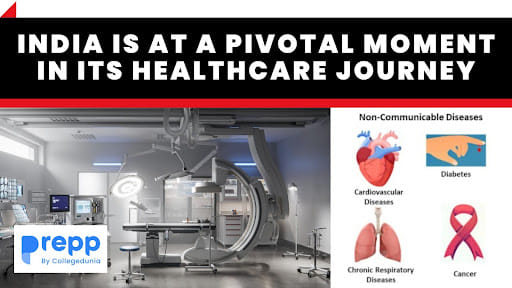
- Non-communicable diseases: India is considered to be the world’s diabetes capital with millions of its people also suffering from other lifestyle diseases hypertension and cholesterolemia.
- Youth: Indian youth are also increasingly at risk of heart attacks, cancer, respiratory issues, depression, etc.
- Economic challenge: By 2030, the non-communicable disease burden in the country could account for around $4 trillion which could adversely impact India’s development by imposing an ‘age tax’ on India’s demographic dividend.
Progress made by India in healthcare
- India has made significant strides in healthcare in order to achieve its ambition of becoming a global leader, guided by its ancient civilizational heritage and powered by the energy and ambition of its young population.
- Infant and maternal mortality: Infant mortality has improved four times since 1983.
- In the same period, maternal mortality has improved by seven times.
- Life expectancy: The average life expectancy of Indians has risen by 30% from 55 years to over 70 between 1983 and 2023.
- Infrastructure: India is now home to state-of-the-art healthcare infrastructure and clinical talent that is capable of delivering world-class clinical services at scale and cost-effectively.
- Specialized treatment: India’s clinical workforce consists of individuals with expertise in highly specialized areas such as organ transplants, cardiology, and oncology.
India as a medical travel hub
- As a result of this progress, India has become a popular destination for medical value travel (MVT).
- Significance: MVT is a significant opportunity for India due to its potential for growth.
- It can be a leading generator of employment opportunities for the youth.
- It is a significant source of foreign exchange for the country.
Factors
- Advanced Medical Technology: India has invested in the best-in-class medical technology and facilities making it a regional leader in diagnosis and treatment.
- Eg: The introduction of proton beam therapy for cancer treatment
- Minimally Invasive Techniques: Indian healthcare institutions are using minimally invasive and precise techniques that are attracting patients from foreign countries.
- Cost-Effectiveness: India provides healthcare services at competitive prices which makes it a viable destination for medical tourism, particularly for neighboring countries like Maldives.
- Cancer treatments in India are 65-90% cheaper in comparison to the USA, Europe, Australia, or even Singapore.
- Traditional medicine: Traditional forms of medicine in India such as ayurveda, yoga & naturopathy are popular among medical tourists for the treatment of various ailments and for wellness tourism.
How can AI improve healthcare services?
- Transformational impact: Artificial Intelligence is rapidly improving healthcare services worldwide.
- India’s vast pool of scientific talent and healthcare professionals makes it well suited to lead the AI-powered revolution of the health sector.
- Improved diagnostics: AI can make a significant impact in diagnostics, particularly by improving the accuracy and efficiency of medical diagnoses.
- This will help quicken diagnoses and lead to faster treatment decisions and better patient outcomes.
- Other capabilities: AI will also predict disease outbreaks, analyze healthcare data, optimize treatment plans by expediting healthcare procedures, and revolutionize drug discovery.
- This will help personalize and enhance healthcare services.
- Advancements: AI expenditure in India is expected to reach $11.78 billion by 2025 and add $1 trillion to India’s economy by 2035.
Way forward
- India must continue to invest in research and development, encourage collaborations between academia and industry, and create an innovation-fostering ecosystem.
- The healthcare industry and the government must coordinate to develop policies that will ensure that India can make the best use of its demographic dividend.
- This can be done in the form of awareness campaigns, encouraging regular and comprehensive health checkups, and advocating better lifestyle choices.
- The country’s healthcare model must be restructured to make it a global destination for medical value travel, and a leader in combating NCDs and implementing AI-driven healthcare solutions.
- India must prioritize community health, foster public-private partnerships, and invest in innovation and research.
Non-communicable diseases (NCDs)
|
(*Click this link to read prelims specific weekly current affairs articles)
FAQs
Question: What is medical tourism?
Answer:
Medical tourism or medical value travel (MVT) refers to the practice of traveling across international borders in pursuit of medical services, including elective or complex surgeries.
Question: What is artificial intelligence?
Answer:
AI or artificial intelligence is the ability of a computer, or robot controlled by a computer to perform tasks like thinking, perceiving, learning, problem-solving, and decision-making. These tasks are typically performed by humans due to the need for human intelligence and discernment.
UPSC Mains Practice Question:
|
MCQs
Question: Consider the following statements:
Statement-I: India's public sector health care system largely focuses on curative care with limited preventive, promotive, and rehabilitative care.
Statement-II: Under India's decentralized approach to healthcare delivery, the States are primarily responsible for organizing health services.
Which one of the following is correct in respect of the above statements?
(a) Both Statement-I and Statement-II are correct and Statement-II is the correct explanation for Statement-I
(b) Both Statement-I and Statement-II are correct and Statement-II is not the correct explanation for Statement-I
(c) Statement-I is correct but Statement-II is incorrect
(d) Statement-l is incorrect but Statement-If is correct
Answer: (b) See the Explanation
- According to the National Health Policy, 2017, India’s public sector health care system is focused on improving health status through coordinated policy action.
- It focuses on expanding and improving the quality of preventive, promotive, curative, palliative, and rehabilitative services through the public health sector. Hence statement 1 is correct.
- Under India’s decentralized healthcare system, the states are primarily in charge of organizing health services. Hence statement 2 is correct.
Therefore, option (b) is the correct answer.
Question: With the print state of development, Artificial Intelligence can effectively do which of the following?
- Bring down electricity consumption in industrial units
- Create meaningful short stories and songs
- Disease diagnosis
- Text-to-Speech Conversion
- Wireless transmission of electrical energy
Select the correct answer using the code given below:
(a) 1, 2, 3 and 5 only
(b) 1, 3 and 4 only
(c) 2, 4 and 5 only
(d) 1, 2, 3, 4 and 5
Answer: (d) See the Explanation
- AI or artificial intelligence is the ability of a computer, or robot controlled by a computer to perform tasks like thinking, perceiving, learning, problem-solving, and decision-making.
- It has applications in sectors such as healthcare, entertainment, finance, education, etc.
- AI has been used in disease diagnosis, the creation of songs, and short stories.
- It has also been used in Text-to-speech conversion and in the power industry to improve energy efficiency and machine-learning-assisted power transfer.
Therefore, option (d) is the correct answer.
Download the PREPP App and attempt FREE IAS Exam Mock Tests and get complete study material!

Full Test - 04: UPSC CSE Prelims CSAT (Paper-II)
Full Test - 03: UPSC CSE Prelims CSAT (Paper-II)
UPSC CSE Prelims 2026 GS Paper 1 Question Paper (24-May-2026)
UPSC CSE Prelims 2026 CSAT Paper 2 Question Paper (24-May-2026)

17 February 2025 | The Hindu Must Read Articles | Current Affairs

16 February 2026 | The Hindu Must Read Articles | Current Affairs

13 February 2026 | The Hindu Must Read Articles | Current Affairs









Comments