India-Middle East-Europe Corridor: The Way To A New World Order
(Source: Indian Express, 09/19/2023)
Click here for Daily Current Affairs
Why in the news?
- Recently, the Prime Minister of India, the President of the United States, the Chancellor of Germany, the Crown Prince of Saudi Arabia, the President of UAE, the Prime Minister of Italy, and the President of the EU unanimously agreed to establish the India-Middle East-Europe Economic Corridor (IMEC).
- The IMEC is designed to provide transport connectivity to accelerate the development and integration of Asia, the Arabian Gulf, and Europe.
Table of Contents
What is the India-Middle East Economic Corridor?
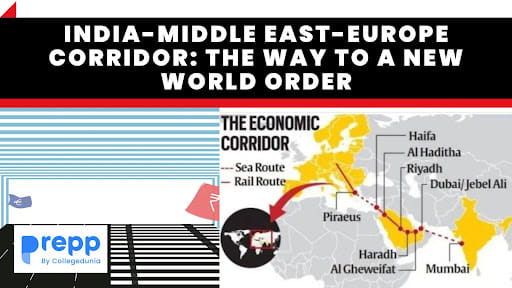
- The India-Middle East-Europe Economic Corridor (IMEC) is a reliable and cost-effective railway and ship-to-rail transit network that aims to supplement maritime and road routes.
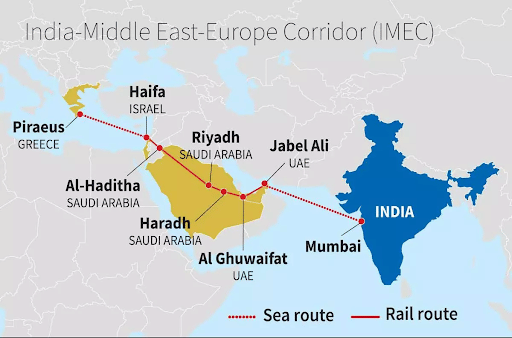
- It will enable the easier movement of goods and services between India and its partners - UAE, Saudi Arabia, Jordan, Israel, and the EU.
- Members: India, the U.S.A., Saudi Arabia, the U.A.E., France, Germany, Italy, and the EU.
- It is part of the Partnership for Global Infrastructure Investment (PGII) which was created by the G-7 as an alternative to the China-led Belt and Road Initiative (BRI).
- Components: It consists of two corridors:
- East Corridor: India to the Arabian Gulf
- West Corridor: Arabian Gulf to Europe
Why is it necessary?
- Improved trade: The IMEC will boost regional trade and connect Asia to Europe through a new regional route.
- Despite the region’s potential for boosting connectivity due to the shorter transit times, easier accessibility, and multimodal connectivity, it has not been previously tapped.
- Challenges with existing routes: Existing maritime corridors such as the Suez Canal and Mediterranean routes, face problems such as congestion, long transits, and higher logistics costs.
- Potential expansion: It can be expanded in the future to cover sectors such as energy pipelines and optical fiber links.
- Geopolitical shifts: It is an opportunity to strengthen Indian-West Asian ties, particularly with the UAE and Saudi Arabia.
- Infrastructure for peace: It could also help reduce tensions in the Arabian peninsula and encourage interregional connectivity.
How will it work?
- IMEC offers shorter routes by linking major ports of western India such as JNPT, Kochi, Kandla, and Mundra with major Gulf shipping ports like Jebel Ali, Fujairah, Ras Al-Khair, Dammam, Duqm, and Salalah.
- The cargo will then be transported via the Saudi rail network through Israel and Jordan.
- Haifa, a deep seaport, can handle bulk container trains to European ports in Greece, Italy, France, and Spain.
- The goods will then be transported across Europe via road container trailers or container cargo trains.
Land-bridging
- Rail links, terminals, and inland container depots have to be constructed at all major Gulf and Mediterranean ports for the transshipment of cargo from ship to rail and rail to ship.
- India with its well-integrated railroad network, mega ports, and highways is on the Eastern end the Western end consists of a well-developed and explored sea route across the Mediterranean to Europe, which also has excellent hinterland connectivity via rail and road.
- A uniform railway network on a standard gauge will help reduce logistics costs and improve the efficiency of operations.
- India can support the implementation of rail projects in the GCC, Jordan, and Israel through its rail PSUs such as IRCON, RITES, DFCC, RailTel, and CONCOR.
Hinterland connectivity
- The Gulf Cooperation Council is constructing a north-south coastal railway network to connect ports along Kuwait and Muscat which will have to be connected to the Saudi Arabian Rail network which runs heavy and long-haul trains in the region.
- In order to ensure the viability of the IMEC, the Saudi rail corridor must be extended to Haifa in Israel via Jordan by building critical infrastructure.
- At present, Jordan is planning a rail link connecting Amman to Beit She’an in Israel while Israel is planning to connect Haifa to Beit She’an.
Significance of the project
Global connectivity
- IMEC has been developed as a sustainable alternative to existing initiatives for global connectivity.
- It will offer an efficient alternative route to the Suez Canal for cargo ships and enhance connectivity, logistics, clean energy production, and economic cooperation in the region.
Improved access to West Asia
- The IMEC will eliminate Pakistan’s monopoly of the inland connectivity between India and West Asia, which has prevented India from improving its access to West Asia and Central Asia.
- It will also reduce India’s reliance on Iran’s Chahbahar port and the International North-South Transport Corridor (INSTC).
Geopolitical ties
- The participation of the EU, France, and Germany in the IMEC will help India improve its economic and diplomatic ties with European countries.
- IMEC also offers India an opportunity to participate in the Trans-African Corridor which has been proposed by the US and the EU.
- It will help enable India-U.S. convergence in West Asia and build upon achievements such as the I2U2.
Competitive trade
- According to the President of the European Commission, Ursula von der Leyen, trade between India and Europe will become 40% faster due to the IMEC.
- This will make Indian exports more competitive in the European market by reducing their costs due to lower logistic expenses.
Multilateral funding
- As member states have committed to implementing the project, it will be easier to obtain funding from multilateral stakeholders like the World Bank.
- The project also promises high returns on investments which will help obtain funding.
Green and sustainable growth
- Unlike other corridors, the IMEC also includes plans to lay electric cables and clean hydrogen pipelines as part of its efforts to reduce greenhouse emissions.
Regional integration
- IMEC could help integrate India, West Asia, and Europe enabling unprecedented levels of growth.
- It will also enable the growth of the regional economy and cement India’s position as a regional leader with technical leadership and forward-oriented strategies.
Challenges
- Lack of clarity: There is a lack of clarity over the official timelines for the project, its expected date of completion, and other details such as the use of existing railway and port infrastructure in West Asia.
- Non-biding nature: While the MoU of the IMEC does not provide any rights or obligations under international law, it only sets out non-binding political commitments for its participants.
- Finance: Large amounts of funds would be required to implement the project which could be affected by recession in advanced economies and the difficulty to mobilize hybrid capital.
- Chinese opposition: China is likely to oppose the project as it has already invested significantly in its BRI project., particularly in countries such as Iran, Saudi Arabia, and the UAE.
Conclusion
- The IMEC offers an opportunity for multilateral unity and economic growth through a shared plan of action developed by experts from the railway sector, ports and shipping, and communications sector.
- A comprehensive IMEC agreement can act as a catalyst for a new strategy of collective growth, globalization, and connectivity which reflects India’s message of Vasudhaiva Kutumbakam, which was the theme of its G-20 Presidency.
- The success of the IMEC could lead to similar regional and global cooperation initiatives for socio-economic development being implemented across the world.
(*Click this link to read prelims specific weekly current affairs articles)
FAQ
Question: What is the GCC?
Answer:
The Gulf Cooperation Council (GCC) is a political and economic alliance of six countries in the Arabian Peninsula - Bahrain, Kuwait, Oman, Qatar, Saudi Arabia, and the UAE. It was established in 1981 to promote economic, security, cultural, and social cooperation. It comprises six main bodies, the Supreme Council, the Ministerial Council, the Secretariat-General, the Consultative Commission, the Commission for the Settlement of Disputes, and the Secretary-General.
Question: What is the INSTC?
Answer:
The INSTC is a 7,200-kilometer Multi-Mode Transit System connecting ship, rail, and road routes between India, Iran, Azerbaijan, Russia, Central Asia, and Europe.
Members: Iran, Russia, India, Azerbaijan, Armenia, Kazakhstan, Kyrgyzstan, Tajikistan, Turkey, Ukraine, Syria, Belarus, and Oman. It consists of three corridors - Central, Western and Eastern.
UPSC Mains Practice Question:
|
MCQs
Question: Which of the following is not a member of ‘Gulf Cooperation Council’? (UPSC CSE 2016)
(a) Iran
(b) Saudi Arabia
(c) Oman
(d) Kuwait
Answer: (a) See the Explanation
- The GCC is a political and economic alliance of six Middle Eastern countries.
- Members: Saudi Arabia, Kuwait, the UAE, Qatar, Bahrain, and Oman.
- Iran is not a member of the GCC.
Therefore, option (a) is the correct answer.
Question: Belt and Road Initiative is sometimes mentioned in the news in the context of the affairs of (UPSC CSE 2016)]
(a) African Union
(b) Brazil
(c) European Union
(d) China
Answer: (d) See the Explanation
- The Belt and Road Initiative ( Belt and Road or One Belt, One Road) is a development strategy that has been proposed by Chinese President Xi Jinping.
- It is a transcontinental investment program that focuses on infrastructure development and economic integration of countries along the historic Silk Road.
Therefore, option (d) is the correct answer.
Download the PREPP App and attempt FREE IAS Exam Mock Tests and get complete study material!

Full Test - 04: UPSC CSE Prelims CSAT (Paper-II)
Full Test - 03: UPSC CSE Prelims CSAT (Paper-II)
UPSC CSE Prelims 2026 GS Paper 1 Question Paper (24-May-2026)
UPSC CSE Prelims 2026 CSAT Paper 2 Question Paper (24-May-2026)

17 February 2025 | The Hindu Must Read Articles | Current Affairs

16 February 2026 | The Hindu Must Read Articles | Current Affairs

13 February 2026 | The Hindu Must Read Articles | Current Affairs









Comments