Ozone Day 2023: Why The South Pole Has Set Alarm Bells Ringing This Year
Relevance: GS3 - Conservation, environmental pollution and degradation, environmental impact assessment GS1- Geographical features and their location-changes in critical geographical features (including water-bodies and ice-caps) and in flora and fauna and the effects of such changes.
(Source: Down To Earth, 09/16/2023)
Click here for Daily Current Affairs
Why in the news?
- Recently, the 2023 winter season for the Antarctic region ended with a record-low sea ice cover in August.
- This low ice cover coincided with the early opening of the ozone hole above the continent.
Table of Contents
Antarctic ice-cover trends in 2023
- General trend: Sea ice cover in Antarctica melts during the summer season between December and February and then returns to its original state during the winter.
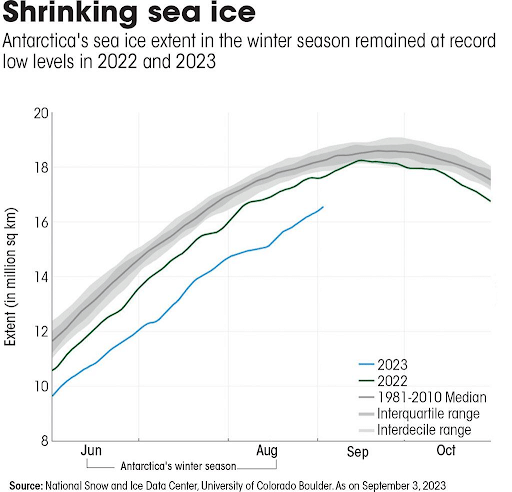
- In July 2023 during the peak of the Antarctic winter, the extent of sea ice extent was around 13.5 million sq km.
- According to the NASA Earth Observatory, this was the lowest level since 1978.
- As of August 2023, ice equivalent to the size of Greenland had not grown back.
- Although the ice surrounding Antarctica was increasing slightly over the long term (1% per decade) before 2014, it has declined sharply since then with record lows in 2017, 2022, and 2023.
Why has the ice not grown back?
- Scientists have termed this aa a five-sigma event, meaning that the low sea ice cover would have happened only once in 7.5 million years in the absence of the change in the climate.
- The formation and existence of ice in the region is the result of an interaction between the ocean and the atmosphere.
- However, global warming-induced changes to the ocean and atmosphere have led to a reduction in ice cover.
- Thermodynamical ice growth has dropped due to the fall in freeze potential which is the result of the rise in sea-surface and lower atmosphere temperatures.
- There is an increased southerly flow in the polar vortex over the Antarctic sea which has pushed more sea ice to the south.
- The current sea ice characteristics indicate that Antarctic sea ice is transitioning to a state of low overall ice cover and shorter durations.
- This transition has been attributed to global warming from anthropogenic causes.
Cascading impact
- The current trend of reduced sea ice cover will have a cascading effect on the atmospheric and oceanic systems.
- Sea ice melt: The sea absorbs more heat from the sun due to the low sea ice cover.
- This creates a feedback loop in which the absorbed heat increases the rate of ice melt.
- Bottom water: Less sea ice cover results in lowered production of Antarctic bottom water which is a critical element in the meridional overturning circulation and the oceanic ‘conveyor belt’, which renews water masses in the deep ocean.
- This circulation brings warmth to various parts of the globe and carries nutrients necessary to sustain ocean life.
- Antarctic bottom water is the coldest and densest water mass on the planet. It plays a crucial role in regulating the heat-storing and carbon-capture ability of the ocean.
- According to a study, bottom waters in the Wedell Sea have shrunk by 20% over the past 30 years, while shallower waters warmed five times quicker than the rest of the global ocean.
- Exchange of materials: The disruption of the cycle of melting and growth of sea ice has also affected the exchange of gases and other materials between the ocean and the atmosphere.
- E.g.: Ocean water absorbs more CO2 than sea ice, which is then stored as a briny solution.
- Lower sea ice cover also affects aerosol production which leads to a drop in cloud cover over the Southern Ocean which leads to an increase in the amount of solar energy impacting Earth.
- Ecosystem disruption: The lowered sea ice cover has affected the characteristics and viability of local species
- For example, four out of five emperor penguins displayed complete failure during the breeding season, as they spend more time on sea ice closer to the coastline (fast ice) to incubate their eggs and raise their chicks.
- Weddel seals also nurture their pups on fast ice due to its stability.
- The low sea ice cover also affects the primary production in the sea (krill, zooplankton, phytoplankton) which produces a knock-on effect on other dependent organisms.
Extreme Weather events
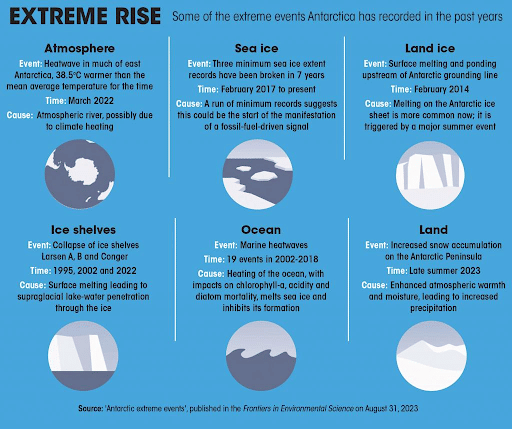
- As a result, of the lowered sea ice cover and rising temperatures in the recent past, Antarctica has been subject to the reoccurrence of extreme weather events in the atmosphere, ocean, cryosphere, and biosphere.
Heat events
- In March 2022, an extreme heat and later melting event was observed in east Antarctica with temperatures around 38.5°C above the yearly normal for the region.
- It was the largest recorded heat anomaly on the planet and was caused by an atmospheric river that brought warm and moist air from Australia to Antarctica.
- Other causes include the presence of high-pressure systems.
- In 2020 Antarctica experienced its highest temperature of 18.3°C and cyclonic events that reduced the sea ice cover.
Marine heatwaves
- Marine heatwaves are regions of the ocean with above-normal sea surface temperatures for extended periods.
- According to a paper published in the Frontiers in Environmental Science, marine heat waves in the Southern Ocean affect marine biodiversity, fisheries, and other marine industries.
- In the period between 2002 and 2018, 19 such events were recorded in Antarctica.
Mid-depth water
- In the Southern Ocean, ice melting due to warm mid-depth water also known as circumpolar deep water has been accentuated by changing atmospheric factors such as strong winds.
- Since 2009, major icebergs have been calved from 10 ice shelves across the continent.
- Ice shelf melting and other extreme internal events have affected the flow of ice on Antarctica’s land surface as observed in the Siple Coast ice stream in West Antarctica.
Melt-water
Melt-water formed due to atmospheric rivers, strong winds, rainfall, and cloud cover is also reducing the sea ice cover.
Antarctic ozone hole
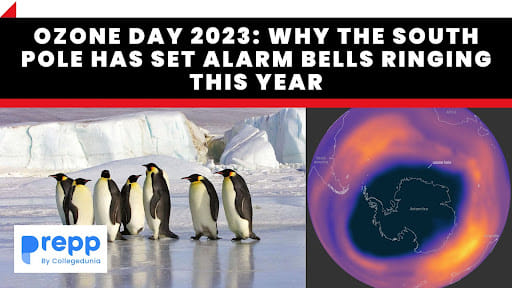
- The Antarctic ozone hole is an annual thinning of the ozone layer in the stratosphere.
- It generally begins to form at the end of September and peaks in October before closing in November or December each year.
How was it different this year?
- In 2023 however, the hole opened in August and had expanded to larger than usual by September.
- According to NASA, the ozone hole over Antarctica was 19.67 million sq km as of September 1st, 2023.
- Although the ozone hole is generally smaller during El Nino years the eruption of the Hunga-Tonga volcano in January 2022 could have caused the early opening of the ozone hole.
- As a result of the eruption, around 50 million tonnes of water vapor was injected into the stratosphere and reached the Antarctic stratosphere after the 2022 ozone hole ended.
- Impact of increased water vapor in the stratosphere:
- Faster ozone depletion due to the reaction of chlorofluorocarbons on the polar stratospheric clouds.
- It helps cool the Antarctic stratosphere and enhances the formation of polar stratospheric clouds which results in a stronger polar vortex.
Healing of the hole
- The hole in the ozone layer has been gradually healing since the Montreal Protocol (1987) which led to the phasing out of ozone-depleting chemicals like chlorofluorocarbons.
- According to the World Meteorological Organization, the entire world except the poles will recover from the ozone hole by 2040, with the poles recovering by 2066.
- However, between 2020 and 2022, there have been strong and persistent Antarctic stratospheric polar vortices with the largest and longest ozone holes.
(*Click this link to read prelims specific weekly current affairs articles)
FAQs
Question: What is the meridional overturning circulation?
Answer:
The meridional overturning circulation is an underwater phenomenon in which warm ocean water from the Equator travels to the North Atlantic and cold water flows back towards the Equator. This water then flows onto Antarctica, and then back to the Equator to become warm, thereby completing the loop. It brings warmth to various parts of the planet and carries nutrients necessary to sustain ocean life.
Question: What is the polar vortex?
Answer:
It is a large area of low pressure and cold air surrounding both of the Earth’s poles.
UPSC Mains Practice Question:
|
MCQs
Question: On planet Earth, most of the freshwater exists as ice caps and glaciers. Out of the remaining freshwater, the largest proportion (UPSC CSE 2013)
(a) is found in the atmosphere as moisture and clouds
(b) is found in freshwater lakes and rivers
(c) exists as groundwater
(d) exists as soil moisture
Answer: (c) See the Explanation
- Freshwater resources in descending order: Ice Caps and Glaciers > Groundwater > Lakes > Soil Moisture > Atmosphere > Streams and rivers > Biosphere.
Therefore, option (c) is the correct answer.
Question: Consider the following statements : (UPSC CSE 2010)
- On the planet Earth, the fresh water available for use amounts to about less than 1% of the total water found.
- Of the total freshwater found on the planet Earth 95% is bound up in polar ice caps and glaciers.
Which of the statements given above is/are correct?
(a) 1 only
(b) 2 only
(c) Both 1 and 2
(d) Neither 1 nor 2
Answer: (a) See the Explanation
- Approximately 99-99.2% of the world’s water is found in saline water, glaciers, and ice.
- This means that the total freshwater available for use on Earth amounts to less than 1% of the total water available. Hence statement 1 is correct.
- Ice caps and glaciers account for around 68.7% of Earth’s total freshwater. Hence statement 2 is incorrect.
Therefore, option (a) is the correct answer.
Download the PREPP App and attempt FREE IAS Exam Mock Tests and get complete study material!

Full Test - 04: UPSC CSE Prelims CSAT (Paper-II)
Full Test - 03: UPSC CSE Prelims CSAT (Paper-II)
UPSC CSE Prelims 2026 GS Paper 1 Question Paper (24-May-2026)
UPSC CSE Prelims 2026 CSAT Paper 2 Question Paper (24-May-2026)

17 February 2025 | The Hindu Must Read Articles | Current Affairs

16 February 2026 | The Hindu Must Read Articles | Current Affairs

13 February 2026 | The Hindu Must Read Articles | Current Affairs









Comments