Why Is 2023 So Hot? A Rare Pacific Volcano Is Among The Suspects
Relevance: GS1 - Important Geophysical phenomena such as earthquakes, Tsunami, Volcanic activity, cyclone etc. GS3 - Conservation, environmental pollution and degradation
(Source: Indian Express, 09/15/2023)
Click here for Daily Current Affairs
Why in the news?
- Recently, scientists claimed that an underwater volcanic eruption off Tonga in the South Pacific in January 2022 could be the major reason for 2023 being such a hot year.
- The June-August 2023 period was the warmest on record worldwide with heat waves occurring across the world.
Table of Contents
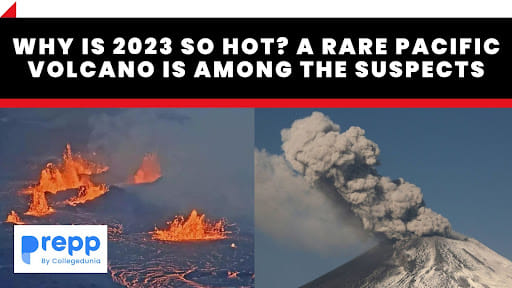
What is the reason for 2023 being a hot year?
- According to climate science researchers at Maynooth University, Ireland, an underwater volcanic eruption in the South Pacific Ocean was majorly responsible for the record temperatures experienced by the world in 2023.
- In January 2022, the Hunga Tonga-Hunga Ha'apai erupted, releasing the equivalent of 60,000 Olympic swimming pools of water into the stratosphere.
- This was equivalent to more than 150 million tonnes of water vapor, i.e. nearly 10% of the 1.4 billion tonnes typically found in the stratosphere.
- The erupted water in the form of water vapor trapped heat in the atmosphere resulting in an increase in temperature.
- The water plume will last in the atmosphere for up to around eight years.
- The eruption also released around 500,000 tonnes of sulfur dioxide into the stratosphere.
- Although sulfur dioxide tends to cool the planet, the mix of water and sulfur released by the eruption complicated the situation.
- The eruption altered atmospheric pressure and briefly helped clear out the fog in Seattle, U.S.A.
- According to a study by the Nature Journal, global temperatures were at risk of breaching 1.5°C in at least one of the next five years.
- Experts claimed that Hunga Tonga-Hunga Ha'apai is the first observed volcano that may warm rather than cool the surface.
Role of water vapor in global warming
|
Role of volcanoes in global warming
According to scientists, more research about the effect of volcanic eruptions on long-term global warming trends.
Cooling effect
- Usually, the eruption of land-based volcanoes results in a temporary dimming of sunshine due to the spread of ash until it falls back onto the earth.
- Therefore, the eruption of volcanoes usually results in a cooling effect.
- E.g.: Pinatubo in the Philippines (1991) cut average global temperatures by about 0.5°C (0.9°F) for more than a year.
- Over the past 2,500 years, sun-dimming eruptions have occurred at the rate of twice each century according to the U.N.'s Intergovernmental Panel on Climate Change (IPCC).
- Tambora in Indonesia (1815) led to a "year without a summer" and subsequently affected agricultural harvests across the world.
- The Samalas in Indonesia (1257) caused famines and are believed to be one of the primary causes of the Little Ice Age, a period of unusually cool weather that lasted until the 19th century.
- There is a lack of information on how many volcanoes are located in shallow water and earlier eruptions similar to the 2022 eruption.
- Volcanoes in shallow water can deposit erupted material in the atmosphere.
- E.g.: Before its eruption, the Hunga Tonga-Hunga Ha'apai was about 150 meters below sea level.
- The IPCC has predicted that at least one Pinatubo-style eruption is likely to occur this century.
- However, volcanoes have had a negligible effect on the overall trend of global warming which is driven by human emissions of greenhouse gas since the Industrial Revolution.
Impact
- Eruptions are likely to become more frequent in icy areas as a result of climate change.
- Previously the weight of thick glaciers had kept a lid on the volcanoes, which could melt as a result of climate change-induced-thaw, leading to eruptions.
- At the end of the last Ice Age (12,000 years ago) in Iceland, the eruption rate was nearly 100 times higher than the present rate.
- Increased rainfall caused by climate change could cause erosion on the sides of volcanoes.
- Eg: In 2018, the flanks of the Kilauea volcano in Hawaii were weakened by unusually heavy rain caused by climate change.
- Volcanic eruptions aid in the formation of new rock on the Earth’s surface.
- Atmospheric circulation patterns help eruptions in the tropics have an effect on the climate in both hemispheres by spreading the dust and pollutants erupted by the volcanoes.
Climate change control activity based on volcanoes
- It is necessary to conduct more research on the impacts of volcanoes as volcanic activity is irregular, unpredictable, and uncontrollable.
- It would be a major challenge if several Pinatubo-style eruptions were to take place in addition to the existing threat posed by climate change.
Volcano-inspired geoengineering
- Methods to cool the planet developed by geoengineers have been inspired by volcanic eruptions.
- This includes the deliberate dimming of sunshine as a shortcut by creating a Pinatubo-like haze which can be maintained throughout the year via a fleet of special planes spraying sulfur into the stratosphere.
- In 2022, the U.S. start-up, Make Sunsets, began launching balloons into the stratosphere carrying sulphur dioxide.
- It also sells "cooling credits" at the rate of $10 per gram of sulfur which will offset the warming effect of one tonne of CO2 for a year.
- However, CO2 can exist in the atmosphere for more than hundreds of years.
- Geoengineering has been criticized for its potential to disrupt weather patterns.
- This could also enable countries to avoid making the necessary deep cuts in emissions.
Tonga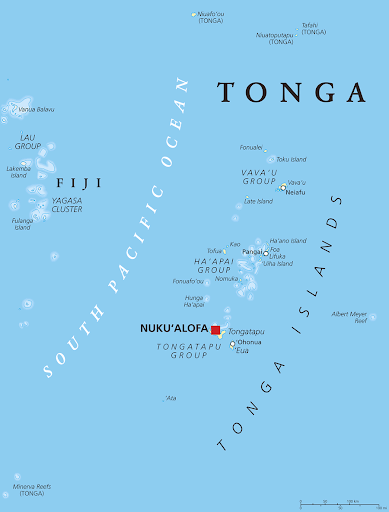
|
(*Click this link to read prelims specific weekly current affairs articles)
FAQs
Question: What are volcanoes?
Answer:
A volcano is an opening in the earth’s surface that allows magma, volcanic ash, and gases to escape. It could lead to earthquakes, landslides, lahars (mudflows), ash, and thunderstorms. The major types of volcanoes are shield volcanoes, composite volcanoes, caldera, mid-ocean ridge volcanoes, and flood basalt province volcanoes.
Question: What is the greenhouse effect?
Answer:
Greenhouse gases refer to gases that absorb infrared radiation and trap the heat in the atmosphere. They are named so as they replicate the effect observed in greenhouses. Examples of greenhouse gases include water vapor, carbon dioxide, methane, nitrous oxide, ozone, etc.
UPSC Mains Practice Question:
|
MCQs
Question: Which of the following add/adds carbon dioxide to the carbon cycle on the planet Earth?
- Volcanic action
- Respiration
- Photosynthesis
- Decay of organic matter
Select the correct answer using the code given below. (UPSC CSE 2014)
(a) 1 and 3 only
(b) 2 only
(c) 1, 2, and 4 only
(d) 1, 2,3 and 4
Answer: (c) See the Explanation
- Volcanic activity releases carbon dioxide, sulfur dioxide, water vapor, dust, and other pollutants into the atmosphere. Hence statement 1 is correct.
- In respiration, oxygen is taken in and carbon dioxide is released. Hence statement 2 is correct.
- Photosynthesis is the process in which plants take up carbon dioxide and release oxygen. Hence statement 3 is incorrect.
- One of the most important products released in the decomposition process is carbon dioxide. Hence statement 4 is correct.
Therefore, option (c) is the correct answer.
Question: Consider the following pairs:
- Electromagnetic radiation
- Geothermal energy
- Gravitational force
- Plate movements
- Rotation of the earth
- Revolution of the earth
Which of the above is/are responsible for bringing dynamic changes on the surface of the earth? (UPSC CSE 2013)
(a) 1, 2, 3 and 4 only
(b) 1, 3, 5 and 6 only
(c) 2, 4, 5, and 6 only
(d) 1, 2, 3, 4, 5 and 6
Answer: (d) See the Explanation
- Electromagnetic radiation results in changes in microwaves, wavelengths of radio, UV rays, infrared rays, X-rays, and gamma rays. Hence statement 1 is correct.
- Geothermal energy is the heat received from the earth’s core. This heat continuously flows outward and transfers to the surrounding layers of rock. When temperature and pressure become very high, it comes out as lava or heat up the nearby rocks and water which comes out as hot springs or geysers. Hence statement 2 is correct.
- The Gravitational force is constantly working on all physical bodies, giving objects weight and causing them to fall when dropped. Hence statement 3 is correct.
- Tectonic movement is a dynamic change on the surface of the earth that is involved in the formation of volcanoes, earthquakes, climate change, and evolution. Hence statement 4 is correct.
- Rotation is responsible for day and night, while revolution is responsible for seasons and the change in the length of day and night. Hence statements 5 and 6 are correct.
Therefore, option (d) is the correct answer.
Download the PREPP App and attempt FREE IAS Exam Mock Tests and get complete study material!

Full Test - 04: UPSC CSE Prelims CSAT (Paper-II)
Full Test - 03: UPSC CSE Prelims CSAT (Paper-II)
UPSC CSE Prelims 2026 GS Paper 1 Question Paper (24-May-2026)
UPSC CSE Prelims 2026 CSAT Paper 2 Question Paper (24-May-2026)

17 February 2025 | The Hindu Must Read Articles | Current Affairs

16 February 2026 | The Hindu Must Read Articles | Current Affairs

13 February 2026 | The Hindu Must Read Articles | Current Affairs









Comments