In A Limbo – Story Of The Mega Refinery Project India, Saudi Arabia Want To Resuscitate
Relevance: GS2 - Bilateral, regional and global groupings and agreements involving India and/or affecting India’s interests. Effect of policies and politics of developed and developing countries on India’s interests, Indian diaspora. GS3 - Infrastructure: Energy, Effects of liberalization on the economy, changes in industrial policy and their effects on industrial growth.
(Source: Indian Express, 09/15/2023)
Click here for Daily Current Affairs
Why in the news?
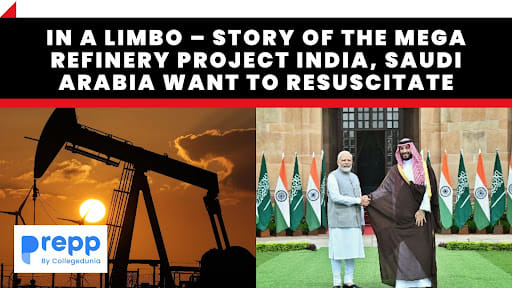
Recently, India and Saudi Arabia decided to enhance efforts to implement the West Coast Mega Refinery project during the visit of the Saudi Crown Prince and Prime Minister Mohammed bin Salman’s state visit to India.
Table of Contents
What is the West Coast Mega Refinery Project?
- The project concerns the construction of a mega oil refinery and petrochemicals facility with a 60-million-tonnes-per-annum (60 mtpa) capacity in the Konkan belt in Maharashtra.
- The project was first proposed in 2015 by India’s public sector refiners to build one of the world’s largest refining complexes with the participation of Saudi Arabia, and the United Arab Emirates.
- The Maharashtra state government recommended Barsu in Ratnagiri district as the new site for the project after previous sites were opposed by locals over environmental concerns.
- IOC, BPCL, and HPCL have incorporated a joint venture — Ratnagiri Refinery & Petrochemicals (RRPCL) — to implement the project.
- The project was initially estimated to cost around ₹3 lakh crores.
Implementation
- Both countries supported the early implementation of the project in the form of trilateral cooperation between Aramco, ADNOC (Abu Dhabi National Oil Company), and the Indian companies.
- $50 billion has already been earmarked for the implementation of the project.
- In April 2018, Aramco signed a preliminary agreement with the Indian Oil Corporation (IOC), Bharat Petroleum Corporation (BPCL), and Hindustan Petroleum Corporation (HPCL) to build the refinery.
- In June 2018, ADNOC joined the project.
- As per the framework agreement, Aramco and ADNOC were to take a 50% stake in RRPCL, while IOC, BPCL, and HPCL would together own 50% of the company.
- The foreign partners have so far not picked up any stake in RRPCL, and IOC continues to own 50% of the joint venture, while BPCL and HPCL have a 25% stake apiece.
- However, it is still unclear if and when the refinery is expected to be up and running.
What is the significance of the project?
Demand for petroleum products:
- India is the world’s third-largest consumer of crude oil with demand for petroleum fuels, products, and petrochemicals expected to grow substantially.
- India is a key driver of global oil demand and is predicted to overtake China as the largest driver of demand.
Global refining hub
- Indian refiners are planning to increase refining and petrochemicals capacity to meet the increasing demand.
- As part of its medium- to long-term refining capacity expansion strategy, India aims to increase its refining capacity from 250 mtpa to 450 mtpa.
- The West Coast project is the single largest proposed greenfield refinery project in the country and will help India become a global refining hub and enhance petroleum product and petrochemical exports.
For Saudi and UAE
- The project offers Aramco and ADNOC an opportunity to tap the Indian petroleum market, which is one of the largest and fastest growing in the world.
- The companies can increase diversification, expand their global footprint, mitigate risk in the form of investments in downstream petroleum segments, and reduce reliance on the upstream segment.
- Aramco and ADNOC are among the top suppliers to India, which depends on imports to meet over 85% of its crude oil requirements.
- It reflects the partnership between India, Saudi Arabia, and the UAE in the energy sector.
Why is the project stuck?
- In 2015, Maharashtra was awarded the project after strong competition with Gujarat, and Tamil Nadu.
- However, locals strongly opposed the project and refused to give up their land.
- Environmental: The project was estimated to require around 15,000 acres of land across 17 villages.
- The locals were concerned about the pollution and damage the region could suffer from the mega oil refinery, especially to the farmers of Alphonso mangos and cashews, and local fishermen.
- Political: The Konkan region is a significant part of Maharashtrian politics and the choice of site for the project was based on the political considerations of the parties in the region.
- Support for the project: Some locals have expressed their support for the project as it is likely to lead to the development of the region and the generation of employment opportunities.
Way forward
- The government-to-government level commitments regarding the project have enthused supporters.
- In Maharashtra: The government and oil companies should identify an alternative coastal site within Maharashtra.
- Alternate state: Another option would be to consider another western coastal state for the project, given the need for maritime proximity to West Asia on account of the participation of Aramco and ADNOC.
- Splitting the refinery: Another option is to split the proposed 60-mtpa refinery into three to four separate refineries of 15-20 mtpa each.
- So far, the proposal to establish one mega refinery has prevailed given that it is more scalable and efficient in comparison to multiple smaller units.
Conclusion
- Petroleum and petrochemical products will remain a critical industry despite the growth in electric mobility and renewable energy sectors.
- Therefore, India and its West Asian partners must take steps to implement the project efficiently and without delays.
To learn more about oil refineries in India, click the link.
(*Click this link to read prelims specific weekly current affairs articles)
FAQs
Question: What are oil refineries?
Answer:
Oil refineries are sites that transform and refine petroleum or crude oil into useful products like petrol, diesel fuel, asphalt base, fuel oils, heating oil, kerosene, LPG, and petroleum naphtha.
Question: What is renewable energy?
Answer:
Renewable energy refers to energy that is generated from naturally replenished resources. It includes solar energy, geothermal heat, wind, tides, water, and biomass. It is not easily depleted, is constantly replenished, and is a viable source of clean and locally-available energy.
UPSC Mains Practice Question:
|
MCQs
Question: Recently with which country government did ONGC Mittal Energy Limited (OMEL) sign a joint-venture deal of $6 billion dealing with infrastructure, refinery, and power? (UPSC CSE 2006)
(a) Colombia
(b) Venezuela
(c) Nigeria
(d) Saudi Arabia
Answer: (c) See the Explanation
In 2005, ONGC Mittal Energy Ltd (OMEL), the joint venture between Oil and Natural Gas Corporation and L. N. Mittal Group, signed an MoU with the Nigerian Government for long-term infrastructure investments in exchange for drilling rights in that country.
Therefore, option (c) is the correct answer.
Question: Consider the following statements:
- The Petroleum and Natural Gas Regulatory Board (PNGRB) is the first regulatory body set up by the Government of India.
- One of the tasks of PNGRB is to ensure competitive markets for gas.
- Appeals against the decisions of PNGRB go before the Appellate Tribunals of Electricity.
Which of the statements given above is/are correct? (UPSC CSE 2006)
(a) 1 and 2 only
(b) 2 and 3 only
(c) 1 and 3 only
(d) 1, 2 and 3
Answer: (b) See the Explanation
- The Petroleum and Natural Gas Regulatory Board (PNGRB) was constituted under the Petroleum and Natural Gas Regulatory Board Act, 2006.
- However, the Telecom Regulatory Authority of India (TRAI) which was set up under the TRAI Act of 1997 was the first independent regulator in India. Hence, statement 1 is incorrect.
- The PNGRB is mandated with the protection of the interests of consumers and entities engaged in activities related to petroleum, petroleum products, and natural gas and to promote competitive markets. Hence, statement 2 is correct.
- The Appellate Tribunal established under Section 110 of the Electricity Act, 2003 (Central Act 36 of 2003) is the Appellate Tribunal to appeal against the decisions of the PNGRB. Hence, statement 3 is correct.
Therefore, option (b) is the correct answer.
Download the PREPP App and attempt FREE IAS Exam Mock Tests and get complete study material!
Live Test : UPSC IAS : GS - Modern History - Subject Knowledge Test

Live Test : UPSC CSE Prelims CSAT (Paper-II) (Oct 14 - 17)
Full Test - 04: UPSC CSE Prelims CSAT (Paper-II)
Full Test - 03: UPSC CSE Prelims CSAT (Paper-II)
UPSC CSE Prelims 2026 GS Paper 1 Question Paper (24-May-2026)
UPSC CSE Prelims 2026 CSAT Paper 2 Question Paper (24-May-2026)

17 February 2025 | The Hindu Must Read Articles | Current Affairs

16 February 2026 | The Hindu Must Read Articles | Current Affairs

13 February 2026 | The Hindu Must Read Articles | Current Affairs









Comments