Oil Refineries in India - Geography Notes
In 2019, India's crude oil reserves were estimated to be around 620 million tonnes, with most of it located offshore in the Arabian Sea and onshore in Assam and Rajasthan. Around 75% of India's total oil consumption is imported. The oil refinery in Jamnagar (Gujarat) is the world's fifth-largest, while RPL's new refinery, the world's sixth-largest and also in Jamnagar, was commissioned in 2008. Indian Oil, the country's second-largest oil refinery, is ranked 19th in the world. In 2018-19, India produced 34.2 million tonnes of crude oil. This article will explain to you about Oil Refineries which will be helpful in preparing for Geography for the UPSC Civil service exam.
| To Read update on this topic: |
What are Oil Refineries?
- Petroleum (crude oil) is transformed and refined into useful products such as gasoline (petrol), diesel fuel, asphalt base, fuel oils, heating oil, kerosene, liquefied petroleum gas, and petroleum naphtha at an oil refinery or petroleum refinery.
- Chinese civilizations were among the first to refine oil.
- Oil refineries are typically large, sprawling industrial complexes with extensive piping running through them, transporting fluid streams between large chemical processing units like distillation columns.
- Oil refineries are similar to chemical plants in that they use a lot of the same technology.
Offshore And Onshore Drilling
- Oil is discovered beneath the earth's surface, and the location is sometimes also underwater.
- Though extracting oil from beneath the ocean's surface is much more difficult than drilling wells on land, it is still profitable, which is why oil exploration is carried out on either floating or fixed platforms on the ocean's bed.
- Offshore drilling is the process of extracting oil from beneath the seabed, whereas onshore drilling is the process of extracting oil from beneath the earth's surface away from the ocean.
- Onshore and offshore drilling is not only used for oil extraction; it is also used for natural gas extraction at times.
Oil Refinery in India
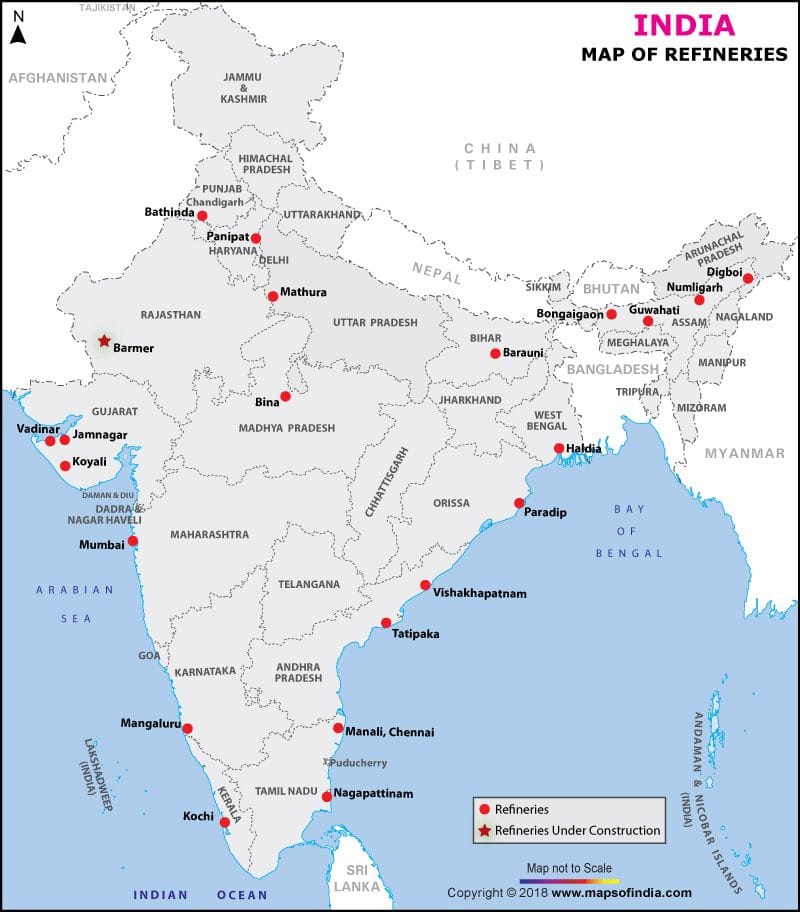
- The oil and gas industry is dominated by public sector companies in India.
- Several private sector companies, including RIL, RPL, and Nayara Energy, are heavily investing in the oil and gas industry. RIL's current 34 MMTPA capacity.
- Offshore fields produced 16.9 million tonnes, while onshore fields produced 17.3 million tonnes.
- With a drop in domestic oil production, India's reliance on imported oil, valued at around USD 112 billion, increased to nearly 84 percent in 2018-19.
- Overall oil consumption increased to 212 MMT in the same year, making India the world's third-largest oil consumer after the United States and the People's Republic of China.
- Assam and Gujarat are the primary producers of onshore oil.
- In 2009, RIL and RPL announced a merger, making the combined company the world's thirteenth largest oil refiner.
- India exported over 59 MMT of petroleum products worth $1.96 trillion (approximately USD $312 billion in 2015), making it one of the world's largest refined oil exporters.
- In 2018-19, India's oil refining capacity was 249 MMTPA (Million Metric Tonne Per Annum), placing it fourth in the world behind the United States, China, and Russia.
The extent of Oil Bearing Strata in India
- Sedimentary rocks cover 1 lakh square kilometres or 42% of India.
- Marine basins from the Mesozoic and Tertiary periods cover 10 lakh square kilometres.
- The total continental shelf of potentially oil-bearing rocks is 2 lakh square kilometres.
- There are 27 basins in total, including both onshore and offshore sedimentary areas.
- The most productive areas are Mumbai High, the Khambhat Gulf, and Assam.
On-shore Oil Production In India
- Brahmaputra valley of north-east India.
- Barmer area of Rajasthan.
- Gujarat coast in western India.
- Cauvery on-shore basin in Tamil Nadu.
- Andhra Pradesh has both on-shore and offshore oil reserves.
Assam Oil Fields
- India's oldest oil-producing state
- The main oil-bearing strata in upper Assam stretch for 320 kilometres along the Brahmaputra valley.
- Assam's oil fields are relatively inaccessible and are located far from the main consumption areas.
- Assamese oil is refined primarily in the refineries of Digboi, Guwahati, Bongaigaon, and Barauni.
Gujarat Oil Fields
- This region's oil fields include Ankleshwar, Khambhat or Lunej, Ahmedabad and Kalol, Nawgam, Kosamba, Kathana, Barkol, Mahesana, and Sanand.
- Ankleshwar: Oil from this field is sent to Trombay and Koyali refineries.
Rajasthan Oil Fields
- In Rajasthan's Banner district, one of the largest inland oil discoveries was made.
- Mangala oil field, Sarswati, and Rajeshwari are three other significant discoveries.
- Rajasthan is India's largest oil-producing state on land.
Off-shore Oil Production In India
Western Coast
- Mumbai High, Bassein, and Aliabet are three main areas in Mumbai where oil is produced.
- Mumbai High: 1974; Miocene-era rock strata.
- Bassein, Sagar Samrat: south of Mumbai High.
- Aliabet, a small island off the coast of Khambhat in the Gulf of Khambhat.
Eastern Coast
- The Godawari, Krishna, and Cauvery rivers' basins and delta regions have a lot of potential for oil and gas production.
- The Rawa field, located in the Krishna- Godavari off-shore basin, is significant.
- The Cauvery on-shore basin's Narimanam and Kovilappal oil fields are also significant.
List of Major Oil Refineries
| Refinery | Sector | State |
|---|---|---|
| Jamnagar Refinery | Private | Gujarat |
| Vadinar Refinery | Private | Gujarat |
| Kochi Refinery | Public | Kerala |
| Mangalore Refinery | Public | Karnataka |
| Paradip Refinery | Public | Odisha |
| Panipat Refinery | Public | Haryana |
| Gujarat Refinery | Public | Gujarat |
| Mumbai Refinery | Public | Maharashtra |
| Manali Refinery | Public | Tamil Nadu |
| Visakhapatnam Refinery | Public | Andhra Pradesh |
| Nagapattinam Refinery | Public | Tamil Nadu |
| Digboi Refinery | Public | Assam |
Areas of Possibility
- There are numerous opportunities to find oil in the country's sedimentary rocks, which cover an area of about one lakh square kilometres.
- Jawalamukhi, Nurpur, Dharamsala, and Bilaspur in Himachal Pradesh are some of the outstanding areas with oil potential.
- Other potential areas include
- Punjab's Ludhiana, Hoshiarpur, and Dasua
- The Gulf of Mannar, off the coast of Tirunelveli.
- Between Point Calimere and the Jaffna Peninsula- an off-shore area.
- An off-shore deepwater area in the Bay of Bengal.
- The Mahanadi, Godavari, Krishna, and Cauvery rivers' marine delta region.
- The sea between the coasts of South Bengal and Baleshwar.
- The Andaman and Nicobar Islands' off-shore area.
Significance
- Oil production is a major source of energy, employment, and tax revenue for the government.
- Oil plays a large and important role in the current structure of our society.
- Oil is much more than just one of the world's most important energy sources.
- Petroleum products, in addition to being an important source of energy, are also used as a feedstock for a variety of consumer goods, giving them a growing and important role in people's lives.
Drawbacks
- The oil industry poses a significant risk to the environment, and it may have an impact on it at multiple levels: air, water, soil, and, as a result, all living beings on our planet.
- Pollution is the most common and dangerous consequence of oil and gas industry activities in this context.
- Pollution is linked to almost every activity in the oil and gas industry, from exploration to refining.
- Wastewaters, gas emissions, solid waste, and aerosols produced during drilling, production, refining (the source of the most pollution), and transportation total over 800 different chemicals, with oil and petroleum products dominating.
- Other environmental effects include increased greenhouse gas emissions, acid rain, poorer water quality, and groundwater contamination, to name a few.
- The oil and gas industry may also contribute to the loss of biodiversity and the destruction of ecosystems that are unique in some cases.
Oil Refinery And Safety
- The refining process releases a variety of chemicals into the atmosphere (see AP 42 Compilation of Air Pollutant Emission Factors), and refineries usually emit a distinct odour.
- Aside from air pollution, there are concerns about wastewater, industrial accident risks such as fire and explosion, and noise health effects from industrial noise.
- Working in an oil refinery can be hazardous at times. In 2005, for example, an accident occurred at BP's Texas City oil refinery.
- A series of explosions occurred during the restarting of a hydrocarbon isomerization unit, according to the US Chemical Safety Board.
- A total of fifteen workers were killed, with another 180 injured.
Conclusion
The oil ministry panel stated that the country's refining capacity would increase by 80% to 439 million tonnes per year by 2030, up from 245 million tonnes at the time. By 2020, the refining capacity was expected to be 259 million tonnes, and by 2025, it would be 415 million tonnes.
|
|
|
|---|---|
| Geography Notes | Major Mineral Belts of India |
| Mineral Resources of India | Conservation of Mineral Resources National Mineral Policy, 2019 |
| Conventional Energy in India | Non-Conventional Energy Resources in India |
| Natural Resources in India | Problems related to mining |
| Major Industrial Regions of the World | Energy Resources in India |
FAQs
Question: What is an oil refinery?
Answer: An oil refinery is an industrial facility where crude oil is processed and refined into useful products such as gasoline, diesel, kerosene, jet fuel, and other petrochemical products. The refining process involves the separation of hydrocarbons through distillation, cracking, and other chemical processes to produce various end products.
Question: How does the location of oil refineries impact the environment?
Answer: The location of oil refineries can have significant environmental impacts due to the release of pollutants such as sulfur dioxide, nitrogen oxides, and volatile organic compounds. Refineries located near coastal areas or in regions with high biodiversity may cause air and water pollution, affecting ecosystems and local communities.
Question: What are the main products derived from oil refining?
Answer: The main products derived from oil refining include gasoline, diesel, jet fuel, kerosene, liquefied petroleum gas (LPG), lubricants, and petrochemical feedstocks. These products are used for transportation, heating, industrial processes, and the production of plastics and chemicals.
Question: What is the difference between upstream and downstream oil activities?
Answer: Upstream oil activities involve the exploration and extraction of crude oil from the earth, while downstream oil activities refer to the refining, processing, and distribution of oil products. Refineries are a key part of the downstream sector, turning crude oil into marketable products.
Question: How does the global demand for oil affect refinery operations?
Answer: Global demand for oil directly impacts refinery operations. High demand increases refinery throughput, leading to greater production of refined products. Conversely, a drop in demand can reduce refinery operations and lead to lower utilization rates, impacting the profitability of refineries.
MCQs
1. Which of the following is NOT a product of oil refining?
A) Gasoline
B) Diesel
C) Natural Gas
D) Jet Fuel
Answer: C See the Explanation
Explanation: Natural gas is not a product of oil refining. It is extracted directly from underground reservoirs, while gasoline, diesel, and jet fuel are products derived from the refining of crude oil.
2. What process is primarily used to separate hydrocarbons in an oil refinery?
A) Cracking
B) Distillation
C) Polymerization
D) Refining
Answer: B See the Explanation
Explanation: The primary process used to separate hydrocarbons in an oil refinery is distillation. This involves heating crude oil and separating its components based on their different boiling points.
3. Which sector does oil refining belong to?
A) Upstream
B) Midstream
C) Downstream
D) Exploration
Answer: C See the Explanation
Explanation: Oil refining belongs to the downstream sector of the oil and gas industry, which involves the processing and distribution of products derived from crude oil. The upstream sector focuses on exploration and production, while the midstream sector handles transportation and storage.
4. What environmental concern is most commonly associated with oil refineries?
A) Deforestation
B) Air and water pollution
C) Soil erosion
D) Overfishing
Answer: B See the Explanation
Explanation: Air and water pollution are the most common environmental concerns associated with oil refineries. Refineries emit pollutants like sulfur dioxide, nitrogen oxides, and volatile organic compounds, which can harm the environment and human health.
5. What is the key difference between upstream and downstream oil activities?
A) Upstream involves refining oil
B) Downstream involves exploration
C) Upstream focuses on extraction, while downstream focuses on refining and distribution
D) Downstream focuses on exploration and production
Answer: C See the Explanation
Explanation: The upstream sector focuses on the exploration and extraction of crude oil, while the downstream sector is concerned with refining, processing, and distributing oil products.
GS Mains Questions and Answers
Q1: Explain the significance of oil refineries in the global energy supply chain and the factors influencing their location.
Answer: Oil refineries play a critical role in the global energy supply chain by processing crude oil into essential products such as gasoline, diesel, jet fuel, and petrochemicals. These refined products are crucial for transportation, industry, and domestic use, making refineries indispensable in meeting global energy demands.
The location of oil refineries is influenced by several factors, including proximity to oil fields, transportation infrastructure, availability of skilled labor, and environmental regulations. Refineries are often located near coastal areas to facilitate easy import and export of crude oil and refined products. Environmental concerns and regulations also play a role in determining refinery locations, as pollution control measures are essential to minimize the environmental impact of refining operations.
Q2: Discuss the environmental challenges posed by oil refineries and the measures that can be taken to mitigate their impact.
Answer: Oil refineries pose significant environmental challenges, including air and water pollution, greenhouse gas emissions, and waste generation. Pollutants such as sulfur dioxide, nitrogen oxides, and volatile organic compounds are released into the atmosphere, contributing to air quality degradation and climate change. Water pollution from refinery effluents can harm aquatic ecosystems, while waste products such as sludge pose disposal challenges.
To mitigate these impacts, refineries can adopt cleaner technologies, such as using low-sulfur crude oil, improving energy efficiency, and employing advanced pollution control systems like scrubbers and filters. Regulations and environmental policies, such as emissions standards and waste management protocols, are also essential in minimizing the environmental footprint of oil refining.
Q3: Analyze the impact of fluctuating oil prices on the operations of oil refineries.
Answer: Fluctuating oil prices have a significant impact on the operations of oil refineries. When crude oil prices are high, the cost of raw materials for refineries increases, which can squeeze profit margins if the prices of refined products do not rise correspondingly. Conversely, when oil prices fall, refineries may experience higher profit margins due to lower input costs. However, a sharp decline in oil prices can lead to reduced demand for refined products, causing refineries to lower production or even shut down operations temporarily.
Refineries need to maintain operational flexibility to adapt to volatile oil prices, such as optimizing production processes, adjusting output levels, and diversifying their product mix. Additionally, investing in modern, energy-efficient technologies can help reduce operational costs and buffer the impact of price fluctuations.
Previous Year Questions on Oil Refineries
1. UPSC CSE Prelims 2020:
Question: Which of the following is an essential product of oil refining?
A) Natural gas
B) Coal
C) Gasoline
D) Wood
Answer: C
Explanation: Gasoline is an essential product of oil refining, used primarily as fuel for vehicles. Other products derived from refining include diesel, jet fuel, and petrochemical feedstocks.
2. UPSC CSE Mains 2019 (GS Paper 1):
Question: "The location of oil refineries is influenced by various geographical and economic factors." Discuss.
Answer: The location of oil refineries is influenced by both geographical and economic factors. Geographically, proximity to crude oil sources, access to transportation networks (such as ports and pipelines), and environmental considerations play a key role in determining where refineries are set up. Coastal locations are often preferred due to easier access to crude oil imports and export markets for refined products.
Economically, the cost of labor, availability of skilled workers, and proximity to major markets also influence refinery locations. Additionally, government policies, environmental regulations, and tax incentives can encourage or deter the establishment of refineries in certain regions. Thus, the choice of refinery location is a complex decision driven by a combination of geographic and economic factors.
Download the PREPP App and attempt FREE IAS Exam Mock Tests and get complete study material!
Live Test : UPSC IAS : GS - Modern History - Subject Knowledge Test

Live Test : UPSC CSE Prelims CSAT (Paper-II) (Oct 14 - 17)
Full Test - 04: UPSC CSE Prelims CSAT (Paper-II)
Full Test - 03: UPSC CSE Prelims CSAT (Paper-II)
UPSC CSE Prelims 2026 GS Paper 1 Question Paper (24-May-2026)
UPSC CSE Prelims 2026 CSAT Paper 2 Question Paper (24-May-2026)

17 February 2025 | The Hindu Must Read Articles | Current Affairs

16 February 2026 | The Hindu Must Read Articles | Current Affairs

13 February 2026 | The Hindu Must Read Articles | Current Affairs









Comments