In Defence Of ‘Bharat’: It’s Not Just Semantics
Relevance: GS1 - Indian Heritage and Culture; GS2 - Indian Constitution—historical underpinnings, evolution, features, amendments, significant provisions and basic structure
(Source: Indian Express, 09/15/2023)
Click here for Daily Current Affairs
Why in the news?
- The recent invitation extended by the Indian President for the G20 dinner has ignited a debate about the potential change to Article 1 of the Indian Constitution, which states, "India, that is Bharat, shall be a Union of States."
- This interchangeability of names has profound implications, not only for India's identity but also for other third world nations.
- The debate surrounding a potential name change for India reflects the larger narratives of reclaiming cultural identity and the legacy of colonialism.
Table of Contents
Why is there a controversy regarding the name change?
- Debate regarding the name change has started because of reports claiming that the Narendra Modi-led government is expected to bring a resolution for changing India's official name to 'Bharat' during the special session of Parliament, scheduled from September 18-22.
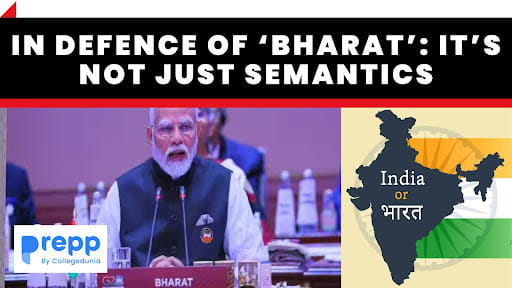
- A row over the name of the country had erupted with a G-20 dinner invitation going out in the name of the ‘President of Bharat’.
- Critics have raised concerns about the Indian government's use of the term "Bharat" in official invitations, especially in light of Hindu-nationalist ideology and the administration's efforts to promote Hindi.
- Some have interpreted this choice of terminology as an indication of the government's intention to potentially change the official name of the country.
- Under Prime Minister Modi's leadership and the Bharatiya Janata Party (BJP) government, there has been a significant focus on renaming towns and cities with names rooted in the colonial era.
Various Constituent Assembly debate on ‘Bharat’ or ‘India’
- Jawaharlal Nehru in his monumental ‘Discovery of India’, referred to “India”, “Bharata” and “Hindustan.” But when the question of naming India in the Constitution arose, ‘Hindustan’ was dropped, and both ‘Bharat’ and ‘India’ were retained.
- The debate on Article 1 of the Indian Constitution, which deals with the name of the country, began in 1948. Initially, it was scheduled to start on November 17, 1948, but was postponed at the suggestion of Govind Ballabh Pant.
- The discussion revolved around whether to use 'Bharat' or 'India' as the official name of the country.
- On September 17, 1949, Dr. B.R. Ambedkar presented the final version of the provision, which included both 'Bharat' and 'India'. However, there were differing opinions among the members of the Constituent Assembly.
- Seth Govind Das from Jabalpur advocated for placing "Bharat" above "India," emphasizing that the latter was merely a translation of the former in English.
- Hari Vishnu Kamath cited the example of the Irish Constitution to argue that 'India' was just a translation of 'Bharat.' He pointed out that the Irish Free State had changed its name upon gaining freedom, and its constitution referred to this change in both Irish (Eire) and English (Ireland).
- Hargovind Pant, representing the hill districts of the United Provinces, strongly advocated for 'Bharatvarsha'. He argued that 'India' was a name imposed by foreign rulers who had colonized India for its wealth, and clinging to it would be an acknowledgment of that insulting history.
- Some Constituent Assembly Members earlier had proposed replacing 'States' in Article 1 with 'Pradesh,' but Pandit Nehru objected, highlighting the ambiguity of the term and advocating for the precision of 'State.'
Retaining and Advocating for the name
- Retaining ‘India’: B.R. Ambedkar, argued for retaining the name 'India' due to its historical continuity and recognition among foreign nations. Ambedkar highlighted that 'India' was the name under which the country had signed international agreements and was a member of the United Nations.
- Advocating for ‘Bharat’: Members like Seth Govind Das supported 'Bharat,' emphasizing that it reflected the country's rich history and culture without hindering progress. Chinese traveler Hiuen-Tsang also referred to the country as 'Bharat'.
The name 'Bharat'
- The name 'Bharat' holds significant cultural and historical importance in India, and its roots can be traced back to ancient texts and legends.
- The roots of “Bharat”, “Bharata”, or “Bharatvarsha” are traced back to Puranic literature, and to the epic Mahabharata.
- The Puranas describe Bharata as the land between the “sea in the south and the abode of snow in the north”.
- In the Mahabharata, 'Bharat' refers to the legendary King Bharata and is considered a symbol of unity and strength.
- In a cultural and religious context, 'Bharata' refers to a supraregional and subcontinental territory where the Brahmanical system of society prevailed.
- It refers to an ambiguous territory, Bharatavarsa, which stretched beyond today’s borders of India and may have extended to include what is today Indonesia.
Significance of changing the nation’s name to ‘Bharat’
- Identity and cultural significance: Changing India's official name from "India" to "Bharat" carries deep historical and cultural significance. "Bharat" is rooted in Hindu mythology and ancient texts, symbolizing India's rich traditions and identity.
- India has been known by multiple names throughout its history, such as "Hindustan," "Aryavarta," and "Jambudvipa," reflecting its diverse cultural and linguistic landscape.
- Decolonizing identity and asserting cultural heritage: Changing a country's name can be a powerful symbolic gesture, particularly for Third World nations striving to decolonize their identities and assert their cultural heritage. For many of these nations, the historical legacy of colonial oppression is deeply ingrained in their national identity. Renaming the country can serve as a symbolic step towards reclaiming their cultural heritage and forging a new path forward.
- For example, when Burkina Faso gained independence from France in 1960, it changed its name from Upper Volta to reflect its cultural identity and history. The new name, which means "Land of Incorruptible People," was chosen to honor the resistance fighters who fought for independence.
- Precedent and inspiration for other third world nations: The decision by one country to change its name can serve as a precedent and inspiration for other Third World nations facing similar identity challenges. It can encourage them to explore and assert their own cultural and historical identities, potentially leading to a broader movement towards decolonisation and linguistic sovereignty across the Third World.
- Global influence: Preserving cultural identity is key in the global soft power competition. It sets nations apart, effectively conveying values and contributions. In the era of cultural diplomacy, a nation's name choice is a powerful tool, fostering pride, unity, and international recognition.
Ancient reference of the terms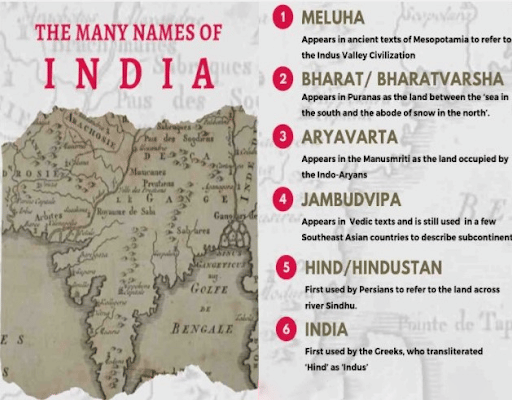
|
What does the Constitution of India say?
- The Constitution of India under Article 1 states that,
- India, that is Bharat shall be a Union of States
- The States and Union Territories thereof shall be specified in the 1st Schedule
- The territory of India shall comprise Territory of States, Union Territories specified in the First Schedule, Other territories may be acquired.
- Article 1 of the Constitution of India is an essential statement specifying what our country will be called and what will comprise the sovereign territory of our nation.
- Article 1 of the Constitution which sets the tone for the entire constitutional framework starts with both 'India' and 'Bharat.' If the name of the country is changed, it would require an amendment to Article 1.
Conclusion
Changing the country's name to "Bharat" should strike a balance between its cultural importance and international recognition and historical continuity associated with “India”. The decision should undergo a transparent democratic process, respecting "Bharat's" cultural significance and acknowledging the historical legacy of colonial oppression. This change symbolizes inclusivity and aligns with the aim of fostering diversity and equity in modern society.
(*Click this link to read prelims specific weekly current affairs articles)
FAQs
Question: What is Article 1 of the Constitution?
Answer:
Article 1 of the constitution says that India, that is Bharat, shall be a union of states and the territory of India consists of that of the states, union territories specified in the First Schedule and other acquired territories.
Question: What is the significance of the name 'Bharat'?
Answer:
The name 'Bharat' holds significant cultural and historical importance in India, and its roots can be traced back to ancient texts and legends. The roots of “Bharat”, “Bharata”, or “Bharatvarsha” are traced back to Puranic literature, and to the epic Mahabharata.
Question: What is the origin of the name India?
Answer:
The name India is derived from the word Indus, which is the name of a river that flows through the northwestern part of the subcontinent.
Download the PREPP App and attempt FREE IAS Exam Mock Tests and get complete study material!

Full Test - 04: UPSC CSE Prelims CSAT (Paper-II)
Full Test - 03: UPSC CSE Prelims CSAT (Paper-II)
UPSC CSE Prelims 2026 GS Paper 1 Question Paper (24-May-2026)
UPSC CSE Prelims 2026 CSAT Paper 2 Question Paper (24-May-2026)

17 February 2025 | The Hindu Must Read Articles | Current Affairs

16 February 2026 | The Hindu Must Read Articles | Current Affairs

13 February 2026 | The Hindu Must Read Articles | Current Affairs









Comments